Ny Alesund cruise port is unlike an ordinary Arctic village call. Ny-Ålesund is an international research settlement operated by Kings Bay, with scientific work, environmental protection and safety rules taking precedence over visitor convenience. Cruise passengers may be allowed ashore on a controlled route, often with ship staff or guides, but the visit is not a free-form wander through a tourism town. The right mindset is to follow the day’s briefing and observe a functioning polar research community without disrupting it.
Ships may berth or use tenders depending on the vessel, harbour plan and local restrictions. Access can be limited by polar bear safety, research activity, wildlife, weather and the capacity of the settlement. CruisePing would not build an independent itinerary for Ny-Ålesund. Treat the ship’s organised landing as the port day, listen carefully to instructions on routes and electronic equipment, and accept that a museum, shop, post office or particular monument may not be available on every call.
Ny-Ålesund Cruise Port at a Glance
| Port name | Ny-Ålesund Cruise Port |
|---|---|
| Main cruise area | Ny-Ålesund Harbour and a controlled visitor route through the research settlement |
| Cruise region | Antarctic / Arctic |
| Country / Territory | Svalbard |
| Currency | Norwegian krone (NOK) |
| Languages | Norwegian and English in the international research community |
| Disembarkation | Docked or tender, subject to harbour and operator arrangements |
| Walkability | Physically compact, but movement is controlled |
| Shuttle required | No |
| Main transport | Walking only within the permitted route; ship-led landing |
| Best option | Follow the organised settlement walk and interpretation |
| Main caution | Research protection, radio rules, polar bear safety and access restrictions override normal sightseeing |
Weather & Best Times to Visit Ny-Ålesund
January to March
Typical high: -14–-8°C
Typical low: -20–-14°C
Rain / conditions: Polar night gives way to returning daylight; severe cold, snow and wind dominate.
April to June
Typical high: -6–7°C
Typical low: -12–1°C
Rain / conditions: Rapidly increasing light, lingering snow and variable sea ice; wind chill remains significant.
July to September
Typical high: 2–8°C
Typical low: -1–4°C
Rain / conditions: Cool Arctic summer with rain, fog, wind and occasional sleet possible.
October to December
Typical high: -12–0°C
Typical low: -18–-5°C
Rain / conditions: Darkness returns, temperatures fall and storms or snow become more frequent.
Weather guide: CruisePing summary based on NASA POWER climate data for Ny-Ålesund and Kongsfjorden. Check the latest forecast.
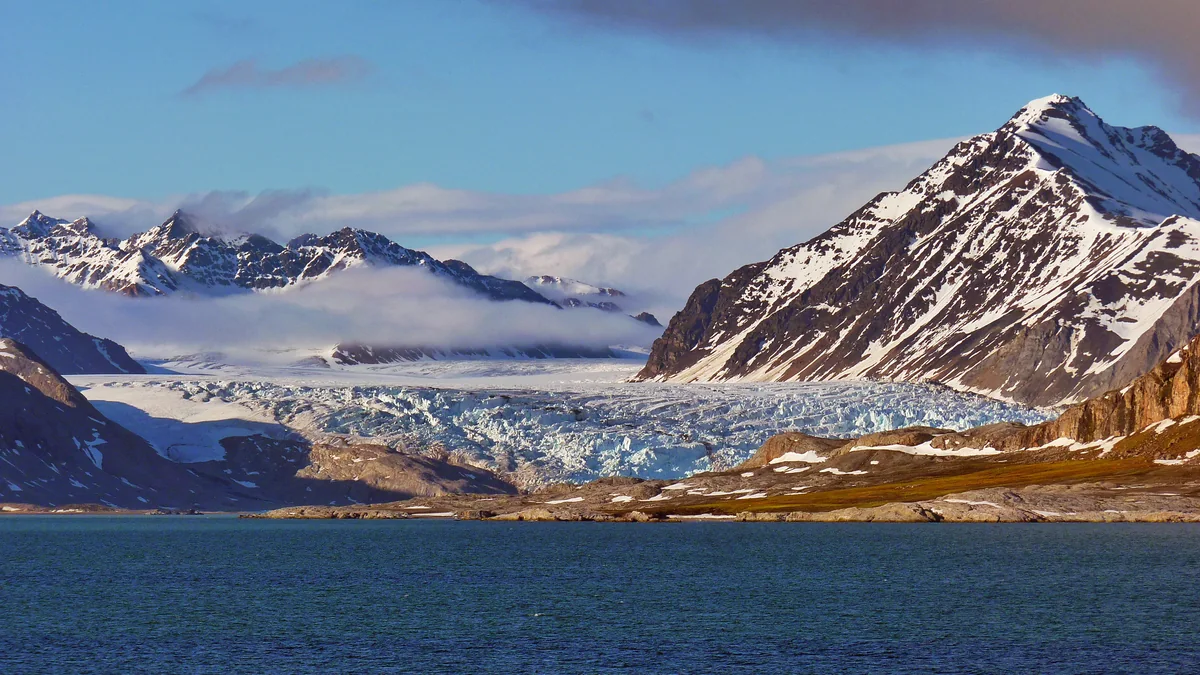
Fog and low cloud can hide Kongsfjorden’s mountain and glacier backdrop even when a landing goes ahead. Wind chill is the main comfort issue, especially while listening to a guide in an exposed open area. Waterproof outerwear, gloves and a warm hat belong in the day pack throughout the cruise season. The settlement’s surface can be wet, muddy, snowy or uneven, so expedition-style footwear is more appropriate than normal city shoes.
Why Ny-Ålesund Is a Controlled Cruise Call
Ny-Ålesund supports national and international scientific institutions conducting Arctic research. Kings Bay manages the settlement and harbour infrastructure. Visitors are entering a workplace where instruments, communications and field programmes can be affected by behaviour that would be harmless in a normal port.
The current harbour regulations and operator briefings determine whether a ship can berth, how passengers land and which areas are open. Cruise lines usually coordinate the visit before arrival. An itinerary name therefore does not create an unrestricted right to go ashore. Conditions or research needs may shorten, alter or cancel the landing.
Movement is normally kept to marked or guided routes. Do not step behind buildings, approach equipment or leave the group for a photograph. The surrounding landscape is polar bear habitat, and independent walking outside the protected settlement is not an option for ordinary cruise passengers.
Ny-Ålesund is known for restrictions on radio-frequency use because sensitive scientific measurements operate nearby. The exact visitor instruction can change and may distinguish between devices, functions and zones. Follow the current ship and Kings Bay briefing rather than relying on a blanket rule remembered from an older article.
Wildlife can also alter access. Birds nest close to parts of the settlement, and guides may redirect passengers to protect them. Never approach an animal, block its route or expect staff to move a boundary for a photograph.
How Cruise Passengers Arrive
The harbour can receive suitable vessels at the quay, while other ships may anchor and use tenders or expedition boats. The operator decides the arrangement in coordination with Kings Bay and the harbour authority. Passenger numbers, vessel dimensions, wind and local activity all influence the plan.
A docked arrival does not mean passengers can simply leave the ship and roam. The gangway may open only when guides, safety staff and route controls are in place. A tender landing similarly leads into an organised assembly rather than an independent waterfront.
Expedition ships often divide guests into groups and rotate landings or activities. Larger conventional cruise ships may have tighter limits on how many passengers can be accommodated ashore. Some guests may be offered a shorter route, and the order can change during the call.
Listen for biosecurity instructions. Svalbard operators may require footwear and outer clothing to be cleaned before landing to reduce the transfer of seeds, soil or organisms. Follow the ship’s procedure rather than assuming a city-style walk requires no preparation.
Return timing is controlled by the group leader and harbour operation. Stay with the allocated group, even when the ship is visible nearby. Delaying a group can affect later rotations and the vessel’s departure.
What You May See on a Ny-Ålesund Visit
Research settlement walking route
Best for: Understanding how people live and work at a high-Arctic research base
Best way: Follow the ship or Kings Bay guide on the permitted route
Watch: Buildings and work areas are not automatically open to visitors.
Amundsen airship mast
Best for: Polar exploration history connected with airship expeditions
Best way: View from the authorised route if included in the day’s programme
Watch: It is outside the core settlement and may be omitted for safety, time or access reasons.
Ny-Ålesund museum or historical displays
Best for: Context on mining, exploration and scientific development
Best way: Visit only when the operator confirms opening and group capacity
Watch: Do not assume the museum opens for every ship.
Post office and shop
Best for: A traditional cruise-call purchase or postcard when services operate
Best way: Use only during allocated free time and follow payment instructions
Watch: Opening and capacity are limited; queues can consume most of a short landing.
Kongsfjorden scenery
Best for: Mountains, glaciers, birds and the setting of the research community
Best way: Enjoy from the permitted route and ship decks
Watch: Fog, low cloud and wildlife boundaries can limit views or access.
Bird and wildlife observation
Best for: Arctic nature encountered without a separate excursion
Best way: Listen to guides and maintain the required distance
Watch: No species or close sighting is guaranteed, and nesting areas may be closed.
The Airship Mast and Exploration History
Ny-Ålesund has strong associations with polar aviation and the airship expeditions of Roald Amundsen, Umberto Nobile and their contemporaries. The mooring mast remains a visible landmark, but it is not beside every harbour route. Reaching it requires permission, appropriate safety cover and enough time.
Some expedition programmes include the mast as part of a guided walk; others remain within the settlement. Weather, polar bear risk and the number of passengers can remove it from the plan at short notice. Do not leave the group because the structure appears close across open ground.
A guide adds essential context because the stories involve multiple expeditions, countries and outcomes. It is easy to reduce the mast to a photograph without understanding why Ny-Ålesund became important in the history of Arctic exploration.
Passengers primarily interested in the mast should choose an itinerary or excursion description that explicitly includes it while accepting that access is still conditional. A general Ny-Ålesund call is not a guarantee.
The wider historical story includes coal mining, accidents, community change and the settlement’s transition towards research. A museum or guided interpretation gives a more balanced view than exploration celebrity alone.
Research Rules and Electronic Devices
Ny-Ålesund hosts instruments that measure the atmosphere and other environmental conditions. Radio transmissions can interfere with sensitive work. Operators may ask passengers to switch off mobile phones, Wi-Fi, Bluetooth, smart watches, cameras with wireless functions or other devices in particular areas.
Do not improvise by placing a phone in flight mode unless the briefing says that is sufficient. Some devices continue to transmit or search for connections. The simplest approach is to follow the ship’s exact instruction and keep unnecessary electronics fully off.
Photography may still be possible with an approved camera, but wireless upload or geotagging functions can be restricted. Ask before using drones, action cameras, satellite messengers or radio equipment; in practice, private drone use should not be expected.
The rules are not a tourist inconvenience invented without purpose. They protect research that depends on a clean radio environment. A few minutes of connectivity is not worth compromising measurements or the community’s willingness to host future visitors.
Because regulations evolve with research and technology, this article deliberately avoids presenting one permanent device list. The current Kings Bay, harbour and cruise-line briefing is the source of truth for the day.
CruisePing Recommended Port Day
CruisePing recommends accepting the organised settlement programme exactly as it is offered. Attend the briefing, prepare clothing and equipment, join the allocated group and give full attention to the guide. This is not a port where independent planning produces a better day.
If the route includes the museum, airship mast or post office, treat those as welcome additions rather than entitlements. The central value is seeing how a remote research community operates within Kongsfjorden and understanding why access is managed.
Use the ship’s outer decks before and after the landing for broader scenery. Glacier and mountain views can be better from the water than from a tightly controlled route, and passengers with limited mobility may experience the destination most comfortably from the vessel.
Skip any attempt to arrange private transport or an unofficial walk. There are no taxis waiting to create a bespoke tour, and moving outside the protected area without authorised polar bear safety is unacceptable.
If the landing is cancelled, look for onboard lectures or interpretation. The reason may be safety, weather, wildlife or research protection, and a cancelled call should not be treated as evidence that the destination failed to organise itself for tourists.
DIY or Organised Excursion?
Ny-Ålesund is organised by definition. Even when passengers have a few minutes of limited free movement near the central route, the landing, boundaries and safety structure remain coordinated by the ship and settlement. The usual DIY-versus-excursion comparison does not apply.
An expedition cruise may offer a more interpretive and flexible programme than a large ship because smaller groups can rotate through activities. That does not make it independent; guides and permits remain central.
A conventional cruise-line call may provide a guided walk or managed shore visit. Read the itinerary for the likely format, but remember that final permission is operational and conditional.
Passengers who want hiking, kayaking or a wilderness landing should select an expedition itinerary that explicitly offers those activities elsewhere in Svalbard. Ny-Ålesund itself is a research stop, not the place to demand an adventure excursion.
The best value comes from good interpretation. A knowledgeable guide who links research, settlement history and environmental rules provides more than an hour of unsupervised souvenir shopping ever could.
Mobility, Cold and Time Ashore
The settlement is compact, but surfaces can include gravel, mud, snow and uneven ground. Standing in wind while a group listens to commentary can be harder than the walking distance. Bring a stable walking aid if the ship permits it and ask about the shortest route.
Tender boarding may exclude some mobility devices depending on sea conditions and cruise-line policy. A docked gangway can also be steep. Obtain call-specific assistance information before relying on the landing.
Wheelchair access to historic buildings, museum areas or the post office should not be assumed. The operator may provide a modified outdoor route, but availability depends on the day’s infrastructure and safety cover.
Cold affects dexterity. Gloves that allow a camera to be operated are useful, while exposed hands become uncomfortable quickly. Keep medication close to the body and protect batteries from low temperatures.
Toilets and shelter may be controlled through the group programme. Use ship facilities before disembarking and do not count on stepping into any building simply because weather worsens.
Responsible Visiting and Common Mistakes
Leaving the route: Open ground is neither a shortcut nor a safe place for a private photograph.
Keeping devices active: Follow the current radio-silence instruction, not a personal interpretation of it.
Approaching scientific equipment: Instruments and marked areas are working research infrastructure.
Expecting guaranteed shopping: The shop and post office can have restricted opening or capacity.
Chasing wildlife: Guides set distance and route; animals never owe passengers a better angle.
Complaining about a changed programme: Research, safety and environmental protection legitimately come before the advertised sightseeing sequence.
How to Prepare Before the Landing
Read the ship’s briefing rather than skipping directly to the time and meeting point. Device restrictions, biosecurity and polar bear rules may be unfamiliar, and misunderstanding them can affect the whole group.
Clean footwear and outer equipment as instructed. Seeds or soil carried from another landing can introduce non-native material into a vulnerable environment. Expedition ships often provide stations and staff to guide the process.
Dress before the group is called. Layers, waterproofs, hat and gloves take time to organise, and delays at the gangway reduce the group’s landing window.
Bring only what is permitted and necessary. A warm layer, approved camera, binoculars and essential medication are more useful than a large bag of electronics.
Ask questions during the briefing if a rule is unclear. Staff would rather clarify a device or mobility issue on board than resolve it after the landing begins.
Photography, Scenery and Viewing from the Ship
Ny-Ålesund’s most memorable images often combine small human structures with the scale of Kongsfjorden. Use the permitted route rather than stepping onto sensitive ground for a cleaner composition. A longer lens can isolate the airship mast, birds or research buildings without crossing a boundary.
Check whether the camera’s wireless functions must be disabled. A device that is acceptable for photography may still need Wi-Fi, Bluetooth or location transmission switched off. Prepare those settings on the ship so the group is not delayed at the landing.
The vessel can provide the broadest panorama. During approach and departure, mountains, glaciers and the settlement’s position become easier to understand than from street level. Keep decks clear, follow wildlife announcements and avoid crowding a single rail when other passengers are trying to view.
Fog is part of the Arctic experience rather than a failed photograph. It can reveal the settlement in fragments and make the relationship between weather and research more tangible. Protect equipment from drizzle and condensation when moving between cold air and a warm interior.
Binoculars add value without interfering with the site. They allow passengers to watch birds or distant glacier features while maintaining the required distance. Do not use visual interest as a reason to separate from the group or ignore a guide’s instruction.
A notebook can be more useful than a connected phone here. Record questions, place names and scientific themes during the walk, then look them up after the ship has left the protected radio environment.
Ny-Ålesund Port-Day Checklist
- Read the current ship and Kings Bay landing briefing.
- Switch off devices exactly as instructed.
- Complete any required biosecurity cleaning.
- Wear waterproof, windproof Arctic layers.
- Stay with the allocated group and route.
- Do not enter buildings unless invited.
- Keep clear of scientific instruments and marked zones.
- Maintain guide-set wildlife distances.
- Use ship facilities before going ashore.
- Accept that weather, research or safety can alter the visit.
Frequently Asked Questions
Can cruise passengers walk around Ny-Ålesund independently?
No ordinary unrestricted visit should be expected. Passengers follow the route and conditions set by Kings Bay, the harbour and the cruise operator.
Do ships dock in Ny-Ålesund?
Some suitable vessels can berth, while others may tender. The harbour plan, vessel and conditions determine the arrangement.
Why are phones and wireless devices restricted?
Ny-Ålesund supports sensitive scientific measurements. Radio transmissions can interfere with research, so passengers must follow the current device instruction.
Will I see the airship mast?
It may be included in a guided route, but access depends on safety, time and the day’s programme. A general port call does not guarantee it.
Is there a museum and post office?
There are historical displays and services associated with the settlement, but opening and visitor capacity vary. Treat them as conditional.
Can I hike outside the settlement?
Not independently. The surrounding area is polar bear habitat and movement requires authorised safety arrangements.
Is the landing accessible?
The settlement is compact, but tendering, gangways, gravel, snow and building access can create barriers. Ask the cruise operator about the specific programme.
What happens if the call is cancelled?
Weather, sea conditions, wildlife, safety or research needs can prevent a landing. Use onboard interpretation and scenery viewing if the ship remains in the area.
CruisePing Port Verdict
Ny-Ålesund is valuable precisely because it is not organised around mass sightseeing. A short, controlled walk can reveal the practical realities of Arctic research, settlement history and environmental restraint more clearly than a conventional attraction list.
CruisePing’s advice is simple: follow the programme, protect the science and leave expectations flexible. The passengers who get most from the call are those prepared to listen rather than those determined to exercise maximum freedom ashore.
Useful Official Links
- Kings Bay and Ny-Ålesund
- Ny-Ålesund Harbour regulations
- Svalbard Cruise Forum visitor information
- Governor of Svalbard
- Yr forecast for Ny-Ålesund
Ready to browse our article library?
Explore more ports in the Antarctic and Arctic, or narrow it to Svalbard in particular. For cruise comparisons, planning shortcuts and value guides, head over to our main article archive.