
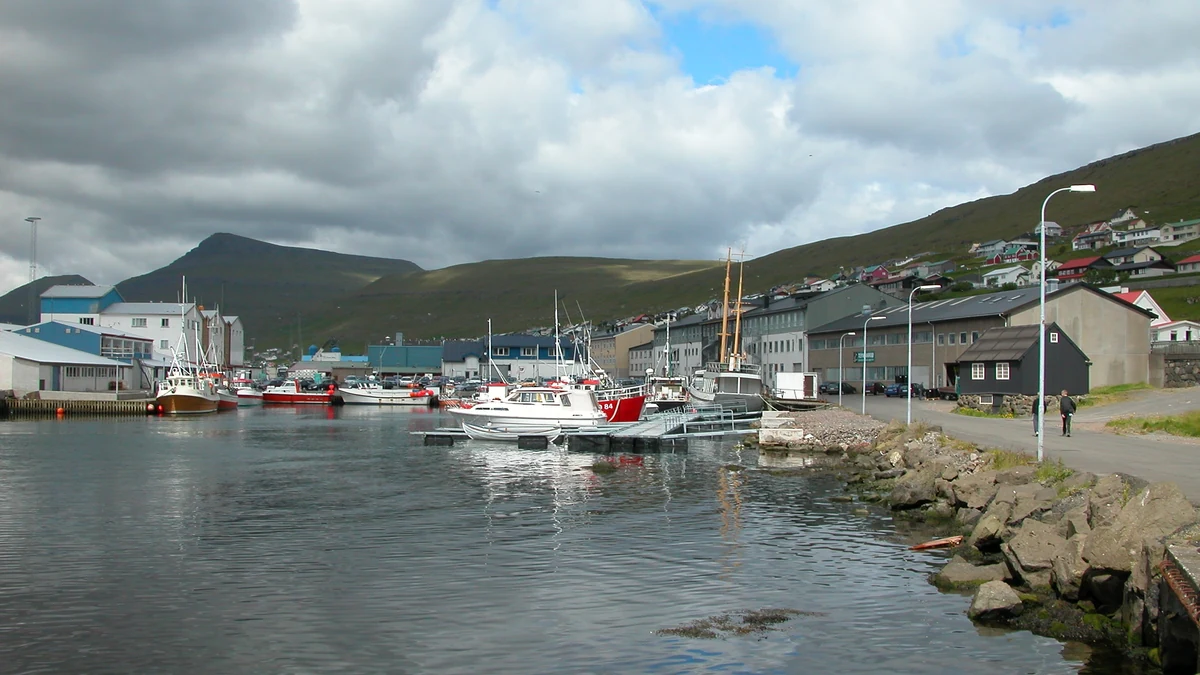
Runavík cruise port places the ship on Eysturoy rather than in the Faroese capital. That matters. Runavík itself is a working settlement stretched along Skálafjørður, while the larger cruise-day prize is access to Eysturoy’s villages, mountain roads and northern landscapes. The best plan usually looks outward to Gjógv, Eiði or Funningur, with the town retained as a practical, low-risk fallback.
The Port of Runavík handles cruise calls at King’s Harbour and provides visitor reception close to the quay, with tourist information a short walk away. A direct berth avoids tender uncertainty, but it does not turn Eysturoy into an easy hop-on sightseeing network. Public buses serve communities and commuters; passengers who want several villages or timed viewpoints are better served by an organised or pre-booked road tour.
Runavík Cruise Port at a Glance
| Port name | Runavík Cruise Port |
|---|---|
| Main cruise area | King’s Harbour, Runavík |
| Cruise region | Northern Europe & Baltic |
| Country / Territory | Faroe Islands |
| Currency | Danish krone and Faroese banknotes, both at equal value |
| Languages | Faroese and Danish; English is common in tourism |
| Disembarkation | Docked |
| Walkability | Medium; the settlement is elongated rather than compact |
| Shuttle required | No for the immediate town |
| Main transport | Walking, SSL bus, taxi or organised excursion |
| Best excursion | An Eysturoy route linking selected villages and viewpoints |
| Main caution | Fog, wind and low cloud can erase the value of mountain viewpoints |
Weather & Best Times to Visit Runavík
January to March
Typical high: 6–8°C
Typical low: 2–4°C
Rain / conditions: Cold, wet and windy, with short daylight and possible wintry showers.
April to June
Typical high: 7–12°C
Typical low: 3–8°C
Rain / conditions: Longer days and cool conditions; weather can still change several times in an hour.
July to September
Typical high: 11–14°C
Typical low: 8–10°C
Rain / conditions: Mild main-season weather, frequent cloud and rain, and exposed winds on higher roads.
October to December
Typical high: 7–11°C
Typical low: 3–7°C
Rain / conditions: Wet, darker and increasingly stormy; road and sea plans need flexibility.
Weather guide: CruisePing summary based on NASA POWER climate data for Runavík and Eysturoy. Check the latest forecast.
Runavík weather is about visibility more than temperature. The road to Gjógv or northern Eysturoy can move from clear fjord views into cloud within minutes. If the hills are covered, a tour that exists mainly for viewpoints loses value; lower villages, local culture and a shorter fjord route become the better choice. Waterproof layers are useful even when the ship is sitting under blue sky.
Arriving at King’s Harbour in Runavík
King’s Harbour is a working port with direct cruise-ship access. Follow the marked route and local welcome arrangements rather than treating the quay as an open promenade. Port information places visitor services close enough to reach on foot, making it easy to confirm local maps, events and last-minute changes before leaving town.
Runavík has several harbour facilities, so the name of the actual berth matters. The cruise programme and port team should be treated as the source of truth for that call. Photograph the gangway information, especially when an excursion returns to a different coach area from where it started.
A direct berth gives more certainty than a tender, but Faroese weather still affects road touring. Operators may reverse a route, drop a high viewpoint or substitute a lower stop. That is sensible adaptation, not necessarily a poorer excursion. The question is whether the replacement still provides a meaningful Eysturoy day.
Getting Around Eysturoy from Runavík
Runavík can be explored on foot, though the settlement runs along the fjord and useful places are more spread out than in a traditional old town. A local walk suits passengers who want harbour life, shops, a café and surrounding scenery without committing to a long road day.
The official SSL route information for buses 440 and 450 is relevant to the area, but they are public services rather than a cruise shuttle. They may enable one clearly chosen journey when the outbound and return times fit. They are not a reliable way to improvise a village circuit, and a timetable connection that arrives close to all-aboard leaves too little resilience.
Taxi supply is limited on a ship day, so book ahead for a private route. An organised excursion is the natural choice for Gjógv, Eiði, Funningur or a broader Eysturoy loop because it can sequence narrow roads and stops without making the passenger manage connections. Ask whether the tour spends time in villages or mostly pauses at road viewpoints.
Best Cruise-Compatible Things to Do from Runavík
Gjógv
Best for: A distinctive village, natural gorge and northern Eysturoy scenery
Best way: Organised excursion or pre-booked private vehicle
Watch: Road time, weather and walking around the gorge
Eiði and the north coast
Best for: Village character and views towards sea stacks and high ground
Best way: Road tour with named stops
Watch: Low cloud can conceal the landscape that justifies the journey
Funningur
Best for: A small historic village in a steep-sided setting
Best way: Combine with Gjógv or an Eysturoy circuit
Watch: Narrow roads and limited visitor facilities
Runavík and Skálafjørður
Best for: A calm local day with harbour and fjord atmosphere
Best way: Walk independently and use local visitor information
Watch: The town is linear, so choose a route rather than walking aimlessly
Tórshavn
Best for: Passengers determined to see the capital
Best way: Direct organised transfer or a thoroughly checked bus plan
Watch: Travel time and the temptation to treat the capital as the only worthwhile destination
Faroese hiking
Best for: Active visitors seeking close contact with the landscape
Best way: Only on a verified guided route appropriate to the call
Watch: Weather, land-access rules, steep ground and navigation
Gjógv
The official Visit Faroe Islands Eysturoy guide helps explain why Gjógv is the strongest named excursion for many first-time visitors because the village and gorge feel specific to the Faroes. It deserves more than a coach photograph. Check how long the stop lasts and whether the walking route reaches the gorge safely in the day’s conditions.
Eiði and the north coast
Eiði works as part of a north-Eysturoy route, not as a generic village tick-box. The quality depends on visibility and on whether the guide explains the landscape. If cloud closes in, a lower coastal stop with time to walk may be better than waiting beside an invisible viewpoint.
Funningur
Funningur adds a different scale: a very small settlement set sharply beneath the mountains. It combines naturally with Gjógv. CruisePing would rather have two well-paced villages than four rushed stops whose names blur together by lunchtime.
Runavík and Skálafjørður
A local Runavík day is understated but robust. It gives time to understand a modern Faroese community and the long fjord rather than seeing only postcard villages. It is especially sensible in severe wind or after an excursion cancellation.
Tórshavn
Tórshavn is reachable, but choosing it means giving up much of Eysturoy. First-time visitors with another Faroese port on the itinerary should compare calls before automatically leaving Runavík for the capital. A direct excursion is more resilient than a chain of public-bus decisions.
Faroese hiking
Independent hiking is not a casual extension of a port walk. Faroese routes can involve fees, private land, steep grass, fog and few obvious trail markers. Use current official hiking guidance and a guide where the route is exposed or time-critical.
CruisePing Recommended Port Day
For most passengers, CruisePing would use Runavík to see Eysturoy rather than transferring straight to Tórshavn. A route built around Gjógv, one additional village and a few weather-dependent viewpoints gives the call its own identity.
The best DIY version is modest: visitor information, a walk along Runavík and Skálafjørður, perhaps one public-bus journey only where the timetable is comfortably aligned. It is not a failure to stay local when the hills are hidden or wind is severe.
Skip a long capital transfer on a short call, and skip unverified solo hiking in poor visibility. The sensible fallback is the fjord settlement itself, where the ship remains visible and the return risk is minimal.
DIY or Organised Excursion from Runavík?
DIY is strongest for Runavík and for a single bus-supported objective. Read the live SSL timetable in both directions, identify the exact stop and keep a wide return margin. Do not assume a bus waits for a late cruise arrival.
An organised excursion is better for the classic northern route because narrow roads, weather substitutions and several short stops require coordination. The guide’s local judgement is part of the value. A good tour should explain why the route changes instead of following a fixed itinerary into cloud.
A private taxi offers control over pace, but availability must be arranged before the ship arrives. Agree the route, price basis and return time. CruisePing would prioritise Gjógv and one complementary place rather than asking a driver to race across Eysturoy.
Choosing a Runavík Plan by Call Length
A shorter call
Use a focused Eysturoy excursion or remain in Runavík. Do not spend the whole visit travelling to and from Tórshavn.
A normal call
Gjógv plus Eiði or Funningur is a sensible structured route, with viewpoints included only when conditions justify them.
A long call
A capital transfer or broader island circuit becomes possible, but compare the value with a slower Eysturoy day and keep weather flexibility.
Mobility and Road Touring from Runavík
The direct berth removes tender steps, but coach and village access still involve uneven surfaces, slopes and exposed weather. Ask where coaches park in Gjógv and how much walking is needed to see the gorge; “village visit” can conceal a meaningful gradient.
Runavík itself provides the lower-stress option. The waterfront route can be shortened, and local facilities are closer to the ship than rural stops. Passengers using wheelchairs should confirm the gangway and port route with the cruise line because berth hardware and tide can alter the slope.
Runavík Port-Day Pitfalls
- Do not confuse public buses with a sightseeing circuit. Plan one robust journey at most.
- Do not chase viewpoints in solid cloud. Lower villages may provide the better day.
- Pre-book taxis. A cruise call can absorb local capacity quickly.
- Check land-access rules before hiking. Some routes cross private land or require payment.
- Compare other Faroese calls before choosing Tórshavn. Runavík may be your best Eysturoy opportunity.
- Carry waterproof layers. The forecast can change during the excursion.
Runavík Cruise Port Checklist
- Confirm the berth and gangway return time.
- Check the live SSL timetable if travelling independently.
- Choose Eysturoy or Tórshavn before leaving the ship.
- Wear waterproof, windproof layers.
- Use footwear with grip for village paths.
- Ask how long excursion stops actually last.
- Check hiking access and conditions.
- Keep a local Runavík fallback.
Choosing an Eysturoy Route
A classic northern Eysturoy excursion usually links villages through mountain and fjord roads, but the order should remain flexible. Gjógv is the natural anchor because its settlement and gorge provide something to do even when the highest viewpoints are obscured. Eiði or Funningur can add contrast, provided the tour allows time to leave the vehicle.
Gjógv deserves a proper village stop. The gorge route, houses and surrounding slopes cannot be understood from the coach park. Ask how far the group walks and whether there is time for the lower village as well as the best-known viewpoint. In wet weather, paths may be slippery, so footwear matters more than the modest distance suggests.
Eiði works well when the north-coast view is visible. Under low cloud, the guide should spend more time on village life, geology or another sheltered stop rather than holding the group beside a blank horizon. Faroese excursions are better when they respond intelligently to the day instead of mechanically following the brochure order.
Funningur is smaller and quieter, which is exactly why it can be memorable. It should not be added merely to increase the number of villages in the title. A short guided walk and explanation of the setting provide more value than unloading for five minutes before the next road section.
Using Public Buses without Turning the Day into a Timetable
Runavík’s bus links can support an independent plan, but they work best when the passenger chooses one destination and accepts the service pattern. Read the outbound and return timetable together. Identify the named stop, check whether the journey needs a connection and write down an earlier return as well as the last possible one.
A route that depends on a single final bus has no resilience if the ship is late, a stop is missed or weather slows walking. Taxis may not be waiting in a small village to rescue the plan. CruisePing would use buses for a simple journey with spare services, not to reproduce a multi-village coach tour at lower cost.
Staying in Runavík can be the correct independent choice. The harbour, fjord and modern settlement show how Faroese communities function beyond the preserved villages. Visitor staff may also know about call-day events or short guided activities that do not appear in a generic island itinerary.
Runavík when the Mountains Disappear
Low cloud does not make the call worthless, but it should change the route. Ask whether the excursion can substitute a lower coastal village, local cultural stop or longer time in Gjógv instead of repeatedly driving to obscured viewpoints. A flexible guide can turn poor visibility into a more human-scale Eysturoy day.
Passengers staying in Runavík can use the visitor office to identify any call-day activity, then walk only as far along the fjord as time and weather make comfortable. The ship, harbour and settlement remain close, which removes the pressure to persist with an exposed plan simply because it was chosen before breakfast.
The town day also gives passengers time to notice the scale of the Faroese fishing and maritime economy. Runavík is not preserved as a visitor set, and that working character is a useful counterpoint to the better-known turf-roof villages.
Frequently Asked Questions
Do cruise ships dock in Runavík?
Runavík normally offers direct berth facilities at King’s Harbour, but confirm the exact location for your call.
Can I walk into town?
Yes. Visitor information and the immediate settlement are accessible on foot, though Runavík is elongated.
Can I reach Gjógv by public bus?
Possible connections may exist, but a cruise-compatible return can be difficult. An excursion or pre-booked vehicle is more robust.
Should I visit Tórshavn?
Only when it is a clear priority. Eysturoy gives Runavík its distinctive value, and the capital transfer consumes time.
Is the Faroe Islands weather really that changeable?
Yes. Wind, rain, cloud and brighter spells can occur in quick succession, especially around higher roads.
What currency is used?
Danish kroner and Faroese banknotes circulate at equal value. Cards are common, but a backup is useful.
Can I hike independently?
Only on an appropriate, current and well-understood route. Weather, access rules and navigation make casual improvisation unwise.
CruisePing Port Verdict
Runavík is strongest when treated as an Eysturoy port, not a secondary doorway to Tórshavn. Its road excursions can show villages and landscapes that feel markedly different from the capital, while the local fjord gives a credible bad-weather fallback.
CruisePing would book a focused Gjógv-based route, let the guide adapt to cloud and return with time to spare. Independent passengers should keep the ambition narrower: Runavík itself or one carefully checked connection rather than a homemade island circuit.
Useful Official Links
- Port of Runavík cruise information
- Runavík tourist information
- SSL bus 450 timetable
- Visit Faroe Islands: Eysturoy
- Official hiking guidance
Ready to browse our article library?
Explore more ports across Northern Europe & Baltic, browse CruisePing destinations in Faroe Islands, or head to the main article library for cruise planning guides, port comparisons and practical ideas.