
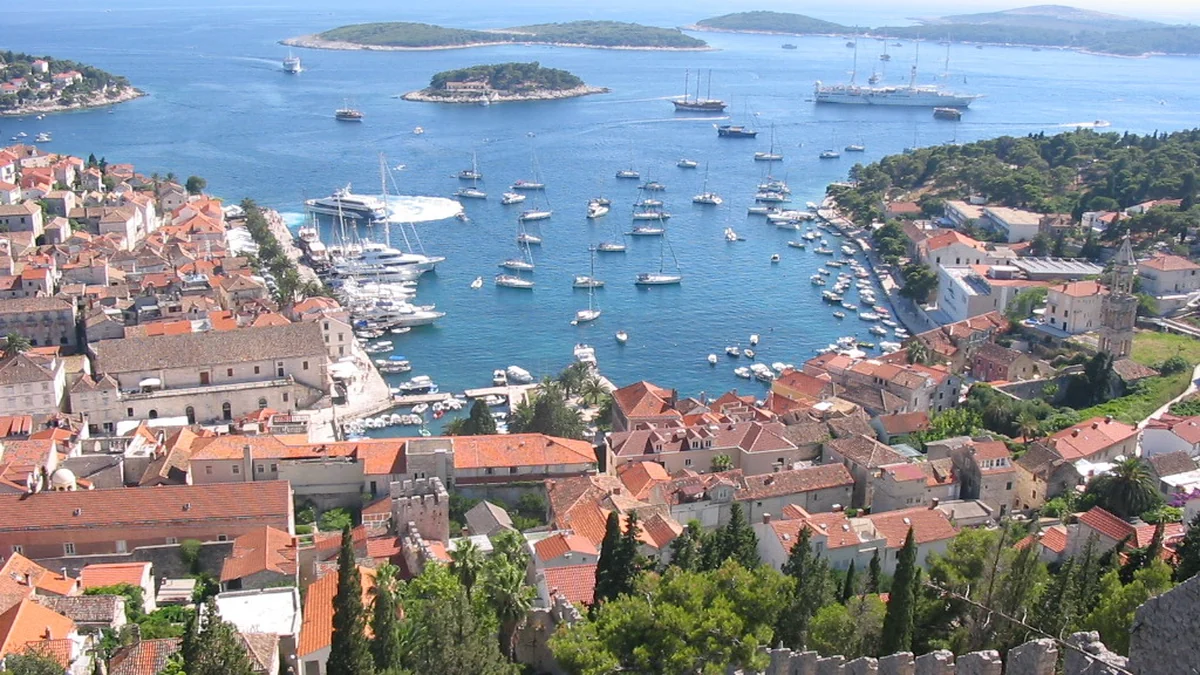
Hvar cruise port usually brings passengers into Hvar Town, where a broad stone square, Venetian-era buildings and a hillside fortress rise directly behind the harbour. The town is substantial enough for a full port day, yet local boats, beaches and island roads make it tempting to add far more than the call can comfortably hold.
The most reliable first visit keeps Hvar Town at the centre. Climb to Fortica before the heat builds, explore the square and waterfront, then choose one extension: a Pakleni Islands beach, Stari Grad, an island drive or a relaxed swim close to town. A Blue Cave speedboat or a hurried attempt to cross the island should be judged against tender timing and sea conditions, not against the appeal of the sales photograph.
Hvar Cruise Port at a Glance
| Typical arrival | Tender into Hvar Town; smaller vessels may use other arrangements |
|---|---|
| Country | Croatia |
| Currency | Euro (EUR) |
| Best first plan | Fortica, Hvar Town and one coastal or island extension |
| Independent transport | Walking, water taxi, local boat, taxi and bus |
| Main caution | Tender queues and weather-sensitive small-boat trips |
Where Cruise Ships Arrive in Hvar
Many cruise ships anchor outside Hvar Town and tender passengers into the harbour. That normally places the main square, waterfront and lower old town within a few minutes’ walk. The exact landing point, tender sequence and final return time are set by the ship, and harbour traffic can affect operations.
Record the final tender time and ask whether independent guests should return earlier than excursion groups. The harbour is compact, but queues can form when several boats arrive together. A local ferry or water taxi returning to Hvar is not the last stage of the journey; passengers still have to reach the correct tender queue and board the ship’s boat.
Smaller cruise vessels and yachts may use different berths or harbour arrangements. Do not build the day from a generic port map until the actual arrival notice is available. The practical advantage remains the same: Hvar Town is close enough to enjoy even when a delay shortens the call.
Start with Fortica Fortress
Fortica, also known as the Spanish Fortress, sits above Hvar Town and provides the defining view across the red roofs, harbour and Pakleni Islands. The climb is part of the visit. A route through old lanes and switchback paths is more rewarding than treating the fortress as a distant photo stop, but it demands time, water and suitable footwear.
Go early in warm weather. The ascent is exposed in places, and both the path and fortress become busier as day visitors arrive. The view is clearest when there is enough time to stop on the way rather than climbing at group pace. Current admission and opening information can be checked through Visit Hvar.
Passengers who cannot manage the full climb can still enjoy viewpoints from the lower town and may be able to use a taxi to reduce some effort, but access within and around a historic fortress remains uneven. Ask where a vehicle can actually set down; “taxi to Fortica” does not necessarily mean step-free entry.
St Stephen’s Square and Cathedral
Hvar’s main square is one of the largest and most impressive civic spaces on the Croatian islands. It stretches inland from the harbour, framed by the cathedral, historic buildings and café terraces. Because it is open and central, passengers sometimes cross it quickly on the way to somewhere else. It deserves time as the organising space of the town.
Visit before the heat becomes strongest or after descending from Fortica. The cathedral and surrounding lanes provide architectural detail, while the square makes a useful meeting point for independent groups. It is also a straightforward part of the day for passengers who wish to avoid steep routes.
Café prices in a prominent square may reflect the location. The value is not simply the drink but the ability to pause in the centre without adding transport. For a tender call, a well-timed break here is safer than crossing the island for a restaurant selected from a list.
The Arsenal, Theatre and Historic Waterfront
The Arsenal reflects Hvar’s maritime importance, while the historic theatre above it adds a cultural layer that is easy to miss when the town is treated only as a beach destination. Opening and access arrangements can vary, so check the current heritage information and decide whether an interior visit matters to you before the day fills.
The waterfront route links the Arsenal, harbour activity and western promenade. It is level compared with the fortress climb and works well for mixed-mobility groups. Take time to look back towards the town: Hvar’s appeal comes from the relationship between civic buildings, defensive heights and the water.
One cultural interior is usually enough for a standard call. Choose the building that best matches your interest, then preserve time for the streets and harbour. Collecting several admission tickets can leave less understanding than a slower walk supported by one good visit.
The Pakleni Islands by Water Taxi
The Pakleni Islands sit immediately offshore and form Hvar Town’s most natural boat extension. Water taxis and local excursion boats connect the harbour with beach areas and coves when conditions allow. The crossing is short enough to be cruise-compatible, but the return must still be planned rather than assumed.
Ask which landing the boat serves, what facilities are open, how frequently returns operate and whether a specific collection is guaranteed. Beach clubs, quieter coves and walking routes offer very different days. A destination described simply as “Pakleni Islands” is too vague for useful planning.
Go after completing the town priority, unless swimming is the main purpose of the call. That sequence means a change in wind can remove the boat trip without damaging the entire day. It also avoids returning from an island with Fortica still waiting in the afternoon heat.
Choosing the Right Pakleni Beach
Not every beach suits every passenger. Some locations focus on lively beach-club facilities, others on swimming and a simple restaurant, and some require rougher paths between the landing and the water. Check whether shade, toilets, loungers and food are actually available during the season of the cruise.
Carry footwear for pebbles or rocky entry and protect valuables on a small boat. The visually closest cove is not necessarily the easiest. If mobility is limited, ask about boarding, the landing surface and the distance from jetty to seating before buying the ticket.
A short beach stay can combine well with Hvar Town. A full beach day is also legitimate, but it trades away the history and architecture that distinguish this port. Make that choice deliberately rather than following the first boat seller encountered on the quay.
Stari Grad as an Island Extension
Stari Grad lies on the opposite side of the island and offers a quieter historic town, a deep bay and access to a cultural landscape shaped over centuries. It is not an add-on reached by a short stroll. Taxi, organised tour or a carefully checked bus plan is required from Hvar Town.
The road journey gives a different view of the island and can include villages or viewpoints. With a private driver, agree whether the price covers waiting and the return to the tender harbour. Public bus services may be useful, but cruise passengers must verify both directions and leave margin for traffic and missed connections.
Choose Stari Grad when island history and a less glamorous atmosphere appeal more than a beach. On a medium call it should replace the Pakleni Islands, not follow them. The most satisfying visit allows time to walk the old centre and waterfront instead of using the town as a brief photograph.
The Stari Grad Plain
The Stari Grad Plain preserves an ancient agricultural landscape and field pattern. It is important precisely because it is a working landscape rather than a single monumental attraction. Appreciating it requires context, a suitable viewpoint or a guide who can explain what is being seen.
A coach window glance does not automatically make a meaningful visit. If the plain is a priority, use a tour that includes an informed stop or combine it with Stari Grad in a private route. Walking or cycling can suit land-based visitors, but a cruise day requires a realistic assessment of heat, distance and return transport.
The plain is especially worthwhile for repeat visitors who have already explored Hvar Town. First-time passengers with a standard call will usually gain more from Fortica and the old town before considering a cross-island journey.
Island Drives, Villages and Lavender Country
Hvar’s interior includes stone villages, agricultural land and seasonal lavender scenery. A private or small-group drive can reveal an island that the harbour alone does not show. The value depends on route quality and the time of year; lavender should never be promised as a permanent spectacle.
Ask the operator to name the villages, viewpoints and expected time out of Hvar Town. A generic “island highlights” tour can spend much of the call in a vehicle. One or two well-chosen stops are preferable to a long list of roadside photographs.
Road trips work best on a long call or for passengers who have visited Hvar before. Keep a generous return because the final tender cannot be approached as casually as a hotel check-in. If traffic or a road issue develops, there may be few fast alternatives across the island.
Should You Book a Blue Cave Trip from Hvar?
Blue Cave excursions are widely marketed from the central Dalmatian islands, but they involve a longer, exposed speedboat day with multiple timings and weather dependencies. From a cruise call at Hvar, the attraction may be possible, yet it is one of the most fragile independent choices in the port.
Only consider a trip sold as cruise-compatible, with a written return commitment and a clear policy for wind, sea state and cave closure. Ask how many other stops are included and how much time is spent in high-speed transit. The cave experience itself may be brief compared with the total outing.
A ship excursion provides greater return protection, but even organised tours can be altered by weather. Passengers who would be disappointed by a cancelled cave visit should remember that Hvar Town and the Pakleni Islands offer strong alternatives. Do not let one excursion define whether the port succeeds.
Beaches Close to Hvar Town
A swim does not require a boat. Coastal paths from town lead to bathing areas and small beaches, allowing passengers to combine water time with Fortica and the historic centre. These choices are useful when the sea is too unsettled for an island crossing or when the tender call is short.
Expect pebbles, rocks and limited space rather than a broad sandy resort beach. Water shoes can improve comfort. Facilities and seasonal businesses vary, so carry water and do not assume that every cove has a staffed bar or changing room.
The advantage is control. You can turn back towards the harbour whenever required and avoid waiting for a return boat. For families or mixed-interest groups, a local swim after sightseeing is often the most balanced version of Hvar.
Weather & Best Time to Visit Hvar Cruise Port
January to March
Typical high: 11–15°C
Typical low: 6–10°C
Rain / conditions: Cooler and changeable, with wind capable of disrupting tenders and boats.
April to June
Typical high: 17–27°C
Typical low: 11–20°C
Rain / conditions: Increasingly warm; late spring is well suited to the Fortica climb.
July to September
Typical high: 27–32°C
Typical low: 20–24°C
Rain / conditions: Hot, bright and crowded; start uphill sightseeing early.
October to December
Typical high: 14–24°C
Typical low: 9–18°C
Rain / conditions: Mild early autumn gives way to wetter and windier conditions.
Weather guide: CruisePing summary based on NASA POWER climate data for Hvar. Check a current marine and local forecast before committing to a tender or small-boat plan.
Summer planning should place Fortica before a beach or long lunch. Wind matters more than the chance of rain when a tender and water taxi are involved. Keep a town-only version of the day ready; Hvar remains worthwhile even when every optional boat is cancelled.
A Recommended First-Time Hvar Day
Leave the tender and walk through the square towards Fortica before the temperature rises. Spend enough time at the fortress to justify the climb, then descend through a different set of lanes to the cathedral, Arsenal and waterfront. Take a break only after the major uphill element is complete.
In the second half, choose either a short water-taxi trip to one Pakleni beach or a coastal walk and swim close to town. Return to Hvar harbour well before the final tender, leaving shopping and a drink for the protected final period.
Stari Grad is the best alternative centrepiece. Pair it with a shorter Hvar Town walk and omit the Pakleni Islands. A Blue Cave trip should replace almost everything else and requires far stronger safeguards.
DIY or Organised Excursion?
Hvar Town is easy to explore independently. Fortica, the square, cultural buildings and local swimming need no coach. Water taxis can also be arranged directly once weather and tendering are clear.
An organised excursion is more useful for Stari Grad, an island drive or a long boat itinerary. It earns its price by coordinating transport and protecting the return, not by guiding passengers around the compact harbour. Compare group size, free time and the exact route.
For a private driver, agree the price, waiting time and tender-harbour return in writing. For a small boat, ask about sea conditions, life jackets, shade and cancellation. The cheapest offer on the quay can become poor value if it creates uncertainty all afternoon.
Mobility and Accessibility
The lower town is comparatively manageable, but polished stone, steps and gradients are common. Fortica is a substantial climb and the historic interior is not uniformly accessible. A taxi may reduce the ascent without removing all uneven surfaces.
Tender boarding is the first constraint. Ask the ship about steps and assistance before booking any activity ashore. Water taxis add a second small-boat transfer, so passengers should assess both embarkation points rather than assuming the boat solves mobility problems.
A strong lower-level day can include the waterfront, main square, cathedral area and selected interiors. Missing the fortress does not mean missing Hvar. The town’s harbour setting remains visible from many easier viewpoints.
Food, Crowds and Event Days
Hvar is popular with day visitors, yachts and holidaymakers. The harbour and square can feel much busier by late morning. Early sightseeing and a later meal usually use the call better than taking a prominent waterfront table immediately after landing.
Choose restaurants according to route. A meal near the tender harbour at the end creates a useful buffer. A cross-island lunch may be memorable but must be built into reserved transport. Allow for slower service during peak season.
Festivals, yacht events and private functions can change access and atmosphere. Consult current local information shortly before sailing. A crowded day does not require abandoning the town; it requires using back lanes, starting early and avoiding a schedule dependent on several queues.
What to Book Before the Cruise
Hvar Town itself needs little advance booking. Reserve only a capacity-limited island driver, a specialist guide or a boat itinerary whose return has been designed around the ship. Water taxis to nearby beaches are often better chosen after seeing the weather, unless a particular venue or private boat is central to the day.
For Stari Grad, confirm whether the booking includes waiting, a fixed collection or only one-way transport. For the Blue Cave, read the cancellation and rerouting terms rather than assuming a refund follows every weather change. Keep proof of the agreed harbour return time.
Using the Final Hour Well
Return to Hvar Town with the difficult connection already complete. The square, waterfront, shops and cafés allow the last part of the call to remain enjoyable while keeping the tender close. This is the right time for a drink or small purchase, not for beginning another uphill walk or accepting an unscheduled boat offer.
Common Mistakes at Hvar Cruise Port
- Leaving the Fortica climb until the hottest part of the day.
- Booking a Pakleni trip without understanding the exact landing and return.
- Trying to combine Stari Grad, a beach and a full Hvar Town visit.
- Treating the Blue Cave as a simple nearby boat ride.
- Returning to Hvar harbour too close to the final tender.
- Assuming a taxi removes every step at a historic hilltop site.
- Spending the whole call in a beach club without seeing the town.
Hvar Cruise Port FAQs
Is Hvar a tender port?
Many ships tender into Hvar Town. Smaller vessels may use different arrangements, so follow the cruise line’s notice.
Can I walk from the tender to the old town?
Yes. The landing is normally close to the square, waterfront and lower historic centre.
Is Fortica worth the climb?
For most first-time visitors, yes. Start early and allow time for the view rather than treating it as a quick fitness test.
Can I visit the Pakleni Islands independently?
Yes, when water taxis are running and the return is confirmed. Choose a specific beach rather than buying a vague island trip.
Is Stari Grad realistic?
Yes with a taxi, organised tour or robust bus plan. Make it the main extension and omit another major trip.
Should I book the Blue Cave?
Only with a cruise-compatible operator and clear weather and return policies. It is a fragile choice for a standard tender call.
CruisePing Port Verdict
Hvar Town provides the substance and the safety net. Climb to Fortica early, explore the square and waterfront, then add one Pakleni beach or one island journey if conditions and timing support it. Stari Grad deserves a dedicated extension. The Blue Cave is an optional high-risk outing, not the default way to use a port that is already excellent on foot.
Ready to Browse Our Article Library?
Explore more ports in the Mediterranean, or narrow it to Croatia in particular. For cruise comparisons, planning shortcuts and value guides, head over to our main article archive.