
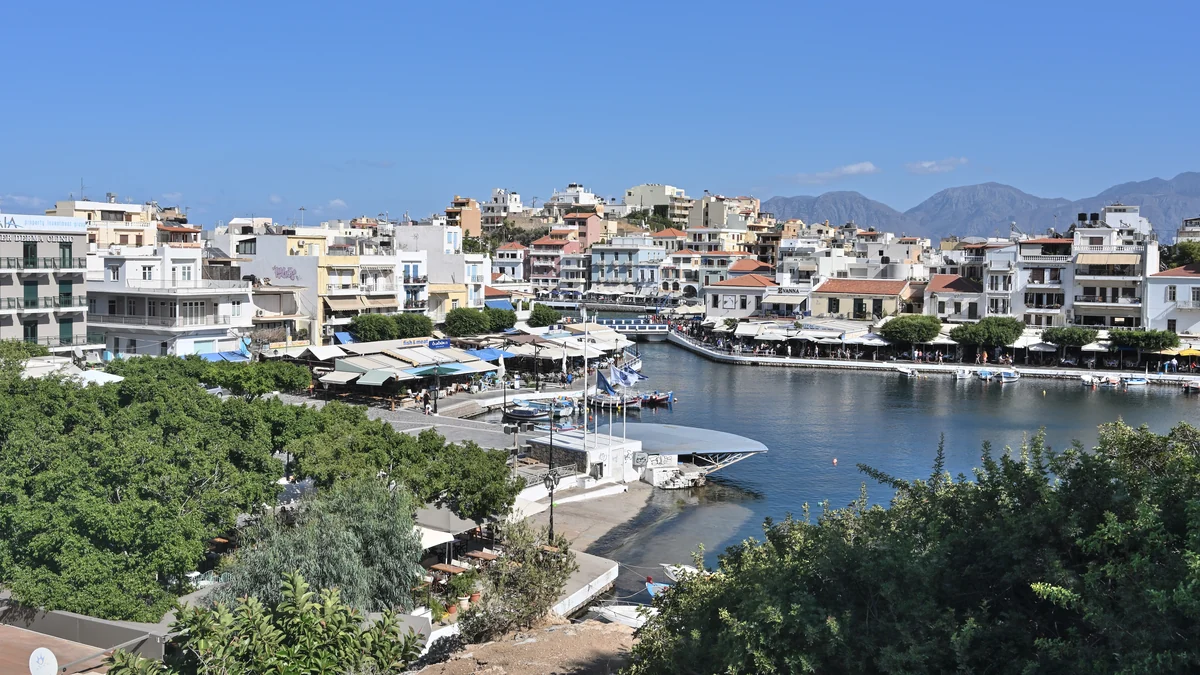
Agios Nikolaos cruise port places passengers beside one of Crete’s most pleasant small cities, with Lake Voulismeni, the marina, Kitroplateia waterfront and central shopping streets all within an easy independent circuit. Some ships can berth in the harbour while others may tender, but the destination remains close enough that a late arrival does not automatically destroy the day.
The main planning decision is Spinalonga. The former fortress and leper colony is the region’s headline excursion, yet reaching it requires a boat connection, either from Agios Nikolaos itself or after travelling north to Elounda or Plaka. A well-timed visit is memorable; a poorly timed independent plan can become a chain of buses, queues and uncertain boats. First-time visitors should decide before the call whether Spinalonga is the day’s purpose. If it is not, Agios Nikolaos, Elounda and a nearby beach make a relaxed and genuinely Cretan alternative.
Agios Nikolaos Cruise Port at a Glance
| Port name | Agios Nikolaos Cruise Port |
|---|---|
| Main arrival area | Harbour beside central Agios Nikolaos; tender landing may vary |
| Cruise region | Greece / Greek Islands |
| Country / Territory | Greek Islands |
| Currency | Euro (EUR) |
| Languages | Greek; English widely used in tourism |
| Port role | Day Call |
| Disembarkation | Docked or Tender |
| Walkability | High in the centre; steep streets around Lake Voulismeni |
| Shuttle required | Normally no for central Agios Nikolaos |
| Main transport | Walking, KTEL bus, taxi, local boat, hire car and organised excursion |
| Best first-time plan | Lake Voulismeni and the waterfront, plus Spinalonga or Elounda |
| Main caution | Boat timetables, summer heat and trying to combine Spinalonga with distant Knossos |
Weather & Best Time to Visit Agios Nikolaos
January to March
Typical high: 15–18°C
Typical low: 9–11°C
Rain / conditions: Mild but unsettled, with rain, wind and quieter seasonal boat services.
April to June
Typical high: 20–29°C
Typical low: 13–20°C
Rain / conditions: Warm, increasingly dry and comfortable for town walking and archaeological sites.
July to September
Typical high: 28–31°C
Typical low: 21–23°C
Rain / conditions: Hot, very dry and bright, with strong sun on boats and exposed ruins.
October to December
Typical high: 17–27°C
Typical low: 11–20°C
Rain / conditions: Often warm in early autumn, followed by increasing rain and reduced seasonal operations.
Weather guide: CruisePing summary based on NASA POWER climate data for eastern Crete. Check the latest Agios Nikolaos forecast before travelling.
Eastern Crete is bright and exposed, so the practical issue in summer is cumulative heat: walking around the lake, waiting for a boat and exploring Spinalonga can all happen with little shade. Carry water from the start and use a hat rather than assuming the sea breeze will be cooling. Wind can alter small-boat operations even when the town itself remains sunny, so keep a central fallback plan.
Where Cruise Passengers Come Ashore
The official Agios Nikolaos tourism and port information describes the harbour as being in the heart of the city. That is accurate from a cruise-planning perspective: the waterfront, Lake Voulismeni and central cafés are close, and there is no long gateway transfer between ship and destination.
Whether passengers dock or tender depends on the ship and call. Do not use a photograph of another vessel as proof that yours will berth. Tender passengers should establish the last-boat time and recognise the landing point; docked passengers should follow the port’s pedestrian instructions. Either way, the compact centre makes it possible to begin on foot rather than queuing immediately for a coach.
Lake Voulismeni is the obvious orientation landmark. It sits just inland from the sea and is ringed by cafés, viewpoints and streets that climb sharply on its western side. The marina and Kitroplateia shore lie nearby, so even a short call can include water views, a meal and a swim without depending on public transport.
The harbour area can become congested when excursion buses, taxis and tender groups arrive together. If you have pre-booked a guide, confirm whether collection is at the berth, tender landing, terminal exit or a named hotel. “At the port” is too vague in a small but active waterfront where several passenger areas sit close together.
Lake Voulismeni and the Centre on Foot
Lake Voulismeni gives Agios Nikolaos its distinctive shape. The inner harbour is linked to the sea by a channel, while cafés and restaurants occupy the lower edge. From water level, streets rise towards viewpoints that reveal the lake, marina and Mirabello Bay. The circuit is short, but some gradients and steps are steeper than the compact map suggests.
A useful walking route starts at the harbour, reaches the lake, climbs only as far as comfort permits, then descends towards Kitroplateia. The waterfront here feels more open than the café-lined lake and leads towards small urban beaches. This sequence gives variety without repeated backtracking and keeps the ship within easy reach.
The Archaeological Museum, churches and local shops can extend the city visit, subject to current opening. Museum expectations should be checked because galleries and access arrangements can change. Do not build a tight route around an attraction that may have a reduced seasonal schedule; the waterfront city remains the reliable core.
For lunch, choose between the atmosphere around the lake and the sea-facing tavernas. The lake is convenient but can be busy with tours. Kitroplateia or streets just away from the main water edge may provide a calmer meal. Tell staff about the ship deadline before ordering a long sequence of dishes, especially if the restaurant is busy.
Spinalonga: The Main Excursion Decision
The island of Spinalonga is the region’s most recognised excursion. The official local tourism page notes access from Agios Nikolaos, Elounda and Plaka, with the shortest crossing from Plaka. The site combines Venetian fortifications, Ottoman layers and the remains of the twentieth-century leper colony, requiring more context than a quick circuit of walls.
Direct boats from Agios Nikolaos can be convenient because they remove a road transfer, but sailing frequency and duration are seasonal. Some trips include swimming or a longer cruise around Mirabello Bay, which may be enjoyable but leaves less time at the archaeological site. Read the actual programme rather than assuming every “Spinalonga boat” provides the same visit.
Travelling first to Elounda or Plaka creates a shorter sea crossing and can offer more departure choice. The trade-off is the road connection. Public buses may be suitable when current timetables align with the ship, while a taxi or organised excursion offers more control. Independent passengers need to coordinate the outbound road, boat, site visit, return boat and final road journey; each leg should have a fallback.
At Spinalonga, expect uneven stone, slopes, exposure and limited shade. The route around the settlement is not an effortless promenade. Comfortable footwear and water matter, and passengers with restricted mobility should ask what portion is realistic. A guide can add real value by explaining how the fortress and community changed over time rather than presenting the island only through its most dramatic label.
Avoid combining Spinalonga with Knossos unless the ship offers a long, carefully designed excursion. They lie in different directions and serve different interests. A rushed two-headline day risks turning eastern Crete into transfers and queues. Spinalonga plus Elounda or central Agios Nikolaos is the coherent pairing.
Elounda and Plaka without Overcomplicating the Day
Elounda is a resort and harbour north of Agios Nikolaos with views across to Spinalonga. It works as a gentle excursion even without entering the island: waterfront cafés, boats and a slower pace can fill a few hours. A current KTEL bus or taxi is the practical connection, with the return arranged before committing to lunch.
Plaka is smaller and lies opposite Spinalonga. It is often used as the short-crossing point, but it also suits passengers who want a waterside meal and direct views of the island. Its compact size means there is less to do if boats are cancelled, so build the plan around the purpose of the visit rather than expecting a large independent destination.
Public transport can be economical, but cruise passengers should verify the date-specific timetable through KTEL Heraklion–Lasithi and identify the correct stop in both directions. Summer buses may be busy, and a timetable that appears frequent can still leave an uncomfortable gap before all-aboard. Use a taxi for the return if the last safe bus does not provide enough margin.
A private driver can combine Elounda, Plaka and a viewpoint while maintaining control. Agree the waiting policy and whether the driver can adjust if the boat queue is long. There is little benefit in paying for a car to sit unused during an extended boat trip unless that guarantee is the reason for booking.
Ancient Lato, Kritsa and Panagia Kera
Passengers who prefer archaeology and villages to boats can travel inland towards Kritsa and Ancient Lato. Lato occupies a dramatic hillside with views across the region and gives a very different impression from the coastal resorts. The site is exposed, uneven and not suited to a hurried stop in peak heat.
Kritsa is a substantial village rather than a decorative handful of lanes. Shops, cafés and traditional products make it a practical companion to the archaeological site. The nearby church of Panagia Kera is known for its frescoes, but current opening and photography rules should be checked. Dress respectfully and allow time for a quiet visit.
This route works best by organised excursion, taxi or hire car collected under a clear plan. Public buses can connect villages, but they may not serve the archaeological site in a way that fits a cruise call. The advantage of a private arrangement is not speed alone; it is the ability to choose one or two meaningful stops instead of accepting a broad coach circuit.
Ancient Lato and Kritsa are particularly good repeat-visitor choices. They reveal the inland landscape and local history without the long westward journey to Heraklion. A first-time visitor torn between Lato and Spinalonga should choose according to interest: hillside archaeology and village life, or maritime fortress and social history.
Knossos and Heraklion: Possible, but Not Local
Knossos is one of Crete’s defining archaeological sites, but Agios Nikolaos is not its nearest cruise gateway. The drive towards Heraklion, site queues and the return all consume a substantial part of the call. It can be justified when Knossos is a once-only priority and the excursion is protected by the ship; it should not be treated as a casual morning trip.
Check how much time the itinerary allocates inside Knossos and whether the Archaeological Museum in Heraklion is included. Both deserve attention, yet adding the museum can make the schedule extremely compressed. A tour that advertises two major names may deliver less understanding than a focused visit to one.
Independent travel is possible in theory, but it creates multiple dependencies: bus to Heraklion, onward transport, admission, queues and the reverse journey. A rental car introduces parking and navigation. Unless the call is exceptionally long and the traveller is experienced in Crete, organised transport is the safer decision.
Agios Nikolaos should not be viewed as a consolation if Knossos is too far. Mirabello Bay, Spinalonga and the eastern villages offer a coherent regional day. Choosing the local experience is not “missing Crete”; it is avoiding the common cruise mistake of crossing an island to tick a famous site while barely seeing the port area.
Best Things to Do from Agios Nikolaos Cruise Port
Lake Voulismeni and Central Agios Nikolaos
Best for: An easy independent day with cafés, views and no transport risk.
How to do it: Walk from the harbour around the lake and down to Kitroplateia.
Watch: Steep side streets and exposed midday heat.
Spinalonga Island
Best for: The region’s major historical excursion.
How to do it: Choose a direct boat or travel to Elounda or Plaka for a shorter crossing.
Watch: Coordinating boats, road transport, queues and the ship deadline.
Elounda Waterfront
Best for: A relaxed coastal extension or a base for Spinalonga boats.
How to do it: Use a checked bus, taxi or excursion and confirm the return.
Watch: Busy summer services and losing track of time over lunch.
Kritsa and Panagia Kera
Best for: Village atmosphere, frescoes and local crafts.
How to do it: Pair with Ancient Lato using a taxi or organised route.
Watch: Church opening and respectful dress.
Ancient Lato
Best for: Exposed hillside archaeology and wide Mirabello views.
How to do it: Visit early with controlled transport and good footwear.
Watch: Rough surfaces, limited shade and a remote return.
Nearby Beaches
Best for: A low-pressure afternoon after the city walk.
How to do it: Use an urban or nearby resort beach with an easy return.
Watch: Sun exposure and relying on an unconfirmed late taxi.
CruisePing Recommended Agios Nikolaos Port Day
For a first visit with a normal-length call, make Spinalonga the morning commitment. Use a ship excursion, a verified direct boat or a road-and-boat combination whose return has been checked in advance. Departing early reduces heat and gives room to recover if one connection changes. Do not schedule the final independent boat of the day.
After returning, keep the rest of the call in Agios Nikolaos. Walk around Lake Voulismeni, choose a viewpoint only if the temperature and mobility permit, then continue to Kitroplateia for lunch or a short swim. This creates a clear contrast between the historic island and the living waterfront city.
If Spinalonga does not appeal, reverse the emphasis: spend an unhurried morning in Agios Nikolaos, then use a taxi or current bus to Elounda. Return with enough time for a final coffee beside the lake. Passengers interested in archaeology should substitute Kritsa and Lato for Elounda rather than trying to add all three.
On a short call, stay local. The lake, marina, shops and beach are enough for a satisfying visit, and the ship remains close. A short port day should not be converted into a stressful Spinalonga race simply because the island appears at the top of every excursion list.
DIY or Organised Excursion?
Central Agios Nikolaos is easy to do independently. There is no need to pay for a guide simply to reach the lake, waterfront or shopping streets. The compact centre is also the best fallback when weather or a delayed arrival makes a longer plan unsuitable.
Spinalonga sits in the middle. Confident travellers can arrange it independently, but only after checking current boats and road transport. An organised excursion earns its cost by controlling the chain of connections and protecting the return. It is especially sensible for first-time visitors, families or anyone uncomfortable with a boat timetable in another language.
Knossos is the clearest organised-excursion choice because of distance. Kritsa and Lato work well with a private driver or small group, where the schedule can respond to heat and walking speed. A large coach may be cheaper but can spend considerable time loading and unloading at short stops.
When comparing tours, look beyond the title. Ask how long is spent at Spinalonga, where the boat boards, whether admission is included and how much free time remains in Agios Nikolaos. A shorter excursion with a proper site visit is often better than a wide “highlights” circuit that gives every place twenty minutes.
Mobility, Heat and Beach Planning
Agios Nikolaos looks flat from the harbour but rises around the lake. The lower waterfront circuit is manageable, while upper viewpoints may involve steep streets or steps. Passengers with mobility restrictions should remain around the marina, lower lake edge and Kitroplateia, or use a taxi to avoid the climb.
Spinalonga presents a harder surface: stone, slopes, thresholds and strong exposure. Ask the excursion operator about the actual route, not merely whether the boat can take a folding wheelchair. Boarding, gangways and the archaeological circuit create separate accessibility questions.
In high summer, carry water before leaving the port and schedule archaeological sites early. A swim can cool the afternoon, but choose a beach with facilities and a reliable return. Beach time far from town becomes risky when changing, finding a taxi and passing port security are all left to the final hour.
Wind can affect boats while leaving road transport intact. If a Spinalonga sailing is cancelled, do not chase another operator around the harbour. Switch decisively to Elounda by road, Kritsa, or the central city. A good fallback should improve the remaining day rather than recreate the cancelled plan at greater risk.
Useful Official Links
Use these official and authoritative pages to check details that can change before a Agios Nikolaos call, including arrival arrangements, transport, opening information and local access.
- Agios Nikolaos port information
- Agios Nikolaos stopover guide
- Official Agios Nikolaos tourism website
- Spinalonga visitor information
- KTEL Heraklion–Lasithi timetables
Frequently Asked Questions
Can you walk from Agios Nikolaos cruise port to the town?
Yes. The harbour is beside the centre, and Lake Voulismeni, the marina and waterfront are accessible on foot. Some streets climb sharply, but the lower route is compact.
Do cruise ships dock in Agios Nikolaos?
Some ships berth while others may tender, depending on vessel size and port operations. Use the call-specific instructions and record the tender deadline if applicable.
How do you get to Spinalonga from Agios Nikolaos?
Options include a direct seasonal boat or road transport to Elounda or Plaka followed by a shorter crossing. Check current schedules and build a generous margin across every leg.
Can you visit Spinalonga independently on a cruise day?
Yes, when boat and road timetables align, but it requires more coordination than the distance suggests. An excursion is safer if the call is short or you do not want to manage multiple connections.
Is Knossos realistic from Agios Nikolaos?
It is possible on a long call, preferably as an organised excursion, but the drive and site queues make it a major commitment. Spinalonga or eastern Crete usually provides a more balanced local day.
What can you do without an excursion?
Walk around Lake Voulismeni, explore the marina and shops, visit a central museum if open, eat by the waterfront and use a nearby beach. This works particularly well on a shorter call.
Is Agios Nikolaos suitable for passengers with reduced mobility?
The lower waterfront is relatively manageable, but streets around the lake rise steeply. Spinalonga has uneven surfaces and boat-access issues, so request specific accessibility information.
How early should you return from Spinalonga?
Choose a boat that returns with enough time for the road connection, walking to the port and any tender or security process. Avoid making the last plausible sailing your planned return.
CruisePing Verdict
Agios Nikolaos is strongest when passengers resist the temptation to cross Crete for every famous name. The harbour city, Mirabello Bay and Spinalonga form a natural day with manageable geography and a clear sense of eastern Crete. Even without the island, the lake, waterfront and nearby villages make the call easy to enjoy.
The defining choice is simple: commit properly to Spinalonga or keep the day relaxed and local. Do not combine a fragile boat plan with Knossos, distant beaches and a late bus. One major excursion, followed by time beside Lake Voulismeni, gives a better day and a far safer return.
Ready to browse our article library?
Looking beyond Agios Nikolaos? Explore more ports in the Greece / Greek Islands region, or narrow it to Greek Islands in particular. For cruise comparisons, planning shortcuts and value guides, head over to our main article archive.