
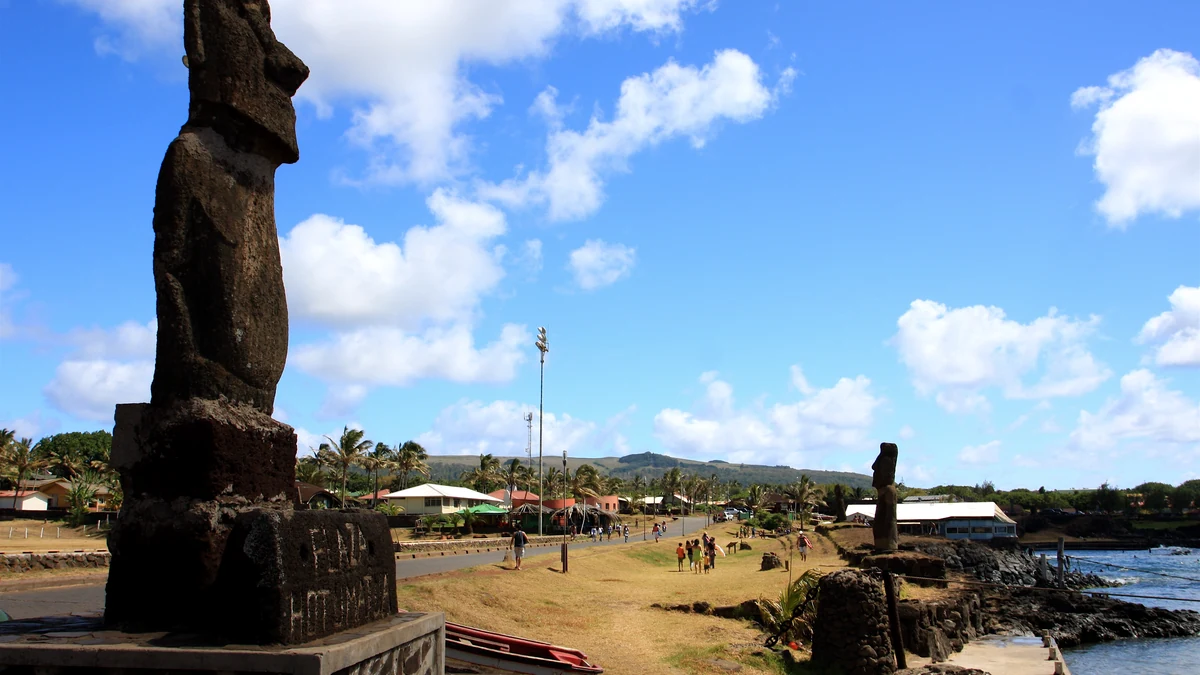
Easter Island cruise portis one of the most rewarding and operationally fragile calls in the Pacific. Ships anchor offshore, passengers tender into Hanga Piko, and visits to the principal Rapa Nui National Park sites require current admission arrangements and authorised local guidance.
A successful day is built around one coherent archaeological circuit, not a race around the island. Sea conditions can shorten the landing, site rules can change, and the distant headline locations need a protected road return. The best plan therefore combines cultural depth with conservative timing.
Easter Island Cruise Port at a Glance
| Port name | Easter Island |
|---|---|
| Main arrival area | Hanga Piko tender harbour near Hanga Roa; landing remains sea-condition dependent |
| Cruise region | South America / Galapagos |
| Country / Territory | Chile |
| Currency | Chilean peso (CLP) |
| Languages | Spanish and Rapa Nui; English used by many guides |
| Port role | Day Call |
| Disembarkation | Tender |
| Walkability | Hanga Roa and nearby sites are walkable; major park sites require road transport |
| Shuttle required | No for Hanga Roa; guided vehicle essential for the main archaeological circuits |
| Main transport | Tender, licensed guided tour vehicle, taxi and walking |
| Best first-time plan | One authorised guided circuit, normally Rano Raraku and Tongariki or Rano Kau and Orongo |
| Main caution | Tender reliability, park rules and the long road return from remote sites leave little room for improvisation |
Hanga Piko is a tender harbour, not a walk-off cruise terminal
Treat successful landing as the first achievement of the day. Cruise ships normally anchor offshore and land passengers by tender at Hanga Piko, subject to sea conditions. The practical advantage is the usable day begins only after the ship has established a safe tender operation; the weakness is Pacific swell can delay, restrict or cancel landing even when the island itself is sunny. Avoid booking an independent tour with an inflexible start time.
Independent planning is realistic only when every transfer is understood. The harbour has limited space and several tender groups may arrive together. Be back within the ship-controlled harbour process well before the last tender. Where one connection is uncertain, a ship excursion or cruise-aware local operator is the stronger choice.
Rapa Nui National Park access requires current tickets and authorised guidance
Do not assume that reaching a site by vehicle guarantees admission. The officialRapa Nui National Parksystem controls visitor access to the principal archaeological sites. The practical advantage is tickets and an accredited local guide are central to most serious sightseeing routes; the weakness is old advice about unrestricted entry or self-guided access can be invalid. Confirm the current ticket, guide and site rules before sailing.
A cruise-line excursion normally packages these requirements, while an independent visitor must verify them directly. Keep proof of purchase and guide details available offline.
One archaeological circuit is better than a rushed island sweep
Chile Travelpresents Rapa Nui as a landscape of ceremonial sites, volcanic terrain and living Polynesian culture. For a cruise passenger, that means a coherent route gives time to understand how ahu, moai, quarries and settlements relate. Choose either the main south-east circuit or a focused crater-and-village route. Trying to touch every famous site can turn the day into repeated vehicle stops and queues.
Ask the guide how much walking and interpretation each stop receives rather than judging by the number of names advertised. Finish the final remote site early enough to return through Hanga Roa traffic and harbour controls.
Rano Raraku and Tongariki form the classic first-time route
The volcanic quarry at Rano Raraku and the restored line of moai at Ahu Tongariki explain both the making and ceremonial placement of the statues. For a cruise passenger, that means together they provide the strongest archaeological narrative for a first visit. Visit with a guide and a confirmed vehicle. They lie well away from Hanga Piko and attract concentrated tour traffic.
Paths, steps, exposed ground and weather can lengthen the stop, so ask whether the tour includes the full quarry walk or only selected viewpoints. Do not add a late independent detour after Tongariki.
Rano Kau and Orongo are a different kind of day
Rano Kau crater and the ceremonial village of Orongo focus on volcanic landscape, the birdman tradition and the island’s south-western edge. For a cruise passenger, that means they can be combined more naturally with Hanga Roa and nearby west-coast sites. Wear secure footwear and follow guide boundaries. Clifftop wind, uneven paths and changing site controls affect access.
This route can suit a shorter call better than the full east-coast circuit, but it still needs transport and authorised entry where required. Return from the crater area before the final harbour rush.
Anakena Beach is not merely a swimming stop
Anakena combines sand, palms and important archaeological remains on the island’s north coast. This matters because it can add a gentler landscape break to a cultural tour. The road distance and site time make it a substantial addition rather than a quick beach visit. The sensible response is to include it only within a planned north-coast route
Swimming conditions, facilities and time in the water should be checked on the day; the archaeological setting still requires respectful behaviour. Leave early enough to cross the island without relying on perfect traffic.
Tahai is the most useful archaeological fallback near town
The Tahai ceremonial complex lies close to Hanga Roa and is easier to reach than the remote east-coast sites. This matters because it gives a shortened call a genuine cultural focus without a long road commitment. Park admission and guide rules must still be checked rather than assumed. The sensible response is to use Tahai when tendering has reduced the available hours
Combine it with the town, museum if open and a waterfront walk rather than chasing a distant headline site. Keep the final movement back to Hanga Piko simple.
Hanga Roa adds living culture to the archaeological day
The island’s principal settlement contains shops, cafés, churches, craft outlets and everyday community life. This matters because time in town prevents the visit becoming only a sequence of ancient monuments. Services can be busy during a cruise call and card connectivity is not guaranteed everywhere. The sensible response is to carry a modest amount of Chilean pesos and allow time for a meal or local purchase
Use designated craft markets and reputable sellers; ask before photographing people or performances. Walk or drive back to Hanga Piko with a margin.
The museum can deepen a shorter or poor-weather visit
Use it as a contextual anchor, not an assumed guaranteed stop. The key local detail is that theSebastián Englert Anthropological Museuminterprets Rapa Nui history and archaeology. In practice, it can add context before or after nearby sites. Verify the current schedule rather than building the whole day around it. Opening days and hours may not align with every cruise call.
A museum stop is especially useful when weather makes long exposed walks less attractive. Do not let a delayed opening consume the protected harbour return margin.
An accredited guide changes the quality of the visit
Rapa Nui’s main sites carry meanings that cannot be read reliably from the landscape alone. This matters because a knowledgeable local guide connects archaeology with genealogy, oral history and current community stewardship. A driver without guiding credentials may not satisfy park rules or provide responsible interpretation. The sensible response is to verify the guide’s current authorisation
Ask whether the same person drives and guides, which sites are included and how entry checks are handled. Keep the operator responsible for returning to Hanga Piko.
Site rules protect both heritage and the visitor experience
Visitors must remain within authorised routes and respect barriers, platforms and instructions. For a cruise passenger, that means the moai and ahu remain culturally significant rather than functioning as props. Follow the guide and posted rules without negotiation. Touching stonework, crossing boundaries or staging intrusive photographs can damage sites and offend local expectations.
Drones, commercial photography and access to some areas may be separately controlled. Allow staff checks to take the time they require.
Road distance is more important than the island’s compact outline
Rapa Nui appears small on a map, but the main sites are spread around a limited road network. The choice works best when each additional stop adds driving, parking, entry and regrouping time use a maintained vehicle and keep the route geographically coherent. Otherwise, a vehicle problem or delayed site entrance can affect the entire circuit.
Do not rely on finding a replacement taxi near a remote archaeological area. Set a firm time to begin the return to Hanga Piko.
Tender queues can remove more time than expected
Protect both ends of the shore visit. Hanga Piko handles passengers through a small harbour rather than a purpose-built high-capacity cruise terminal. The practical advantage is morning and afternoon queues may be the largest single timing variable; the weakness is independent tours that promise to wait may still have other passengers and park appointments. Communicate the ship name and tender uncertainty before the call.
On return, the ship may require security checks or staged loading before the tender departs. Join the queue before the advertised last tender.
Walking conditions are exposed and uneven
Archaeological routes cross volcanic ground, grass, gravel, steps and open slopes. For a cruise passenger, that means distance alone understates the effect of wind, sun and unstable footing. Ask the tour operator for a stop-by-stop access description. Wheelchair and limited-mobility access varies substantially by site and vehicle.
A panoramic vehicle route with selected accessible viewpoints may be more rewarding than forcing every path. Save energy for the tender transfer.
Food and water need a deliberate place in a long circuit
carrying water and arranging lunch prevents the group from losing time searching between sites Remote archaeological areas do not provide the same services as Hanga Roa. Do not overlook that heat and wind can mask dehydration. Bring a refillable bottle and confirm whether food is included.
Respect restrictions on eating within protected areas and remove all waste. Do not schedule a late restaurant meal immediately before the tender cut-off.
Weather at the harbour may differ from exposed sites
wind, showers and cloud can vary across the island and alter both tendering and visibility Chile’s official meteorological information is available throughMeteoChile. Do not overlook that a seemingly mild forecast can still mean strong clifftop gusts or rough offshore water. Carry layers, sun protection and a waterproof outer layer.
Guides may change the order of sites to use better conditions; that flexibility is valuable if all key admissions remain valid. Follow the ship’s marine instructions even if land tours continue.
The last remote stop must finish early
Ahu Tongariki, Rano Raraku and Anakena all require a cross-island return to the south-west harbour. This matters because a road margin is essential because there is no alternative cruise landing if Hanga Piko is missed. Late photography, shopping or an extra viewpoint can consume the only recovery time. The sensible response is to agree the departure time from the final site before the tour begins
Ask the guide to distinguish the ideal sightseeing schedule from the non-negotiable ship schedule. Arrive at Hanga Piko with enough time for queuing and security.
Ship time and local time must be reconciled explicitly
Remove time-zone ambiguity before the vehicle leaves Hanga Piko. Cruise itineraries, onboard clocks and local Rapa Nui time can create confusion on a remote Pacific call. The practical advantage is one agreed time standard prevents missed meetings and premature returns; the weakness is a guide may quote local time while the ship continues to announce ship time. Write both times on the tour confirmation and verify them after landing.
Set a phone manually if automatic network updates are unreliable. Use the ship’s stated all-aboard time as the final authority.
Photography stops must remain inside the guided route
A respectful image is more valuable than an unauthorised one. The key local detail is that rapa Nui’s wide horizons encourage visitors to wait for changing light and uncluttered views. In practice, a guide can identify legal and culturally appropriate viewpoints. Accept the available angle and follow the route. Stepping beyond barriers for a cleaner photograph can damage archaeology or violate park rules.
Long tripod setups, drones or commercial equipment may require separate permission. End photography when the guide calls the group back.
Independent cycling is rarely the best cruise-day answer
Use cycling for local exploration, not as a substitute for an authorised island tour. The key local detail is that bicycles are used by longer-stay visitors around Hanga Roa and parts of the island. In practice, a local ride can suit an active passenger who remains near town. Keep any ride short and confirm rental return arrangements. Wind, road distance, limited shoulders and park access rules make a remote moai circuit risky within a tender call.
Carry water, repair essentials and an offline map. Turn back early enough to return the bicycle and reach Hanga Piko.
A missed or cancelled landing should not trigger unsafe improvisation
Some itineraries approach Rapa Nui after long sea days, making disappointment understandable when tenders cannot operate. For a cruise passenger, that means the absence of a safe harbour alternative means passengers must accept the captain’s decision. Use onboard interpretation and retain plans for a future land stay. Pressure on local boats or unofficial transfers would add unacceptable risk.
Check excursion cancellation terms and park-ticket policies before the voyage. Do not leave the ship except through the authorised tender system.
Waste and water should be managed as island resources
Rapa Nui’s remote location makes responsible use of water and disposal of visitor waste especially important. For a cruise passenger, that means small choices by a large tour group can reduce pressure on protected sites and community services. Carry a refillable bottle and take all waste back to an authorised bin. Single-use litter and careless disposal are particularly damaging in windy archaeological landscapes.
Use toilets and refreshment stops identified by the guide rather than assuming facilities at every site. Leave each stop without delaying the group’s return.
Medical and flight options are limited by remoteness
TheUK travel advice for Chileshould be read alongside local arrangements, andMataveri Airportis the island’s only aviation gateway. For a cruise passenger, that means a cruise passenger should carry essential medication and suitable insurance rather than relying on rapid mainland support. Keep passport details, insurer contacts and medical information accessible. Serious disruption can require complex onward arrangements.
Tell the tour operator about mobility or health needs before leaving Hanga Piko. Return to the ship promptly if the cruise line changes the call.
One Archaeological Route, Properly Timed
The landing itself may be delayed or cancelled by sea conditions. Book through an operator who understands the ship schedule and keep expectations flexible enough to accept a shortened route.
Easter Island’s protected sites and road distances make a guided circuit the sensible default. Rano Raraku and Tongariki form one strong eastern route; Rano Kau and Orongo form another. Trying to cover both on a conditional tender call reduces time at the sites and increases the return risk.
CruisePing Recommended Port Day
For a full-length call with an early landing, CruisePing recommends a pre-booked authorised guide and a south-east circuit centred on Rano Raraku and Ahu Tongariki. Add only the stops that fit naturally along the route, confirm all park admissions in advance and agree the exact time the vehicle will leave the final remote site.
When tendering starts late, switch to the south-west: Rano Kau and Orongo if access and timing remain sound, or Tahai, Hanga Roa and the museum where available. A shortened but coherent visit is much better than reaching a remote site and spending the rest of the day worrying about the return.
Weather & Best Time to Visit Easter Island
| Month / season | Typical high | Typical low | Rain / conditions |
|---|---|---|---|
| December–March | 27°C | 19°C | Warmest period; sun, showers and humidity |
| April–June | 24°C | 17°C | More rain and variable wind; exposed sites can feel cooler |
| July–November | 23°C | 15°C | Cooler, windy and changeable; tender swell remains important |
Rapa Nui has a maritime climate, so wind and swell are more consequential than small temperature differences. Exposed craters and coastal ahu can feel much cooler than Hanga Roa, while UV remains strong. Check thecurrent official forecastbefore committing to the day.
Frequently Asked Questions
Where do cruise ships tender on Easter Island?
Most calls use Hanga Piko near Hanga Roa, subject to sea conditions and the ship’s operational decision.
Can you visit the moai without a guide?
The principal national-park sites are subject to current ticket and authorised-guide rules. Confirm the latest requirements before sailing.
Which sites are best on a first cruise call?
Rano Raraku and Ahu Tongariki form the classic full-day circuit. Rano Kau, Orongo and Tahai work better when time is shorter.
Can an Easter Island call be cancelled?
Yes. Offshore swell and harbour conditions can prevent safe tendering even when the island forecast appears reasonable.
Is Easter Island walkable from the tender?
Hanga Roa and some nearby sites are. The major archaeological areas need a vehicle and guide.
Useful Official Links
- Rapa Nui National Park
- Chile Travel: Rapa Nui
- Sebastián Englert Anthropological Museum
- MeteoChile
- UK travel advice for Chile
CruisePing Port Verdict
Easter Island is not a port to improvise. The combination of offshore tendering, protected-site rules and dispersed archaeology rewards an authorised guide and one disciplined route. When the landing works, a carefully paced circuit can be among the most memorable days of a world cruise; when time contracts, nearby Rapa Nui culture is the intelligent fallback.
Ready to browse our article library?
Looking beyond Easter Island? Explore more ports in theSouth America / Galapagosregion, or narrow it toChilein particular. For cruise comparisons, planning shortcuts and value guides, head over to ourmain article archive.