
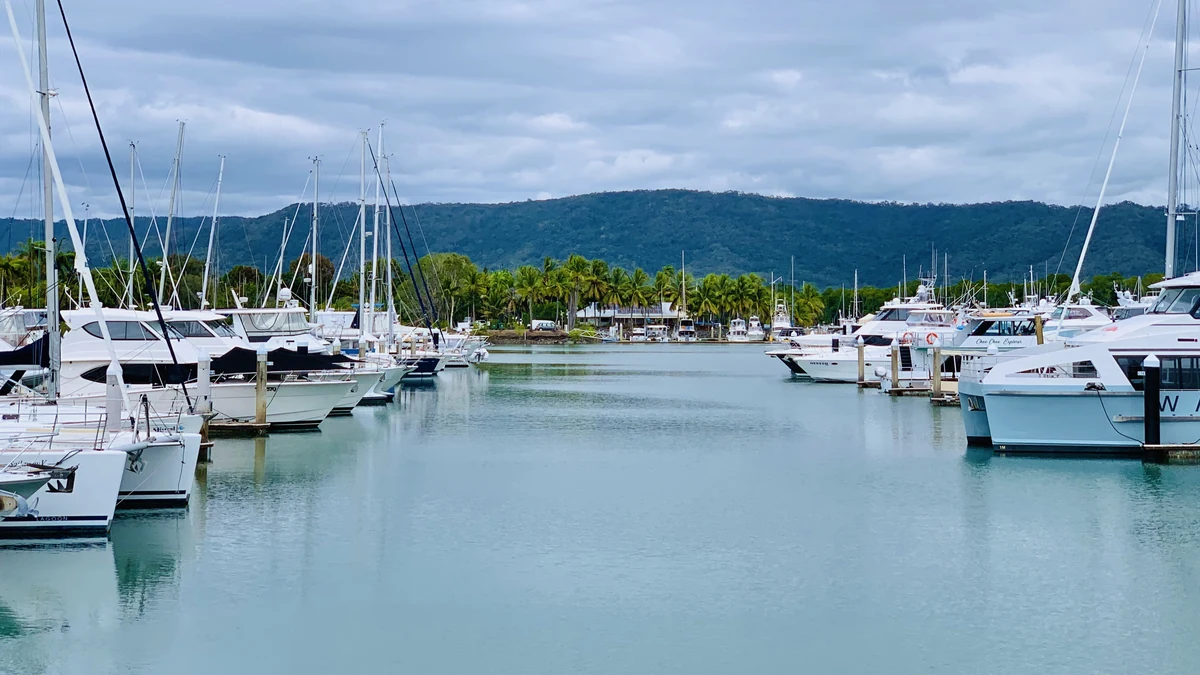
Port Douglas cruise port is an offshore tender call at Crystalbrook Superyacht Marina. Macrossan Street, the waterfront and Four Mile Beach are walkable, but the destination’s two world-class choices—the Great Barrier Reef and Daintree rainforest—need organised transport and a schedule built around the ship.
Our opinion is simple: choose reef or rainforest, not both. A cruise-aligned outer-reef or Low Isles trip is the best premium day when departure and return are protected. A half-day Mossman Gorge or Daintree route is the stronger land alternative. DIY town and beach is an excellent fallback, while an ordinary full-day public excursion with a late return is a bad cruise gamble.
Port Douglas Cruise Port at a Glance
| Port name | Port Douglas |
|---|---|
| Main arrival area | Tender landing at Crystalbrook Superyacht Marina |
| Cruise region | Australasia / Pacific Islands |
| Country / Territory | Australia |
| Currency | Australian dollar (AUD) |
| Languages | English |
| Port role | Day Call |
| Disembarkation | Tender |
| Walkability | Good to Macrossan Street, waterfront and Four Mile Beach |
| Shuttle required | No for town; organised transport needed for reef and rainforest |
| Main transport | Walking, cruise-aligned reef boat, ship excursion, tour coach and local shuttle |
| Best first-time plan | Protected reef trip when timing fits; otherwise half-day rainforest or DIY town and beach |
| Main caution | Normal public reef and Daintree schedules may return too late once tender time is included |
The marina is the actual cruise landing
Port Douglas Tourism confirms that tender boats dock at Crystalbrook Superyacht Marina. The map marks the marina basin rather than the town centre.
Check whether a booked operator meets passengers at the tender point or a separate check-in desk. Morning tender delay can make a standard public departure unsuitable even when the advertised return looks comfortable.
DIY or organised tour? Organised for the headline environments
Use an organised trip for reef or rainforest. Boats, park access, interpretation and long regional roads make expertise valuable.
Go DIY only for Port Douglas town, Four Mile Beach and the waterfront. That local day is genuinely enjoyable; it should be chosen deliberately rather than after missing an inflexible excursion.
The reef is the strongest first-time choice
The Great Barrier Reef is the experience that most clearly justifies paying for an excursion. Outer-reef platforms and island trips offer different levels of snorkelling, diving, glass-bottom viewing and comfort.
Choose the product that matches swimming ability and call length. Do not select solely by the number of reef sites; departure compatibility and return protection matter more.
Compare the complete product rather than the headline reef name. Vessel stability, travel time, shade, water entry, guided snorkelling, glass-bottom access, medical facilities and the number of passengers can affect the day more than visiting one additional reef site.
A cruise passenger also needs a departure that tolerates tender delays. An excellent public trip leaving before the first realistic arrival is not a bargain; a slightly shorter cruise-aligned product is the better purchase.
Quicksilver is practical only on a cruise-aligned schedule
The official Quicksilver Outer Barrier Reef cruise offers a large wavepiercer and reef platform, with options for non-swimmers as well as snorkellers.
Book through the ship or obtain written cruise-call timing. A normal full-day public schedule can fail if the first tender is late, so the operator must know the vessel and final tender.
Low Isles suits a gentler reef day
A Low Isles sailing and snorkelling trip provides an island setting, sheltered lagoon and guided water activities.
It is often better for passengers who value beach time, sailing and a less industrial reef platform. It must still return early enough; a beautiful sail is not protected merely because the island is closer.
The island environment gives non-swimmers something meaningful to do ashore and can be easier for mixed groups than a day centred entirely on an outer-reef platform. Guided walks and glass-bottom viewing should still be checked rather than assumed.
Sailing vessels may feel more atmospheric but can have slower passages and more movement than a powered catamaran. Choose by physical comfort and return time, not by the romance of the vessel photograph.
Non-swimmers should compare viewing options
Reef pontoons may offer underwater observatories, semi-submersibles or glass-bottom boats, while smaller sailing products can require more active transfers.
Ask what is guaranteed on the exact sailing. We would choose a product with strong dry-viewing options rather than paying for snorkelling equipment a passenger will not use.
Outer-reef pontoons may offer underwater observatories, semi-submersibles and glass-bottom boats, while smaller vessels can focus mainly on snorkelling. The presence and frequency of dry viewing should be confirmed before booking.
Passengers with limited mobility should ask about gangways, stairs, platform surfaces and whether the vessel returns directly to the marina. A non-swimmer can have an excellent reef day, but only on the right product.
Do not combine reef and rainforest
Each environment deserves most of the usable call. Attempting a reef boat followed by Mossman Gorge, or a rainforest coach followed by a late marine trip, creates a sequence vulnerable to every delay.
Choose one headline and add only town or beach afterwards. The destination is richer when one ecosystem is understood properly.
Mossman Gorge is the best short rainforest target
Mossman Gorge provides rainforest, river and cultural context within a more manageable road journey than Cape Tribulation. A half-day route can return passengers to Port Douglas with time in hand.
Use a ship excursion or cruise-aware operator. We would prioritise Mossman Gorge above a rapid checklist of distant Daintree stops on a medium call.
The gorge shuttle and visitor arrangements mean the vehicle cannot simply stop at the water’s edge. Account for transfer, walking, interpretation and any swimming advice when comparing the nominal road distance with the actual excursion.
A strong route includes local cultural context and time beneath the canopy rather than using the gorge as a quick photograph before several retail stops. It should replace, not precede, an ambitious Cape Tribulation drive.
Cape Tribulation is usually too ambitious
The Daintree ferry, road distances and multiple stops make Cape Tribulation a full land day. A delayed tender or road disruption can remove the return margin.
Book only as a protected ship excursion on a long call. Independently, it is a poor first-time cruise choice even though it is outstanding during a land stay.
The Daintree River ferry introduces a fixed crossing into both outward and return journeys. Queues, roadworks, rain or a wildlife stop can consume the margin even when the distance looks acceptable in a navigation app.
Passengers determined to visit should use the ship’s protected excursion and accept that Port Douglas itself may receive almost no time. The attraction is outstanding, but it belongs to a full rainforest day rather than a reef-and-rainforest sampler.
A Daintree river cruise can work in a focused route
A wildlife-oriented river cruise can add crocodile and mangrove interpretation to a half-day rainforest plan. Sightings are never guaranteed and boat times create another fixed element.
Choose a route that pairs the river with one rainforest stop, not a brochure that claims the whole Daintree in a few hours.
The river adds mangroves, estuarine ecology and the possibility of crocodiles without requiring the full journey to Cape Tribulation. It pairs naturally with Mossman Gorge or a limited northern drive.
Choose an operator that sequences the ferry, river and gorge sensibly rather than criss-crossing the region. Wildlife remains uncertain, so the guide and landscape must justify the trip even when no crocodile appears.
Macrossan Street is the independent spine
The marina connects easily with Port Douglas town, where cafés, galleries and shops line Macrossan Street. It is compact enough to explore without transport.
Use it after an excursion or as part of a relaxed fallback. Do not spend the morning shopping before a weather-dependent reef departure.
A practical town route runs from the marina through Macrossan Street towards Four Mile Beach, with galleries, cafés and shops used as flexible stops rather than objectives that control the day. This remains worthwhile after a late tender or cancelled reef departure.
The Sunday market, if operating, can add local produce and crafts near the waterfront, but it should be treated as date-specific. Do not sacrifice the only comfortable beach or lookout period because an old guide promised a market on every call.
Four Mile Beach is worth a walk, not a whole paid tour
The broad beach is close to town and provides an easy tropical coast experience. It is better reached independently than through a generic beach-transfer excursion.
Follow local swimming, crocodile and marine-stinger advice. In stinger season, use designated areas and protective recommendations rather than assuming every stretch is suitable.
A short beach walk gives passengers the tropical coastline without another booking, while the town end remains close to cafés and the marina route. Check local swimming advice and marine-stinger conditions before entering the water. We would use the beach as a flexible final component after Flagstaff Hill or Macrossan Street, not pay for a transfer that offers little more than access to the same public shoreline.
Flagstaff Hill gives efficient orientation
The lookout and short coastal walk connect town, beach and Coral Sea views without a long vehicle transfer. Heat and gradient still matter.
Include it on a DIY day when conditions are comfortable. We would skip it after a physically demanding reef trip if the final tender margin has begun.
The Lady Douglas is a strong short-call boat option
The Lady Douglas river cruise departs from the marina and explores Dickson Inlet and mangroves.
It is not a substitute for the Great Barrier Reef, but it is an excellent shorter organised activity when a late tender makes the reef impossible. Its proximity to the landing keeps return risk low.
The river cruise works because it offers mangrove scenery, local commentary and a chance of wildlife without the long open-water commitment of the reef. It is the organised product most easily combined with town.
Crocodile sightings remain possible rather than guaranteed. Choose the trip for the river environment and guide, and leave enough time to walk back through the marina before tender boarding.
A private driver is best for a tailored rainforest day
A private vehicle can adapt walking, add Mossman Gorge and remove coach waiting. It is particularly useful for families or reduced-mobility passengers.
The driver must understand cruise tenders and road buffers. Do not use flexibility as an excuse to extend towards Cape Tribulation after a late start.
What to skip on a normal call
Skip trying to see reef and rainforest together, skip standard public tours whose check-in precedes the realistic tender landing, and skip Cape Tribulation independently.
We would also skip Cairns: Port Douglas has its own marina, beach and stronger immediate identity, while the road transfer wastes the call.
Heat, UV and marine stingers need planning
Tropical humidity can make even the town walk demanding, while water activities require stronger sun protection than passengers expect.
Carry water and use the operator’s recommended protective suit. A cloudy reef day can still produce severe UV exposure.
Reef suits, shade and hydration advice should be followed even when the water feels warm. On land, exposed beach and lookout walks can become demanding much faster than the short distance suggests.
A wet-season call may still be worthwhile, but passengers should compare water clarity, rain, humidity and cancellation terms rather than judging the day solely by temperature.
Cyclone and wet-season conditions change operations
Heavy rain can affect roads, river levels and water visibility. Tropical systems can alter or cancel tenders and boats well beyond the period of obvious bad weather.
Accept operator decisions and keep the local town plan ready. Do not replace a cancelled licensed boat with an unverified small vessel at the marina.
Heavy rain can reduce road speed, affect Daintree access and change reef visibility even when excursions continue. Operators may alter sites or cancel for reasons that are not obvious from the marina.
Keep a town-and-river fallback ready and read cancellation terms before paying. Port Douglas remains enjoyable in wet weather, but only when the plan can shrink without becoming a disappointment.
Accessibility differs sharply between products
Large reef vessels and pontoons may be easier than small sailboats, while rainforest boardwalks differ from riverbank paths.
Ask about the tender, boat gangway, toilets, water access and coach steps as one complete chain. Choose the excursion whose accessible elements are meaningful, not merely technically possible.
Return to the marina with a real buffer
A reef vessel’s published docking time is followed by disembarkation, equipment return and the cruise tender queue. A road tour also has the marina drop-off before ship transfer.
Book a return that leaves room for those stages. Use spare time in town or at the marina rather than accepting a product scheduled to the edge.
Reef boats, rainforest coaches and public tenders can all unload into the same marina precinct. The final few hundred metres may therefore take longer than expected even after the main excursion has returned.
Finish shopping and collect stored belongings before the formal margin begins. A tour arriving at the marina at the last tender time has not delivered a safe cruise excursion.
That margin also covers tender queues created when several excursion boats return together.
The safest plan reaches the marina early enough to absorb unloading delays and a slower-than-expected tender queue.
Cruise-specific departures are worth more than discounts
A cheaper public boat that leaves before the first tender or returns close to all-aboard has no real value. The cruise-aligned product is paying for timetable resilience as well as the activity.
Ask what happens when ship clearance is late. Written waiting or refund terms are a stronger buying signal than a small online discount.
A cruise-compatible operator understands that passengers may arrive in waves rather than at one hotel pickup time. It should provide a named marina meeting point, monitor the ship and state what happens when tendering is late.
This service is worth paying for. A cheaper public product with rigid check-in can leave the passenger choosing between missing the excursion and gambling on the final return.
Crocodile viewing is never guaranteed
Daintree and inlet cruises operate in wildlife habitat, not a managed display. Tide, heat and animal behaviour affect sightings.
Choose the trip for mangrove interpretation and river ecology. Avoid providers who imply that a crocodile photograph is certain.
CruisePing Recommended Port Day
When the ship or a cruise-aware operator offers a protected reef departure, make that the first choice. Select Quicksilver for broad facilities and dry-viewing options, or Low Isles for a gentler island-and-sailing day. Treat the reef as the entire excursion and return early.
When reef timing is weak, choose a focused Mossman Gorge or Daintree river route, not an overloaded Cape Tribulation circuit. A late or cancelled excursion should become a DIY marina, Macrossan Street, Flagstaff Hill and Four Mile Beach day—not a rushed substitute.
Weather & Best Time to Visit Port Douglas
| Month / season | Typical high | Typical low | Rain / conditions |
|---|---|---|---|
| December–March | 31°C | 24°C | Hot, humid and wet; cyclone, stinger and heavy-rain risk |
| April–May | 29°C | 21°C | Warm with easing humidity |
| June–August | 26°C | 18°C | Drier, milder and popular for reef and rainforest touring |
| September–November | 29°C | 21°C | Warming, strong UV and increasing storm risk |
Port Douglas is tropical. Marine wind, reef visibility, stinger advice, heavy rain and Daintree road conditions are more important than the headline maximum alone. Check the current official forecast before finalising the day.
Frequently Asked Questions
Where do cruise tenders land in Port Douglas?
At Crystalbrook Superyacht Marina.
Should you choose reef or rainforest?
Choose one. Trying to combine them makes the day rushed and fragile.
Can you walk into town?
Yes. Macrossan Street and the waterfront are close to the marina.
Is Cape Tribulation suitable independently?
Usually not on a cruise call because of distance, ferry and road-return risk.
What is the best fallback?
Town, Flagstaff Hill, Four Mile Beach or a short Lady Douglas river cruise.
Useful Official Links
- Port Douglas cruise visitor guide
- Quicksilver Outer Barrier Reef
- Sailaway Low Isles
- Port Douglas tours and experiences
- Bureau of Meteorology
CruisePing Port Verdict
Port Douglas requires one clear environmental choice. Take a cruise-aligned reef excursion when the marine day is the priority, or choose a focused Mossman Gorge and rainforest route. Trying to combine the reef, Daintree and town produces more transport than experience.
When weather or timing defeats both headline options, Port Douglas still provides a good independent fallback around the marina, Macrossan Street, Flagstaff Hill and Four Mile Beach. A shorter coherent day is better than forcing a fragile excursion.
Ready to browse our article library?
Looking beyond Port Douglas? Explore more ports in the Australasia / Pacific Islands region, or narrow it to Australia in particular. For cruise comparisons, planning shortcuts and value guides, head over to our main article archive.