
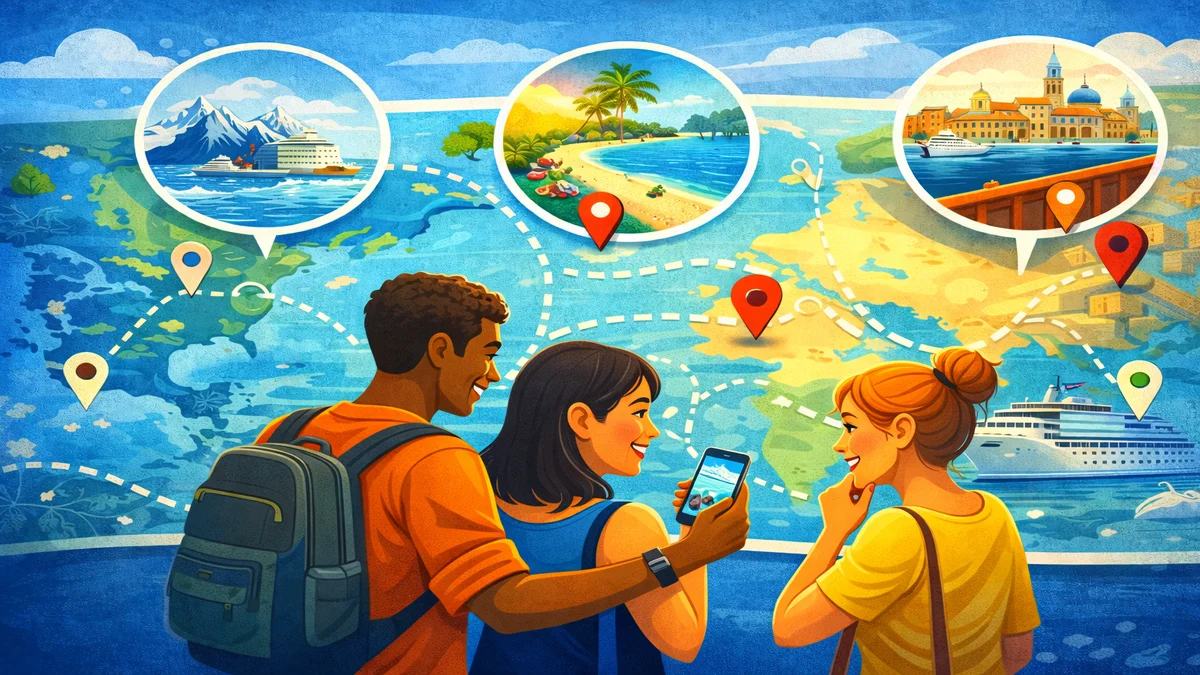
When planning a cruise, most first-time travellers spend months obsessing over which ship to book and which cabin to sleep in. They look at the waterslides, the speciality restaurants, and the Broadway shows.
Then, almost as an afterthought, they pick a destination because the brochure photos look pretty.
This is the Itinerary Illusion, and it is the fastest way to ruin a £3,000 holiday.
If you book a massive mega-resort ship packed with entertainment, but your chosen itinerary stops at a new European city every single morning at 7:00 AM, you will never actually have the time or energy to use the ship’s facilities. You will spend your week exhausted from 8-hour walking tours in the blistering summer heat, desperately needing a holiday to recover from your holiday.
Choosing your destination is not just about picking a spot on a map. The itinerary you choose dictates the pace of your trip, the type of people you will sail with, and your ultimate budget.
Here is the master blueprint for understanding global cruise routes, decoding the “fake ports” industry secret, and choosing an itinerary that matches your actual travel stamina.
1. The Stamina Test: Port-Intensive vs. Sea-Day Heavy
Before you decide between the Caribbean beaches or the Norwegian Fjords, you need to understand the fundamental rhythm of a cruise ship. Every itinerary in the world falls onto a spectrum between “Port-Intensive” and “Sea-Day Heavy.”
The Port-Intensive Itinerary (The Explorer)
A port-intensive cruise means the ship docks at a new destination almost every single day.
- The Reality: Your alarm will go off at 6:30 AM. You will rush through breakfast, queue to get off the ship, spend seven hours exploring ruins or museums, and return to the ship at 4:30 PM with aching feet. After dinner, you will likely be asleep by 10:00 PM.
- Classic Routes: The Mediterranean, the Baltic Sea, and Japan.
- The Strategy: If you are booking a highly port-intensive route, do not overspend on a massive suite or a ship with endless onboard entertainment. You simply won’t be on board enough to justify the cost. A basic balcony or interior room is often perfectly adequate.
The Sea-Day Heavy Itinerary (The Resorter)
A sea-day heavy itinerary involves multiple full days where the ship never touches land.
- The Reality: You wake up whenever you want. You spend the morning by the pool, enjoy a leisurely two-hour lunch, and stay up until 2:00 AM at the nightclub or casino. The ship itself is the primary destination.
- Classic Routes: Transatlantic crossings, the Southern Caribbean, and cruises from the UK to the Canary Islands.
- The Strategy: This is when you should invest in the ship’s hardware. If you have four sea days, paying extra for a premium cruise line, a larger cabin, or a drinks package provides a massive return on investment.
2. The UK Cruisers’ Geography: No-Fly vs. Fly-Cruise
For British cruisers, your itinerary options are immediately split into two distinct categories based on one simple question: Are you willing to get on an aeroplane?
Your answer to this question completely alters the geography of your holiday.
The No-Fly Reality (Sailing from Southampton or Regional Ports)
Sailing directly from the UK is the ultimate convenience. You avoid the 100ml liquid limits, the luggage weight restrictions, and the chaos of Gatwick or Heathrow. However, you pay for this convenience with your time.
If you want to sail from Southampton to the Mediterranean sunshine, you must cross the Bay of Biscay and sail all the way down the coast of Portugal before you reach the Strait of Gibraltar.
- The Math: A Mediterranean cruise from the UK requires a 14-night booking. At least four of those days will be spent entirely at sea in transit. If you only have seven days of annual leave to spare, a no-fly Mediterranean cruise is geographically impossible.
- The Best UK Routes: If you only have 7 nights and refuse to fly, your best options are the Norwegian Fjords or Northern Europe (like Bruges and Amsterdam).
The Fly-Cruise Advantage (Meeting the Ship There)
A fly-cruise involves taking a short 2-hour flight from the UK to a major embarkation hub like Barcelona, Rome, or Palma de Mallorca, and stepping straight onto the ship.
- The Math: Because you skip the transit time down the European coast, a 7-night fly-cruise allows you to visit up to six different countries in a single week.
- The Catch: You are at the mercy of the airlines. If your flight is delayed, the ship will not wait for you, which is exactly why you must arrive a day early or book your flights directly through the cruise line.
(Unsure how to protect yourself against flight delays? Read our guide: Why Cruise Travel Insurance is Essential.
3. The Short-Haul Staples (Europe & North Africa)
If you are flying from the UK (or braving the Bay of Biscay on a no-fly cruise), Europe and North Africa offer the most densely packed, culturally rich itineraries in the world. But you need to know exactly which sub-region matches your travel style.
The Mediterranean: Western vs. Eastern
The Mediterranean is not a single destination. It is geographically split into two very distinct cruising experiences:
- The Western Med (Spain, France, Italy): This is the ultimate first-timer route. You will visit iconic, easy-to-navigate cities like Barcelona, Marseille, and Rome. It is highly focused on food, architecture, and relaxed sightseeing.
- The Eastern Med (Greece, Turkey, the Adriatic): This route is far more intense. It focuses heavily on ancient history (Athens, Ephesus) and island-hopping (Santorini, Mykonos).
- The 2026 Warning: The Eastern Med is experiencing increasingly intense summer heatwaves. If you are sailing in July or August, be prepared for 40°C days while climbing ancient ruins without shade.
The Norwegian Fjords: The Scenic Marvel
A Fjords cruise is the exact opposite of the Mediterranean. Instead of port-intensive city hopping, the ship itself becomes the excursion.
- The Vibe: You will spend hours slowly gliding past towering waterfalls and snow-capped peaks right from your balcony. It is incredibly relaxing, highly photogenic, and usually requires zero flying from the UK.
- The Catch: The weather is completely unpredictable. You can experience glorious sunshine and freezing rain on the same afternoon, even in July.
The Canary Islands: The Winter Sun Escape
When the UK freezes over in January, the cruise lines send their ships south to the Canaries (Tenerife, Lanzarote, Gran Canaria) and Madeira.
- The Vibe: This is pure, unadulterated holiday mode. The ports are easy to navigate, the beaches are fantastic, and the climate sits at a comfortable 20°C to 24°C all winter long.
4. The Long-Haul Escapes (The Global Reach)
If you are willing to endure a long-haul flight from Heathrow or Gatwick, the entire world opens up. Here is how the major long-haul destinations break down.
The Caribbean: Choosing Your Zone
Just like the Mediterranean, the Caribbean is divided into three distinct zones, each offering a totally different holiday:
- Eastern Caribbean (The Classic): Stops like St. Thomas and St. Maarten. Best for pristine beaches, duty-free shopping, and massive mega-ships.
- Western Caribbean (The Adventure): Stops like Cozumel (Mexico) and Roatan (Honduras). Best for snorkelling, zip-lining, and exploring ancient Mayan ruins.
- Southern Caribbean (The Exotic): Stops like Aruba, Bonaire, and Curacao (The ABC Islands). Because these islands are so far south, only longer cruises (10+ days) or ships homeporting in Puerto Rico can reach them. You will find fewer crowds and boutique premium ships here.
Alaska: The Ultimate Bucket List
Alaska is widely considered the greatest cruising destination on earth, but booking the wrong itinerary will severely limit what you see.
- Round-Trip (Seattle or Vancouver): These 7-night cruises start and end in the same city. They are cheaper and easier for flights, but they only scratch the surface of the Inside Passage.
- One-Way (Vancouver to Whittier/Seward): This is the superior option. Because the ship doesn’t have to turn around, it travels much further north, allowing you to see massive, calving glaciers (like Glacier Bay National Park) that the round-trip ships simply cannot reach.
The Middle East & Asia: The 2026 Rising Stars
For UK cruisers looking for guaranteed winter sun without the 9-hour flight to the Caribbean, Dubai and the Emirates have become massive hubs. You can fly to Dubai in just 7 hours and embark on a futuristic, luxury-heavy cruise around the Persian Gulf.
Meanwhile, Japan has exploded as the ultimate bucket-list destination for 2026. Taking a cruise around Japan is often significantly cheaper and logistically easier than navigating the bullet trains and hotels on land.
5. Ocean Crossings: The Ultimate Sea-Day Experience
For a specific type of traveller, the absolute best part of a cruise is when there is no land in sight. If you view the ship as your primary destination and want to disconnect from the world completely, ocean crossings are the holy grail of cruising.
These voyages are defined by long stretches of uninterrupted sea days, offering a totally different rhythm to a standard holiday.
Transatlantic Crossings (The Classic Journey)
There are two completely different ways to sail across the Atlantic:
- The Scheduled Crossing: Cunard’s Queen Mary 2 is the only ship in the world that runs a regular, scheduled route between Southampton and New York. This is a formal, traditional 7-night voyage across the North Atlantic, famous for its guest lectures, ballroom dancing, and elegant dress codes.
- The Repositioning Cruise: Twice a year (Spring and Autumn), cruise lines move their fleets between the Caribbean and Europe to chase the summer sun. Because these voyages have 6 to 8 sea days in a row, the cruise lines price them incredibly cheaply just to get passengers on board. They offer some of the best value-for-money daily rates in the entire industry.
Transpacific Voyages (The Time Traveller)
If the Atlantic is a classic, the Pacific is an epic adventure. These voyages often sail between North America (like Vancouver or Seattle) and Asia (Japan) or Australia.
- The Vibe: These sailings are longer – often 14 to 21 nights – and attract veteran cruisers who truly love maritime travel.
- The International Date Line: The biggest thrill of a Transpacific crossing is crossing the International Date Line. Depending on which direction you are sailing, you will either experience the surreal novelty of living the same day twice, or you will go to sleep on a Tuesday and wake up on a Thursday, completely skipping a day of the week.
The Ocean Crossing Reality Check
Ocean crossings are not for everyone. If you are prone to cabin fever or need the stimulation of a new port every morning, a string of seven sea days will drive you crazy. Furthermore, the middle of the ocean is entirely at the mercy of the weather. The North Atlantic in November can be exceptionally rough, while the southern repositioning routes tend to be much smoother.
But if your goal is to read three books, attend enrichment lectures, and watch the endless horizon, an ocean crossing is unbeatable.
6. The “Fake Port” Warning (Crucial Insider Knowledge)
Once you have chosen your region—whether it is the Mediterranean, the Fjords, or the Caribbean—you will start looking at specific itineraries. This is where you must be incredibly careful.
Cruise lines are notorious for marketing what the industry calls “Fake Ports.”
When you look at a brochure, it might proudly advertise that the ship stops in Paris, Rome, and London.
Here is the geographic reality: Cruise ships are massive floating cities. They cannot sail up the River Seine to the Eiffel Tower, and they cannot navigate the Tiber River to the Colosseum.
- “Paris” is actually the industrial port of Le Havre. To see the Eiffel Tower, you must sit on a coach for 2.5 hours each way. That is 5 hours of your day spent on a motorway.
- “Rome” is the port of Civitavecchia. Reaching the Vatican requires a 90-minute train ride or a costly private transfer.
- “London” is Southampton or Dover, both of which are over 70 miles from Buckingham Palace.
- “Florence/Pisa” is Livorno, a 90-minute drive from the Uffizi Gallery.
Why this matters for your budget and stamina: If you book an itinerary packed with “Fake Ports,” you are committing to a highly exhausting, incredibly expensive holiday. You cannot simply walk off the ship and explore; you are forced to purchase expensive shore excursions or navigate complex foreign train systems just to reach the destination you paid to see.
Always check the actual name of the port on Google Maps before you book. If the port is two hours from the city centre, factor the cost of that transfer into your daily budget.
7. The “When to Sail” Cheat Sheet
You have picked the perfect region and checked the ports. The final step is getting the timing right. Booking the cheapest week of the year is pointless if you are sailing into a monsoon or a heatwave.
Here is a quick guide to the optimal (and riskiest) times to sail the major regions:
| Destination | The Prime Season (Best Weather, Highest Prices) | The “Shoulder Season” (Best Value, Good Weather) | The Risk Zone (Weather Warnings & Extreme Heat) |
| Mediterranean | May, June & September | April & October | July & August (Extreme heat, massive crowds) |
| Caribbean | December to April | November & May | September & October (Peak Hurricane Season) |
| Norwegian Fjords | June to August | May & September | October to April (Many ports close; freezing) |
| Alaska | July & August | May & September | N/A (Season strictly runs May-Sept) |
| Canary Islands | November to March | October & April | Summer (Ships relocate back to the UK/Med) |
Once the route is chosen, decide how you will use the time ashore. Our guides compare ship excursions with independent tours, show how Norwegian fjord ports can work DIY, and examine the very different resort-style option of Cozumel beach clubs.
8. Conclusion & The Ultimate Strategy
Choosing the right cruise destination requires far more thought than just picking a spot on a map.
It requires you to be honest about your travel stamina, your budget for shore excursions, and your willingness to navigate the Bay of Biscay or endure a transatlantic flight.
But once you have decided between the high-energy port-hopping of the Mediterranean, the majestic silence of the Norwegian Fjords, or the ultimate relaxation of a 14-night ocean crossing, you face the final hurdle: Securing the best price.
Because cruise pricing is dynamic, the cost of that perfect 7-night Norwegian Fjords sailing can fluctuate wildly. The cruise lines will drop the price when the ship is empty and raise it when the UK school holidays approach.
Do not manually check the prices every day. Let the data do the heavy lifting.
Tell CruisePing where you want to go. Whether you are tracking a no-fly cruise out of Southampton or a bucket-list crossing on Cunard, set your alert and let our software monitor the algorithms. The moment the cruise line drops the base fare, we will send an automated email straight to your inbox.