
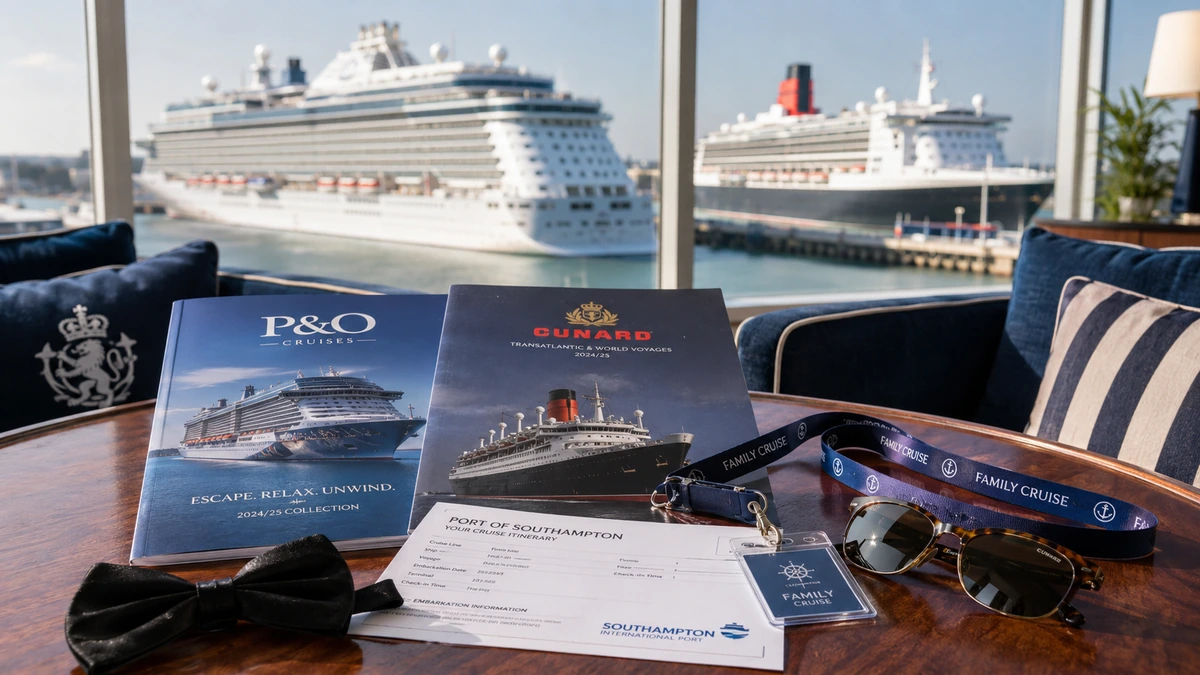
P&O vs Cunard is one of the most searched and most meaningful comparisons in the UK cruise market. Both brands are familiar to British passengers. Both sail regularly from Southampton. Both offer no-fly cruises to the Norwegian fjords, the Mediterranean, the Canary Islands, Northern Europe and beyond. Both carry a strong sense of maritime history.
But they do not offer the same kind of holiday.
P&O Cruises is the more relaxed, mainstream and value-conscious choice. It is built around British tastes, broad no-fly convenience, family-friendly ships, included gratuities, casual dining options and a holiday atmosphere that feels closer to a floating resort. You can still dress up, enjoy speciality restaurants and find elegant venues, but the overall mood is flexible and accessible.
Cunard is the more traditional, premium and ceremony-led choice. It leans into ocean liner heritage, White Star service, ballroom culture, afternoon tea, smart evenings, themed Gala Nights and the romance of proper sea travel. Cunard is not “old-fashioned” in a negative sense, but it does ask passengers to enjoy a more polished rhythm at sea.
So the P&O vs Cunard decision is not simply a question of price. It is about holiday personality. Do you want relaxed British cruising with lots of choice and fewer formal expectations? Or do you want a ship that feels like part of the occasion, where dressing for dinner and enjoying sea days are central to the experience?
This CruisePing guide compares P&O vs Cunard across ships, atmosphere, dining, dress codes, family appeal, gratuities, onboard value and booking strategy, helping you decide which British maritime icon is the better fit for your next cruise.
At-a-Glance P&O vs Cunard Showdown Matrix
| Comparison Point | P&O Cruises | Cunard |
|---|---|---|
| Best For | British no-fly cruising, families, couples, value-focused passengers and relaxed holidays | Traditional ocean travel, formal evenings, transatlantic crossings, premium service and elegant sea days |
| Core Style | Contemporary British mainstream cruising | Classic premium ocean liner heritage |
| Main UK Port | Southampton | Southampton |
| Fleet Identity | Larger resort ships plus smaller classic ships | Four Queens with a strong heritage identity |
| Current Fleet | Arvia, Iona, Britannia, Ventura, Azura, Arcadia, Aurora | Queen Anne, Queen Mary 2, Queen Victoria, Queen Elizabeth |
| Dress Code Feel | Evening Casual and Black Tie, generally more relaxed | Smart Attire and Gala Evenings, with stronger evening formality |
| Dining Style | Flexible dining, casual venues, main dining rooms and speciality restaurants | Stateroom-linked dining across Britannia, Britannia Club, Princess Grill and Queens Grill |
| Family Appeal | Stronger family infrastructure, especially on larger ships | Family-friendly, but more adult, refined and tradition-led in feel |
| Gratuities | Included in the fare | Daily hotel/service charge added to onboard account |
| Best Iconic Feature | British resort-style cruising from Southampton | Queen Mary 2 transatlantic crossings and White Star heritage |
| Biggest Trap | Assuming every P&O ship feels the same | Assuming Cunard is just a “posher P&O” |
| CruisePing Verdict | Better for value, choice and relaxed British cruising | Better for occasion, tradition and elegant sea days |
P&O vs Cunard: The Core Difference
The easiest way to understand P&O vs Cunard is to imagine the same sea day on each line.
On P&O, the day feels broad, flexible and familiar. You might start with breakfast in the buffet, take part in a quiz, spend time around the pool or SkyDome, book a casual lunch, use the children’s clubs, attend a theatre show, and dress up for Black Tie if the evening schedule calls for it. If you prefer a more relaxed evening, you can usually find somewhere that fits.
On Cunard, the same sea day feels more structured and ceremonial. You might walk the promenade deck, attend a guest lecture, browse the library, take afternoon tea, dress smartly for dinner, listen to live music, watch a show, or spend the evening in the Queens Room. The pace is calmer, but the sense of occasion is stronger.
That is the real P&O vs Cunard split. P&O gives you a British cruise holiday with a wide range of options. Cunard gives you a more distinctive style of ocean travel. One is easier and more casual. The other is more elegant and ritualised.
Neither is automatically better. The right answer depends on whether you want flexibility or formality, resort energy or maritime theatre, broad value or polished tradition.
Fleet Comparison: P&O Variety vs Cunard Identity
P&O Cruises currently has seven ships: Arvia, Iona, Britannia, Ventura, Azura, Arcadia and Aurora. The official fleet page describes the line as offering ships for different occasions and styles, including family-friendly ships and holidays exclusively for adults.
That variety is one of P&O’s strengths. Arvia and Iona are the large modern flagships, with bigger resort-style facilities, multiple dining venues, large entertainment spaces and strong family appeal. Britannia, Ventura and Azura sit in a more familiar large-ship mainstream space. Arcadia and Aurora offer a smaller, more traditional feel, generally suiting passengers who prefer a calmer atmosphere.
This means “P&O” is not a single experience. A school-holiday cruise on Arvia can feel very different from a longer itinerary on Aurora. When comparing P&O vs Cunard, you must compare the actual ship, not just the brand name.
Cunard has a tighter and more consistent fleet identity. Its four Queens are Queen Anne, Queen Mary 2, Queen Victoria and Queen Elizabeth. Queen Anne is the newest ship and blends Cunard tradition with more contemporary design. Queen Mary 2 is the flagship ocean liner, strongly associated with transatlantic crossings. Queen Victoria and Queen Elizabeth offer the classic Cunard mix of elegant public rooms, theatre, ballroom, promenade decks, afternoon tea and refined service.
The fleet distinction is simple. P&O gives you more variety. Cunard gives you a clearer brand world.
Southampton Departures: Same Port, Different Mood
Both lines are strongly associated with Southampton, which makes the P&O vs Cunard choice especially relevant for UK travellers who want to avoid flying. From a practical perspective, the embarkation process may feel similar: drive or take the train to Southampton, drop luggage, check in, board and unpack once.
But once the ship sails, the mood changes.
On P&O, Southampton is the launch point for a broad British holiday. You will find couples, families, solo travellers, multigenerational groups, first-time cruisers and regulars who like the familiarity of the brand. The feel can be lively, especially on short breaks, school-holiday sailings and larger ships.
On Cunard, Southampton often feels more like the beginning of a voyage. That is especially true on Queen Mary 2 transatlantic crossings, where the sea journey is the main event rather than just transport between ports. The line leans more strongly into sailaway, sea days, smart evenings and the romance of ocean travel.
If your main aim is convenient access to destinations, P&O may feel more practical. If your main aim is to enjoy the ship as a destination in itself, Cunard becomes more compelling.
Dining: Flexible British Choice vs Stateroom-Linked Tradition
Dining is one of the clearest P&O vs Cunard dividing lines.
P&O offers a mix of main dining rooms, buffets, casual venues and speciality restaurants. Its dining pages emphasise broad choice, included dining and optional extras. Depending on the ship, passengers may find flexible dining, casual food courts, poolside grills, pizzerias, speciality restaurants and more traditional main dining options.
This suits passengers who do not want every evening to follow the same pattern. Families with children, couples who like spontaneity and passengers who prefer casual meals will usually find P&O easier to manage.
Cunard works differently because dining is linked more closely to accommodation grade. Its dining guide explains that Britannia Club, Princess Grill and Queens Grill restaurants offer open dining, while the broader dining structure connects to the stateroom category booked. Queen Mary 2 dining information also refers to guests enjoying a regular reservation at their stateroom’s restaurant.
This creates a more layered dining experience. Britannia, Britannia Club, Princess Grill and Queens Grill are not just labels. They shape where you eat, how flexible your dining is, and how premium the service feels. Moving up the Cunard accommodation ladder changes the holiday more noticeably than a simple cabin upgrade on many mainstream lines.
The value question therefore changes. With P&O, ask how many included venues meet your needs and how much you are likely to spend on speciality dining. With Cunard, ask whether paying more for Britannia Club or Grill accommodation is worth it because dining is part of the upgrade.
Dress Codes: P&O Black Tie vs Cunard Gala Evenings
Dress codes are central to the P&O vs Cunard decision because they affect how the ship feels after 6pm.
P&O’s what to wear guide uses Evening Casual and Black Tie as its key evening categories. Evening Casual is smart but relaxed. Black Tie invites passengers to dress up more formally, but the overall P&O atmosphere is still more flexible than Cunard’s. On the larger ships, there are usually enough venues and passenger styles for the evening to feel varied rather than uniform.
For many people, this is the sweet spot. P&O gives you the chance to dress up without making formalwear the whole point of the holiday. A couple who enjoys the occasional dinner jacket or cocktail dress can join in, while passengers who prefer a more relaxed cruise wardrobe may still feel comfortable in the right venues.
Cunard’s packing guide uses Smart Attire on most evenings and Gala Evenings for more formal nights. Cunard also publishes Gala themes in advance through My Cunard, with examples such as Black and White, Red and Gold, Roaring 20s and Masquerade Ball.
The difference is cultural rather than merely technical. On Cunard, dressing well is part of the shared shipboard atmosphere. It supports the restaurants, lounges, live music and ballroom tradition. If you enjoy putting on a jacket, walking into a grand dining room and feeling that the evening has properly begun, Cunard has the advantage.
If you dislike formalwear, hate packing dress shoes, or want a low-effort evening wardrobe, P&O is usually the safer choice.
Families and Multigenerational Travel
P&O is usually the stronger family choice. Its family pages and children’s club information describe age-specific clubs, family entertainment and facilities for younger passengers. The line has a long-established British family-cruise proposition, especially on ships such as Arvia, Iona, Britannia, Ventura and Azura.
This makes P&O a better fit for many multigenerational groups. Grandparents, parents, teenagers and younger children can all find something to do without the ship feeling too formal or quiet. Casual dining also makes family life easier. A child who is tired after a long port day does not always want a slow formal dinner.
Cunard does offer family facilities, and children can travel well on Cunard if they suit the atmosphere. But the overall feel is more adult, more elegant and more restrained. Children who enjoy calm ships, dressing smartly, enrichment, libraries and sea days may do beautifully. Children who want water slides, high-energy deck attractions and constant noise may be happier on P&O or another family-focused line.
The P&O vs Cunard family rule is direct: P&O is the easier default for most families; Cunard is better for families who actively want a quieter, more traditional ship.
Entertainment, Activities and Sea Days
P&O entertainment feels broader and more mainstream. Depending on ship, expect theatre productions, live music, comedians, quizzes, cinema, deck activity, guest entertainers and family programming. On the larger ships, the entertainment schedule can feel busy and varied, with more of a resort rhythm.
Cunard entertainment is more enrichment-led and traditional. It offers theatre, music, lectures, ballroom dancing, afternoon tea, library time, guest speakers and slower sea-day rituals. Queen Mary 2 is especially strong for passengers who love the idea of days at sea and do not need a port every morning.
This is another major P&O vs Cunard distinction. P&O is better if you want more casual activity and entertainment variety. Cunard is better if you want the ship to feel calmer, more cultured and more ocean-liner-like.
The difference becomes especially important on longer itineraries. If several consecutive sea days sound dull unless there is constant activity, choose P&O. If consecutive sea days sound like the point of the holiday, Cunard may suit you perfectly.
Gratuities, Currency and Onboard Spend
P&O has a major advantage for budget clarity: tips and gratuities are included in the holiday price. Its tipping policy states that passengers will not be charged extra for gratuities on board. P&O also operates onboard spending in pounds sterling, which helps British passengers avoid exchange-rate uncertainty.
That does not mean P&O is all-inclusive. Drinks, speciality dining, Wi-Fi, spa treatments, shopping and excursions can still add up. But the absence of a daily gratuity charge makes the baseline cost easier to understand.
Cunard uses a different system. Its service charge page says a hotel and dining service charge is added for each night of the voyage, currently US$18 per person per day for Britannia and Britannia Club staterooms, and US$19 per person per day for Princess Grill and Queens Grill suites.
For a seven-night cruise, that is a noticeable extra. For a 14-night cruise, it becomes a serious comparison point. When judging P&O vs Cunard, do not compare headline fares alone. Add Cunard’s service charge, drinks, Wi-Fi, travel to Southampton, insurance, parking, excursions and any cabin upgrade that changes the dining experience.
The CruisePing pricing rule is simple: compare the total holiday cost, not the brochure fare.
Cabin Grades and the “Class” Difference
P&O cabins follow a more mainstream structure: inside, sea view, balcony, suites and ship-specific cabin types. Cabin choice affects space, light, location and comfort, but it usually does not transform the entire onboard experience.
Cunard’s accommodation structure matters more because it links to dining and service style. Britannia, Britannia Club, Princess Grill and Queens Grill create a more visible tiering of experience. A passenger in Britannia and a passenger in Queens Grill are not simply sleeping in different rooms. They are dining in different restaurants and experiencing the ship through different service layers.
This can be a strength or a drawback depending on your perspective. Some passengers love the sense of progression and occasion. Others prefer the more democratic feel of P&O, where the experience feels less shaped by accommodation class.
In a P&O vs Cunard booking decision, cabin grade matters more on Cunard. Do not stretch to Cunard purely for the brand if the grade you book does not deliver the experience you imagined. Conversely, if you can afford Britannia Club or Grill accommodation and will use the dining benefits, Cunard can feel far more special.
Who Should Choose P&O?
Choose P&O if you want a relaxed British cruise with strong value, no-fly convenience, included gratuities and broad appeal. It is particularly strong for families, multigenerational groups, first-time cruisers and passengers who want plenty of choice without too much ceremony.
P&O is also the safer choice if you want to control spending. Because gratuities are included and the onboard style is less formal, it is easier to build a cruise that feels complete without constantly adding premium experiences.
The best P&O passenger is someone who wants the cruise to be easy. They may enjoy dressing up once or twice, but they do not want formal evenings to define the whole holiday. They like British touches, flexible dining, familiar entertainment and the ability to choose a ship that matches their pace.
In short, choose P&O if the phrase P&O vs Cunard makes you think: “I want the British cruise experience, but I want it relaxed.”
Who Should Choose Cunard?
Choose Cunard if you want the ship to feel like an event. Cunard is strongest for passengers who enjoy traditional service, smart evenings, ballroom culture, live music, lectures, afternoon tea, grand lounges and the romance of ocean travel.
It is especially attractive for transatlantic crossings on Queen Mary 2, milestone birthdays, anniversaries, longer sea-day voyages and passengers who feel modern cruising has become too casual.
The best Cunard passenger is someone who values atmosphere as much as itinerary. They are not simply buying transport to ports. They are buying the experience of travelling in a particular style.
In short, choose Cunard if the phrase P&O vs Cunard makes you think: “I want the ship itself to feel special.”
The Value Hack: Compare the Right Ships, Not Just the Brands
The biggest mistake in a P&O vs Cunard comparison is comparing the brands too broadly.
A family cruise on Arvia is not the same as a longer sailing on Aurora. A Queen Mary 2 transatlantic crossing is not the same as a warm-weather cruise on Queen Anne. A Cunard Britannia inside cabin is not comparable with a P&O balcony if what you really want is space and light. A Cunard Grill suite is not comparable with a standard P&O cabin if what you are buying is service and dining.
Before booking, compare specific sailings:
- Same departure port.
- Similar length.
- Similar season.
- Similar cabin grade.
- Full cost including gratuities or service charges.
- Likely onboard atmosphere for that ship.
- Dress-code comfort.
- Family or adult focus.
- Sea-day balance.
That is the only fair way to decide P&O vs Cunard. Otherwise, you risk choosing the cheaper fare and discovering the holiday mood was wrong.
Actionable Booking Checklist
- Use P&O vs Cunard as the starting comparison, but compare specific ships before booking.
- Choose P&O for relaxed British cruising, family appeal and simpler value.
- Choose Cunard for tradition, elegant evenings and a stronger sense of occasion.
- Add Cunard’s daily service charge to the real fare calculation.
- Remember P&O gratuities are included.
- Check whether you are comparing similar cabin grades.
- Look carefully at Cunard dining categories before booking.
- Check the number of formal or Gala evenings before packing.
- Choose P&O’s larger ships if children and family facilities matter.
- Choose Cunard if sea days, lectures, afternoon tea and smart evenings appeal.
- Compare drinks, Wi-Fi, speciality dining and excursions before deciding value.
- For first-time cruisers, choose the line whose evening culture feels more comfortable.
- For a milestone trip, decide whether Cunard’s sense of ceremony is worth the premium.
FAQ: P&O vs Cunard
What is the main difference between P&O and Cunard?
The main difference is atmosphere. P&O is more relaxed, mainstream, British and family-friendly. Cunard is more traditional, elegant, premium and ceremony-led. The P&O vs Cunard choice is mainly about holiday style.
Is Cunard posher than P&O?
Yes, in general. Cunard has a more formal and premium atmosphere, especially in the evenings. P&O can still feel stylish, but it is usually more relaxed and accessible.
Which is better value, P&O or Cunard?
P&O is usually better for straightforward fare value because gratuities are included and the onboard style is less premium. Cunard may be better value if you specifically want formal evenings, traditional service, elegant sea days and the Queen Mary 2 experience.
Are gratuities included on P&O?
Yes. P&O states that tips and gratuities are included in the holiday price, so passengers are not charged extra for this on board.
Are gratuities included on Cunard?
No. Cunard adds a daily hotel and dining service charge to the onboard account. The current official rate is US$18 per person per day for Britannia and Britannia Club, and US$19 for Princess Grill and Queens Grill suites.
Which is better for families, P&O or Cunard?
P&O is usually better for families, especially on larger ships such as Arvia and Iona. Cunard can work for families who enjoy a quieter, smarter atmosphere, but P&O has the broader family-cruise setup.
Which has stricter dress codes, P&O or Cunard?
Cunard has the stronger formal culture. P&O has Evening Casual and Black Tie nights, but Cunard’s Smart Attire and Gala Evenings are more central to the ship’s identity.
Is P&O better for first-time cruisers?
For many UK first-time cruisers, yes. P&O feels familiar, relaxed and easier to understand. Cunard is also suitable for first-timers if they like tradition, formality and elegant sea days.
Is Cunard worth the extra money?
Cunard is worth the extra money if you value atmosphere, service, formal evenings, live music, lectures, afternoon tea and ocean liner heritage. If you mainly want ports, casual dining and broad value, P&O may be a better fit.
Which is better from Southampton, P&O or Cunard?
Both are strong from Southampton. P&O is better for relaxed no-fly cruising and family-friendly choice. Cunard is better for traditional ocean travel, formal evenings and transatlantic crossings.
Should I choose P&O or Cunard for a special anniversary?
Choose Cunard if you want the trip to feel elegant and ceremonial. Choose P&O if you want a more relaxed celebration, especially with family or friends.
What is the best way to decide P&O vs Cunard?
The best way to decide P&O vs Cunard is to compare the exact ship, cabin grade, itinerary, dress code, service charges, dining style and total onboard cost. Do not decide on brand name alone.
For nearby alternatives, compare Marella with P&O, examine Fred Olsen versus Saga for a more mature market, and use the cruise dress-code guide to judge how much formality suits you.
CruisePing Value Verdict
The P&O vs Cunard decision is not about which line is “better” in the abstract. It is about which one matches your idea of a good holiday.
P&O is the better choice for most passengers who want relaxed British cruising, family appeal, included gratuities, broad dining choice and simpler value from Southampton. It is flexible, familiar and generally easier for first-time cruisers or multigenerational groups.
Cunard is the better choice for passengers who want elegance, tradition, smart evenings, afternoon tea, lectures, White Star service and the unique appeal of Queen Mary 2. It may cost more once service charges and premium cabin grades are included, but it offers a more distinctive experience at sea.
So the real answer to P&O vs Cunard is personal. If you want freedom, familiarity and value, choose P&O. If you want occasion, heritage and ceremony, choose Cunard.
Ready to browse our article library?
Looking for more practical cruising shortcuts? Head back to our main hub directory to explore comprehensive stateroom comparisons, tipping breakdowns, port guides and value guides.