
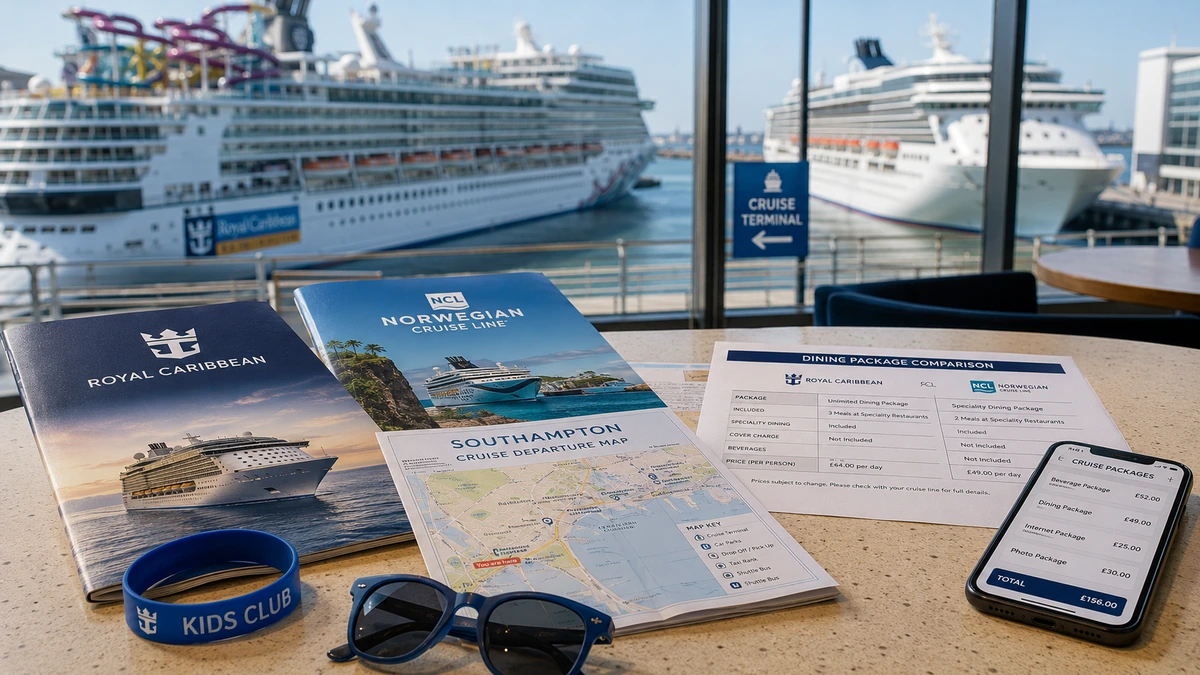
Royal Caribbean vs Norwegian Cruise Line is one of the most useful comparisons for UK families who want a big, activity-rich cruise without moving into luxury-line pricing. Both brands are mainstream, international, informal and family-friendly. Both offer large ships, casual dining, children’s clubs, entertainment, speciality restaurants, drinks packages, balcony cabins, and plenty of ways to spend money once on board.
But the way they build a family holiday is different.
Royal Caribbean is the high-energy ship-design specialist. Its strongest ships are built around visible activity: waterslides, surf simulators, climbing walls, splash zones, sports courts, theatres, big pool decks and a constant sense that the ship itself is part of the attraction. For families with children or teenagers who need stimulation, Royal Caribbean is often the safer bet.
Norwegian Cruise Line, commonly abbreviated as NCL, is the flexibility specialist. Its Freestyle Dining model removes fixed dining times and pre-assigned seating, while its Free at Sea and More at Sea-style offers bundle drinks, speciality dining, Wi-Fi, and shore-excursion credits, making it a more package-led booking decision. NCL is not always cheaper, but it can feel easier for families who hate rigid dinner times.
So the Royal Caribbean vs Norwegian Cruise Line question is not just “which has the better ships?” It is really: do you want the ship to entertain the family through big deck hardware and structured activity, or do you want a more casual, flexible cruise where dining and package value do more of the work?
This CruisePing guide compares Royal Caribbean vs Norwegian Cruise Line across family facilities, deck design, childcare, dining, package math, gratuities, UK departure convenience, and overall cruise value.
At-a-Glance Line Showdown Matrix
| Comparison Point | Royal Caribbean | Norwegian Cruise Line |
|---|---|---|
| Best For | Families who want big activities, teen energy, waterslides and high-impact ships | Families who want casual flexibility, Freestyle Dining and perk-led cruise value |
| Core Style | High-energy family resort at sea | Flexible, casual resort at sea |
| Dining Identity | Main Dining Room, Windjammer, My Time Dining and speciality dining | Freestyle Dining with no fixed dining times or pre-assigned seating |
| Family Strength | Adventure Ocean, teen spaces, splash zones and ship attractions | Splash Academy, Entourage and flexible family rhythm |
| Deck Appeal | Stronger visible activity architecture on the right ships | More relaxed deck feel, stronger on dining and package flexibility |
| UK Advantage | Strong Southampton presence, including Liberty of the Seas in 2026 | Southampton and wider Europe options, but less dominant as a UK family departure brand |
| Gratuity Structure | Daily gratuities added unless prepaid | Daily service charges added, generally higher than Royal for standard cabins |
| Package Trap | Drinks, Wi-Fi, gratuities and speciality dining can lift the real fare | Free at Sea/More at Sea perks need careful maths, especially for children |
| Best Family Fit | Children and teens who want lots to do | Families who dislike fixed schedules and want casual dining freedom |
| CruisePing Verdict | Better for active family hardware | Better for flexible family budgeting, if the perks genuinely suit you |
Hook Intro: Two Different Versions of a Family Cruise
The Royal Caribbean vs Norwegian Cruise Line decision often starts with the children, but it should not end there. Parents need to enjoy the holiday too. A cruise that keeps the children busy but leaves the adults constantly queuing, paying extra and organising everyone can still feel hard work. Equally, a flexible cruise with good dining can fall flat if teenagers spend the week saying there is not enough to do.
Royal Caribbean solves the family problem through scale and spectacle. On the right ship, children see the fun immediately: slides, pools, sports, shows and deck zones. It is the cruise line equivalent of walking into a big resort and knowing the family will find something.
NCL solves the family problem through looseness. Its Freestyle model means you are not locked into a fixed dinner table time every night. You can eat earlier after a long port day, later after a pool afternoon, casually if the children are tired, or more seriously if the adults want a proper restaurant evening.
CruisePing’s view is that Royal Caribbean is usually the stronger choice for families with school-age children and teenagers who want maximum ship activity. NCL is often better for families who value a less regimented daily rhythm and are willing to do the package maths properly.
Deck Innovations: Where Royal Caribbean Pulls Ahead
Royal Caribbean’s family reputation is built on ship hardware. This is the line that has spent years making the top deck and public spaces feel like part of the destination.
On many ships, that means a mix of waterslides, FlowRider surf simulators, climbing walls, sports courts, splash areas, big pool decks, arcades and theatres. The exact features depend heavily on the ship, which matters. A newer or recently amplified Royal Caribbean ship will usually feel much stronger for families than an older ship with fewer headline attractions.
For UK passengers, Liberty of the Seas from Southampton in 2026 is a good example of why Royal matters in this comparison. Royal’s own ship pages promote features such as The Perfect Storm waterslides, Tidal Wave and Splashaway Bay. That is precisely the kind of visible family hardware that gives parents confidence before booking.
NCL also has activity-rich ships. Norwegian Prima, Norwegian Viva and Norwegian Aqua bring modern deck design, kids’ aqua parks, race-track-style attractions on selected ships, slides, lounges and resort spaces. But the line’s core identity is not quite as dominated by “wow deck” architecture as Royal Caribbean’s. NCL feels more balanced between dining, bars, entertainment, accommodation and flexibility.
This is the first big CruisePing judgement: if your children judge a ship by what they can see and do on deck, Royal Caribbean usually has the advantage.
That does not make Royal automatically better. Some families do not need a ship full of adrenaline features. Younger children may be happy with pools, clubs and casual food. Older teenagers may care more about Wi-Fi, freedom and friends. Parents may prefer NCL’s more flexible dining rhythm. But for the typical family “keep them busy” problem, Royal is hard to beat.
Childcare and Teen Programmes
Both lines take family cruising seriously, but they have slightly different personalities.
Royal Caribbean’s youth programme is Adventure Ocean. Its official family pages describe activities for kids and teens running throughout the ship and into the evening. The emphasis is on age-appropriate programming, family activities and plenty of energy. On the right ship, the youth programme is reinforced by visible attractions around the vessel, so children do not rely solely on the club space.
NCL’s youth structure uses Splash Academy for children aged 3–12 and Entourage for teenagers aged 13–17. NCL describes these as complementary supervised youth programmes, although registration is required and spaces may be allocated on a first-come, first-served basis. Late-night group sitting for younger children can attract an hourly fee.
The practical difference is subtle but important. Royal Caribbean often feels as if the entire ship has been designed around the family activity ecosystem. NCL feels more like a casual resort that includes youth programming as part of a flexible holiday.
For families with younger children, both can work well. For teenagers, the ship choice becomes crucial. A teen who wants slides, sports, activity zones and a bigger ship buzz may prefer Royal. A teen who is more independent, social and happy with casual dining and flexible evenings may do well on NCL.
CruisePing’s advice is to check the specific ship’s youth and teen facilities before booking. Do not assume every Royal Caribbean ship is an Icon-class-style playground, and do not assume every NCL ship has the same modern activity profile as its newest vessels.
Dining Flexibility: NCL’s Strongest Argument
Dining is where NCL makes its strongest case.
Norwegian Cruise Line’s Freestyle Dining is simple in principle: dine when and where you want, with no fixed dining times or pre-assigned seating. Complimentary restaurants incur no charge, while speciality restaurants apply cover charges or à la carte pricing, depending on the venue and package.
For families, this can be a genuine advantage. Fixed dining sounds elegant until a child is exhausted, a port day runs long, or everyone wants different things. NCL’s model makes it easier to adapt. You can eat early one night, later the next, casually when needed, and use speciality dining when it makes sense.
Royal Caribbean has more structure, but it is not rigid in the old-fashioned sense. The Main Dining Room and Windjammer are included, and Royal offers both traditional set dining and My Time Dining. The Windjammer buffet gives families an easy fallback, and casual venues vary by ship. But the line still feels more recognisably “cruise structured” than NCL.
The Royal approach can work beautifully for families who like routine. Same table, same dining team, same time each night can be a comfort, especially with younger children. My Time Dining adds flexibility, but it usually works best when reservations are made rather than treated as a completely spontaneous system.
The NCL approach works better for families who dislike routine. It is not necessarily more luxurious, but it is less rule-bound. For parents who spend enough of their lives managing timetables already, that freedom has real value.
CruisePing’s dining verdict: Royal is better if your family likes structure and easy buffet fallback; NCL is better if your family hates fixed dining and wants evenings to flex around the day.
Package Mathematics: Free at Sea, More at Sea and Royal Add-Ons
This is the section that can save families money.
Royal Caribbean often starts with a simple fare, then adds choices. You may add gratuities, drinks packages, Wi-Fi, speciality dining, arcade spend, shore excursions, photos and other extras. The cruise can still be a good value, but the final price may look very different from the headline fare.
NCL often sells value through bundled promotions such as Free at Sea or More at Sea-style upgrades. These can include drinks, speciality dining, Wi-Fi, shore excursion credit, and third- or fourth-guest offers, depending on the promotion, market, and sailing. The offer can look generous, but families need to read the terms properly.
The key issue is that “included” does not always mean “free for everyone in the way you imagined”. Some upgrades apply differently by guest number, age, cabin type or sailing length. Children may not need an adult drinks package, but third- and fourth-guest pricing can matter a great deal. Speciality dining meals vary by cruise length. Wi-Fi allowances may not equal unlimited streaming. Shore-excursion credits may apply per cabin or per excursion rather than functioning like cash in your pocket.
NCL’s official UK terms show exactly why the maths matters: Free at Sea upgrade pricing is listed by sailing length and number of guests, and the upgrade may be required for all guests of the applicable age in the same stateroom. More at Sea pages also promote upgrade pricing by cruise length, including beverage, speciality dining, Wi-Fi, and excursion components.
Royal Caribbean’s maths is different. Its daily service gratuities are currently US$18.50 per guest per day for non-suite staterooms and US$21 per guest per day for suites if not prepaid. It also adds gratuities to drinks, speciality dining, room service, minibar, spa and salon purchases. That means the family budget depends heavily on how many packages you buy.
The CruisePing rule is blunt: never compare Royal Caribbean vs Norwegian Cruise Line by headline fare alone. Compare the family’s actual behaviour.
- If nobody drinks alcohol, NCL’s beverage perk may be less valuable.
- If the adults want cocktails every night, NCL may look stronger.
- If the children need constant paid extras, Royal can climb quickly.
- If your family is happy with included food and simple drinks, Royal may stay competitive.
- If you love speciality dining, NCL’s bundled meals can be a valuable option.
- If you need full Wi-Fi for everyone, check both lines carefully.
A family cruise is not cheap because the fare is cheap. It is cheap when the fare structure matches how your family really travels.
UK Family Practicality
For UK families, departure port matters almost as much as ship style.
Royal Caribbean has a strong Southampton identity and a clear UK family-cruise proposition. Southampton is familiar, well served by rail and motorway links, and already functions as Britain’s main cruise departure hub. For families travelling with children, luggage, pushchairs or grandparents, that matters.
NCL also offers cruises from Southampton and wider European options, but it does not currently own the UK family imagination in quite the same way as Royal Caribbean. Many British families think of Royal first when they want big ships and children’s activities from the UK.
That does not mean Royal is always the better choice. NCL’s Southampton itineraries can be very attractive, especially for families who want Northern Europe, Iceland, the British Isles or repositioning options. But if your starting point is “we want a straightforward UK family cruise with lots for the kids”, Royal Caribbean is usually the more obvious choice to compare first.
The best practical move is to price both from the same departure port where possible. If one line needs flights and the other sails from Southampton, the comparison changes immediately. Flights, baggage, transfers, hotel nights and airport stress can wipe out any apparent fare savings.
For UK families, the convenience of no-fly has value. Put a number on it before you book.
Who Should Choose Royal Caribbean?
Choose Royal Caribbean if your family wants visible activity, big-ship energy and a ship that feels like a resort from the moment you board.
It is strongest for school-age children, teenagers, active families, multigenerational groups and first-time cruisers who want plenty to do. If your children are excited by slides, pools, sports, shows, clubs, and casual food, Royal Caribbean is likely to be a good fit.
Royal is also a strong choice if you prefer a familiar cruise structure. Main Dining Room, Windjammer, set dining or My Time Dining, theatre shows and organised activities can make the holiday easier for families who like a clear rhythm.
The risk is cost creep. Drinks, Wi-Fi, speciality dining, arcade spend, photos and gratuities can all push up the final bill. Royal works best when you know which extras matter and which ones you can ignore.
Choose Royal Caribbean if the ship’s activity list is central to the holiday.
Who Should Choose Norwegian Cruise Line?
Choose Norwegian Cruise Line if your family wants flexibility, casual dining and a less regimented onboard rhythm.
NCL is strongest for families who dislike fixed dinner times, prefer casual evenings, want a package-led fare structure and like the idea of deciding each day as it comes. It can be particularly good for families with older children or teens who want more independence.
The Free at Sea or More at Sea-style offer can be a real advantage if the perks match your behaviour. Adults who use the drinks package, families who value speciality dining, and passengers who want some Wi-Fi or shore excursion credit may find NCL’s pricing attractive.
The risk is assuming the package solves everything. Service charges still matter. Package terms matter. Children’s usage matters. Wi-Fi limits matter. NCL is flexible, but it is not automatically cheaper.
Choose NCL if dining freedom and package value matter more than maximum deck hardware.
Actionable Budget Checklist
- Price the same week, cabin type and departure port where possible.
- Add Royal Caribbean gratuities if not prepaid.
- Add NCL service charges for every eligible guest.
- Check whether children are charged differently under the NCL offer terms.
- Decide whether adults will genuinely use the drinks element of NCL’s package.
- Price Royal Caribbean drinks and Wi-Fi before comparing with NCL.
- Check how many speciality dining meals are included with NCL for your cruise length.
- Price Royal speciality dining only if you will actually use it.
- Do not give full value to shore-excursion credit unless you already plan to book excursions.
- Compare Southampton convenience against any flight-based option.
- Check the specific ship, not just the cruise line.
- For teenagers, compare actual activity facilities ship by ship.
- For younger children, check kids’ club registration, opening patterns and late-night fees.
- Set a realistic onboard extras budget before booking.
FAQ: Royal Caribbean vs Norwegian Cruise Line
What is the main difference between Royal Caribbean and Norwegian Cruise Line?
The main difference is emphasis. Royal Caribbean is stronger on big-ship family attractions and high-energy deck design. Norwegian Cruise Line is stronger on flexible dining, casual scheduling and package-led value.
Which is better for families, Royal Caribbean or Norwegian Cruise Line?
Royal Caribbean is usually better for families who want maximum activities, slides, shows and teen-friendly ship features. NCL is better for families who value flexibility, casual dining and a less structured daily rhythm.
Which is better for teenagers?
Royal Caribbean often has the edge for teenagers on the right ship because the visible activity hardware is stronger. But NCL can work well for independent teens who like casual dining, social spaces and flexible evenings.
Is NCL Freestyle Dining good for families?
Yes. Freestyle Dining can be excellent for families because there are no fixed dining times or pre-assigned seats. That makes it easier to adjust meals around port days, tired children and changing plans.
Does Royal Caribbean have flexible dining?
Yes. Royal Caribbean offers traditional dining and My Time Dining, plus casual options such as Windjammer. It is more flexible than old-style cruising, but it still feels more structured than NCL.
Which line has better included food?
That depends on the ship and taste. Royal has strong included basics such as the Main Dining Room and Windjammer. NCL’s strength is flexible restaurant choice and the way speciality dining can be bundled into promotions.
Which line has more extra charges?
Both can generate significant extras. Royal Caribbean extras often come through drinks, Wi-Fi, speciality dining, gratuities and onboard purchases. NCL extras involve service charges, package upgrade terms, speciality dining outside allowances and other onboard spend.
Is Free at Sea really free?
Not exactly. Free at Sea and More at Sea-style offers can add strong value, but they are governed by terms, upgrade charges, sailing length, guest number and package rules. Treat them as bundled value, not magic free money.
Which is better from Southampton?
Royal Caribbean is usually the stronger and more obvious Southampton family choice. NCL also offers Southampton options, but Royal has the clearer UK family mega-ship identity.
Which is better for parents?
Royal is better if parents want the ship to keep the children busy. NCL is better if parents want flexible dining and less pressure on the timetable. The better choice depends on what makes the adults relax too.
Which is cheaper, Royal Caribbean or NCL?
Neither is always cheaper. Royal may have lower headline fares, while NCL may include more package value. Compare the total family cost after gratuities, service charges, drinks, Wi-Fi, dining and travel to the port.
What is the CruisePing verdict on Royal Caribbean vs Norwegian Cruise Line?
Royal Caribbean wins for active family ship design. Norwegian Cruise Line wins for flexible family rhythm and perk-led value, if the package maths works for your household.
CruisePing Value Verdict
Royal Caribbean vs Norwegian Cruise Line is a proper family-cruise battle because both lines make sense. The right answer depends on what your family actually needs.
Royal Caribbean is the stronger choice for families who want the ship to do the heavy lifting. If your children or teenagers need slides, sports, splash zones, shows, clubs and constant visual excitement, Royal has the clear advantage. It is especially strong from Southampton when the right ship is deployed, because the no-fly convenience and activity-led design work well together.
Norwegian Cruise Line is the stronger choice for families who want freedom. Freestyle Dining is genuinely useful, especially when children are tired or port days run long. The Free at Sea and More at Sea-style packages can also offer good value, but only if the perks fit your real behaviour. Do not give full value to drinks, Wi-Fi or excursion credits unless your family will actually use them.
The blunt CruisePing view is this: choose Royal Caribbean if the ship is the playground. Choose Norwegian Cruise Line if flexibility is what you’re looking for. Then do the package maths before falling for either headline fare.
Ready to browse our article library?
Looking for more practical cruising shortcuts? Head back to our main hub directory to explore comprehensive stateroom comparisons, tipping breakdowns, port guides and value guides.