
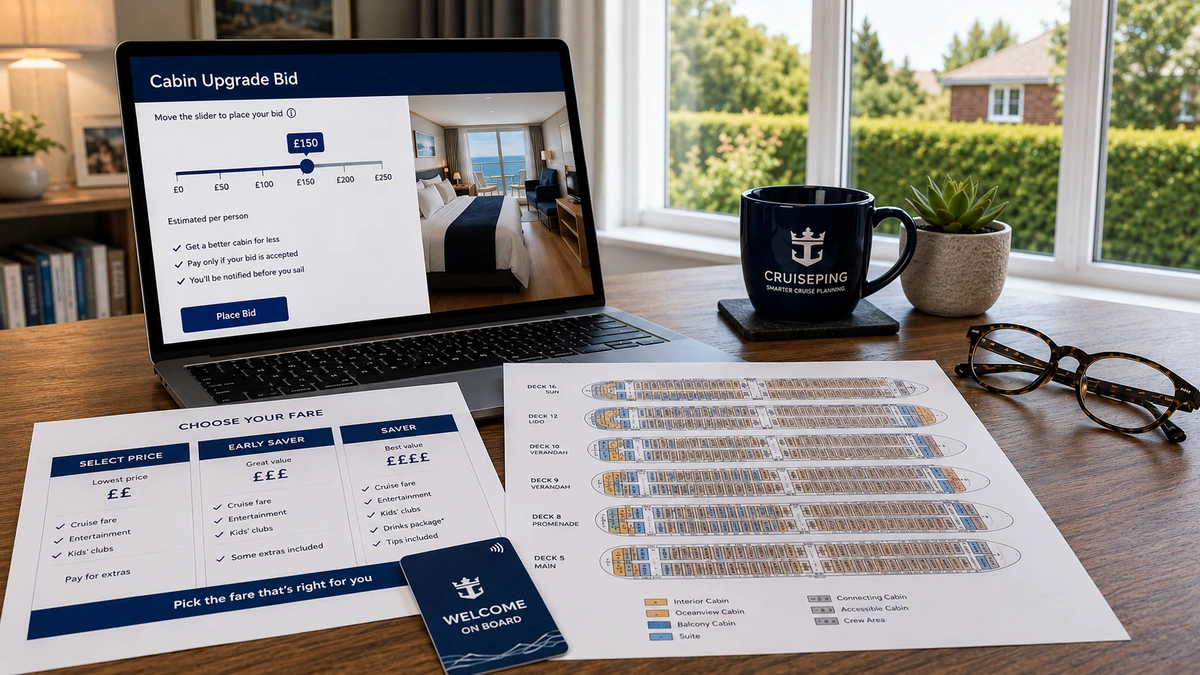
Cruise cabin upgrades sound wonderfully simple. Book a cheaper cabin, wait for the magic email, place a clever bid, and sail away in a balcony, suite or better location for less than everyone else paid. That is the dream version.
The reality is more complicated.
Cruise cabin upgrades can be an excellent value, but they can also be a trap. Sometimes the cheapest fare removes your ability to choose a cabin. Sometimes an “upgrade” moves you to a technically higher category in a worse location. Sometimes a bid is charged per person rather than per cabin. Sometimes the new cabin does not bring the perks you assumed it would. Sometimes paying more upfront for the right fare tier is smarter than gambling on later fare changes.
This is where many passengers get caught. They compare only the headline price and ignore control. They book the cheapest guaranteed fare, lose cabin choice, then try to fix the problem through an upgrade bid. Or they pay too much for Select Price because the benefits sound comforting, without checking whether the onboard credit, parking, coach transfer and cabin control are actually worth the difference.
CruisePing’s view is direct: cruise cabin upgrades are not about luck. They are about knowing what control is worth, what risk you are accepting, and whether the upgrade price beats the real market price.
This guide explains how cruise cabin upgrades work, how to compare P&O Select Price against Early Saver and Saver fares, how bidding systems such as Celebrity MoveUp and RoyalUp work, and how to calculate whether an upgrade is genuinely good value.
Cruise Cabin Upgrade System Matrix
| Upgrade Route | How It Works | Best For | Main Risk |
|---|---|---|---|
| Pay upfront for better cabin | Choose the cabin grade and often the cabin number at booking | Passengers who know exactly what they want | Higher initial fare |
| Fare-tier upgrade priority | Higher fare type may receive better dining or upgrade priority | P&O-style fare comparison | Paying for benefits you may not use |
| Guarantee cabin | Book a grade or type and let the line allocate the room | Price-focused passengers | Poor location, late allocation, less control |
| Bidding system | Offer extra money after booking for a higher category | Flexible passengers who would enjoy an upgrade but do not need it | Bid accepted into a location you would not have chosen |
| Paid post-booking upgrade | Reprice or upgrade directly before sailing | Passengers monitoring fare drops | Availability can disappear quickly |
| Complimentary upgrade | Cruise line moves you without payment | Rare bonus | Usually unpredictable and not a strategy |
The key distinction is control. The more control you want over cabin number, deck, dining time, perks and location, the more you should expect to pay upfront. The more flexible you are, the more you can use guaranteed fares, saver fares and upgrade bidding.
The mistake is wanting both: the cheapest fare and full control. Cruise lines do not usually price that way.
Hook Intro: The Cabin Upgrade Myth
The biggest myth about cruise cabin upgrades is that “higher” always means “better”.
A balcony is usually better than an inside cabin, but not always. A balcony above a noisy venue, under a pool deck, far forward in rough seas, or with an obstructed view may be worse for you than a carefully chosen inside cabin midship. A suite sounds glamorous, but if the accepted bid strips away expected package benefits or places you in an inconvenient location, the value may be less clear.
Upgrade systems are designed to help cruise lines fill cabins efficiently. They are not primarily designed to offer passengers secret bargains. That does not make them bad. It just means you should treat them like a marketplace rather than a favour.
The CruisePing test is simple:
Would I still be happy if this bid were accepted into the worst cabin in that upgrade category?
If the answer is no, do not bid.
That one question protects you from many bad upgrade decisions. Bidding is best when the category matters more than the exact cabin. It is risky when location matters more than cabin type.
Fare Tiers and Hidden Restrictions
Before you think about bidding, look at the fare you are booking in the first place. P&O is a useful example because its fare tiers show how cruise lines price control.
The official P&O Cruises prices explained page sets out three broad fare types: Select Price, Early Saver and Saver.
Select Price is the control fare. It is available on all cruises and includes a choice of cabin number, first priority for dining time and table size, first priority for cabin upgrades, a 15% deposit, flexibility to change up to the balance due date, complimentary shuttle buses in ports where available, and a choice of onboard spending money, Southampton car parking, or return coach travel on cruises of seven nights or more.
Early Saver is the middle ground. It is available on selected cruises and selected cabin types. P&O assigns your cabin number, gives second priority for upgrades, second priority for dining seating and table size, takes a 15% deposit and allows flexibility to upgrade to Select Price.
Saver is the deepest-control trade-off. It is available on selected cruises and cabin types, gives third priority for cabin upgrades and dining seating, allows the cabin number to be allocated any time up to one day before departure, requires full balance at booking and carries a 100% cancellation fee if cancelled at any time before the holiday.
That is not just a pricing detail. It is the whole upgrade game.
Select Price may be worth it if you care about a specific cabin, need a particular dining time, want the Southampton parking or coach benefit, or strongly value the ability to make changes before balance due. Early Saver may be better if you want a lower price and can tolerate P&O assigning the cabin. Saver may be a good value only if the price saving is strong enough to compensate for the loss of flexibility.
P&O Select Price vs Early Saver: The Maths That Matters
The correct P&O question is not “Is Select Price better?” It often is. The correct question is: “Is Select Price worth the extra money on this sailing?”
Use this calculation:
Select Price difference
minus onboard credit value
minus parking or coach value if you would use it
minus shuttle bus value if relevant
minus the value you place on cabin choice
minus the value you place on dining priority
equals the real control premium.
Imagine Select Price costs £500 more per cabin than Early Saver. If it includes £250 onboard spending money that you would definitely use, the true difference drops to £250. If you would otherwise pay £150 for parking in Southampton, the effective difference drops to £100. If you also care strongly about choosing a quiet midship cabin, Select Price may be a bargain.
Now reverse the example. If the Select Price costs £900 more, the onboard credit is £250, you are not driving to Southampton, you do not care about coach travel, and you are relaxed about dining time, you may be paying hundreds of pounds mainly for cabin choice and upgrade priority. That might still be worth it on a special cruise, but it should be a deliberate decision.
CruisePing’s view is that Select Price is strongest when at least two of the benefits matter to you. If you only value one benefit, do the maths carefully.
Early Saver and Saver: When Cheap Stops Being Cheap
Early Saver can be excellent if you are flexible. The danger is pretending you are flexible when you are not.
If you dislike forward cabins, need to be near lifts, want cabins close together, suffer from motion sensitivity, need a specific dining time, or hate the idea of late allocation, Early Saver may feel stressful. The fare saving then becomes compensation for anxiety rather than a true bargain.
Saver is more extreme. Full balance at booking and 100% cancellation fee make it a serious commitment. Saver can work for a last-minute, low-cost, highly flexible traveller who would rather be on the ship than fuss over cabin details. It is less suitable for families, passengers with mobility concerns, linked bookings, nervous first-time cruisers or anyone who would be upset by a poor location.
The upgrade priority also matters. Select Price gets first priority, Early Saver second, and Saver third. That does not guarantee an upgrade for anyone, but it makes clear how the line ranks passengers when upgrade opportunities exist.
The CruisePing rule is blunt: do not book a restricted fare and then complain that it restricts you. The saving is the compensation.
Bidding Systems: Celebrity MoveUp and RoyalUp
Cabin upgrade bidding systems are now common across several cruise lines. Celebrity MoveUp and RoyalUp are two of the best-known examples because their rules are published clearly and they work in a broadly similar way.
With Celebrity MoveUp, eligible passengers can bid for a higher stateroom category after booking. Celebrity says eligible reservations can use the system within 90 days of departure, and passengers browse options, choose how much they are willing to pay, and submit offers. Making offers on multiple room categories can increase the chance of success, but only one upgrade is charged if accepted.
RoyalUp follows a similar pattern. Eligible guests select the amount they are willing to pay for each upgrade. If the bid is accepted, the card is charged. If not, the original stateroom remains and no upgrade charge is taken.
The important detail is that these bids are usually priced per person for the whole cruise, based on two guests in the stateroom. Only the first and second guests are charged, but solo travellers may still be charged based on double occupancy. That means a £300 bid is not necessarily £300 per cabin. It may be £600 total.
This catches people. Always read the final price before submitting.
The Hidden Rules That Make or Break an Upgrade Bid
Upgrade bidding is not just “offer money and hope”. The rules change the value.
Celebrity and Royal both warn that cabin location and specific features are not guaranteed. You are bidding on a category, not a cabin number. If accepted, you may get a cabin in that category that you would never have chosen at full price.
Both systems also warn that upgrades do not add new promotions or benefits that would have applied if you had originally booked the higher category. You generally keep the promotions attached to your original booking, but the upgrade itself does not magically add every perk associated with the new cabin grade. Celebrity specifically notes that special fares and MoveUp upgrades from non-suite staterooms do not receive Premium Drinks and Premium Wi-Fi.
Accepted bids are also final. Celebrity says that once accepted, the total amount is charged and becomes final and non-refundable. Royal Caribbean says that once accepted, the card is charged immediately and the paid upgrade amount is final and non-refundable.
Linked cabins are another danger. If you are travelling with another reservation, each offer is considered individually. There is no guarantee that both cabins will be upgraded or kept close together. That makes bidding risky for families, groups, carers or anyone who needs neighbouring cabins.
CruisePing’s upgrade-bid rule is simple: bid only when you would be genuinely happy with any cabin in the upgraded category, without extra promotions, at the total price shown.
Bidding Mathematics and Probability Hacks
Nobody outside the cruise line knows the exact acceptance algorithm. Anyone promising a guaranteed hack is overselling. But you can still improve your decision-making.
The first calculation is the retail gap. Check what the higher category would cost if you booked it directly today. If the balcony cabin is £800 more than your inside cabin and the minimum bid would cost £600 total, the maximum possible saving is £200. That may not be enough to justify losing cabin control.
The second calculation is the “bad-location discount”. If you would only accept a balcony in a good location, reduce your bid sharply or do not bid at all. Upgrade bidding rarely lets you choose the exact room.
The third calculation is the “per-night comfort value”. Divide the total upgrade cost by the number of nights. A £400 total upgrade on a 14-night cruise is about £29 per night. A £400 upgrade on a three-night cruise is about £133 per night. Same bid, very different value.
The fourth calculation is the “use-time test”. A balcony on a cold, port-heavy winter itinerary may be less valuable than a balcony on a warm sea-day itinerary. A suite on a cruise where you are ashore every day may be less valuable than a suite on a transatlantic crossing.
The fifth calculation is the “fare-protection test”. If booking the higher cabin upfront would also give you better promotions, more control or loyalty points, a bid may not be the same product. A cheap upgrade is not a bargain if it excludes the benefits you actually wanted.
The probability hack is to bid where supply is plausible and demand is weaker. You may have a better chance moving from inside to ocean view on a sailing with many unsold outside cabins than from balcony to a tiny suite inventory on a popular school-holiday cruise. But that is still inference, not certainty.
The Upgrade Ladder: Which Moves Make Sense?
Not all cabin upgrades are equally valuable.
Inside to ocean view can be good if natural light matters, but the improvement is often modest. If you spend little time in the cabin, do not overpay.
Ocean view to balcony is usually the classic upgrade. It changes how the cabin feels and gives private outdoor space. This is often the most emotionally satisfying upgrade.
Balcony to larger balcony or better location can be worthwhile, but only if the location is genuinely better. A higher category can sometimes mean a less attractive deck position.
Balcony to mini-suite or junior suite can be good for space, bathrooms, storage and comfort, especially on longer sailings. Check whether suite-style benefits are actually included.
Suite upgrades are the trickiest. They can be wonderful, but they are often highly bid-on, expensive, and perk rules vary. Do not assume a suite bid gives you the same experience as booking the suite originally.
CruisePing’s best-value upgrade is usually the one that changes how you use the cabin, not just what the category is called. Balcony, extra space, better bathroom and a genuinely quieter position matter more than marketing labels.
When to Pay Upfront Instead of Bidding
Bidding is not always clever. Sometimes it is just delayed uncertainty.
Pay upfront if you need a specific location. Midship, low deck, near lifts, connecting cabins, accessible cabins, adjoining cabins and quiet zones are not things to gamble with.
Pay upfront if the higher category comes with benefits you genuinely want. If booking the suite directly includes perks that a bid does not add, direct booking may be better value even if it costs more.
Pay upfront if the cruise is special. Honeymoon, anniversary, once-in-a-lifetime itinerary or first family cruise? Do not let the whole holiday depend on a bid.
Pay upfront if the itinerary makes the cabin important. Scenic fjords, Alaska, Panama Canal, transatlantic crossings, long sea-day cruises and warm-weather itineraries often make balconies and suites more valuable.
Bid if you already like your current cabin and would simply enjoy an upgrade if it happens. That is the healthiest bidding mindset.
Actionable Cabin Upgrade Strategy Checklist
Decide what cabin you would be happy sailing in before booking.
Do not book a guarantee or Saver-style fare unless you can accept the worst likely location.
For P&O, price Select Price against Early Saver after subtracting any benefits you would genuinely use.
Give no value to free parking if you are arriving by train.
Give no value to onboard credit if it will encourage spending you would not otherwise do.
Check dining priority if your preferred dining time matters.
Before bidding, check the current retail price of the upgrade category.
Multiply the bid by two if the system charges first and second guests.
Remember solo travellers may be charged based on double occupancy.
Check whether accepted upgrades add new perks. Often they do not.
Do not bid for a category if you would reject a poor location within that category.
Avoid bidding linked cabins unless separation would not matter.
Do not bid if you need an accessible cabin unless the rules clearly protect accessibility.
Use lower bids on categories where the retail gap is small.
Use stronger bids only when the per-night comfort value is genuinely worth it.
Cancel or amend bids before the deadline if fare prices change.
Keep screenshots of bid terms, total price and cancellation rules.
Treat upgrade bidding as a bonus, not a rescue plan.
FAQ: Cruise Cabin Upgrades
What is a cruise cabin upgrade?
A cruise cabin upgrade means moving from your originally booked cabin category to a higher category, such as inside to ocean view, ocean view to balcony, balcony to suite, or a better subcategory within the same broad cabin type.
Are cruise cabin upgrades free?
Sometimes, but not often. Complimentary upgrades can happen, but they are unpredictable. More commonly, passengers pay upfront, book a higher fare tier, accept a paid upgrade offer, or bid through systems such as Celebrity MoveUp or RoyalUp.
Is a cabin upgrade always worth it?
No. A cabin upgrade is worth it only if the new category, location, space or benefits justify the extra cost. A technically higher category in a poor location may be worse than a carefully chosen lower-category cabin.
How does RoyalUp work?
RoyalUp lets eligible Royal Caribbean guests bid for a higher stateroom category. If the offer is accepted, the card is charged. If not, the passenger keeps the original cabin and pays nothing extra.
How does Celebrity MoveUp work?
Celebrity MoveUp lets eligible Celebrity passengers bid for a higher stateroom category after booking. Offers are normally priced per person for the whole cruise, based on two guests, and accepted offers are charged automatically.
Is a RoyalUp or Celebrity MoveUp bid per cabin?
Usually no. The offer amount is normally per person for the full cruise, based on two guests in the stateroom. Only the first and second guests are usually charged, but solo travellers may still be charged based on double occupancy.
Can I choose my cabin location with an upgrade bid?
Usually no. You are bidding on a stateroom category, not a specific cabin number. The cruise line assigns the upgraded cabin, and location or specific features are not guaranteed.
Do upgrade bids include extra perks?
Often no. Celebrity and Royal both state that upgrades do not add new promotions that would have applied if the higher category had been booked originally. You usually keep your original promotions, but do not assume you gain new ones.
Can I cancel an accepted cabin upgrade bid?
Usually no. Once accepted, upgrade bids are normally final and non-refundable. Your card is charged and you cannot simply reject the upgrade because you dislike the cabin location.
Is P&O Select Price worth it?
P&O Select Price is worth it if you value cabin choice, dining priority, upgrade priority and benefits such as onboard spending money, Southampton parking or return coach travel. It may not be worth it if you are highly flexible and the price gap is large.
What is the difference between P&O Select Price and Early Saver?
Select Price gives more control, including cabin-number choice and first priority for dining and upgrades. Early Saver is cheaper on selected cruises and cabin types, but P&O assigns the cabin number and gives second priority.
What is the biggest mistake with cruise cabin upgrades?
The biggest mistake is booking a cabin you would not be happy with and hoping an upgrade will fix it. Upgrade bidding should be a bonus strategy, not a rescue plan.
CruisePing Value Verdict
Cruise cabin upgrades can be brilliant, but only when the maths and the risk line up.
For P&O passengers, the smartest move is to compare Select Price, Early Saver and Saver as control products, not just fare products. Select Price is not automatically overpriced, because cabin choice, dining priority, flexibility, parking, coach travel and onboard credit can all have real value. But Early Saver or Saver can win if the saving is large enough and you genuinely do not care where the cabin is assigned.
For Celebrity MoveUp, RoyalUp and similar bidding systems, the best strategy is disciplined indifference. You should like your original cabin, set a strict maximum bid, and treat any upgrade as a pleasant bonus. If the accepted cabin could disappoint you, the bid is too risky.
The blunt CruisePing view is this: never let an upgrade system make the booking decision for you. Book the cabin grade you can live with. Pay upfront for the control you genuinely need. Bid only when the total price beats the direct upgrade cost and you would be happy with any cabin in the higher category.
That is how cruise cabin upgrades stop being casino psychology and start becoming a useful planning tool.
Ready to browse our article library?
Looking for more practical cruising shortcuts? Head back to our main hub directory to explore comprehensive stateroom comparisons, tipping breakdowns, port guides and value guides.