
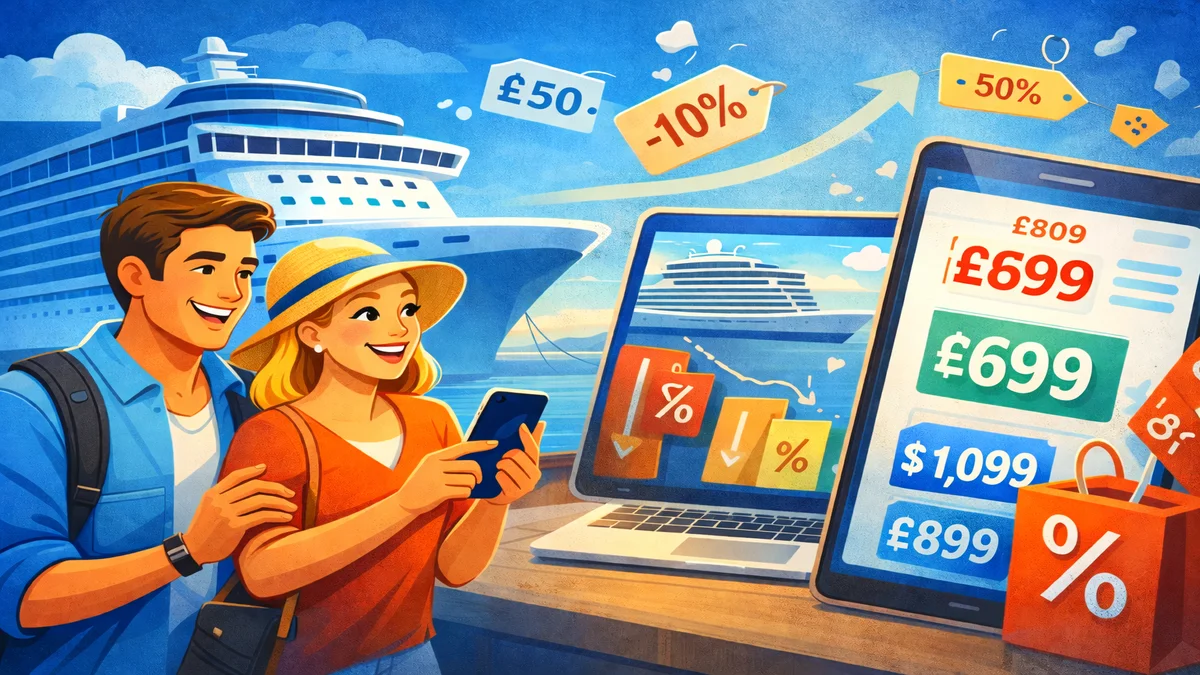
Imagine this: You are sitting at the Martini bar on your second night at sea, chatting with the couple in the cabin next door. You are both sailing on the exact same ship, on the exact same deck, with the exact same balcony view.
Then, the topic of booking comes up, and you realise a harsh reality—they paid £500 less for their holiday than you did.
This isn’t a mistake, and the cruise line didn’t single you out. You have simply experienced the reality of dynamic pricing.
Just like airlines and major hotel chains, the global cruise industry uses sophisticated “Yield Management” software. These algorithms adjust cabin prices daily—and sometimes hourly—based on supply, demand, and how close the ship is to its departure date. The goal of the cruise line is to ensure the ship sails at 100% capacity, which means prices will constantly fluctuate to attract different waves of buyers.
Finding a genuine cruise deal isn’t about luck, and it isn’t about endlessly refreshing travel agency websites. It is about understanding how these pricing algorithms work, and knowing exactly when to let automation do the tracking for you.
Here is everything you need to know about the lifecycle of a cruise fare, how to decode promotions, and how to never overpay for your cabin again.
1. How Cruise Pricing Algorithms Actually Work
To understand when a price might drop, you have to look at how a cruise line sells a ship over a two-year period. Every sailing goes through distinct pricing phases, driven by the revenue algorithms operating behind the scenes.
Phase 1: The “Base-Loading” Release (18 to 24 Months Out)
When a cruise line releases a new set of itineraries, the prices are typically set at a premium baseline. The algorithm isn’t panicking yet; it has two years to fill the ship.
- The Strategy: The cruise line is targeting highly organised planners, loyal past guests, and people who want to secure a very specific room (like an Aft Balcony or a large family suite).
- The Value: You pay a premium for total choice. Prices rarely drop during this initial phase, but you get exactly the cabin you want.
Phase 2: The Mid-Cycle Lull (8 to 14 Months Out)
This is the quietest period for bookings. The initial excitement of the itinerary release has faded, but the sailing is still too far away to attract last-minute bargain hunters. If the algorithm notices that bookings are pacing behind schedule, this is when you might see the first subtle price drops or the introduction of “Value-Add” promotions (like free onboard credit) to stimulate demand.
Phase 3: The 90-Day Mark (The Algorithm Shift)
For UK cruisers, the 90-day mark (or sometimes 120 days for luxury lines) is the most critical date on the calendar. This is the “Final Payment Date”—the deadline when passengers who paid a small £50 deposit must pay their remaining balance in full.
Inevitably, life gets in the way. People’s financial situations change, or they simply change their minds, leading to a wave of cancelled bookings.
- The Result: The algorithm suddenly sees 200 empty cabins reappear in the system just three months before the ship sails. To prevent the ship from sailing empty, the software will often trigger significant price drops. This is historically the best window to secure a cash discount on your base fare.
2. The “Base Fare” Bellwether Strategy
Because cruise pricing is so complex, tracking the price of every single specific cabin type on the ship is nearly impossible. Instead, savvy cruisers use the Base Fare Bellwether strategy.
Every cruise is advertised with a “From” price (e.g., 7 Nights from £599). This usually represents the cheapest available interior cabin.
Even if you have absolutely no intention of sleeping in an interior cabin—perhaps you only want a Midship Balcony or a Mini-Suite—you should still track that “From” price.
Why? Because the base price acts as a tripwire. When a cruise line launches a massive ship-wide sale to fill empty inventory, the base price will plummet. When you see that £599 interior drop to £399, it is an almost guaranteed signal that the premium balcony cabins have also been discounted proportionally. Tracking the cheapest room tells you exactly when the whole ship is on sale.
3. The Early Bird vs. Last-Minute Debate
One of the most common questions in the travel industry is whether it is cheaper to book a cruise two years in advance or wait until the very last minute. The honest answer? It entirely depends on where you are sailing from and who you are sailing with.
There is a persistent myth that “last-minute” is always the cheapest. While this was often true a decade ago, modern pricing algorithms have become much smarter. Here is how you should play it:
The “Last-Minute” Strategy (Best for European Fly-Cruises)
If you are incredibly flexible, do not care which cabin you sleep in, and are willing to fly to a major European hub (like Barcelona, Rome, or Athens), last-minute bookings can offer spectacular value.
- Why it works: Mega-ships sailing the Mediterranean (like those operated by MSC or Royal Caribbean) have over 5,000 beds to fill every single week. If the algorithm is panicking at the 60-day mark, it will slash prices to rock bottom.
- The Catch: What you save on the cruise fare, you will often lose on last-minute flights and expensive guaranteed cabin assignments.
The “Early Bird” Strategy (Best for UK Departures & No-Fly Cruises)
If you are booking a no-fly cruise from Southampton (especially during the UK school summer holidays), waiting for a last-minute deal is a terrible idea.
- Why it works: No-fly cruises are currently the highest-demand product in the UK market. Ships operated by P&O and Cunard frequently sell out six months before departure. Because the demand is so high, the algorithm never needs to panic. Instead of dropping the price as departure day approaches, the algorithm steadily raises it.
- The Rule: If you want a specific family suite, an Aft Balcony, or a sailing during August, book it the day the itinerary is released.
(Unsure if a no-fly cruise is right for you? Read our guide: No-Fly Cruises from the UK: The Ultimate 2026 Guide).
4. Decoding Sales and “Wave Season”
If you track cruise prices for more than a few months, you will notice an endless cycle of sales: “Black Friday Spectacular,” “Summer Splash Sale,” and the infamous “Wave Season.”
Wave Season is the cruise industry’s massive Q1 booking frenzy, running roughly from January through March. Every major line releases its biggest marketing campaigns simultaneously to try and “base-load” its ships for the upcoming year.
But here is where the algorithms get clever. Not all sales are genuine fare reductions. Cruise lines use two distinct strategies to make you feel like you are getting a deal:
Strategy A: The Fare Reduction
This is a straightforward cash discount on the base fare of the cabin.
- Examples: “Kids Sail Free,” “50% off the Second Guest,” or a flat £300 discount.
- The Reality: These are usually excellent deals for budget-conscious travellers, as it genuinely lowers the amount of money leaving your bank account.
Strategy B: The Economics of Bundled Fares (The “Value-Add”)
This is where the pricing gets complicated. Instead of dropping the price of the cabin, the cruise line keeps the base fare high – or even quietly raises it – but bundles in expensive “extras” for free.
- Examples: “Free Premium Drinks Package,” “Free Gratuities,” or “£500 Onboard Credit.”
- The Reality: If you were planning to buy a £60-a-day drinks package anyway, a “Value-Add” sale is a phenomenal deal. However, if you don’t drink alcohol, you are effectively paying a premium base fare for perks you won’t use.
Understanding the difference between a cash discount and a bundled fare is the key to spotting a true bargain.
5. The “Hidden Extra” Illusion: Spotting a True Deal
When comparing two different cruise deals, the biggest mistake you can make is looking only at the “Base Fare.”
For a UK consumer used to standard all-inclusive package holidays, the way some cruise lines price their onboard experience can be a massive shock. To spot a genuine deal, you must calculate the True Daily Cost of the holiday, not just the cost of getting on the ship.
Consider this scenario:
- Cruise A (Budget Mega-Ship): £599 per person for a 7-night Mediterranean sailing.
- Cruise B (Premium Adults-Only Ship): £999 per person for the exact same route.
On paper, Cruise A looks like an incredible deal. But let’s look at the hidden economics.
Cruise A charges £15 per day in mandatory gratuities (tips), £80 per day for a premium drinks package, and £20 per day for Wi-Fi. Over a 7-night cruise, those extras add an astonishing £805 to your bill. Your £599 “cheap” cruise now costs £1,404.
Meanwhile, Cruise B (like Virgin Voyages or P&O Cruises) operates on a more inclusive model. Their £999 base fare already includes your gratuities, your Wi-Fi, and your essential drinks. When you step off the ship, your final bill is zero. The “expensive” cruise was actually £400 cheaper.
Always calculate your expected onboard spend before declaring a low base fare a “deal.”
6. The Holy Grail: Repricing After You Book
So, you have tracked the algorithms, found a great base fare, and paid your deposit. But what happens if you check the price two months later and see that the exact same cabin is now £300 cheaper?
Can you get that money back?
This is where understanding UK consumer law and cruise line terms and conditions is vital. If you read American cruise blogs, they will tell you to simply cancel your booking and rebook at the lower rate. Do not do this in the UK.
Because of how UK travel agencies and booking conditions operate, deposits in the UK are strictly non-refundable. If you cancel to rebook the cheaper fare, you will lose your £150 deposit, completely wiping out the £300 saving you were trying to secure.
However, you still have massive negotiating power.
If you spot a price drop before your final payment date (the 90-day mark), you should immediately call your travel agent or the cruise line. While they rarely refund cash, they will frequently offer you the difference in Onboard Credit (OBC) or give you a free Cabin Upgrade. Getting £300 of free spending money to use in the spa or speciality restaurants is the ultimate cruiser’s holy grail.
Price is only one part of the comparison. Set a cruise price alert to catch genuine movements, check the hidden costs that can inflate a cheap fare, and compare cabin-upgrade bidding before deciding whether an apparent bargain is really the best buy.
7. The Ultimate Strategy: Automate Your Savings
By now, you understand the secret language of cruise pricing. You know that booking early secures the best cabins for UK departures, that “Value-Add” sales hide base fare increases, and that tracking the “From” price acts as a bellwether for massive ship-wide discounts.
But there is one glaring problem: You do not have the time to check cruise prices every single morning.
The algorithms never sleep. A cruise line might drop the price of a Southampton sailing on a Tuesday afternoon to fill a sudden wave of cancellations, only to raise it back up by Thursday morning once the cabins are sold. If you are relying on manual Google searches or waiting for a weekly travel agent email, you will miss the drop.
That is exactly why we built CruisePing.
We monitor the backend pricing systems so you don’t have to. Our software tracks the “From” price of your chosen itinerary. When the algorithm panics and the base fare plummets, we instantly send an automated alert directly to your inbox.
Whether you are looking to book a new holiday at rock-bottom prices, or you want to track a cruise you have already booked to negotiate free onboard credit, automation is the only way to beat the system.