
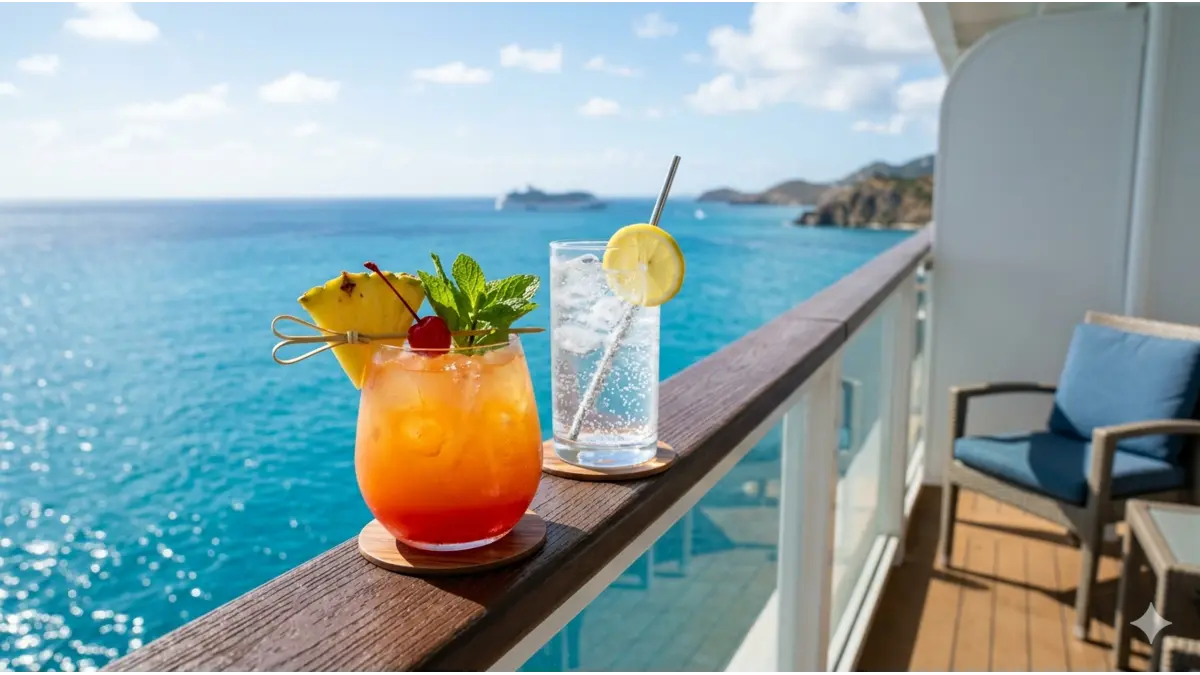
If you have spent any time in a cruise forum lately, you know the “Drink Package Debate” is the undisputed heavyweight champion of travel topics. Recently, cruise drink packages have become much more than just an “unlimited” button; they are carefully designed systems that vary significantly by ship, itinerary, and even how many days you are sailing.
If you are currently staring at that “Buy Now” button in your cruise planner, here is a common-sense breakdown to help you decide if prepaying is the right move for your vacation.
The “Stateroom Balance”: Understanding the Cabin Rule
The most important rule to know before you reach for your wallet is the Mandatory Purchase Policy. Across almost all major lines, if one adult in a stateroom buys an alcoholic beverage package, every other adult of legal age in that cabin must also purchase it.
- The Policy: This is designed to keep the programs simple and easy for the crew to manage on a busy ship.
- The Impact: If you are a social drinker but your partner prefers tea and water, you are essentially paying for two packages to cover one person’s habits.
- A Positive Exception: Celebrity Cruises remains a favourite for families with mixed drinking habits, as they allow a “Zero Proof” (non-alcoholic) package for the second guest if they have a documented reason for not consuming alcohol.
The “Cunard Scaling” Strategy
If you are sailing with Cunard in 2026, your “break-even” point actually depends on how long you are at sea. They are the only major line utilising a sliding scale for their beverage collections.
- Short Trips: On a 1–6 night “taster” cruise, the standard collection is at its peak price of $94.50 per day.
- Long Hauls: If you are lucky enough to be on a World Voyage (75+ nights), that daily price drops all the way to $49.50.
- The Guardrail: Regardless of the price, all Cunard alcoholic packages include a 15-drink limit per 24-hour period.
Breaking Down the Math: The “6 Cocktail” Threshold
You might hear that you need to drink 6 cocktails a day to make a package worth it. But where does that number actually come from? Let’s look at the 2026 industry averages.
In 2026, a top-tier drink package generally averages $100 per day once you include the mandatory 18% or 20% service charge. Meanwhile, the average cocktail onboard now costs $14.00. Once you add a 20% tip to that individual drink, the price per cocktail is $16.80.
- The Formula: $100 (Package Cost) divided by $16.80 (Individual Drink Cost) = 5.95 drinks.
- The Conclusion: You need to finish that 6th cocktail every single day just to reach “parity” with what you paid for the package.
2026 Quick-Look: Major Line Highlights
| Cruise Line | What’s New for 2026? | Average Daily Cost (incl. gratuity) |
| Royal Caribbean | Prices are dynamic and can hit $125/day on ships like Icon of the Seas. Chipped cups are now a $4.99 surcharge. | $55 – $125 |
| Carnival | Gratuities rise to 20% in April 2026. Strict 15-drink alcoholic limit. | ~$90 |
| Norwegian (NCL) | The Standard package is no longer valid on Great Stirrup Cay as of March 2026. | $130.80 |
| Princess | The 15-drink limit on the “Plus” package now includes soda and bottled water. | $70 – $105 |
| Virgin Voyages | No daily fee; uses a Prepaid Bar Tab with no added gratuities. | Flexible |
The “Ping” Insight: The “Bridge Beverage” Factor
When deciding on a package, don’t just count the margaritas. The real value for many cruisers in 2026 is in the “Bridge Beverages”—things like specialty coffees ($5.50) and bottled waters ($3.50). If you drink two lattes and three waters a day, you have already cleared $21.50 of your package cost, meaning you only need about 4 cocktails in the evening to break even.
P&O passengers should also run the numbers against the line-specific P&O drinks package comparison. Whichever line you choose, include automatic gratuities and service charges and the wider hidden costs of a cheap cruise in the calculation.
The Ping Verdict
Should you go for the package?
- GO FOR IT IF: You have a lot of “Sea Days” on your itinerary, you value the “All-Inclusive” peace of mind, and you enjoy premium coffees and bottled water throughout the day.
- SKIP IT IF: You are on a port-heavy itinerary (where you’ll be off the ship most of the day), or if you are a light drinker travelling with a partner who is being “forced” into the package by the cabin rule.