
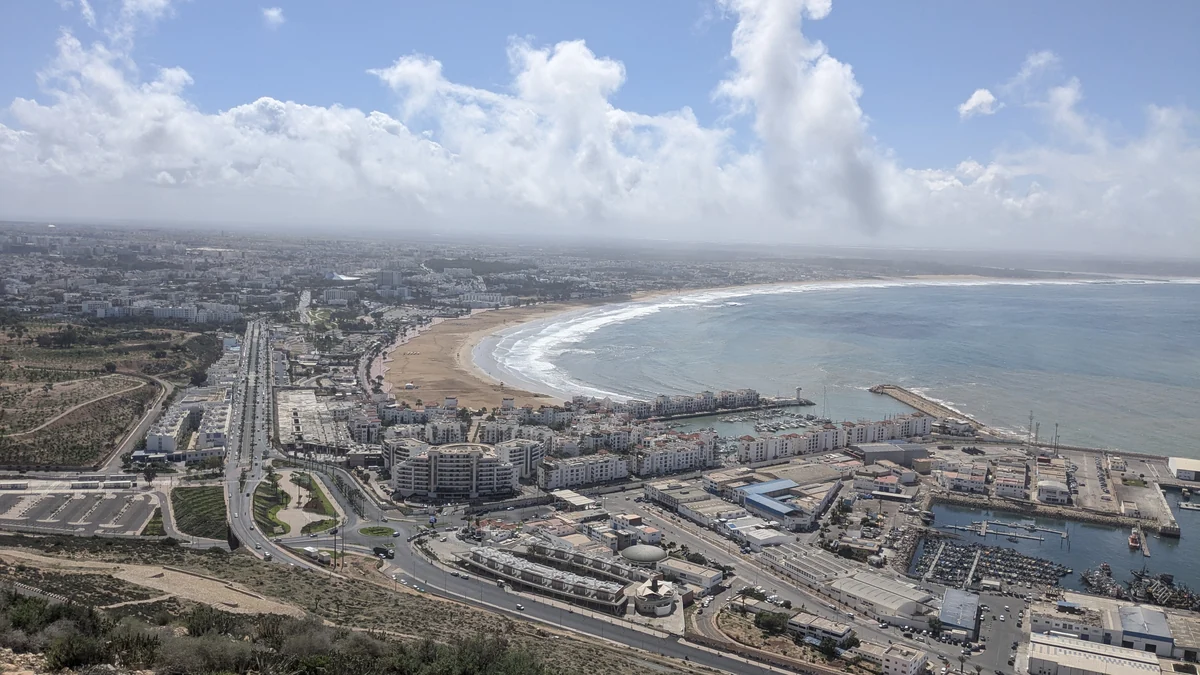
Agadir cruise port is a working commercial harbour rather than a city-centre promenade. Ships normally dock inside the secure port, but passengers may need a ship shuttle, authorised taxi or organised excursion to clear the industrial area. Once outside, Agadir offers a long beach, modern seafront, vast Souk El Had and panoramic Agadir Oufella hill, all within a practical local circuit.
The city was largely rebuilt after the destructive 1960 earthquake, so visitors expecting the medieval lanes of Marrakech or Essaouira can misread the destination. Agadir’s strengths are Atlantic light, broad public spaces, Berber and Moroccan food, the souk and access to the Souss region. A first-time cruise day works best when it embraces that character: viewpoint first, market second, then the beach or marina. Paradise Valley, Taghazout and Taroudant are worthwhile alternatives, but each should replace part of the local plan rather than be added to an already crowded day.
Agadir Cruise Port at a Glance
| Port name | Agadir Cruise Port |
|---|---|
| Main arrival area | Secure commercial and fishing port north of the city beach |
| Cruise region | Africa |
| Country / Territory | Morocco |
| Currency | Moroccan dirham (MAD) |
| Languages | Arabic and Amazigh; French widely used; English in tourism |
| Port role | Day Call / Fly Cruise itinerary port |
| Disembarkation | Docked |
| Walkability | Low from the berth; high on the seafront and within the souk |
| Shuttle required | Often required or strongly advisable from the working port |
| Main transport | Ship shuttle, licensed taxi, ALSA bus, cable car, private driver and organised excursion |
| Best first-time plan | Agadir Oufella, Souk El Had, beach promenade and marina |
| Main caution | Secure-port access, taxi negotiation, Friday or seasonal opening and long road excursions |
Weather & Best Time to Visit Agadir
January to March
Typical high: 20–23°C
Typical low: 9–12°C
Rain / conditions: Mild Atlantic weather with occasional rain, cool mornings and variable coastal cloud.
April to June
Typical high: 22–27°C
Typical low: 12–17°C
Rain / conditions: Warm and generally dry; morning mist can clear to strong sun by midday.
July to September
Typical high: 27–31°C
Typical low: 18–21°C
Rain / conditions: Hot inland but often moderated near the coast by Atlantic air, haze and sea breezes.
October to December
Typical high: 21–29°C
Typical low: 11–18°C
Rain / conditions: Often warm in autumn, with increasing chance of rain later in the year.
Weather guide: CruisePing summary based on NASA POWER climate data for Agadir and the Souss Atlantic coast. Check the latest Agadir forecast before the call.
Agadir can begin under low Atlantic cloud and become bright or hot later, so do not judge the whole day from the harbour sky at breakfast. The Oufella viewpoint is exposed, while the souk can feel warm and crowded even when the beach is breezy. Inland excursions towards Taroudant or Paradise Valley are usually hotter than the coast; carry water and dress for both sun and cultural context.
Where Cruise Passengers Come Ashore
The National Ports Agency information for Agadir reflects the harbour’s role as a commercial, fishing and passenger facility. Cruise ships berth inside a large operational zone, and independent walking from the gangway is not always permitted or sensible. The ship’s daily programme should state whether a shuttle runs to a port gate, marina area or central drop-off.
Take the port procedure seriously. Heavy vehicles, security controls and long internal roads make the berth different from a Mediterranean old-town quay. Do not set off along an unmarked route because the city appears close on a map. If a shuttle is provided, use it; if taxis are authorised to collect inside, confirm the meeting point and the price before entering the vehicle.
The marina and beach promenade lie south of the working harbour. A shuttle drop near the marina gives immediate access to cafés, the waterfront and onward taxis. A gate-only drop may still leave a meaningful walk beside busy roads. Record the exact return point, because “the port” can refer to the gate, the marina, a security checkpoint or the berth itself.
Build a larger final margin than the road distance alone suggests. Returning passengers may need to find the correct gate, pass security and wait for an internal shuttle. A driver dropping you outside cannot guarantee the time needed from gate to ship. Aim to reach the designated passenger point at least an hour before the stated deadline, and more after a long excursion.
Agadir after the 1960 Earthquake
Agadir’s modern appearance is central to understanding the call. The earthquake of 1960 destroyed much of the old city and caused heavy loss of life. Rebuilding produced a lower-rise, spacious resort city with broad avenues and a long planned seafront. Visitors searching for an intact medieval medina will therefore be disappointed unless they adjust expectations.
The ruins and memorial setting at Agadir Oufella provide the clearest physical connection to the pre-earthquake city. The hill also gives the defining view over the commercial harbour, crescent beach and urban plain. Access and restoration arrangements have changed over time, so follow current signs and do not assume every historic enclosure is freely open.
The city’s modernity does not make it culturally empty. Souk El Had, neighbourhood cafés, mosques, Amazigh design, food and the working fishing port all express contemporary southern Morocco. The mistake is to compare every street with Marrakech rather than noticing what Agadir does differently: sea, space, regional trade and a more relaxed resort rhythm.
Medina Polizzi, sometimes promoted as the “new medina”, is a modern reconstruction and craft complex rather than the preserved old city. It can be visually attractive and useful for passengers who want architecture and workshops, but it should be described honestly. Choose it for design and atmosphere, not under the impression that it survived the earthquake.
Agadir Oufella, Cable Car and the Best View
Agadir Oufella is the strongest first stop because morning visibility and temperature are often better, and the viewpoint explains the geography of the whole call. From the hill, passengers can see the port, marina, beach, modern city and Souss plain. This makes later taxi journeys and the scale of the resort easier to understand.
The cable car provides one route from the lower city towards the hill, subject to current operation, queues and ticketing. A taxi or organised tour may also reach designated access points. Check whether the chosen method reaches the same viewpoint and how much walking remains; “cable car to the Kasbah” does not necessarily mean step-free access to every historic area.
At the top, sun and wind can be strong. Keep hold of hats and allow more than a five-minute photograph if the site is open for walking. The view towards the Arabic hillside inscription is familiar from the beach, but the panorama from above is the reason to go. Haze can reduce distant detail without making the harbour view worthless.
Independent taxi users should agree whether the driver waits or collects later. It is easy to find transport in busy areas, but demand rises when a ship unloads and when the cable car queue changes plans. A round-trip agreement with a clear next destination—usually Souk El Had—reduces negotiation and prevents time being lost at the hill.
Souk El Had: How to Visit without Feeling Overwhelmed
Morocco’s national tourism guide to Agadir–Taghazout identifies Souk El Had as one of the city’s principal attractions. The large walled market contains produce, spices, household goods, clothing, leatherwork, crafts and food. It is a working market as well as a visitor destination, which explains both its energy and its scale.
Choose an entry gate, photograph its number and set a meeting point before separating. The internal lanes can feel repetitive, and a group that drifts in different directions may spend the rest of the visit trying to reunite. Offline maps are useful, but a memorable gate and agreed time are more reliable than a phone battery.
Bargaining is normal for many discretionary goods, but it should be calm rather than theatrical. Ask the price, decide what the item is worth to you, and walk away politely if the gap remains too large. Fixed-price food stalls and ordinary household purchases may not follow the same pattern. Do not begin a long negotiation when you have no intention of buying.
Quality varies. Argan oil is strongly associated with the region, but decorative packaging does not prove purity or cooperative origin. Ask about ingredients, certification and whether the product is culinary or cosmetic. Similar care applies to saffron, leather and jewellery. A guide may help explain products, but commission relationships should be expected rather than treated as a surprise.
Check current opening, particularly around religious holidays and the market’s weekly closure pattern. Friday rhythms can affect shops, prayer times and transport. The city does not close completely, but a plan centred on one market should always have the seafront, museum or Medina Polizzi as a fallback.
Beach, Marina and the Seafront
Agadir’s beach stretches in a broad curve south of the port and is one of the easiest parts of the day. The promenade supports walking, cafés and sea views, while the marina provides a polished dining and shopping area close to the harbour side. This is the right place to finish because the return to the port is relatively short and transport is easier to find.
The Atlantic is not automatically calm or warm. Waves, currents and local safety flags matter, and the beach may be better for a walk than a swim on a particular day. Use lifeguarded areas where available and do not leave valuables unattended while everyone enters the water. Sand and changing time should be included in the return plan.
A beachfront lunch gives a relaxed contrast to the souk. Seafood, tagines, grilled meat, couscous and Moroccan salads are widely available, but alcohol policies vary by venue. Order according to the time available. A traditional tagine is not fast food, and a leisurely meal can become the day’s main activity if the kitchen is busy.
The marina is convenient but does not represent the whole city. Prices and atmosphere may feel more international than in central neighbourhoods. Use it for a controlled final stop, not as evidence that Agadir is simply a generic beach resort. The Oufella and souk provide the context that makes the seafront more meaningful.
Taghazout and the Northern Coast
Taghazout lies north of Agadir and is known for surf culture, beaches and a smaller village atmosphere. It works well for passengers who prefer coast and cafés to a large market. A taxi, private driver or organised excursion provides the most reliable cruise-day control, though current local transport can be checked through ALSA Agadir.
The road can be busy, particularly when resort traffic and construction overlap. Agree a return time before settling at a beach club or restaurant. The journey is not exceptionally long in ideal conditions, but a slow coastal road can consume the margin quickly. Avoid combining Taghazout, Paradise Valley, Souk El Had and Oufella unless the call is very long and transport is private.
Surf lessons are possible but require more planning than a casual beach stop. Confirm equipment, changing facilities, water conditions, insurance and the time needed to return. Beginners should not let the attraction of a famous surf destination override local safety advice or the ship schedule.
For many passengers, a scenic drive through Taghazout with a short walk and lunch is enough. The purpose is to experience the northern coast, not to collect every resort. A shorter, well-controlled visit leaves room for the Oufella view on the return.
Paradise Valley, Taroudant and Longer Excursions
Paradise Valley is promoted for pools, palms and rocky scenery inland from the coast. Water levels and the visual character of the pools vary by season and rainfall, so current local information matters. Reaching the best sections may involve uneven paths, heat and more walking than a coach description suggests.
A private or organised excursion is preferable because the route, parking and return need coordination. Ask how much walking is included, whether swimming is realistic on the date and what the alternative is if water levels are poor. A tour should offer landscape and interpretation, not simply deliver passengers to a crowded roadside stop carrying the Paradise Valley name.
Taroudant provides walls, markets and a more traditional urban setting inland. It is sometimes described as a smaller Marrakech, but that shorthand can create the wrong expectation. The town has its own pace and regional role. The road commitment makes it a full excursion, particularly when shopping or lunch is included.
Essaouira and Marrakech are much farther. A ship may sell a protected excursion, and a passenger with a singular priority may accept the long day, but most calls are better served by Agadir and the Souss region. Count the hours on the road before being persuaded by the destination name. Marrakech deserves more than a rushed square and a late coach back to port.
Best Things to Do from Agadir Cruise Port
Agadir Oufella
Best for: The defining city, beach and harbour panorama.
How to do it: Use the cable car, taxi or organised tour early in the day.
Watch: Haze, exposure and changing access arrangements.
Souk El Had
Best for: Food, crafts, daily commerce and a strong sense of modern Agadir.
How to do it: Agree a gate and meeting point, then explore with time to compare quality.
Watch: Weekly or holiday opening changes and overlong bargaining.
Agadir Beach and Promenade
Best for: A relaxed final phase close to the port.
How to do it: Walk, eat or swim in a supervised area before returning by taxi or shuttle.
Watch: Atlantic conditions and the time needed to change and clear port security.
Taghazout
Best for: Surf culture, coastal scenery and a smaller resort atmosphere.
How to do it: Use controlled transport and set the return before lunch.
Watch: Coastal traffic and trying to add too many northern stops.
Paradise Valley
Best for: Inland scenery and active travellers.
How to do it: Choose a current local excursion that states walking and water conditions.
Watch: Seasonal pools, heat and uneven terrain.
Taroudant
Best for: Walls, markets and a full inland cultural excursion.
How to do it: Use a ship, private or reputable small-group tour.
Watch: Road time and itineraries that leave little time inside the town.
CruisePing Recommended Agadir Port Day
Use the ship shuttle or authorised transport immediately rather than attempting to walk through the working harbour. Travel first to Agadir Oufella while visibility is good and the heat is manageable. Spend enough time to understand the panorama, then continue by the same taxi or tour to Souk El Had.
Allow roughly the middle of the day for the souk and lunch. The market rewards a deliberate visit, but set a departure time before entering. If it is closed or uncomfortably crowded, substitute Medina Polizzi or a longer beachfront meal instead of searching for another market across the city.
Finish on the promenade and marina side. Walk a section of the beach, swim only if conditions and time permit, and have coffee close to the agreed shuttle point. This sequence moves from panorama to commerce to relaxation while gradually returning towards the port.
On a repeat visit, replace the souk-and-beach section with Taghazout or Paradise Valley. On a long call, Taroudant can become the main excursion, but it should be paired only with a brief Oufella stop if timings allow. Do not try to perform the local city circuit after returning late from a full inland day.
DIY, Taxi or Organised Excursion?
Agadir is independent-friendly once outside the port, but the secure harbour complicates the first and last leg. A shuttle plus city taxis can handle the standard Oufella, souk and beach plan. Keep small notes for agreed fares, confirm whether the price is per vehicle, and establish the currency before moving off.
Taxi meters and negotiation practices can vary. Use authorised ranks, ask the shuttle staff or tourist information for guidance, and avoid accepting an unclear “city tour” from someone who will not state the route or price. A written amount on a phone can prevent misunderstanding. Pay after the agreed journey unless a reputable pre-booking arrangement says otherwise.
An organised excursion is valuable for Paradise Valley, Taroudant or long regional routes. It also suits passengers who want a guide inside the souk and do not wish to negotiate transport. Compare the time spent at shops with the time at actual sights; commission stops can quietly dominate a programme.
A private driver is often the sweet spot for two to four people. It allows an early viewpoint, a controlled market visit and a beach finish, or a targeted journey to Taghazout. Confirm port access, meeting point, vehicle licensing and the latest safe return. The driver should know the correct passenger gate, not merely the harbour entrance.
Culture, Dress, Money and Food
Agadir is accustomed to international tourism, yet Morocco’s social norms remain relevant. Lightweight clothing can still cover shoulders and knees in markets, villages and religious areas. Swimwear belongs on the beach or at a resort. Mosques generally are not open to non-Muslim visitors unless specifically stated; admire exterior architecture without blocking worshippers.
The Moroccan dirham is the everyday currency. Cards are accepted in many formal businesses, but cash remains useful for markets, taxis and small cafés. Use a bank ATM rather than an informal exchange, keep smaller notes and check whether prices are quoted in dirhams or euros. A seller accepting euros does not guarantee a favourable conversion.
Food is a highlight, but basic hygiene judgement still applies. Choose busy stalls with visible turnover, drink sealed or trusted water and be cautious with food that has sat in heat. Argan oil for eating is different from cosmetic oil; ask before tasting or buying. Mint tea may be sweet unless requested otherwise.
Photography should be considerate. Ask before taking close portraits of traders, workers or families. The working port and security areas may have restrictions, so keep the camera away until the passenger route is clear. At the souk, a friendly request is more respectful than treating every colourful stall as a free backdrop.
Agadir Cruise Port Checklist
Confirm the shuttle destination, return point and final departure before leaving the berth. Photograph the passenger gate or drop-off and carry the ship’s port-agent contact details. Do not assume independent pedestrians can re-enter through any harbour entrance.
For taxis, agree the route, price, currency and waiting arrangement. Check current opening for Souk El Had, cable-car operation and any Friday or holiday changes. Keep cash in small denominations and retain a larger time margin after an inland excursion.
Carry sun protection, water and clothing appropriate for markets and cultural sites. Finish near the marina or designated shuttle point rather than across the city. Port security is an additional leg of the return, not the place where the margin should begin.
Useful Official Links
Use these official and authoritative pages to check details that can change before a Agadir call, including arrival arrangements, transport, opening information and local access.
- National Ports Agency: Port of Agadir
- ALSA Agadir bus information
- ALSA Agadir routes and lines
- Moroccan National Tourist Office: Agadir–Taghazout
- Visit Agadir official tourism website
- Visit Agadir activities guide
Frequently Asked Questions
Can you walk from Agadir cruise port to the city?
Do not assume so. The ship berths in a secure working harbour, and walking may be restricted or impractical. Use the ship shuttle, authorised taxi or organised transport to reach the marina or centre.
Does Agadir cruise port provide a shuttle?
Many calls provide transport from the berth or port area, but the destination and frequency are ship-specific. Record the drop-off and final return before starting the day.
Is Agadir an old historic city?
Most of the city was rebuilt after the 1960 earthquake. Agadir Oufella preserves the old-city setting, while Souk El Had and the modern seafront show contemporary Agadir.
What is the best first-time excursion in Agadir?
A local circuit of Agadir Oufella, Souk El Had and the beach gives the best balance. It limits road time and covers the city’s main landscape, commerce and resort character.
Can you visit Marrakech from Agadir on a cruise call?
Some long ship excursions may offer it, but the road commitment is substantial and time in Marrakech can be limited. For most calls, Agadir, Taghazout, Paradise Valley or Taroudant is more sensible.
Is Souk El Had open every day?
Opening patterns can include a weekly closure and changes around religious holidays. Check current official or local information rather than assuming a normal schedule.
Are taxis safe and easy to use in Agadir?
Authorised taxis are widely used, but agree the price, currency, route and waiting arrangement. Use official ranks or recommendations and preserve the return details in writing.
What should you wear in Agadir?
Agadir is a resort city, but modest lightweight clothing is appropriate in markets, villages and cultural areas. Keep swimwear for the beach and use respectful dress near religious sites.
CruisePing Verdict
Agadir is a practical port day when its modern identity and working-port logistics are understood. The Oufella view explains the city, Souk El Had supplies energy and regional character, and the beach creates an easy finish. None requires an exhausting transfer, but the first and last shuttle legs must be treated as part of the itinerary.
The weakest plan is to chase a more famous Moroccan city simply because Agadir looks modern. A well-paced local day reveals the Atlantic coast and Souss region while keeping the ship secure. Longer excursions can be excellent, but they should be chosen deliberately and given the whole middle of the call—not squeezed between a market, cable car and late beach stop.
Ready to browse our article library?
Looking beyond Agadir? Explore more ports in the Africa region, or narrow it to Morocco in particular. For cruise comparisons, planning shortcuts and value guides, head over to our main article archive.