
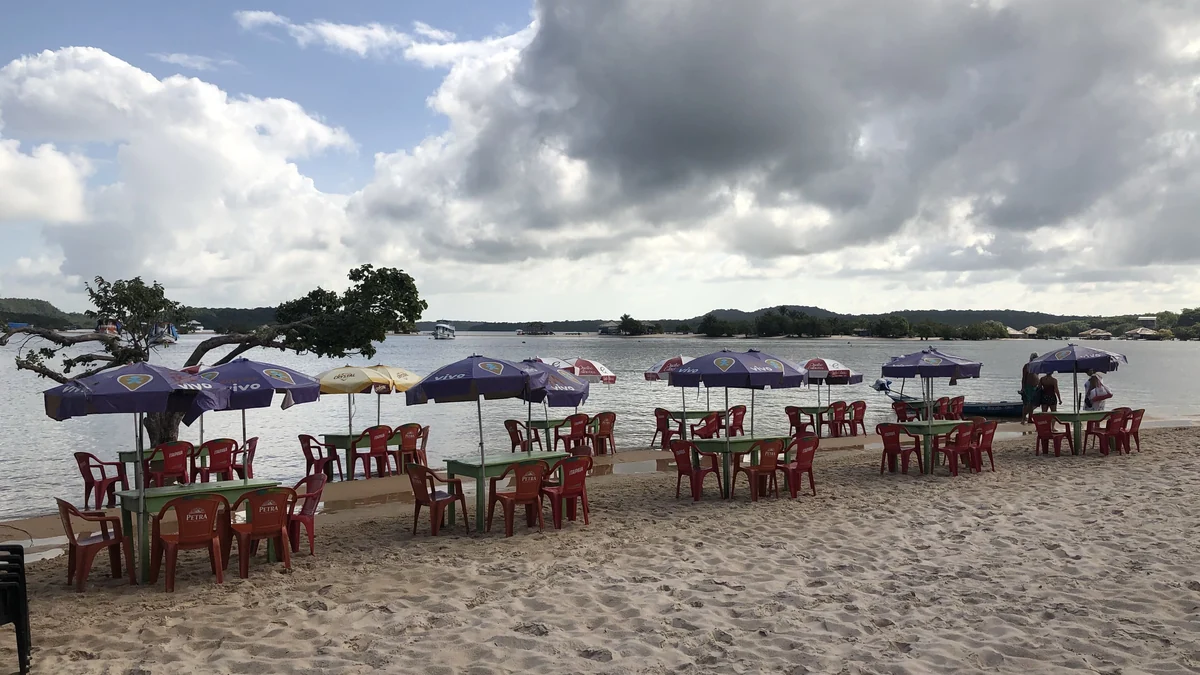
Alter do Chão cruise port is an Amazon river call shaped by water level rather than a fixed maritime terminal. Ships normally anchor in the Tapajós and land passengers by tender or local boat near the village waterfront. From there, the day can remain delightfully small—village, Ilha do Amor and Lago Verde—or expand into a longer motorboat or forest programme that needs firm organisation.
The famous white-sand beach is seasonal. During lower-water months, Ilha do Amor and other sandbanks become more extensive; during higher water, the landscape, crossings and available beach area change. A successful call therefore begins by looking at the river in front of you, not by expecting a postcard scene from a different month. For most passengers, the strongest plan is the village plus one short water excursion, leaving long Tapajós National Forest or wildlife routes to an organised tour with a protected return.
Alter do Chão Cruise Port at a Glance
| Port name | Alter do Chão Cruise Port |
|---|---|
| Main arrival area | Tender or local-boat landing on the village waterfront |
| Cruise region | South America / Galapagos |
| Country / Territory | Brazil |
| Currency | Brazilian real (BRL) |
| Languages | Portuguese; English may be limited outside organised tourism |
| Port role | Day Call |
| Disembarkation | Tender |
| Walkability | Medium in the village and waterfront |
| Shuttle required | No |
| Main transport | Walking route, catraia canoe, motorboat, taxi or van and organised excursion |
| Best first-time plan | Village, Ilha do Amor and a short Lago Verde or Tapajós boat circuit |
| Main caution | River-level seasonality, heat and stacking several boat movements before the final tender |
Weather & Best Time to Visit Alter do Chão
January to March
Typical high: 30–32°C
Typical low: 23–25°C
Rain / conditions: Hot, humid and frequently wet, with high river levels and heavy tropical showers.
April to June
Typical high: 30–32°C
Typical low: 23–25°C
Rain / conditions: Continued humidity and rainfall; flooded forest and high-water scenery may be prominent.
July to September
Typical high: 31–34°C
Typical low: 23–25°C
Rain / conditions: Drier, sunnier and increasingly hot; seasonal sandbanks often become more visible.
October to December
Typical high: 31–34°C
Typical low: 24–25°C
Rain / conditions: Very hot; lower-water beaches may remain strong before rains become more frequent.
Weather guide: CruisePing summary based on NASA POWER climate data for Alter do Chão and the lower Tapajós. Check the latest forecast.
Heat and humidity are the operational issue in Alter do Chão. Start any exposed climb or village walk early, carry more water than a Mediterranean port day would require and expect a tropical shower even in a drier period. River level determines whether Ilha do Amor is reached by a short catraia crossing, a longer boat movement or, in exceptional low water, partly on foot. Use the landing-day reality rather than an old seasonal assumption.
Tendering into a River Village
Alter do Chão does not operate like a conventional ocean cruise terminal. The ship anchors offshore in the Tapajós, then passengers transfer by tender or locally arranged boat to a waterfront landing. The exact sequence, craft and landing point are ship-specific and may change with river level, wind, current and local port organisation.
The Municipality of Santarém has described specific landing areas for catraias, tour launches and other craft around the village and Ilha do Amor in its local water-transport guidance. Cruise passengers should nevertheless use the ship’s tender instructions, because local recreational boat zones do not necessarily identify the cruise landing.
Photograph or note the landing place before walking away. The waterfront can become busy with tenders, catraias, motorboats and beach traffic, and a return point described only as “by the square” may be ambiguous. Check whether the ship requires tender tickets, whether independent passengers must be back earlier than tours and what happens if a storm pauses boat operations.
The village centre is close enough to explore on foot once ashore. The main square, church, shops, cafés and beach-facing waterfront create a compact base. Paths can be sandy or uneven, shade is intermittent and the heat quickly increases the effort. Plan the town walk in short blocks rather than saving all local sightseeing for the final half-hour.
Reading the River Level
Brazil’s Ministry of Tourism describes Alter do Chão’s famous white-sand beaches as seasonal features of the dry period, including Ilha do Amor. Its recent overview of Amazon nature destinations explains that the sandbanks emerge as water levels fall. That distinction matters: a cruise call in high water can be beautiful, but it will not look or function like a low-water beach season visit.
During lower water, the sandy island may appear broad and the crossing from the village can be very short. During higher water, the shoreline contracts, boat routes shift and flooded vegetation becomes more prominent. Very low conditions can also create navigation and access challenges. None of these versions is automatically inferior; they support different experiences.
Ask the ship’s destination team or a locally established operator what is realistic on the day. Useful questions are concrete: Is Ilha do Amor operating normally? Is the catraia crossing needed? Are Lago Verde channels navigable? How long is the selected boat route at today’s river level? A generic promise of “the Amazon Caribbean” does not answer those questions.
The river level also changes the return calculation. A tender or local launch may need a different route than expected, and boarding can take longer when water or weather conditions shift. Keep the final part of the day close to the village landing rather than ending at a distant sandbank.
Ilha do Amor and the Catraia Crossing
Ilha do Amor is the iconic local beach and normally the easiest extension from the village. The municipality recognises the catraieiros—the boatmen who use small traditional canoes—as part of Alter do Chão’s tourism culture and has run training around the crossing. In higher water, the catraia may be the practical link between the waterfront and the sandbar.
The crossing is short but involves getting into a small craft from a river edge or simple landing. Passengers with limited balance, reduced mobility or bulky equipment should ask for assistance and decide whether the beach facilities suit them. The exact boarding arrangement is more important than the nominal distance.
Once on the sandbar, choose a position that keeps the village and collection point easy to identify. Facilities and food service can vary, and municipal work on beach structures may affect what is available. Carry water, use sun protection and do not assume that an umbrella removes the intensity of equatorial heat.
Swimming conditions should be judged locally. The Tapajós can appear calm and clear, but river currents, depth, boat traffic and underwater terrain are not visible from a photograph. Follow local guidance, remain in recognised bathing areas and avoid combining alcohol, heat and a rushed boat return.
Ilha do Amor is enough for a relaxed second half. Passengers do not need to add a long motorboat journey merely to feel they have seen the Amazon. The view back to the village, the river scale and the catraia crossing already make the call distinctive.
Lago Verde and Short Boat Circuits
Lago Verde lies beside Alter do Chão and is the most natural short-boat extension. Routes may pass channels, forest edges, quiet water and local beaches, with the exact experience changing between high and low water. A short circuit can add Amazon landscape without taking the group far from the tender landing.
Choose an operator who states the duration, boat type, shade, lifejacket provision and return point. Ask whether the itinerary is private, shared or likely to wait for additional passengers. On a cruise call, a slightly more expensive departure that leaves promptly and returns to the village is often better value than an open-ended bargain trip.
Wildlife may be seen, but no responsible operator can guarantee dolphins, monkeys or particular birds on a short circuit. Judge the trip by the river and forest experience. An itinerary that depends on chasing animals can lengthen unpredictably and encourage poor viewing behaviour.
Keep the route modest if the ship tender has already consumed much of the morning. Lago Verde and Ilha do Amor can often be combined; a distant beach, sunset stop or multiple lake circuit may not. Ask the boatman to state the latest safe return based on the ship, not on local evening leisure patterns.
Serra da Piraoca: A Heat-Sensitive Walk
Serra da Piraoca rises behind Ilha do Amor and provides a wider view over the Tapajós and village. Municipal accounts describe organised walks beginning from Alter do Chão and crossing towards the island before the trail. The route is exposed, and the combination of heat, sand and ascent makes it a serious choice rather than a casual beach stroll.
Start early, carry water, use closed footwear and take local advice on the current path. A midday climb can be punishing even for fit passengers. Rain can make parts slippery, while strong sun on the return across the sandbar compounds fatigue.
Do not combine the full climb with a long boat tour on an ordinary call. The viewpoint is the main activity for an active passenger, followed by a short beach recovery and return to the village. Anyone uncertain about the heat should choose a boat circuit instead; shade and airflow do not eliminate humidity, but they reduce the sustained physical effort.
Longer Tapajós and Forest Excursions
Operators may offer routes to Ponta de Pedras, Cururu, Canal do Jari, communities or areas linked to the Tapajós National Forest. These excursions can reveal much more of the region, but distances, fuel stops, river conditions and activity duration make them unsuitable for improvisation after landing.
A ship excursion or pre-arranged specialist operator is the sensible method. The itinerary should state whether the day uses only boats or includes road transport, whether meals are included, what footwear is required and how medical or weather changes are handled. In the Amazon, “nearby” on a map can still mean a long exposed journey by water.
Community or forest visits should be chosen for the experience itself, not as a collection of wildlife promises. Respect photography guidance, buy local products directly where appropriate and follow the host’s rules. A rushed group arriving late and leaving early creates little benefit for either visitor or community.
For a first Alter do Chão call, the long forest day is usually less attractive than staying closer to the village. It removes the seasonal beach and local waterfront from the experience and increases the number of transport links before the ship. Choose it when rainforest interpretation is the clear priority and the operator has a strong return plan.
The Village, Culture and Food
Alter do Chão is not only a beach platform. The village has Borari Indigenous heritage, the long-running Sairé cultural tradition, a church and a working community whose daily life continues around tourism. Walk the square and waterfront with time to notice local craft and food rather than moving directly between boats.
Menus may include Tapajós fish, manioc-based accompaniments, fruit juices and regional dishes. Ask about preparation time before ordering a full meal. A relaxed river lunch is valuable, but service paced for holiday visitors may not match a tender deadline. Pay before the final rush and keep small notes or an accepted payment method available.
English can be limited. A translation app, the ship’s Portuguese-speaking guide or a pre-arranged operator reduces confusion over route and return. Confirm prices in Brazilian reais and clarify whether a quoted boat fare is per person or for the craft.
The strongest purchases are local and portable: craft, food products that meet ship rules and items bought from community vendors. Avoid wildlife products, unverified “Indigenous” souvenirs or anything made from protected natural materials. Ask rather than assume.
Best Things to Do from Alter do Chão Cruise Port
Ilha do Amor
Best for: The iconic seasonal beach and the simplest local extension.
How to do it: Walk or use a catraia according to the day’s water level.
Watch: Heat, small-craft boarding and changes to available beach area or facilities.
Lago Verde Boat Circuit
Best for: A short introduction to river channels, forest edge and Amazon scenery.
How to do it: Agree a fixed-duration local motorboat trip with lifejackets and a village return.
Watch: Open-ended departures and wildlife promises can extend the route.
Alter do Chão Village
Best for: Culture, food and a low-risk day close to the tender.
How to do it: Walk the waterfront, square, church area and local shops.
Watch: Midday heat and slow meal service before the final tender.
Serra da Piraoca
Best for: Active passengers seeking a high view over the Tapajós.
How to do it: Start early with local route advice, water and proper shoes.
Watch: The exposed climb is unsuitable in peak heat or after a long boat trip.
Ponta de Pedras or Cururu
Best for: A longer beach-and-river excursion on an extended call.
How to do it: Pre-book a cruise-compatible motorboat operator.
Watch: Distance, fuel, weather and the need to return through the tender operation.
Tapajós Forest or Community Visit
Best for: Passengers prioritising ecology, interpretation and local culture.
How to do it: Use a specialist organised excursion with clear logistics.
Watch: Long duration and multiple transport legs make this a full-day commitment.
CruisePing Recommended Port Day
After tendering ashore, spend a short first period in the village to understand the landing, river level and weather. Confirm the ship’s return point, then take a catraia to Ilha do Amor or book a fixed-duration Lago Verde circuit. The decision can be made locally because the landscape in front of you reveals more than a pre-sailing description.
Return to the village for lunch, the square and waterfront. If the call is long, add the beach after the boat route or reverse the order according to heat and crowding. Keep the final hour on the same side of the water as the cruise tender unless the ship has specifically coordinated the last local crossing.
Active passengers can replace the boat circuit with Serra da Piraoca, while repeat visitors may choose a longer forest or community tour. The first-time plan should remain close, seasonal and flexible. Alter do Chão’s value comes from the Tapajós setting, not from travelling the greatest distance.
Alter do Chão DIY or Organised Excursion?
The village and Ilha do Amor can work independently when the ship’s tender lands centrally and local crossings are operating. Prices and route should still be agreed, and passengers need enough Portuguese or translation support to confirm the return.
Organisation is worth paying for any longer motorboat route, forest visit or community programme. The operator should understand the cruise timetable, carry appropriate safety equipment and have a plan for storms or river changes. A ship excursion provides the strongest protection when several boats or a road transfer are involved.
CruisePing would stay local on a first visit, using a catraia and one short motorboat circuit rather than buying the longest itinerary available. That choice gives more time to the village, reduces transport risk and adapts to the actual water level.
Alter do Chão Cruise Port Checklist
- Record the tender landing and final boarding time before leaving the waterfront.
- Ask how the current river level affects Ilha do Amor, catraia crossings and Lago Verde routes.
- Carry water, high-factor sun protection, insect repellent and a light rain layer.
- Confirm whether boat prices are per passenger or per craft and whether lifejackets are supplied.
- Use closed footwear for Serra da Piraoca or any forest trail.
- Do not rely on guaranteed wildlife sightings or follow animals aggressively.
- Return to the village early enough for weather delay and the ship’s final tender process.
Useful Official Links
Use the Santarém Tourism Portal and Municipality of Santarém for local information, the Brazilian Ministry of Tourism’s Amazon overview for seasonal beach context, and the ship’s own destination notice for the tender and approved operators.
Alter do Chão Cruise Port FAQ
Is Ilha do Amor always a large white-sand beach?
No. The sandbar is seasonal and changes with the Tapajós water level. Lower-water periods usually reveal more sand, while high water creates a different river and forest landscape.
How do passengers get ashore?
Cruise ships normally anchor and use tenders or local boats. The exact landing and boarding process depend on the ship, water level and local operations.
Can I explore Alter do Chão independently?
Yes for the village and, when operating normally, the short crossing to Ilha do Amor. A translation app and clear price agreement are useful. Longer boat or forest routes should be organised.
Are catraias safe?
They are traditional small craft used for short local crossings. Follow local and ship guidance, use assistance when boarding and choose a different option if balance or mobility makes the transfer unsuitable.
Will I see pink dolphins?
Possibly, but no sighting is guaranteed. Choose boat trips for the river landscape and use operators that keep a respectful distance from wildlife.
What is the best option in heavy rain?
Stay close to the village, use sheltered cafés and follow the ship’s guidance on boat movements. Tropical storms can pause local launches, so do not start a distant excursion when conditions are deteriorating.
CruisePing Port Verdict
Alter do Chão is most rewarding when the cruise day responds to the river that exists on arrival. Ilha do Amor may be a broad beach, a smaller sandbar or part of a high-water landscape; each version supports a different but worthwhile visit.
For a first call, combine the village with the seasonal crossing and one short Lago Verde or Tapajós boat route. Use a specialist tour for forest or community experiences and avoid stacking several water transfers before the tender. Staying close is not a lesser Amazon day—it is the clearest way to experience the place rather than the timetable.
Ready to browse our article library?
Looking beyond Alter do Chão? Explore more ports in the South America / Galapagos region, or narrow it to Brazil in particular. For cruise comparisons, planning shortcuts and value guides, head over to our main article archive.