
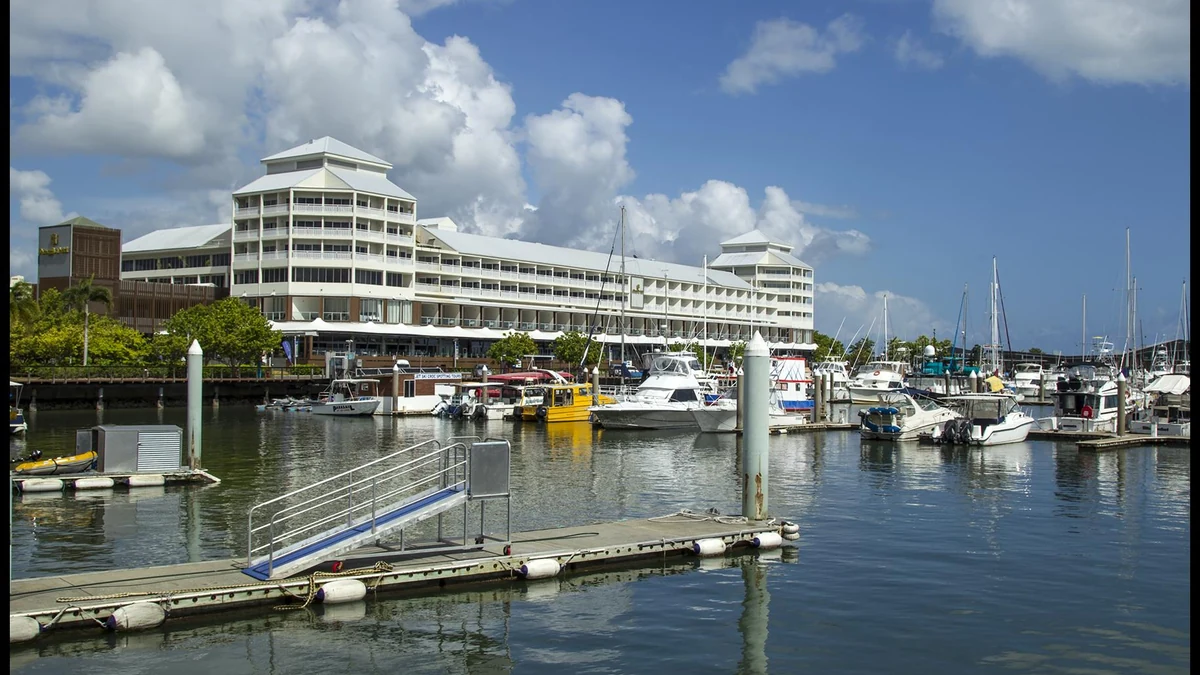
Ports North describes Cairns cruise port as a central, dedicated terminal beside the city, with the main wharves close to downtown shopping and the marina. That is unusually convenient for a tropical gateway: passengers can leave the ship and be on the Esplanade within minutes rather than waiting for an industrial-port shuttle.
The easy berth does not make every excursion easy. The Tropical North Queensland cruise guide points visitors towards the Great Barrier Reef, rainforest and wider region, but each is effectively a full-day direction. The most important Cairns decision is therefore not how to get into town; it is whether the call belongs to the reef, Kuranda and the rainforest, or Cairns itself.
Cairns Cruise Port at a Glance
| Port name | Cairns |
|---|---|
| Main arrival area | Cairns Cruise Liner Terminal on the central wharves; larger or operationally restricted calls may use alternative arrangements |
| Cruise region | Australasia / Pacific Islands |
| Country / Territory | Australia |
| Currency | Australian dollar (AUD) |
| Languages | English |
| Port role | Day call and turnaround gateway |
| Disembarkation | Docked for most scheduled calls |
| Walkability | Excellent around the terminal, marina and Esplanade |
| Shuttle required | No for central Cairns; yes or organised transport for major regional attractions |
| Main transport | Walking, reef vessels, coaches, taxis, local buses, Kuranda railway and Skyrail |
| Best first-time plan | Choose one major day: outer reef, Kuranda rainforest circuit or a relaxed central Cairns route |
| Main caution | Normal land-based reef and rail timetables may not align with ship clearance and all-aboard time |
Cairns cruise port starts in the centre of the city
Ports North places the dedicated Cairns Cruise Liner Terminal on Wharf 2/3 beside the city, with passenger berths extending along Wharves 1–6. For most docked calls, this is a genuine walk-off arrival rather than an industrial transfer port. The Esplanade, Reef Fleet Terminal, marina, restaurants and central shops are close enough to reach on foot once the ship has cleared passengers.
That convenient berth can disguise how far the headline experiences lie from the gangway. The reef needs a substantial boat journey, Kuranda needs a coordinated rail, cableway or road circuit, and the Daintree is a long regional excursion. The first ten minutes are easy; the rest of the day succeeds only when one major direction has been chosen.
Reef, rainforest or Cairns city: choose one main day
Cairns is one of the few ports where two World Heritage environments compete for the same call. A reef trip uses most of the day at sea. A Kuranda or Atherton Tablelands route uses most of it in transport and sightseeing. A city day is less ambitious but resilient and works well when the call is short, the weather is poor or the passenger does not want a full excursion.
Do not build a plan that assumes an outer-reef boat in the morning and Kuranda in the afternoon. Even if individual timetables look possible, check-in, loading, transfer and return margins make the combination weak. A satisfying Cairns call normally has one headline experience, one short central addition and a generous walk back to the ship.
Outer Great Barrier Reef trips need the strongest timetable check
The Great Barrier Reef Marine Park Authority explains the protected marine environment, but passengers must still select a commercial operator and product. Cairns departures range from large pontoons to smaller dive and snorkel vessels. They differ in sea time, swimming access, glass-bottom viewing, introductory diving, child suitability and the amount of shade or seating.
Compare the operator’s check-in time with the realistic time you can leave the ship, not the itinerary’s arrival time. A normal land-based departure may close check-in before independent passengers have cleared the terminal. The safest options are a ship excursion or a cruise-compatible departure whose operator has confirmed your vessel, berth and final return requirement.
Green Island and Fitzroy Island are different compromises
Island products usually require less sea time than an outer-reef pontoon, but they should not be treated as interchangeable. Green Island combines a developed visitor setting with reef access, while Fitzroy Island offers beaches, walks and fringing reef. Coral quality, water entry and visibility vary with location, tide and weather; the nearest option is not automatically the best snorkelling experience.
Ask what is included after the ferry: equipment, guided snorkel, glass-bottom boat, beach facilities and return sailing. A mid-afternoon ferry that technically reaches Cairns before departure can still be too tight once unloading and walking back to the terminal are included. Keep a distinct margin after the scheduled marina arrival.
Kuranda is a transport circuit rather than a single attraction
The classic route links the Skyrail Rainforest Cableway with the Kuranda Scenic Railway, using road transfers at one or both ends. It can be an excellent day because the journey reveals the rainforest from different angles, but every segment has a departure time. A delayed ship or disrupted rail service therefore affects the whole circuit rather than one isolated booking.
Choose the direction that fits the call and confirm where the coach meets you. Kuranda village time should be protected rather than squeezed between transport legs; otherwise the day becomes several hours of queuing and travel with little time in the destination. Ship excursions are often the simplest way to align the terminal, cableway and train.
The Daintree and Cape Tribulation are long cruise-day excursions
The Daintree lies north of Cairns and involves highway travel before the rainforest experience begins. Cape Tribulation extends the commitment further. These are strong choices for passengers who specifically value ancient rainforest, wildlife and coastal landscape, but they are poor additions to a reef or city itinerary.
Use an organised excursion with a protected return or an operator experienced with cruise calls. Road incidents, ferry queues and weather can lengthen the journey. A tour that turns back earlier than an overnight visitor would is not necessarily inferior; it may be the responsible version of the route within a ship’s fixed sailing time.
The Cairns Esplanade is the dependable no-excursion plan
The waterfront route offers the lagoon, shaded paths, public art, cafés, marina views and access to central services. It is level compared with many excursion sites and can be shortened at any point. There is no conventional sandy swimming beach in the city centre, so the lagoon is the practical place for a managed swim rather than the tidal mudflats.
A city day can also include the markets, a museum or the aquarium without committing to remote transport. It works particularly well on embarkation or disembarkation days when luggage, airport timing or check-in reduces the usable hours. The port’s proximity to the airport makes Cairns a genuine turnaround gateway as well as a day call.
Cairns Aquarium is a strong wet-weather alternative
Cairns Aquarium interprets tropical north Queensland habitats from rainforest rivers to the reef. It does not replace seeing the living landscape, but it gives structure to a stormy or shortened call and is reachable from the central port area by a modest walk or short taxi ride.
Allow enough time for the exhibits rather than treating the aquarium as a thirty-minute filler. It is especially useful for mixed-mobility groups, families and passengers who cannot safely snorkel. Check current entry times and any animal presentations before leaving the ship.
Botanic Gardens and northern beaches require transport
The Cairns Botanic Gardens sit north of the centre and present tropical plants in a more natural setting than a city park. A taxi, local bus or organised transfer is normally more sensible than walking in tropical heat. Nearby walking routes can be steep, slippery or exposed after rain.
The northern beaches are farther again and do not combine naturally with every other plan. Beach swimming is seasonal and controlled by local signs, patrols and marine-stinger precautions. Never interpret an attractive shoreline as permission to enter the water wherever you choose.
Public transport helps with modest routes, not fragile full-day plans
Translink’s official journey planner is the right place to check current bus routes and times. Buses can support a garden, suburban or beach visit, but frequencies and walking connections may not suit a short cruise call. The system is not a substitute for a coordinated Kuranda, Daintree or reef excursion.
Build the return from the last reliable service, then add time to walk from the city stop to the ship. Contactless payment rules and fares can change. A taxi or rideshare is often worth the extra cost when missing one bus would remove the return buffer.
Tropical heat changes how far the centre feels
Distances around central Cairns look small on a map, yet humidity, intense UV and sudden rain can slow walking. Carry water, use sun protection and schedule air-conditioned stops. The Esplanade has benches and shade, but exposed marina and terminal approaches can still feel demanding around midday.
Passengers with reduced stamina should save energy for the tender or gangway process and avoid an unnecessary long walk before a booked excursion. A short taxi to a central attraction is not wasteful when it protects comfort for the rest of the day.
Turnaround passengers need a separate airport and luggage plan
Cairns Airport is close by road, but a short transfer does not remove airline check-in rules or cruise embarkation windows. Arriving passengers should allow for baggage collection, taxi queues and possible tropical weather. Departing passengers should not leave luggage with an unverified operator or assume the terminal will store bags.
A late flight can support a city attraction after disembarkation, but only when secure luggage storage has been confirmed. The aquarium, Esplanade and central dining are easier than a remote excursion. Treat the final day as a logistics day with sightseeing, not a full port call that happens to include an airport.
Marine conditions matter more than the city forecast
A sunny morning beside the terminal does not guarantee comfortable conditions at the outer reef. Wind and swell can make the crossing rough or change the sites an operator visits. Take seasickness precautions early if advised, and listen to the operator rather than judging conditions from the sheltered marina.
Conversely, rain in Cairns does not always ruin reef visibility or a rainforest day. The right response is not automatic cancellation but checking the specialist operator’s update. The ship controls whether the call and gangway remain safe; individual operators control their own boats, flights and roads.
Accessibility must be checked across every transfer
The cruise terminal can be straightforward, but the complete chain may include coach steps, vessel gangways, floating pontoons, beach landings or train platforms. Ask the operator about the exact product, not just whether the attraction is “accessible”. A wheelchair that reaches a reef pontoon may still face limits on glass-bottom boats or water entry.
For a lower-risk day, keep to the Esplanade, lagoon and an accessible central attraction. Confirm taxi capacity for mobility equipment in advance. Tropical surfaces become slippery in rain, and long queues without seating can be as limiting as stairs.
Return timing should be measured from the attraction, not Cairns
The ship may be visible from the marina, but a reef boat returning late leaves little room for unloading hundreds of passengers. Kuranda tours can also be delayed far from the city. Ask where the excursion officially ends and whether the final transfer reaches the cruise terminal or another central point.
CruisePing would not accept an independent full-day product whose advertised return merely matches the ship’s all-aboard time. Keep a meaningful margin after the final scheduled arrival, and use the ship’s excursion when the destination is worth visiting but the independent timetable is too fragile.
Other Cairns Choices and Booking Detail
Beyond the reef, Kuranda and central city routes, Cairns offers several specialist options. These are valuable only when their transport and cancellation terms are treated as part of the experience. Grouping them together makes the trade-offs clearer without giving every minor alternative the same weight as the three principal day shapes.
Scenic flights exchange sea time for weather sensitivity
Helicopter and fixed-wing flights can show reef patterns or rainforest ranges without committing to several hours on a vessel. They suit passengers who want the scale of the landscape but do not swim, and they can sometimes fit a shorter call more easily than an outer-reef boat. The trade-off is that aviation has strict check-in, weight and weather rules. A bright view from the ship does not guarantee safe cloud, wind or visibility along the flight route.
Confirm the departure airfield and every transfer. Some products leave from Cairns Airport, others use a helipad closer to the marine precinct, and a combined flight-and-boat trip may finish somewhere different from where it began. Book a cruise-compatible schedule and do not use the final available flight before all-aboard.
Port Douglas and Mossman Gorge are regional day choices
Port Douglas, Mossman Gorge and the northern beaches appear close when viewed on a regional map, but the Captain Cook Highway and onward transfers consume a meaningful part of the call. A Port Douglas visit can work for a passenger who specifically wants its village and marina atmosphere; Mossman Gorge adds cultural and rainforest access that deserves a proper guided stop.
Neither route belongs after a full reef day or Kuranda circuit. Use a ship excursion or a confirmed vehicle with a conservative return. Roadworks, traffic and tropical rain can slow the coastal highway, and an independent driver should turn back earlier than an overnight visitor would.
A city extension should remain genuinely central
After a major excursion, the sensible extras are close to the terminal: a short Esplanade walk, a meal, the night markets when open or a marina drink. Do not use a slightly early reef return as permission to begin another taxi journey to the northern suburbs. Boat unloading and weather delays can erase that spare hour.
Keep purchases compact enough to carry through the terminal and follow biosecurity instructions for food or natural products. Central Cairns is well supplied, but a busy multi-ship day can still produce restaurant queues and rideshare surges.
Fishing, river and wildlife products need the same return discipline
Inlet cruises, fishing charters and wildlife-oriented trips can offer a quieter alternative to the headline reef products. Their smaller-group format may feel flexible, yet tide, weather and marina loading still control the operation. Ask whether the boat remains within Trinity Inlet or travels farther offshore, because that changes comfort and recovery time.
A private charter should not be allowed to improvise the return. Put the ship’s all-aboard time in writing and agree the latest turn-around point. Wildlife is never guaranteed, and a responsible skipper should not extend the search at the expense of the cruise deadline.
Cancellation terms matter for weather-sensitive bookings
Reef boats, scenic flights and rainforest products use different cancellation rules. Ask what happens when the ship misses Cairns, when the operator cancels for conditions and when the passenger chooses not to travel. A flexible cruise-call policy is worth paying for, particularly in the wet season. Keep the confirmation and emergency contact offline in case mobile data is slow at disembarkation.
Check whether a refund is returned automatically, issued as operator credit or requires a claim through the booking agent. The clearest policy is one written for cruise passengers rather than a general holiday cancellation clause.
CruisePing Recommended Port Day
For a first visit with a long call and a timetable designed for cruise passengers, select either a properly aligned outer-reef experience or the Kuranda railway-and-Skyrail circuit. Both justify using most of the day. Book through the ship when the independent check-in or return leaves no substantial margin. Add only a short Esplanade walk after the main excursion.
For a shorter, weather-affected or turnaround call, remain central. Walk the marina and Esplanade, use the lagoon, visit the aquarium or city centre and have a relaxed meal. This plan uses Cairns’ greatest operational advantage—the terminal’s location—and remains enjoyable even when a remote reef or rainforest itinerary would be rushed.
Weather & Best Time to Visit Cairns
Cairns has a tropical climate with a pronounced wetter, hotter summer and a drier, more comfortable winter. The wet season can bring intense rainfall, thunderstorms, flooding and tropical-cyclone disruption. The dry season is generally better for walking, but marine wind and visibility still vary.
| Month/season | Typical high | Typical low | Rain/conditions |
|---|---|---|---|
| December–March | 31°C | 24°C | Hot, humid and wettest; heavy rain, thunderstorms, flooding and cyclone disruption possible |
| April–May | 29°C | 21°C | Humidity and rainfall ease, with warm conditions and occasional heavy showers |
| June–August | 26°C | 17°C | Usually driest and most comfortable; cooler mornings and periods of marine wind |
| September–November | 29°C | 21°C | Rapidly warming with strong UV, rising humidity and early wet-season storms |
Use the Bureau of Meteorology Cairns climate information for seasonal context and check the live forecast, marine warnings and road notices close to arrival. Reef operators may alter sites for wind and swell even when the city remains sunny.
Practical Questions for a Cairns Cruise Call
Can I walk from the ship into Cairns?
Yes for the normal central terminal. Follow the ship’s berth information because occasional alternative arrangements can occur.
Can I book a normal outer-reef day independently?
Only when the operator confirms the cruise arrival, check-in and a safe return margin. Many standard departures leave too early.
Is Kuranda close to the port?
No. It is a coordinated rail, cableway and road day rather than a quick city attraction.
Is there a beach in central Cairns?
The central waterfront is tidal. The public lagoon is the practical managed swimming option.
How far is Cairns Airport?
It is a short road transfer, but allow for traffic, baggage and airline or cruise check-in requirements.
What currency is used?
Australian dollars; cards are widely accepted.
Useful Official Links for Cairns
Use these current sources to confirm arrival arrangements, attraction access, tour timings and live weather before your call.
- Ports North cruise shipping
- Ports North cruise schedules
- Tropical North Queensland cruise guide
- Great Barrier Reef Marine Park Authority
- Skyrail Rainforest Cableway
- Kuranda Scenic Railway
- Bureau of Meteorology Cairns climate
CruisePing Port Verdict
Cairns combines one of the easiest city berths with some of the most time-consuming excursions in the region. The port works best when passengers recognise that contrast. Walking out is simple; reaching the experience advertised in the brochure may require a boat, train, cableway or long road transfer.
Our first-choice advice is to commit to one environment. Choose the reef, choose the rainforest or enjoy Cairns. The poor plan is a collection of partial experiences linked by optimistic timetables.
Ready to browse our article library?
Explore more ports in the Australasia / Pacific Islands region, browse Australia cruise ports, or return to the main CruisePing article library.