
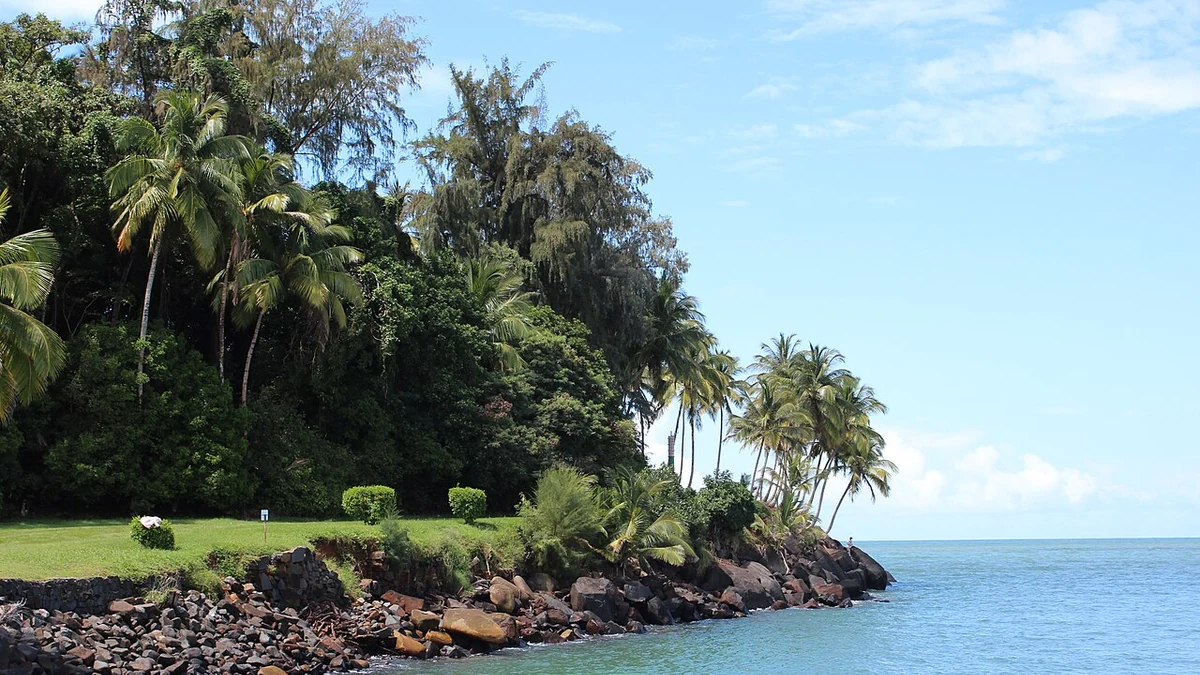
Devil’s Island cruise portis a misleadingly simple itinerary label. The Îles du Salut contain three islands, and cruise passengers normally tender to Île Royale, the largest and most accessible. Île du Diable—the small island made famous by the French penal colony—is separated by dangerous currents and is viewed from across the water rather than visited.
That distinction changes the whole guide. The day is a walking visit through the remains and landscape of Île Royale: former administrative buildings, hospital and prison sites, chapel, cemetery, forest paths, wildlife and coastal viewpoints. The experience is historically important, tropical and physically more demanding than the short distances suggest.
There is little scope for improvising a separate independent itinerary. The ship controls the tender operation and often the time ashore. The best plan is to understand the island before landing, choose a route that matches mobility and heat tolerance, and visit the penal-colony remains with restraint rather than treating suffering as a theme-park story.
Devil’s Island Cruise Port at a Glance
| Port name | Devil’s Island Cruise Port / Îles du Salut |
|---|---|
| Main arrival area | Small landing on Île Royale in the Îles du Salut archipelago |
| Cruise region | South America / Galapagos |
| Country / Territory | French Guiana |
| Currency | Euro (EUR) |
| Languages | French; English may be limited outside ship arrangements |
| Port role | Remote heritage and expedition-style day call |
| Disembarkation | Tender, normally to Île Royale; passengers do not land on Île du Diable itself |
| Walkability | Moderate distance but demanding because of steep, uneven and potentially slippery paths |
| Shuttle required | No general road transport; the visit is on foot from the landing |
| Main transport | Ship’s tender, local launch where arranged, and walking trails |
| Best first-time plan | Follow the ship’s tender plan, walk a shortened or full Île Royale circuit according to heat and mobility, and treat Île du Diable as a viewpoint |
| Main caution | Assuming the itinerary name means passengers step ashore on Devil’s Island |
Weather & Best Time to Visit Devil’s Island
January to March
Typical high:28–30°C
Typical low:23–25°C
Rain / conditions:Hot, very humid and often wet; heavy showers can make paths slippery.
April to June
Typical high:29–31°C
Typical low:24–25°C
Rain / conditions:Peak wet-season conditions with frequent rain, high humidity and tender disruption risk.
July to September
Typical high:30–32°C
Typical low:23–25°C
Rain / conditions:Drier overall but still tropical, hot and exposed around the coast.
October to December
Typical high:30–32°C
Typical low:24–25°C
Rain / conditions:Heat and humidity remain high as rainfall generally increases towards year-end.
Weather guide: CruisePing summary based on NASA POWER climate data for the Îles du Salut and Kourou coast. Check thelatest forecastfor the call.
Rain changes the visit more than temperature. Stone steps, roots and compacted earth can become slippery, while the tender landing remains dependent on sea and swell.
The island’s shade can hide the level of heat stress. Carry water, use insect protection and turn back early if the full circuit is becoming a test of endurance.
What the Itinerary Name Actually Means
The Îles du Salut comprise Île Royale, Île Saint-Joseph and Île du Diable, each with a different role in the former penal system and a different level of visitor access. The French space agency’sÎles du Salut heritage overviewgives useful official context for the islands and their conservation.
Île Royale served as the administrative centre and contains the landing, most visitor paths and the largest concentration of surviving buildings.
Île du Diable is visible across a narrow channel but strong currents and access restrictions prevent ordinary visitor landings.
Some itineraries and shore descriptions use Devil’s Island as shorthand for the whole archipelago, so read the ship’s landing notice for the precise island and route. A workable plan should still function after a thirty-minute delay; if it does not, remove a connection or move the activity closer to Devil’s Island.
Tendering to Île Royale
The ship anchors offshore and uses tenders or local boats when sea conditions permit. The landing can be cancelled even when the sky looks acceptable from the open deck.
Tender steps, movement and the transfer between vessels can be challenging; passengers should disclose mobility limitations before collecting a tender ticket.
The first and last boats can be busy, but the final return should never be treated as the preferred option on a remote call.
Carry only what can be managed safely through the tender and landing, keeping both hands available for rails where staff instruct.
A Sensible Île Royale Walking Route
A full circuit combines the administrative plateau, chapel, hospital and prison remains with coastal and forest sections, but the order may be set by the landing and temporary closures. The regional tourism board publishes anofficial Île Royale circuit description, but actual access still depends on the ship and conditions.
Starting uphill while energy is fresh can make the later return easier, though passengers should follow any one-way routing or crew instruction.
A shorter route focusing on the central buildings and the Devil’s Island viewpoint can still provide the essential historical experience.
Paths may include roots, stone, mud, steep gradients and limited handrails, so advertised distance alone is a poor measure of difficulty. Use the slowest member of the group to judge the timing.
Understanding the Penal Colony
France used the wider penal system in French Guiana for transportation, forced labour and confinement, with the Îles du Salut becoming enduring symbols of isolation and punishment. For wider destination context, France’s official tourism site has aFrench Guiana destination guide.
The surviving walls and buildings deserve context: individual famous prisoners form only a small part of a system that harmed many people.
A guide or ship lecturer can help distinguish the functions of buildings that are otherwise easy to misread in a tropical landscape.
Avoid climbing on fragile structures or turning cells and ruins into staged comic photographs; respectful behaviour is part of preserving the site.
Viewing Île du Diable
The most meaningful view of Île du Diable comes from the side of Île Royale facing the channel, where the physical isolation becomes visible. The officialGuyane visitor highlightshelp place the islands within a broader French Guiana itinerary.
Vegetation can obscure parts of the island, and the best viewpoint may vary with path access and maintenance. A clear one-sentence plan is usually robust.
The cable or historical connection described in accounts should be understood as part of penal-colony logistics, not a current visitor route.
Do not attempt to reach the shoreline outside marked paths or interpret calm-looking water as safe; the currents are central to why the island remained isolated.
Île Saint-Joseph Possibilities
Île Saint-Joseph contains additional prison remains and has a different atmosphere, but access is not automatically part of a cruise call to Île Royale.
A ship may offer a specific excursion or local boat arrangement, while another sailing provides only the Île Royale landing.
Combining islands requires protected boat timing and should never be improvised from a short tender window without explicit ship approval.
If Saint-Joseph is unavailable, use the time to explore Île Royale more slowly rather than treating the main landing as a consolation prize.
Wildlife and Tropical Landscape
Monkeys, agoutis, birds and other wildlife can appear close to visitor paths, creating a striking contrast with the penal-colony remains.
Do not feed or touch animals; habituated wildlife can become aggressive and human food damages normal behaviour.
Coconut palms, dense forest and sea views can make the island seem idyllic, which is precisely why historical interpretation is needed to understand the suffering once concealed by the scenery. Keep outward and return arrangements in the same note.
Insects, falling fruit, wet leaves and exposed coastal sections all require normal tropical caution rather than fear. A sensible buffer is usable time once the group is safely back near Devil’s Island, but a missing buffer cannot be recreated when a connection is late.
Facilities, Food and Water
Facilities are limited compared with a conventional cruise port, and opening can depend on the call, maintenance and local arrangements. Choose for the actual interests of the group.
Bring water from the ship unless current instructions prohibit it, and do not plan around finding a full meal or a wide choice of refreshments.
Toilets may be concentrated near the landing or central facilities, so use them before committing to the longer outer path.
Cash or card acceptance should not be assumed; the visit is stronger when essentials are already carried and purchases remain optional.
Mobility and Heat
The shortest meaningful visit may still involve an incline from the landing and uneven ground around historic buildings.
Passengers using sticks or managing balance problems should ask the shore team about the landing, gradient and possibility of remaining near the lower area.
A wheelchair-accessible tender does not guarantee an accessible island route, because paths and heritage surfaces create separate barriers.
Turn back before fatigue becomes severe. There is no benefit in completing a circuit if the final descent to the tender is unsafe.
Photography and Respectful Visiting
Photography is generally part of the visit, but images should document place and history without trivialising confinement, illness or death.
Keep clear of doorways and narrow paths while composing photographs, since groups can quickly block the limited route.
Drone use, commercial photography and access inside fragile structures may be restricted and should be checked rather than assumed.
The strongest photographs often place ruins within the landscape, showing how isolation and tropical beauty existed alongside the penal system.
Full Circuit, Short Route or Guided Walk?
The full circuit suits steady walkers with adequate time, water and dry-enough conditions. It provides the clearest sense of the island’s geography but should not be treated as a fitness target.
A short route is the correct choice for heat, reduced mobility or a compressed tender window. Focus on the central buildings, historical interpretation and one viewpoint.
A guided walk adds context and manages the route, while independent walking gives more time for observation. The ship’s programme may decide which option is available.
Whatever the route, be near the landing before the final tender sequence begins. A remote anchorage offers no reliable independent rescue from a missed boat.
Devil’s Island Cruise Port Mistakes
The most avoidable problems at Devil’s Island come from treating a small map as proof of an easy operation.
- Expecting to land on Île du Diable: recheck this against the ship’s current call information and protect the route back.
- Judging difficulty only by distance: recheck this against the ship’s current call information and protect the route back.
- Carrying too little water: recheck this against the ship’s current call information and protect the route back.
- Wearing smooth footwear after rain: recheck this against the ship’s current call information and protect the route back.
- Treating a remote tender call like an ordinary town port: recheck this against the ship’s current call information and protect the route back.
- Feeding monkeys or other wildlife: recheck this against the ship’s current call information and protect the route back.
- Turning penal-colony remains into comic photo props: recheck this against the ship’s current call information and protect the route back.
- Waiting for the final tender: recheck this against the ship’s current call information and protect the route back.
Devil’s Island Cruise Port Checklist
Use this as a final practical review for Devil’s Island.
- Actual landing island confirmed.
- Tender mobility requirements understood.
- Water, hat and insect protection carried.
- Grippy footwear worn.
- Full and shortened routes identified.
- Historical context read before landing.
- Facilities not assumed.
- Wildlife left unfed and untouched.
- Return tender target set early.
- Weather and trail notices followed.
What to Carry and What to Leave Behind
Carry a light waterproof layer because tropical rain can arrive quickly and the tender ride may be exposed to spray.
Use a small backpack rather than a shoulder bag that swings on steps, while keeping valuables protected from rain and monkeys.
Download or photograph a simple island map and mark the landing, central buildings, Devil’s Island viewpoint and shortest return.
Bring any essential medication and allow for the possibility that there is no pharmacy, ATM or normal town service ashore. A clear one-sentence plan is usually robust.
Leave heavy camera kits and unnecessary beach equipment on the ship unless the call information confirms a use for them.
Read the ship’s historical material before landing so the limited time ashore is spent observing rather than trying to reconstruct the basic story.
Useful Official Links for Devil’s Island
Access is controlled by the call and sea conditions; these official heritage and tourism sources are the most useful background checks.
- CNES heritage information for the Îles du Salut
- Official Île Royale walking circuit
- France.fr guide to French Guiana
- Official Guyane visitor highlights
Devil’s Island Cruise Port FAQ
Do cruise passengers actually land on Devil’s Island?
Normally no. Cruise tenders usually land on Île Royale, while Île du Diable is viewed across the channel.
Can the call be cancelled?
Yes. The remote tender landing depends on sea and weather conditions.
Is the island easy to walk?
Distances are modest, but heat, humidity, gradients, roots and slippery surfaces make the route demanding.
Can I visit Île Saint-Joseph?
Only when the ship or a permitted operator specifically includes it. It should not be improvised from a short call.
Are there shops and restaurants?
Facilities are limited and may not operate for every call. Carry water and treat purchases as optional.
Why is respectful behaviour emphasised?
The islands preserve a history of punishment, forced labour, illness and isolation. Visiting thoughtfully protects both the site and the people whose experiences it represents.
Treat the Landing as the Experience
Heat, humidity, uneven surfaces and tender timing should determine how much of the circuit is sensible. A shorter route that keeps the historical context intact is better than reaching the far end exhausted and then hurrying back to the landing.
The itinerary name can be misleading: passengers normally experience the penal-colony history from Île Royale rather than stepping onto Île du Diable itself. The strongest day is therefore a measured island circuit, with time for the surviving buildings, viewpoints and interpretation rather than an attempt to chase a place that is not normally accessible.
CruisePing Port Verdict
Devil’s Island is one of the rare cruise calls where accuracy changes the emotional meaning of the day. Passengers land on Île Royale, not the inaccessible island of the itinerary name, and explore a landscape shaped by the wider penal colony.
Choose a route that respects heat and mobility, listen to the history and return early to the tender. A shorter informed visit is far more valuable than a hurried circuit completed without context.
Ready to browse our article library?
Looking beyond Devil’s Island? Explore more ports in theSouth America / Galapagosregion, or narrow it toFrench Guianain particular. For cruise comparisons, planning shortcuts and value guides,head over to our main article archive.