
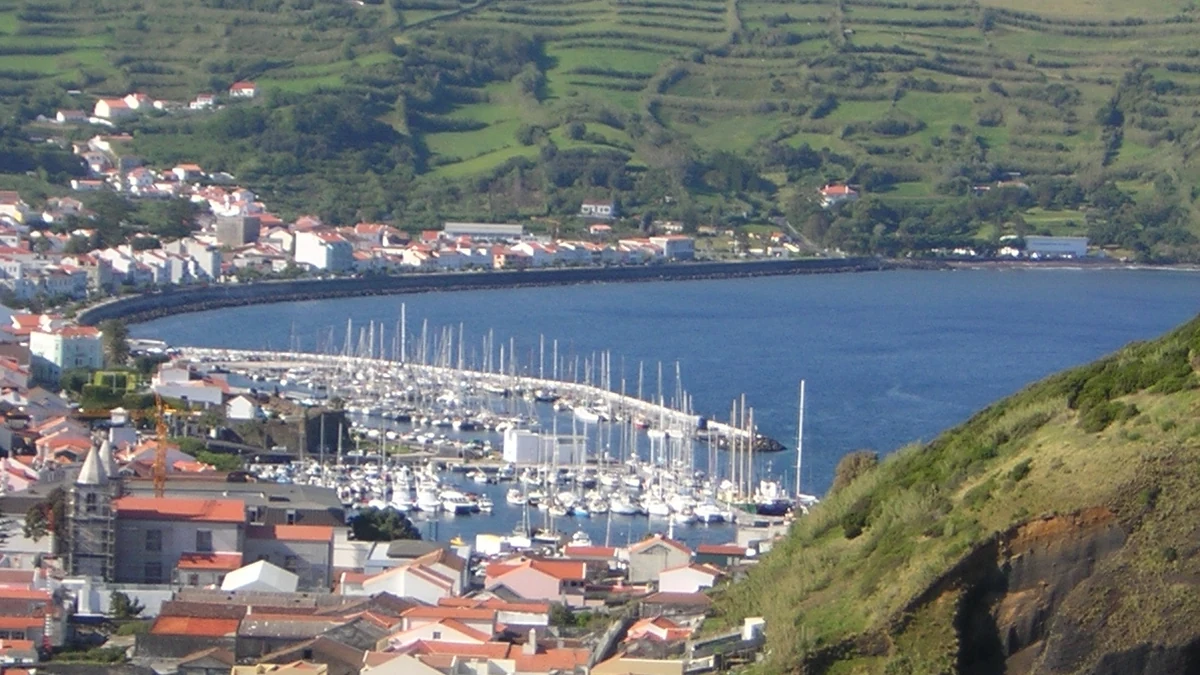
Horta cruise port sits on Faial, one of the central islands of the Azores, facing Pico across a narrow Atlantic channel. Horta is both a practical harbour and a destination with its own character: yachts fill the marina, sailors’ paintings cover the breakwaters, and the town rises behind a waterfront shaped by transatlantic travel.
The cruise-day decision is between an easy Horta day and a vehicle circuit into Faial’s volcanic landscape. The Caldeira and Capelinhos can justify leaving town, but cloud, wind and sea conditions carry more weight here than a fixed sightseeing list. Pico ferries and whale-watching trips are possible on suitable calls; neither should be treated as a casual extra.
Horta Cruise Port at a Glance
| Port name | Horta Cruise Port |
|---|---|
| Main cruise area | Port of Horta and Horta Marina on southeast Faial |
| Cruise region | Canary Islands, Madeira & Azores |
| Country / Territory | Azores |
| Currency | Euro (EUR) |
| Language | Portuguese; English is commonly useful in tourism |
| Disembarkation | Docked or tender, depending on ship and allocation |
| Typical arrival | Commercial harbour or central tender landing near the marina |
| Walkability | High for Horta town |
| Shuttle required | Sometimes, depending on berth and operator arrangements |
| Main transport | Walking; taxi; ferry; organised excursion |
| Best DIY option | Marina, old town and Porto Pim |
| Main caution | Caldeira cloud, sea conditions and over-ambitious Pico or boat-trip timing |
Weather & Best Times to Visit Horta
January to March
Typical high: 16–17°C
Typical low: 11–13°C
Rain / conditions: Mild but wet and changeable, with stronger winds and rougher-sea days more likely.
April to June
Typical high: 17–22°C
Typical low: 12–16°C
Rain / conditions: Gradually warmer with long bright intervals, although showers and crater cloud remain common.
July to September
Typical high: 23–26°C
Typical low: 17–20°C
Rain / conditions: Warmest and generally drier; humidity, sun exposure and sudden cloud on higher ground still matter.
October to December
Typical high: 17–23°C
Typical low: 13–18°C
Rain / conditions: Mild Atlantic autumn turning wetter and windier, with sea conditions increasingly influential.
Weather guide: CruisePing summary based on NASA POWER climate data for Horta and southeast Faial. Check the latest forecast.
At Horta, the forecast should change the route rather than merely the clothing. Low cloud can remove the Caldeira view, while rough seas weaken whale watching and Pico plans; Capelinhos and the town remain stronger fallbacks because their value does not depend on a distant panorama or a second sailing.
Where ships arrive in Horta
Horta’s commercial harbour and marina occupy the southeast side of Faial beside the town. Depending on the ship, berth allocation and harbour conditions, passengers may walk ashore from a berth or arrive by tender. The distinction matters at the edges of the day, but not because the town is far away. Once outside the secure port area or off the tender, Horta’s waterfront, marina, cafés and historic streets are close.
The marina is part of the identity of the place rather than a decorative stop. Atlantic sailors have long used Horta as a staging point, and crews traditionally leave painted emblems on the harbour walls. Peter Café Sport, the marina and the view across to Pico give a local day a clear maritime thread. The town does not need to be padded with distant attractions to become worthwhile.
Faial’s strongest landscape sights, however, are outside Horta. The Caldeira occupies the island’s high interior, while Capelinhos on the western tip preserves the ash-coloured landscape created by the 1957–58 volcanic eruption. Public transport is not designed around a short cruise call. A taxi circuit, pre-booked small-group tour or ship excursion is normally the sensible way to combine them.
The weather decides the island circuit
Faial is green because Atlantic weather changes quickly. A clear view across the Caldeira can disappear into cloud, while Pico’s summit may emerge for only part of the day. Build the order around what you can see rather than treating a fixed itinerary as sacred. Local drivers and guides are useful partly because they understand which side of the island currently offers the stronger conditions.
Capelinhos remains visually interesting in lower cloud because the eruption landscape is close at hand. The Caldeira is less forgiving: if the rim is fully covered, the main reward is lost. In poor visibility, CruisePing would move Capelinhos, Horta’s marina and the town’s museums ahead of a long wait at the crater.
Sea conditions also matter for whale watching, boat tours and the ferry to Pico. A calm morning does not guarantee that an independent inter-island plan will remain convenient through the afternoon. Check official services and the ship’s all-aboard time, then keep a Horta fallback ready.
Best things to do from Horta Cruise Port
Faial Caldeira
Best for: The island’s broad volcanic geography and a high-level view into the central crater.
Best way: Include it in a taxi or organised island circuit. Ask the driver to adapt the order if cloud is sitting on the rim.
Watch: Visibility is the whole point. Exposed paths, wind and damp surfaces make a proper rim walk a different undertaking from a short viewpoint stop.
Capelinhos volcano and interpretation centre
Best for: Faial’s most distinctive recent volcanic story, with ash, lava, lighthouse and Atlantic coast in one stop.
Best way: Visit on a half- or full-island vehicle circuit. Allow time for the landscape as well as the interpretation centre if it is open.
Watch: It is on the far side of the island from Horta. Do not rely on an improvised outward taxi without agreeing the wait or return.
Horta Marina and painted harbour walls
Best for: The easiest low-risk introduction to the island and its Atlantic sailing culture.
Best way: Walk independently from the port, continuing along the waterfront and into the historic centre.
Watch: The marina is exposed to showers and sun. Painted emblems are working-harbour traditions, so stay within public areas and respect barriers.
Porto Pim and Monte da Guia
Best for: A coastal walk, sheltered bay views and a more active local day without crossing the island.
Best way: Walk or take a short taxi depending on your mobility and the weather. A full climb or longer circuit needs more time than the compact map suggests.
Watch: Gradients and exposed sections matter. In heat, rain or strong wind, keep the route to the bay and lower viewpoints.
Whale-watching trip
Best for: Passengers whose main Azores priority is marine wildlife rather than a land circuit.
Best way: Pre-book a reputable departure that explicitly fits the ship’s time in port and confirms the meeting point.
Watch: Sightings are never guaranteed and sea conditions can alter or cancel departures. Avoid a return scheduled close to all-aboard.
Pico as an inter-island day
Best for: Repeat Azores visitors with a long call who want Madalena, vineyards or a view back towards Faial.
Best way: Use the official Atlânticoline service only after checking the exact seasonal timetable in both directions. Pre-arrange transport on Pico if you intend to leave Madalena.
Watch: The crossing adds weather and timetable dependency. Climbing Mount Pico is not a normal cruise-day plan and requires permits, fitness and far more margin.
Horta museums, churches and cafés
Best for: A gentle or poor-weather day that still feels rooted in Faial.
Best way: Combine the marina with one museum, church or historic building and leave time for local food rather than rushing through a list.
Watch: Opening days and lunch closures vary. Check the official tourism information for the date of your call.
CruisePing Recommended Port Day
On a first visit with a normal-length call, CruisePing recommends a pre-booked Faial circuit covering the Caldeira and Capelinhos, with enough flexibility to reverse the order around cloud. Ask whether the route includes a meaningful Horta stop rather than returning directly to the ship. The island’s scale allows a satisfying contrast between crater, eruption coast and maritime town without spending most of the day on a coach.
The best independent alternative is Horta itself: marina paintings, the waterfront, Porto Pim and one indoor attraction or café stop. It is not the consolation prize it can appear on an excursion list. It is the most robust plan if tendering is slow, the crater is hidden or you prefer to avoid a vehicle tour.
CruisePing would not combine a full Faial circuit with a casual ferry trip to Pico. Choose one island strategy. Pico is reasonable only on a long call with confirmed sailings, a generous fallback and a clear reason to go beyond saying you visited two islands.
Choosing between DIY, taxi and excursion
Horta town is emphatically DIY. The port, marina and central streets are close enough that a coach would add little. Use a walking day when you want flexibility, are unsure how early you will disembark, or expect the weather to change.
The island interior is different. A taxi hired for an agreed circuit is often the sweet spot for two to four passengers because it gives control over stops and lets the driver respond to cloud. Confirm the duration, price, route and whether waiting time is included before setting off. Do not assume every taxi at the harbour is available for a long island tour on a busy ship day.
A small-group or ship excursion is stronger when you want guaranteed transport, interpretation and a structured return. Compare how much time is actually spent at Caldeira and Capelinhos. Some “island highlights” products add many photo stops but hurry the two places that justify leaving Horta.
Whale watching and Pico crossings are specialist choices. Book the activity itself rather than trying to bolt it onto a land circuit. Where the operator is independent, tell them the ship name and all-aboard time and ask what happens if the vessel changes arrival mode or misses the call.
A low-pressure Horta walking plan
Start at the marina while the waterfront is still relatively quiet. The painted breakwaters and visiting yachts explain Horta’s role in Atlantic navigation better than a generic souvenir street. Continue towards the town centre, choosing one historic or cultural stop rather than several brief entrances.
From there, decide whether conditions favour Porto Pim. The bay gives a different perspective on Horta and can be combined with the lower slopes around Monte da Guia. A full ascent is not compulsory. Passengers with limited mobility can use a taxi for the outward section and walk back selectively.
Leave space for lunch or a drink where you can see the harbour. Pico may appear, vanish and reappear across the channel. This is one of those ports where waiting ten minutes for the cloud to shift can add more than racing to another minor sight.
Port-day pitfalls and better choices
Fixing the Caldeira at a precise time. Cloud does not respect an excursion sequence. A flexible vehicle circuit is more valuable than a rigidly timed independent taxi drop.
Treating Pico as a quick ferry add-on. The sea crossing is only one part of the plan. You also need matching return sailings and a realistic activity after reaching Madalena.
Booking separate land and sea excursions. A delayed whale-watching return can dismantle the second booking. Choose one headline experience and keep the rest local.
Assuming every Horta call docks. Some arrivals may use tenders. Do not make the first independent connection dependent on an exact walk-off time until the ship confirms the operation.
Leaving no Horta time. A tour that drives straight from harbour to harbour misses the maritime character that distinguishes Faial from a generic volcanic-island circuit.
Using average temperature as the whole clothing plan. The crater rim can be cooler, wetter and windier than the waterfront. Carry a layer and light waterproof even when Horta feels mild.
Horta port-day checklist
- Confirm whether your ship is scheduled to berth or tender and how independent disembarkation will be managed.
- Check cloud and wind as well as temperature before deciding between Caldeira, Capelinhos and a town day.
- Pre-book a taxi circuit or excursion if the island interior is your priority; vehicle capacity is finite on a busy call.
- Ask the driver or operator whether the route can be reversed when the Caldeira is covered.
- Use the official Atlânticoline timetable for any Pico plan and identify a return sailing earlier than the last workable one.
- Wear layered clothing and shoes suitable for damp viewpoints, volcanic surfaces and harbour walking.
- Carry sun protection; Atlantic cloud can hide strong ultraviolet exposure.
- Check whale-watching cancellation and late-return policies before paying.
- Keep a local fallback built around the marina, Porto Pim and town rather than inventing one after an excursion is cancelled.
- Be back near the port well before all-aboard if your day includes a ferry, boat trip or far-west island circuit.
Useful official links for Horta and Faial
- Port of Horta
- Horta Marina
- Official Azores tourism: Faial
- Discover Faial travel planning
- Atlânticoline ferries
- Latest Horta forecast
Horta cruise port FAQs
Do cruise ships dock in Horta?
Some ships can berth in the Port of Horta, while other calls may use tenders depending on vessel size, allocation and conditions. Check the ship’s current information rather than assuming one arrival method.
Can I walk into Horta from the cruise port?
Yes. The marina and central waterfront are close to the port area, making Horta a strong independent walking destination once you are outside any controlled harbour zone.
What is the best first-time excursion from Horta?
A flexible Faial island circuit combining the Caldeira and Capelinhos gives the strongest overview. The order should respond to cloud, and the tour should retain some time in Horta.
Is the Caldeira always worth visiting?
It is a major sight when visibility is good. If the rim is covered by low cloud, Capelinhos and Horta are often better uses of limited cruise time than waiting for a view that may not open.
Can I visit Pico during a Horta cruise call?
It can work on a long call with suitable official ferry times and a large return margin. Decide what you will do after reaching Madalena and avoid relying on the last possible ferry.
Is whale watching safe to book independently?
Independent booking can work when the departure is designed around cruise calls and the operator understands your ship time. Sea conditions may cancel or delay trips, so examine the terms and protect the return.
Is Horta good for passengers with limited mobility?
The central waterfront is relatively manageable, but some pavements, slopes and volcanic attractions are more demanding. A taxi can make Porto Pim or a selected island viewpoint more accessible, subject to the operator’s vehicle arrangements.
What should I do in poor weather?
Use the marina and town between showers, add an indoor museum or church, and consider Capelinhos if road conditions are suitable. A fully clouded Caldeira and rough-sea boat trip should not be forced.
Do I need euros in Horta?
The euro is the local currency. Cards are commonly useful, but carry a modest cash reserve for small purchases or a taxi arrangement and check fees with your bank.
How much return margin should I allow?
A town day needs less margin than a Pico ferry, whale-watching trip or western-island circuit. For any sea-based or distant option, plan to finish substantially before all-aboard and keep an earlier fallback connection.
Matching the Faial plan to the length of the call
A short Horta call favours the marina, town and Porto Pim. Even if an island taxi is available, a hurried drive to one cloudy viewpoint offers less than a coherent waterfront route. Use the local day to learn why Horta matters to Atlantic sailors and retain a comfortable berth or tender return.
With six to eight usable hours, a Caldeira-and-Capelinhos circuit becomes the strongest choice. Ask the operator to keep the final hour flexible for Horta rather than adding another distant stop. A longer call makes Pico or whale watching more realistic, but only as the principal experience. It does not make two separate marine timetables risk-free.
Passengers starting late because of tendering should ask a driver what remains worthwhile under the current cloud rather than demanding the full advertised circuit at double speed. Faial’s roads are manageable, but the island rewards observation. A shorter visit to Capelinhos with time in Horta is better than reaching both headline sites after the conditions that made them attractive have disappeared.
CruisePing Port Verdict
Horta is two excellent port days sharing one harbour. The ambitious version is a weather-aware circuit to the Caldeira and Capelinhos; the relaxed version is an Atlantic town of painted marina walls, Porto Pim and views towards Pico. Both are better than a frantic attempt to combine Faial, whale watching and another island. Pick the experience that depends most on conditions, secure it early, and let Horta absorb the rest of the day.
Ready to browse our article library?
Explore more ports in the Canary Islands, Madeira & Azores, or narrow it to the Azores in particular. For cruise comparisons, planning shortcuts and value guides, head over to our main article library.