
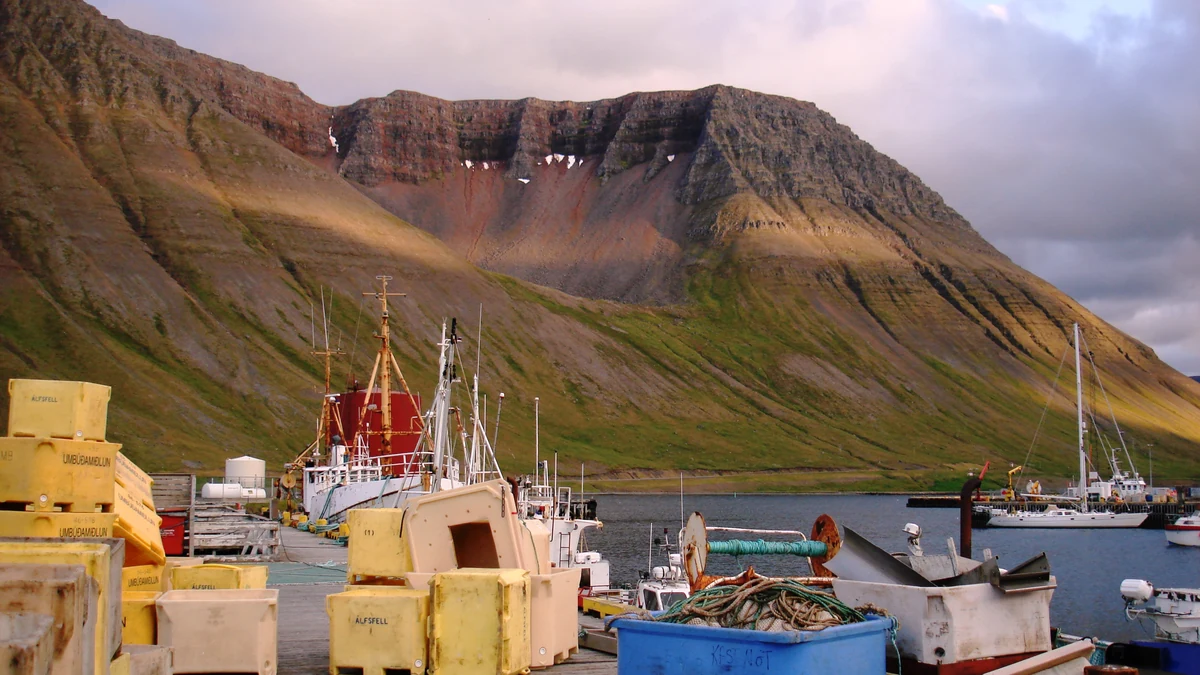
Isafjordur cruise port sits deep in Iceland’s Westfjords, where a compact fishing town occupies a narrow shelf beneath steep mountains. Many ships berth close enough for passengers to walk into town; others may tender when quay capacity is tight. The easy arrival should not disguise the harder excursion question, because Dynjandi and the surrounding villages require finite vehicles and substantial road time.
Dynjandi is the headline choice for many first-time visitors and deserves advance booking if it matters. Bolungarvík, Ósvör Maritime Museum, Súðavík and the Arctic Fox Centre create closer alternatives. Staying in Ísafjörður also works: historic buildings, maritime heritage and local food make a coherent day without gambling on a last-minute seat or a distant return.
Ísafjörður Cruise Port at a Glance
| Port name | Ísafjörður Cruise Port |
|---|---|
| Main cruise area | Sundabakki and other Ísafjörður harbour facilities; tendering may supplement berth capacity |
| Cruise region | Antarctic / Arctic |
| Country / Territory | Iceland |
| Currency | Icelandic króna (ISK) |
| Language | Icelandic; English is widely useful in tourism |
| Disembarkation | Docked or tender |
| Typical arrival | Short walk into town from the assigned quay or tender landing |
| Walkability | High for central Ísafjörður |
| Shuttle required | No for the town |
| Main transport | Walking; local bus; taxi; organised excursion |
| Best DIY option | Old town, harbour and Westfjords heritage |
| Main caution | Excursion capacity, long Westfjords roads, changing weather and multi-ship congestion |
Weather & Best Times to Visit Ísafjörður
January to March
Typical high: 1–4°C
Typical low: -5–-1°C
Rain / conditions: Cold, snowy and windy with limited daylight; winter access and cruise activity are highly specialised.
April to June
Typical high: 4–11°C
Typical low: -1–6°C
Rain / conditions: Cool with rapidly lengthening days; snow can linger on higher ground and rain or wind remains common.
July to September
Typical high: 9–13°C
Typical low: 5–8°C
Rain / conditions: Cool main cruise season with long daylight, frequent cloud and rapidly changing rain and wind.
October to December
Typical high: 1–7°C
Typical low: -4–2°C
Rain / conditions: Darkening, colder and increasingly wintry, with snow, wind and road conditions becoming central.
Weather guide: CruisePing summary based on NASA POWER climate data for Ísafjörður and the central Westfjords. Check the latest forecast.
Low cloud can hide Westfjords viewpoints and make a long scenic drive less rewarding, while rain turns the approach at Dynjandi slippery. Wind matters most for kayaking, small boats and tendering. A poor panorama day still supports Ísafjörður’s heritage museum, town walk and a focused village visit.
Docking, tendering and the first five minutes ashore
Ísafjörður has several harbour facilities, and the port publishes a changing cruise schedule rather than one permanent arrival point for every vessel. Many ships berth at Sundabakki or another designated quay, while tendering can be used when berth capacity or vessel requirements demand it. Follow the ship’s current information, particularly on days when several cruise ships are listed.
Once ashore, the town is close. The port itself notes the short walk into central Ísafjörður, and the distinctive flat area of the town sits between steep mountains and the fjord. You do not need a shuttle to create a useful local visit. The practical pressure comes from the opposite direction: excursion vehicles and guides are finite, while popular road tours leave the town through tunnels and around long fjords.
Multiple-ship days can change the atmosphere. Coaches load in waves, cafés fill quickly and the most desirable small-group departures sell out. The port may introduce traffic controls or different passenger routes when call volume is high. Do not assume that a walkable arrival means you can wait until the pier to buy a seat for Dynjandi.
Ísafjörður is a destination, not merely a bus park
The old town contains timber buildings, local museums, cafés and a working fishing-port character that disappears when passengers board a coach immediately. A town day works particularly well after a slow tender start, in poor road weather or for anyone who has already seen Iceland’s larger waterfalls.
The Westfjords Heritage Museum, housed in historic buildings at Neðstikaupstaður, is the natural anchor for maritime history where current opening permits. A guided town walk can add stories that the compact streets do not reveal by themselves. The harbour, church, residential streets and viewpoints towards the surrounding mountains create a route that can be shortened without losing the whole experience.
Do not oversell casual hiking from the ship. Mountains rise sharply around the town, and marked routes vary in gradient, exposure and time. A passenger seeking a gentle independent walk should stay around the lower town and waterfront. Longer hill routes require proper clothing, current local advice and enough time to turn back without negotiating the final descent against all-aboard.
Best things to do from Isafjordur Cruise Port
Dynjandi waterfall
Best for: The headline Westfjords landscape and a waterfall whose broad, stepped form is unlike Iceland’s most common roadside falls.
Best way: Pre-book a cruise-compatible coach, small-group or private tour. The journey is part of a substantial road excursion, not a quick taxi ride from town.
Watch: Weather, road conditions, vehicle capacity and walking surfaces at the falls. Verify how much time the tour allows outside the vehicle.
Ísafjörður old town and heritage museum
Best for: The strongest independent plan, local fishing history and a day that remains useful after delays.
Best way: Walk from the ship, adding a guided town tour or the official museum when opening aligns.
Watch: Seasonal opening and crowd concentration on multi-ship days. Start with the museum if it matters, then use the flexible outdoor route.
Bolungarvík and Ósvör Maritime Museum
Best for: Fishing heritage, coastal scenery and a shorter regional outing than Dynjandi.
Best way: Use a pre-arranged tour or taxi through the tunnel to Bolungarvík, checking whether Ósvör is open for the date of your call.
Watch: The open-air museum has a defined season and exposed coastal setting. Agree the return rather than expecting a waiting taxi.
Súðavík and the Arctic Fox Centre
Best for: Wildlife interpretation, families and a focused half-day road excursion.
Best way: Book a small-group or private transfer that includes the centre and enough time in Súðavík.
Watch: The centre is an exhibition and research organisation, not a guaranteed wild-fox sighting. Confirm current animal and visitor arrangements directly.
Westfjords village circuit
Best for: Passengers who want tunnels, fjord roads and settlements such as Suðureyri or Flateyri without committing to the longer Dynjandi route.
Best way: Choose an organised circuit with a clear theme: fishing culture, scenery or local food. Smaller vehicles often suit village stops better than a full coach.
Watch: Several village names can disguise long vehicle time. Ask for the minutes spent at each stop.
Kayaking or small-boat activity
Best for: Active travellers who want to experience the fjord at water level.
Best way: Pre-book a specialist operator providing equipment, safety briefing and a finish comfortably before the ship deadline.
Watch: Wind and cold-water conditions. A suitable activity for one passenger may be inappropriate for another; check experience and mobility requirements.
Hornstrandir or remote wildlife boat trip
Best for: Repeat visitors and expedition-minded travellers with a long call and a specific remote objective.
Best way: Only through a specialist cruise-compatible operator whose boat, landing and return plan match the ship.
Watch: This is weather-sensitive and logistically fragile. Do not confuse a full wilderness visit with a short scenic cruise near the harbour.
CruisePing Recommended Port Day
If Dynjandi is one of the reasons you booked a Westfjords itinerary, reserve a cruise-compatible tour before sailing. It is the strongest first-time excursion from Ísafjörður, but it should be chosen as the day’s main project. CruisePing would favour a smaller group or well-paced ship excursion that allows meaningful time at the waterfall over a route that adds several brief village stops.
If Dynjandi is sold out, cloud and road conditions are poor, or you prefer less coach time, choose either Bolungarvík with Ósvör or Súðavík with the Arctic Fox Centre. They are not attempts to imitate the waterfall. They offer closer, more focused views of fishing culture or Westfjords wildlife interpretation.
The best DIY day remains Ísafjörður itself. Visit the heritage museum where open, follow a town walk and leave time for local food. On a crowded call, starting in town while excursion coaches depart can produce a calmer morning; a short pre-booked afternoon activity may then fit without turning the day into a transport race.
Why Dynjandi needs advance planning
Dynjandi is often marketed as if it were simply “the waterfall near Ísafjörður”. The Westfjords road network tells a different story. Reaching the site requires a substantial drive through a remote landscape, and the same road relationship must be reversed before the ship sails. Conditions can change with weather, road work and traffic generated by several coaches.
Ask the operator for the approximate time at Dynjandi as well as the total tour length. The lower viewpoint is not the entire visit. Paths lead past smaller cascades towards the principal fall, with uneven and potentially wet surfaces. Passengers who cannot complete the full approach can still appreciate the landscape, but should understand how far the group is expected to walk and where facilities are located.
Independent car hire is rarely the easy bargain it first appears. Vehicle availability is limited, rental collection consumes time and the driver carries full responsibility for unfamiliar roads and the return. A private driver can preserve flexibility without those disadvantages, although prices rise quickly on a high-demand call.
A ship excursion offers the clearest protection if a road delay occurs. That protection does not automatically make every ship tour well paced, so compare descriptions. A long coach convoy with a short site stop may be less satisfying than a reputable local small group returning earlier.
Can public transport replace a shore excursion?
Local buses connect Westfjords communities, but they are community services rather than a turn-up-and-go sightseeing network. Schedules can be infrequent, date-specific and poorly aligned with ships. They are not the sensible default for Dynjandi.
A bus or taxi may support a carefully planned visit to Bolungarvík or Súðavík, but the return must be confirmed before leaving. On a busy day, assuming taxis will be waiting in a smaller village is unsafe planning. Agree collection or use a tour that retains the vehicle.
Walking eliminates timetable risk inside Ísafjörður. That simplicity is valuable on a port day where every distant option depends on the same limited road corridors. Spend money on an excursion because it reaches a place you genuinely want, not because the town looks too small on a map.
Mobility and surfaces
A berth makes disembarkation easier than a tender for many passengers, but the ship may not know the final arrangement until closer to the call. Ask about gangway slope, shuttle or tender policy if mobility affects the decision to book a non-refundable excursion.
Central Ísafjörður is manageable for many visitors, although kerbs, weather and walking distance still matter. Excursions introduce coach steps, gravel, wet paths and uneven terrain. Dynjandi’s path is the obvious challenge; Ósvör’s open-air coastal site and exposed viewpoints can also be slippery.
Request exact information rather than a broad “easy” label. How far is the vehicle from the attraction? Can a passenger remain at a lower viewpoint? Is there a toilet on the coach? Can a folding wheelchair be carried? A route with modest total walking can still be difficult when every stop involves high steps or loose ground.
Crowds, capacity and timing
Ísafjörður’s resident scale is small beside the passenger count of several cruise ships. The pressure appears in vehicles, guides and indoor seating more than in the length of the walk from port. Pre-book the excursion that matters and remain flexible about lunch timing.
At Dynjandi, multiple coaches can arrive in clusters. A tour departing slightly earlier or later may improve the visit, but only if it still protects the return. In town, the heritage museum and popular cafés may be busiest immediately after excursion groups return. Consider eating before the standard coach wave or choosing a less obvious venue.
Do not interpret crowds as a reason to stay on the ship. The town remains easy to explore, and a guided walk can reveal residential streets and harbour perspectives beyond the busiest block. The better response is to distribute the day, not to add a longer excursion automatically.
Weather alternatives that still feel specific
Low cloud can flatten distant mountain views, but it does not remove the town’s maritime history. Rain favours the heritage museum, cafés and a shorter guided walk. Wind may cancel kayaking or small-boat products while road excursions continue.
If the Dynjandi operator changes the route, ask what replaces the waterfall and why. A village or museum can be a good alternative; a vague “panoramic drive” should not be accepted as equal value without detail. Independent travellers should keep waterproof clothing accessible rather than buried in the ship cabin, because conditions can change between the quay and a fjord viewpoint.
Ísafjörður pitfalls and value choices
Waiting until the pier for Dynjandi. Vehicle seats are finite, especially on a multi-ship day. Book the priority excursion before sailing.
Counting village names instead of time outside. Three settlements seen from a minibus are not necessarily better than one museum and a proper coastal stop.
Assuming a docked call cannot tender. Berth assignment depends on the day’s schedule and vessel. Read the ship’s latest information.
Using public buses as a tour network. A timetable designed for local travel may not provide a safe round trip during the call.
Underestimating Dynjandi’s path. The lower view is worthwhile, but the full experience uses wet, uneven ground and gradual ascent.
Ignoring the town. A long road tour can leave no time for Ísafjörður’s historic buildings and harbour. Even 45 minutes after an excursion adds local context.
Booking two weather-sensitive activities. Kayaking plus a remote boat trip creates cancellation and return problems. Choose one specialist experience.
Ísafjörður port-day checklist
- Check the official cruise schedule and the ship’s berth or tender information close to the call.
- Pre-book Dynjandi, a private driver or any small-capacity wildlife activity that matters to you.
- Ask how long the tour spends at the principal attraction and how much is coach time.
- Confirm walking distances, surfaces and coach access for Dynjandi, Ósvör or other outdoor stops.
- Pack a waterproof layer, warm mid-layer and shoes with grip even in midsummer.
- Use the Icelandic Met Office forecast and current road information rather than a generic monthly summary alone.
- For Bolungarvík or Súðavík, arrange the return before leaving Ísafjörður.
- Keep the heritage museum and town walk as a fallback after delayed arrival or excursion cancellation.
- Allow for queues and slower service when several ships are in port.
- Do not rely on the last theoretical public bus, taxi or excursion return.
- Finish distant road tours with enough margin for traffic controls around the port.
- Leave some time to see Ísafjörður itself instead of moving directly between gangway and coach.
Useful official links for Ísafjörður
- Port of Ísafjörður
- Official Ísafjörður cruise schedule
- Port visitor information
- Visit Westfjords: Ísafjörður
- Dynjandi waterfall
- Ósvör Maritime Museum
- Arctic Fox Centre
- Icelandic Met Office
Ísafjörður cruise port FAQs
Do cruise ships dock in Ísafjörður?
Many ships berth at one of the port facilities, while tendering can be used when berths are occupied or vessel requirements call for it. Check the official schedule and the ship’s daily information.
Can I walk into town from the port?
Yes. Central Ísafjörður is close to the harbour and is a strong independent visit. The exact distance depends on the assigned berth or tender landing.
Is Dynjandi worth the drive?
For passengers seeking the principal Westfjords landscape excursion, yes. It requires substantial road time and advance booking, so it should be the main plan rather than one item in an overloaded day.
Can I reach Dynjandi by public bus?
Local public transport is not a dependable cruise-day solution for Dynjandi. Use a cruise-compatible excursion, small-group tour or private driver.
What is the best alternative to Dynjandi?
Bolungarvík and Ósvör suit maritime-history interests; Súðavík and the Arctic Fox Centre suit wildlife interpretation and families. Ísafjörður itself is the lowest-risk alternative.
Is the Arctic Fox Centre a wildlife safari?
No. It is a research and exhibition centre focused on Iceland’s native terrestrial mammal. Check its current visitor and animal arrangements before booking a transfer.
What can I do independently in Ísafjörður?
Walk the old town and harbour, visit the Westfjords Heritage Museum when open, join a guided town walk and use cafés or local shops. Longer hikes require more preparation.
Is Ísafjörður crowded on cruise days?
It can feel busy when several ships call because excursion vehicles and central venues are limited. The town remains walkable; starting early or timing lunch outside the coach wave helps.
Are taxis readily available?
Supply is limited relative to a large ship. Pre-arrange a long taxi tour or village return rather than assuming a vehicle will be waiting.
Is this a good port for limited mobility?
The town can be manageable, particularly from a berth, but tendering and outdoor excursion surfaces may be difficult. Ask the ship and operator for exact access details.
What weather causes the biggest problem?
Low cloud weakens panoramic views, while wind can stop kayaking or boat trips. Rain alone does not necessarily cancel road excursions, though it makes paths slippery.
How early should I return?
Distant road tours should be scheduled to reach the port well before all-aboard. Independent village trips need an earlier fallback, and tender calls require time for the final water transfer.
Do I need Icelandic cash?
Cards are widely used in Iceland. A small cash reserve is optional, but check whether a small operator or community venue has a specific payment arrangement.
What is CruisePing’s first choice?
Pre-book Dynjandi when it is a priority and the tour is well paced. Otherwise, choose one closer regional theme and retain time for the town rather than buying the longest possible coach itinerary.
Choosing the right excursion duration
A two- to three-hour outing is best used close to Ísafjörður. Bolungarvík, Ósvör, Súðavík or a guided local nature and culture tour can fit without devoting the day to the road. These shorter products are particularly useful after a tender delay or for passengers who want half the call free in town.
Dynjandi belongs in the longer category. The drive, site approach and return need enough room that the waterfall does not become a photograph between coach doors. When two tours advertise Dynjandi at different durations, ask whether the shorter product reduces site time, removes a secondary stop or simply uses a smaller vehicle. The answer is more informative than the headline price.
Full-day remote products towards Hornstrandir or the farther Westfjords require specialist logistics and a generous call. They should not be booked because the itinerary sounds dramatic. Confirm the vessel, landing, physical demands, meals, clothing and contingency if wind prevents the planned route. For most conventional cruise passengers, one road excursion plus Ísafjörður provides a better balance.
Protect the final hour. A tour that reaches town early leaves room for the heritage museum, food and a relaxed gangway. A tour scheduled to use every minute leaves no tolerance for road controls, a coach queue or a tender return.
CruisePing Port Verdict
Ísafjörður offers a rare choice between an easy walk-off town and a remote road excursion that genuinely deserves advance planning. Dynjandi is the headline, but it is not the only successful answer. Bolungarvík, Súðavík and the town itself give stronger days than a rushed waterfall seat bought at the last minute. Secure one meaningful experience, respect the scale of Westfjords roads and finish with enough time to see the harbour that made the excursion possible.
Ready to browse our article library?
Explore more ports in the Antarctic & Arctic region, or narrow it to Iceland in particular. For cruise comparisons, planning shortcuts and value guides, head over to our main article library.