
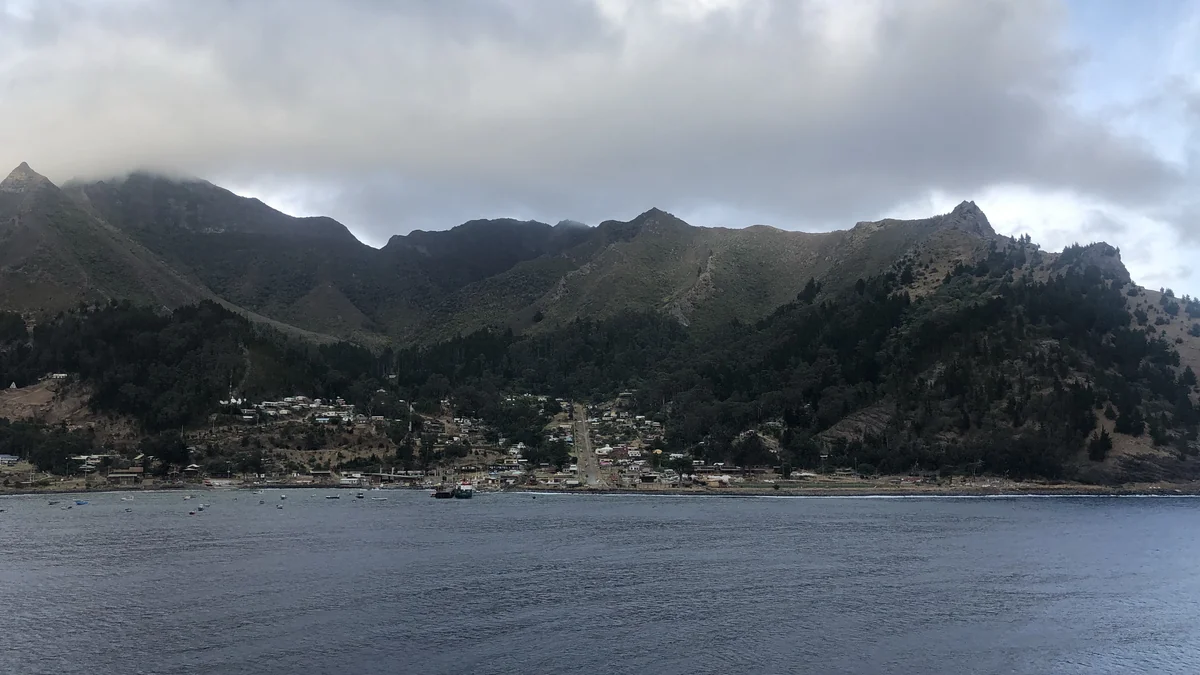
Isla Robinson Crusoe cruise port is an expedition-style landing in Cumberland Bay, below the steep settlement of San Juan Bautista. There is no conventional terminal and little reason to search for an independent taxi tour; the ship’s landing plan, local guides and sea conditions decide what is safely possible.
The island deserves a focused day built around its endemic ecology, Alexander Selkirk history and the community itself. Walk San Juan Bautista and one nearby historical route, or join one properly guided national-park or boat activity. Skip any attempt to combine a major mountain hike, diving, village sightseeing and a distant bay within a single call.
Isla Robinson Crusoe Cruise Port at a Glance
| Port name | Isla Robinson Crusoe |
|---|---|
| Main arrival area | Muelle Fiscal in San Juan Bautista, Cumberland Bay |
| Cruise region | South America / Galapagos |
| Country / Territory | Chile |
| Currency | Chilean peso (CLP) |
| Languages | Spanish |
| Port role | Day Call |
| Disembarkation | Tender or local launch |
| Walkability | Good in the village; difficult beyond it |
| Shuttle required | No |
| Main transport | Walking, expedition guide, small boat and limited local vehicle |
| Best first-time plan | Guided San Juan Bautista and Selkirk history, with one short nature trail or bay activity |
| Main caution | Swell, wind and steep protected trails can cancel or radically shorten the landing |
Cumberland Bay Controls the Entire Call
Ships anchor in or off Cumberland Bay and transfer passengers to the fiscal pier at San Juan Bautista when conditions allow. The surrounding slopes create a dramatic arrival, but the bay is not guaranteed calm. A change in wind direction or swell can suspend operations even when the village is visible and the sky is clear.
The official San Juan Bautista information identifies the pier as the practical access point for local boats and trails. Follow the expedition team’s landing order and do not treat a delay as lost independent time that can be recovered by walking faster. The ship may need to withdraw tenders before the advertised departure.
San Juan Bautista Deserves More Than a Transit Walk
The settlement climbs from the waterfront into a narrow valley. Its houses, fishing activity, civic buildings and tsunami memorial context explain how a remote community lives with isolation, weather and the sea. A guided walk helps passengers distinguish everyday island life from the literary story attached to the name Robinson Crusoe.
Allow residents room around the pier and working waterfront. Cruise groups can dominate the main route quickly. Buy local food or crafts where available, ask before photographing people and avoid treating storm or tsunami rebuilding as visual entertainment.
Alexander Selkirk Is the Historical Thread
Scottish sailor Alexander Selkirk lived alone in the archipelago in the early eighteenth century and later became associated with the inspiration for Daniel Defoe’s novel. A good guide separates documented history from the many stories that have accumulated around it. That distinction makes the island more interesting, not less romantic.
Nearby caves, viewpoints and interpretation can be combined with the village, depending on the ship’s programme. Do not expect a single preserved “Crusoe house”. The landscape, lookout logic and isolation are the evidence. A short historical route is more appropriate for most calls than an ambitious trek to a high viewpoint.
The National Park Is the Main Natural Asset
The Archipiélago de Juan Fernández National Park protects an island system with exceptional endemism. Visitors should not remove seeds, plants, shells or natural material, and they must follow closures and biosecurity measures designed to protect species found nowhere else.
Clean soil from footwear before landing, keep to the guide’s path and never introduce food, plant matter or animals. Expedition lines often manage this before disembarkation. Independent passengers should not dismiss the process as bureaucracy: invasive species are a direct threat to the island’s flora and nesting birds.
Endemic Wildlife Is Observed, Not Chased
The Juan Fernández firecrown, fur seal and distinctive plant life are sought-after sightings, but none is guaranteed close to the pier. Choose a naturalist-led walk for habitat and interpretation rather than a promise of a particular animal. Remain quiet around birds and respect any seasonal exclusion area.
A telephoto lens or binoculars gives a better experience than stepping off-trail for a photograph. Do not feed birds or ask boat operators to approach resting seals too closely. The island’s conservation value is the reason for visiting; disturbing wildlife to prove the visit defeats that purpose.
Selkirk Lookout Is for Fit, Prepared Walkers
The route associated with Selkirk’s lookout climbs strongly through exposed and forested terrain. It can be wet, muddy or hot, and the time shown on a land-holiday guide is not automatically suitable for a cruise landing. A full ascent needs a long call, an early authorised start and a guide who can turn the group back.
For most passengers, a lower trail or village-history circuit is the better choice. The high walk is worth prioritising only when the ship specifically offers it and the expedition leader confirms conditions. Do not leave a guided group to continue independently; route-finding and return timing are not trivial.
Patriot Caves and the Waterfront Fit a Normal Landing
The caves associated with Chilean patriots exiled during the independence era offer a manageable historical objective near San Juan Bautista. They pair naturally with the village and do not require the same commitment as a high mountain route. Exact access and interpretation should still come from the local guide.
Add the waterfront, cemetery or memorial points only when the route remains coherent. The value is in understanding several layers of island history—Selkirk, exile, fishing, naval events and natural hazards—rather than collecting every named feature on a hurried map.
The Dresden Story Belongs to the Bay
The German cruiser Dresden was scuttled in Cumberland Bay during the First World War. Divers may visit the wreck under controlled conditions, while non-divers can understand the event from the shore or a guide’s explanation. It is a significant maritime story, but the wreck is not a casual snorkelling site.
Only certified divers with an approved operator, suitable equipment and a ship schedule built around the dive should consider it. For a first expedition call, the village and national-park ecology offer a more reliable day. Do not book an informal dive after landing without clear safety, medical and return arrangements.
Boat Trips Need a Clear Purpose
Chile Travel notes that boats can be arranged from the pier to reach trails and distant bays. A short launch trip can reveal cliffs, sea caves, seabirds or fur seals, but it should have a defined route and return. Ask about flotation, spray protection, seating and the ability to reboard the pier in changing swell.
Choose a boat when the naturalist value is clear or when it replaces a land walk. Do not add one merely because it is offered at the waterfront. A second small-boat transfer after the ship tender increases fatigue and exposure, especially for passengers with back, knee or balance problems.
Local Lobster Is Special but Seasonal
Juan Fernández lobster is central to the island economy and can be an excellent meal when legally available. It is not a guaranteed cruise-day product, and a small community cannot instantly serve a large passenger group. Pre-arranged ship or local lunches are more realistic than expecting every restaurant to have spare capacity.
Ask the price and preparation before ordering, and accept that weather or fishing rules affect supply. A simpler fish dish or home-style meal may offer a better local experience than an expensive lobster served under time pressure. Pay in Chilean pesos where practical.
Weather Protection Matters Even in Summer
Cumberland Bay can move quickly between sun, cloud, wind and rain. Carry a light waterproof layer and secure hat rather than relying on a tropical-island image. The Humboldt-influenced setting is cooler and more changeable than many passengers expect from the latitude.
Footwear should grip wet pier surfaces, village slopes and natural paths. Dress in layers that can be removed during a climb and replaced on an exposed boat. A spare dry layer in a waterproof bag is more useful than formal town clothes.
Mobility Is the Limiting Factor
The tender and fiscal pier may involve moving steps, narrow boarding points and assistance from crew. Above the waterfront, gradients increase quickly. There is limited accessible transport and little scope to create an equivalent version of every expedition activity.
Passengers with restricted mobility should ask whether a sheltered launch landing and short village route are possible. Remaining aboard can be the safer decision when swell is high. A ship excursion cannot remove the physical realities of the pier, but it can provide the clearest assessment and assistance.
Booking and Permissions Should Be Settled Before Arrival
National-park visits may require current arrangements or reservations through Chile’s park system, including Pases Parques. Expedition ships commonly coordinate group access, guides and biosecurity. Independent passengers should not assume they can step ashore and negotiate entry to any trail.
Confirm the included programme before buying a duplicate private tour. On remote expedition calls, the ship’s naturalists often provide the strongest interpretation and the most accountable return. Local services are best added only when the ship explicitly allows independent activity and the operator is expecting the call.
The First and Last Tender Deserve More Margin Than Usual
Cumberland Bay is exposed enough that loading conditions can change during the call. An outward trip that felt straightforward does not guarantee the same platform height, swell or boat position on return. Attend the ship briefing, take only a small day bag and watch the crew’s instructions rather than copying the passenger in front.
Return before the published final tender if you have been on a trail or boat trip. Expedition teams may operate a rolling shuttle rather than a fixed public timetable, and weather can compress the service. The village has no alternative transport route to an offshore ship; protecting the transfer is more important than completing one extra historical stop.
Village Services Are Small and Conservation-Led
San Juan Bautista supports residents, park work and expedition visitors, but it should not be approached as a shopping port. Carry Chilean pesos, expect limited card connectivity and buy food or locally made products without demanding a large tourism selection. Ask before photographing people, fishing activity or private recovery work around homes.
Water, waste and imported supplies are constrained on a remote oceanic island. Refill on the ship, avoid disposable purchases where possible and take all personal rubbish back. A guide or host who explains conservation and island logistics adds more value than a rushed list of viewpoints, particularly when trail access has been reduced by weather.
DIY or Organised Tour?
This is not a port where CruisePing recommends a fully independent day. Walk within the village only when the ship permits free time and the tender schedule is clear. Use the ship expedition programme or a pre-arranged local guide for trails, historical sites, boats and wildlife.
The ship excursion is usually the best choice because it coordinates landing windows, park access, biosecurity and changing conditions. A local guide can add depth when contracted through the expedition line or booked well before arrival. Avoid on-the-spot offers that separate you from the ship’s return system.
CruisePing Recommended Port Day
Join the ship’s guided landing into San Juan Bautista, then follow a village-and-history route covering the waterfront, Selkirk context and one nearby site such as the Patriot Caves. Add a naturalist-led lower trail if conditions and group ability allow, keeping the high slopes as scenery rather than a target.
On a long, calm call, replace the lower walk with either a pre-approved Selkirk Lookout hike for fit passengers or one short naturalist boat trip. Do not combine both. The best Robinson Crusoe day protects the landing window and leaves enough attention for the community and endemic environment.
When the park closes a trail, accept the village-and-bay plan. Local history, endemic species interpretation and Cumberland Bay still justify going ashore without forcing a substitute hike.
Weather & Best Time to Visit Isla Robinson Crusoe
| Period | Typical high | Typical low | Cruise-day implication |
|---|---|---|---|
| December–February | 22°C | 15°C | Mildest period, but cloud, wind and swell can still interrupt tendering |
| March–May | 20°C | 13°C | Cooling with more changeable conditions; carry layers and rain protection |
| June–August | 16°C | 10°C | Cooler and wetter with greater landing and trail risk |
| September–November | 19°C | 12°C | Spring variability; paths may remain wet while winds shift quickly |
Check the Dirección Meteorológica de Chile forecast, but let the ship’s bridge and expedition leader decide whether Cumberland Bay is safe. A numerical forecast cannot capture the exact combination of swell, pier movement and tender capability.
Conditions should determine the activity hierarchy. If the bay is marginal, take the short village programme. If rain has saturated the trails, choose history or a controlled boat only when marine conditions are better. Never try to recover a delayed landing by accelerating a steep hike.
Isla Robinson Crusoe Cruise Port FAQs
Where do cruise passengers land on Robinson Crusoe Island?
When conditions permit, tenders or local launches use Muelle Fiscal at San Juan Bautista in Cumberland Bay. The ship may alter or cancel the landing because of swell.
Can I visit independently?
Limited village free time may be possible, but the recommended plan is the ship’s expedition programme or a pre-arranged local guide. Trails, boats and park access should not be improvised.
Is the Selkirk Lookout hike suitable for a cruise day?
Only for fit walkers on a long call when the ship offers or approves the route. It is steep, condition-dependent and should be the main activity.
What is the main reason to visit?
The strongest combination is endemic nature, the lived community of San Juan Bautista and the layered Selkirk, exile and maritime history.
Useful Official Links
- Chile Travel: Robinson Crusoe Island
- Chile Travel: San Juan Bautista
- CONAF Juan Fernández National Park
- Pases Parques
- MeteoChile
CruisePing Port Verdict
Isla Robinson Crusoe is an expedition landing, not a conventional port day. Follow the ship’s operational lead, use local and naturalist interpretation, and choose one route that fits the conditions.
The village, Selkirk story and endemic ecology are genuinely worth prioritising. The high lookout, wreck dive and distant bays are specialist alternatives rather than compulsory sights. A shorter completed landing is better than a cancelled or unsafe attempt to do everything.
Ready to browse our article library?
Looking beyond Isla Robinson Crusoe? Explore more ports in the South America / Galapagos region, or narrow it to Chile in particular. For cruise comparisons, planning shortcuts and value guides, head over to our main article archive.