
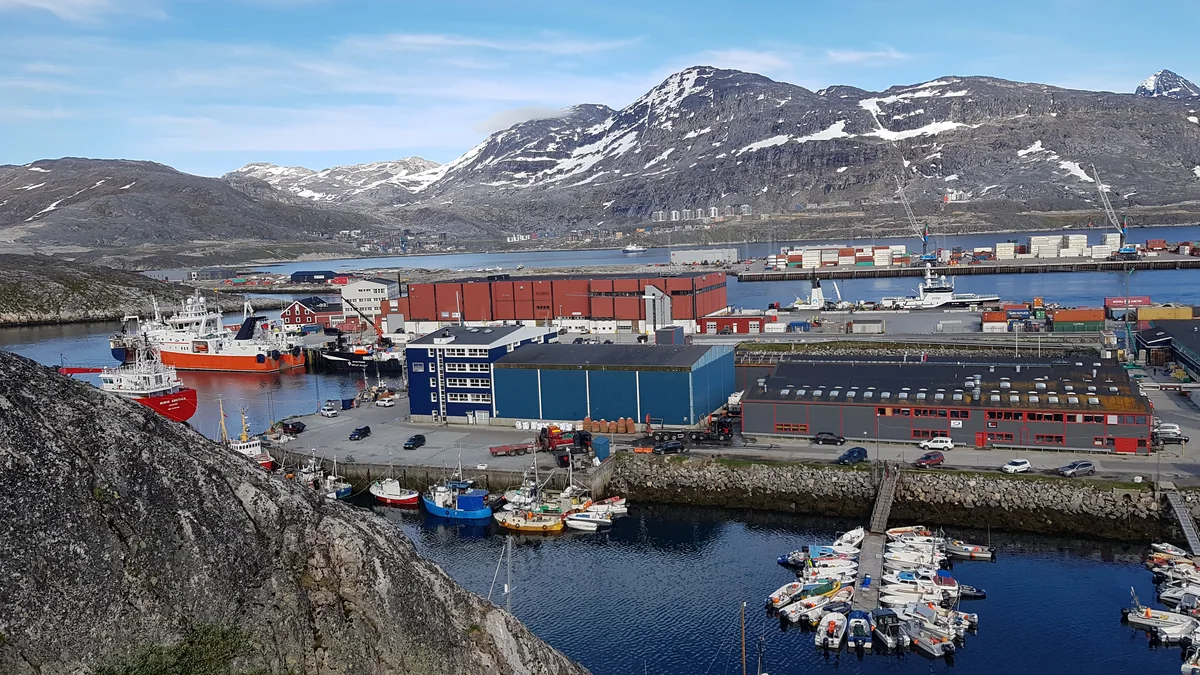
Nuuk cruise port introduces Greenland through a capital that is both distinctly Arctic and recognisably urban. Colourful colonial buildings stand close to modern apartments, government offices, cultural venues and a busy working harbour, while mountains and a vast fjord system frame the city. The best port day is not to rush through Nuuk on the way to “real Greenland”. The capital itself is the destination, and its museums, waterfront and contemporary life deserve the first part of the call.
Cruise arrivals can use different areas of the expanding Port of Nuuk, and the route into the centre varies by berth, ship and local operations. Some passengers may walk from a suitable berth; others may be directed to a shuttle, controlled pedestrian route or tender landing. CruisePing would confirm the ship’s final instructions before committing to a timed city tour or boat. The sensible first visit combines the National Museum and colonial harbour with central Nuuk, then adds a fjord excursion only when the call is long and the operator is reliable.
Nuuk Cruise Port at a Glance
| Port name | Nuuk Cruise Port |
|---|---|
| Main cruise area | Port of Nuuk working harbour, with berth or landing arrangements varying by vessel |
| Cruise region | Antarctic / Arctic |
| Country / Territory | Greenland |
| Currency | Danish krone (DKK) |
| Languages | Greenlandic and Danish; English is used in many visitor services |
| Disembarkation | Usually docked, with tender or controlled transfer possible depending on the call |
| Walkability | Medium; central sights are walkable, but berth distance and hills vary |
| Shuttle required | Sometimes |
| Main transport | Walking, shuttle, taxi, local bus, boat or organised excursion |
| Best DIY option | National Museum, colonial harbour, city centre and Katuaq |
| Main caution | Working-port access, hills, weather and fast-changing port development |
Weather & Best Times to Visit Nuuk
January to March
Typical high: -6–-2°C
Typical low: -12–-8°C
Rain / conditions: Cold, snowy and often windy, with short daylight early in the period.
April to June
Typical high: 0–10°C
Typical low: -5–4°C
Rain / conditions: Rapidly lengthening days, lingering snow and highly changeable spring conditions.
July to September
Typical high: 7–13°C
Typical low: 3–8°C
Rain / conditions: Cool summer weather with rain, low cloud and brisk winds possible.
October to December
Typical high: -4–5°C
Typical low: -10–0°C
Rain / conditions: Temperatures fall quickly, snow returns and daylight becomes limited.
Weather guide: CruisePing summary based on NASA POWER climate data for Nuuk and its harbour. Check the latest forecast.
Nuuk can feel several degrees colder beside the water or on a boat than the forecast suggests. Low cloud can remove the mountain views that make a fjord trip attractive, while rain and wind strengthen the case for the National Museum, Katuaq and a shorter central route. Snow or ice outside the main summer season changes walking conditions on hills and harbour approaches. Dress for a moving day that alternates between heated interiors and exposed waterfronts.
Where Cruise Ships Arrive in Nuuk
The Port of Nuuk is Greenland’s largest commercial port and handles cargo, fishing, passenger and cruise activity. It is not a single tourist pier designed only for visitors. The official Sikuki port information should be used alongside the cruise line’s daily notice to identify the assigned berth and permitted pedestrian route.
Some berths sit within practical reach of the older harbour and centre, while others make a shuttle or taxi more sensible. Security arrangements can prevent passengers from walking through parts of the working port even when the map shows a short distance. Follow marshals and do not leave the marked route to take photographs of port operations.
Nuuk’s harbour is undergoing substantial expansion. Construction phasing, traffic and access can alter the passenger experience before older guidebooks catch up. This article therefore avoids promising one fixed terminal or shuttle. Check the current port notice close to the sailing.
A tender may be used when berth availability, ship size or operations require it. Tendering changes the timing of any independent boat booking because passengers first have to leave one vessel, land, clear the harbour route and then join another. The operator must understand that sequence.
On return, allow time for the correct port entrance and security. Nuuk has several waterfront areas, and “meet at the harbour” is too vague for a cruise-day booking. Record the berth, terminal or shuttle stop exactly as supplied by the ship.
Getting Around Nuuk Independently
Central Nuuk is walkable for reasonably mobile passengers once the working port has been cleared. The colonial harbour, Greenland National Museum, cathedral area, city centre and Katuaq can be linked on foot. The difficulty is not enormous distance but gradients, variable surfaces and weather.
The National Museum sits near the older harbour and is the strongest first stop for understanding Greenlandic history, archaeology, clothing, boats and cultural change. Opening days and exhibitions should be checked on the official museum site. Do not rush it simply because the building looks modest from outside.
From the colonial harbour, the route into central Nuuk rises. Katuaq, the cultural centre, provides a useful modern counterpoint to the historic waterfront, while shops, cafés and public art reveal daily life in the capital. Cruise passengers who only photograph the old houses miss half the reason Nuuk is interesting.
Local buses can extend the day to residential districts or viewpoints, but routes and payment need current checking. They are most useful for repeat visitors or passengers comfortable navigating a small capital, not as an improvised way to reach a distant wilderness site.
Taxis are limited compared with a major European port and can be in demand on cruise days. Pre-arrange one for a specific tour or mobility need. A taxi is not a substitute for a boat if the goal is the fjord, because road travel ends within the city’s local network.
Nuuk is not connected by road to Greenland’s other towns. Wider travel is by sea or air. That geographical reality makes the capital’s harbour central to both local life and visitor planning, and it explains why a fjord excursion must be treated as a proper marine trip rather than a quick suburban detour.
Best Cruise-Compatible Things to Do from Nuuk
Greenland National Museum and Archives
Best for: Greenlandic history, archaeology and the best context for a first visit
Best way: Walk or transfer to the colonial harbour and allow meaningful time inside
Watch: Opening and exhibitions vary; confirm current visitor information.
Colonial harbour and Nuuk Cathedral
Best for: Historic waterfront, photographs and a compact self-guided route
Best way: Combine with the museum before walking uphill into the modern centre
Watch: Some streets and paths are uneven or slippery in poor weather.
Katuaq Cultural Centre and central Nuuk
Best for: Contemporary Greenlandic culture, design and an indoor weather fallback
Best way: Walk from the old harbour or arrive by shuttle/taxi depending on berth
Watch: Events and public access vary, so check what is open.
Nuuk Art Museum or local galleries
Best for: Passengers interested in Greenlandic visual culture beyond the main history museum
Best way: Use a focused city route and verify opening before setting out
Watch: Smaller venues may have limited cruise-day hours.
Nuuk Fjord boat excursion
Best for: Arctic scale, mountains and a strong contrast with the city
Best way: Pre-book a reputable operator or cruise-line excursion matched to the call
Watch: Weather, sea state and visibility can change or cancel the route.
City viewpoints and residential Nuuk
Best for: A broader understanding of the capital and its setting
Best way: Use a guided city tour, taxi or local bus where current access is clear
Watch: Hills, wind and distance make an unplanned extended walk tiring.
A City-First Route Through Nuuk
Begin at the colonial harbour when the berth or shuttle arrangement makes that practical. The museum, old houses, waterfront sculpture and cathedral zone create a coherent historical introduction. Look across the harbour as well as at the buildings: fishing vessels, small boats and commercial activity show that this remains a working capital.
Give the National Museum enough time to connect objects with the landscape outside. The collections can address thousands of years of settlement and adaptation, and they complicate simplistic ideas of Greenland as an empty wilderness. A guided visit is not essential, but reading the interpretation carefully changes the rest of the day.
Walk uphill towards central Nuuk after the museum. Katuaq’s architecture and programme represent contemporary Greenland rather than a preserved past. Even when no event fits the call, the building and surrounding centre help balance the harbour’s historic imagery.
Use cafés, shops and public spaces selectively. Nuuk prices reflect the realities of an Arctic capital, and shopping should not dominate the day. Locally designed items can be meaningful, but check materials and export rules before purchasing anything connected with wildlife products.
A city viewpoint can be added if weather is clear and energy remains. Ask official visitor staff for a suitable route rather than following an unmarked trail towards the mountains. Nuuk’s surroundings begin quickly, but cruise passengers do not have the time or equipment to turn a city walk into an unsupervised backcountry hike.
Return by a different central street if the ship’s access route allows it. Nuuk’s apartment blocks, schools, public art and everyday services are not gaps between attractions; they are evidence of how Greenland’s capital functions.
Should You Take a Nuuk Fjord Excursion?
Nuuk Fjord is one of the world’s large fjord systems and the headline reason to consider leaving the city by boat. Operators offer routes of different length and emphasis, sometimes including waterfalls, settlements, fishing or wildlife searching. Read the actual itinerary. “Fjord tour” does not describe one standard product.
The strongest case for the excursion is a long call, clear conditions and a passenger who values scenery more than museums. The trip can reveal the scale surrounding Nuuk in a way that no city viewpoint does. The trade-off is reduced time in the capital and dependence on marine conditions.
Choose a provider that explains vessel type, flotation equipment, clothing, toilet access, cancellation and return. A heated cabin matters in poor weather, while a small open boat may provide a more immediate experience at the cost of comfort.
Wildlife is never guaranteed. Whales and birds may be present seasonally, but the fjord itself should justify the booking. Avoid language promising a specific encounter and do not pressure operators to approach animals closely.
Cruise-line excursions reduce the return risk and may receive operational coordination with the ship. Independent operators can offer smaller groups or different routes, but the booking must include the ship name and tender or berth uncertainty.
CruisePing would not combine a long fjord trip with an ambitious museum and city checklist. Decide whether the day’s centre of gravity is Nuuk or the water. On a first visit, the city should normally win unless the fjord is a long-held priority.
CruisePing Recommended Port Day
For most first-time visitors, CruisePing recommends a city-first plan: National Museum, colonial harbour, cathedral area, central Nuuk and Katuaq. It can be done independently when the berth route is clear, costs less than a major excursion and gives a more rounded understanding of Greenland.
Start with the museum because opening and attention are easier to manage early. Then move from old Nuuk into the modern centre, taking a meal or coffee when convenient. Add a guided city circuit or short taxi only if it provides a specific viewpoint or cultural visit.
Choose the fjord instead when the call is long, the forecast is favourable and the operator’s return plan is strong. Treat the boat as the main event and leave one simple city stop before or after it.
If the ship docks far from the centre, use the supplied shuttle rather than walking through an uncertain industrial route. Saving energy and avoiding port access problems is worth more than proving the city is theoretically close.
The bad-weather fallback is unusually strong: museum, Katuaq, central cafés and a shorter harbour circuit. Nuuk does not become pointless when mountains disappear into cloud.
DIY or Organised Excursion?
The central city is suitable for DIY. Distances are manageable, official attractions are identifiable and there is no need to pay for a coach simply to move between the museum and Katuaq. A local guide can add cultural interpretation, but navigation is not the reason to hire one.
A guided city tour is most useful when it includes conversation, neighbourhood context or a specific viewpoint rather than a drive-by list. Small-group tours can help passengers with limited walking, provided vehicle access and museum time are clear.
The fjord belongs in the organised category. Whether booked through the ship or locally, it requires a professional boat operator. CruisePing would favour the cruise-line version on a short or tender-dependent call and consider an independent operator on a long docked call with transparent terms.
Do not arrange a private vehicle expecting to travel far beyond Nuuk. Roads serve the local urban area but do not connect the capital with other towns. Any seller suggesting a road trip to a distant Greenlandic settlement is misunderstanding the geography.
A ship shuttle should be judged by destination and frequency. If it simply reaches a central drop-off, it may be exactly what is needed. If it runs infrequently, note the last service and keep taxi details as a backup.
Mobility and Accessibility in Nuuk
The practical difficulty begins with the assigned port area. A close berth and shuttle can make the day straightforward; a long controlled route, tender or icy conditions can make it much harder. Ask for call-specific information rather than relying on a general walkability rating.
Central Nuuk includes hills. The climb from the colonial harbour towards the centre is manageable for many passengers but tiring for anyone with reduced stamina. A taxi or shuttle to the higher area followed by a downhill route may be more comfortable.
The National Museum occupies historic buildings and should be checked directly for current access arrangements. Katuaq is a modern building and may provide a more straightforward indoor stop, though event setup can alter public routes.
Small-boat access varies considerably. Ask about steps, handrails, seating, toilet and whether a wheelchair or mobility device can be carried safely. “No walking” does not mean accessible if boarding is difficult.
Outside summer, snow and ice can change every surface. Cruise operators may adjust routes or provide different landing arrangements, and passengers should use local traction advice.
Port-Day Pitfalls and Value Choices
Assuming one fixed terminal: Nuuk’s working port and expansion mean the ship’s final berth instructions matter.
Treating the capital as a brief photo stop: The museum and contemporary centre add more value than a rushed search for wilderness.
Booking a fjord boat without ship details: The operator needs the berth, tender and all-aboard information.
Underestimating hills and wind: Short distances can still be tiring between the colonial harbour and centre.
Buying restricted wildlife products: Check official export and import rules before purchasing materials of animal origin.
Using the final shuttle as the only return: Keep time for a taxi or earlier service if the port route is unfamiliar.
How Call Length Changes the Nuuk Plan
On a short call, focus on the National Museum and colonial harbour. Add central Nuuk only if the transfer is efficient. A fjord trip is too fragile unless sold and coordinated by the ship.
A normal day call supports the museum, centre and Katuaq with time for lunch. This is CruisePing’s preferred first-visit format because it balances history and current life without relying on weather.
A long call creates a genuine choice between a half-day fjord excursion plus one city anchor, or a deeper city day with museums, art and viewpoints. Do not assume the longer call requires a boat; depth in the capital is also worthwhile.
Families may prefer the museum, cultural centre and a short guided drive, while active passengers can add a verified local walking route. In both cases, weather should determine the outdoor portion.
If the port expansion or traffic changes the shuttle journey, cut the final optional stop. The city’s main story can be understood without reaching every viewpoint.
Food, Connectivity and Responsible Visiting
Nuuk offers more cafés and restaurants than smaller Greenlandic ports, yet opening and capacity can still tighten when a large ship arrives. Eat within the route you are already following rather than crossing the city for a single recommendation. Greenlandic ingredients may appear on menus, but availability and preparation vary; ask questions without expecting every venue to offer a fixed “traditional” plate.
Mobile coverage is generally useful in the city, while service can weaken on the fjord. Save the port return point and boat operator contact before leaving shore. Do not build a safety plan around being able to call from every inlet.
Responsible visiting in Nuuk means recognising that the capital is not a performance staged for a cruise ship. Keep schools, homes and working areas clear, follow photography restrictions in museums and ask before taking close photographs of residents. Spending with locally run guides, cafés, museums and shops spreads the value of the call more directly.
Nuuk Port-Day Checklist
- Confirm the assigned berth, shuttle and permitted pedestrian route.
- Start with the National Museum if it is open.
- Plan for hills between the colonial harbour and centre.
- Check Katuaq events and public access.
- Book fjord boats only with a reputable ship-aware operator.
- Carry waterproof and warm layers even in summer.
- Do not expect roads to connect Nuuk with other towns.
- Check rules before buying wildlife-derived products.
- Save the exact port return point on your phone.
- Allow time for security, shuttle or tender on return.
Frequently Asked Questions
Do cruise ships dock in Nuuk?
Many do, but berth allocation varies and tendering or controlled transfer can occur. Use the cruise line’s final information for the specific call.
Can you walk from Nuuk cruise port to the centre?
Sometimes. It depends on the assigned berth and working-port access. A shuttle may be required or simply more comfortable.
What is the best first thing to do?
The Greenland National Museum and colonial harbour provide the strongest introduction, followed by central Nuuk and Katuaq.
Is a Nuuk Fjord excursion worth it?
Yes when scenery is the priority, conditions are favourable and the call is long. It should normally replace part of the city day rather than be added to a full itinerary.
Is Nuuk a good DIY port?
The central sights are good for independent exploration once transport from the berth is settled. Boat trips require an organised operator.
How difficult is the walking?
Medium. Distances are reasonable, but hills, wind, port access and possible snow or ice increase the effort.
Can I travel to another Greenland town by road?
No. Nuuk’s road network is local; Greenlandic towns are connected by sea and air rather than inter-town roads.
What should I do in poor weather?
Prioritise the National Museum, Katuaq, cafés and a shorter central walk. Fjord visibility and boat comfort may be reduced.
CruisePing Port Verdict
Nuuk deserves to be treated as a capital rather than a waiting room for the fjord. Its museum, old harbour and contemporary centre produce one of Greenland’s most rounded independent port days, provided passengers respect the assigned working-port route.
CruisePing would put the city first and add the fjord only when it is the clear priority. The strongest day connects Greenland’s history with the modern life visible around Katuaq and the harbour; the weakest spends every hour chasing a scenic promise in uncertain weather.
Useful Official Links
- Port of Nuuk
- Sikuki harbour information
- Visit Nuuk
- Visit Greenland: Nuuk
- Greenland National Museum
- Katuaq Cultural Centre
- DMI Greenland weather
Ready to browse our article library?
Explore more ports in the Antarctic and Arctic, or narrow it to Greenland in particular. For cruise comparisons, planning shortcuts and value guides, head over to our main article archive.