
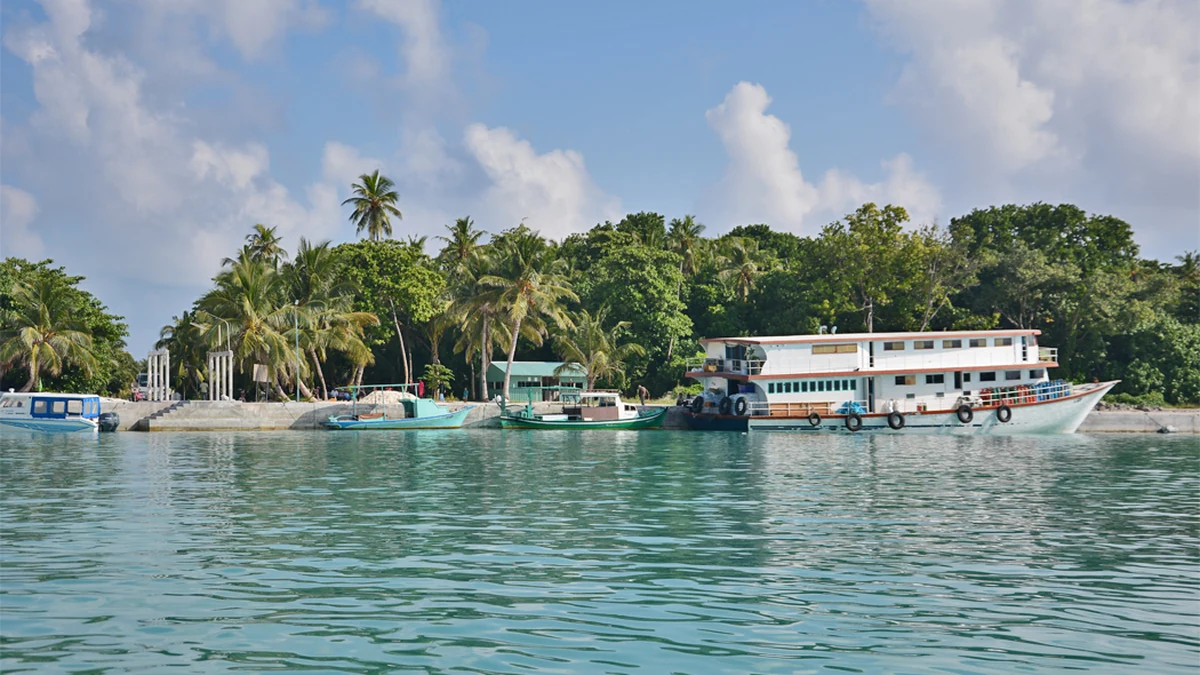
Utheemu cruise port is a small-island heritage call in the far north of the Maldives. Ships normally remain offshore and use tenders or local boats, bringing passengers to a compact harbour settlement whose importance is historical rather than commercial. The central reason to come ashore is Utheemu Ganduvaru, the traditional wooden home associated with Sultan Mohamed Thakurufaanu, a national hero remembered for resistance to Portuguese rule.
That single focus gives the day a useful shape. Visit the palace complex with enough context to understand it, walk through the village at a respectful pace, and leave space for the harbour and shoreline rather than searching for a long list of attractions. Operational details can still be fragile: the landing, access to the historic site and any boat add-on must be confirmed for the actual sailing.
Utheemu Cruise Port at a Glance
| Port name | Utheemu |
|---|---|
| Main arrival area | Utheemu harbour or another ship-arranged landing close to the village |
| Cruise region | Indian Ocean |
| Country / Territory | Maldives |
| Currency | Maldivian rufiyaa (MVR); some tourism purchases may be quoted in US dollars |
| Languages | Dhivehi; English is commonly used by guides |
| Port role | Remote heritage-focused day call |
| Disembarkation | Tender or local launch; landing arrangements are ship-specific |
| Walkability | High within the village, with short distances but heat and uneven surfaces |
| Shuttle required | No for the village and palace; a boat is required for any off-island activity |
| Main transport | Walking, ship tender and pre-arranged local boat |
| Best first-time plan | Utheemu Ganduvaru with a guide, followed by a village and shoreline walk |
| Main caution | Do not assume the palace is open, independently ticketed or accessible without the ship’s local arrangements |
Utheemu Is a Heritage Call First
Many Maldivian cruise calls are sold through beaches, reefs and blue water. Utheemu has those surroundings, but its distinctive value is cultural. The official Visit Maldives page for Utheemu Ganduvaru identifies the island as the birthplace and home of Sultan Mohamed Thakurufaanu, one of the country’s most revered historical figures.
That makes the palace more than an attractive old building. It is a place through which Maldivians tell a national story about resistance, identity and leadership. A short guided explanation is therefore more useful than rushing through rooms for photographs. Passengers who arrive expecting only a tropical village may be surprised by how much of the day’s meaning sits in this one modest complex.
How the Tender Arrival Shapes the Visit
The ship’s tender or local launch normally brings passengers towards the island harbour. The harbour photograph used for this article is geotagged at the waterfront, but the visible landing in the map is still a reference point rather than a guarantee that every call uses the identical step or jetty. Swell, vessel size and local instructions can alter the final approach. Where entry formalities apply, use the Maldives Immigration traveller-declaration guidance and the cruise line’s instructions.
Before walking away, identify the return queue, tender ticket system and last-boat time. Small-island calls often feel informal, yet the operation is not. Maldives Customs publishes general vessel-arrival guidance, but the ship’s call-specific process controls the passenger landing. A delayed boat can compress the visit, so keep the palace visit early enough that an altered tender schedule does not remove the main reason for coming ashore.
Visiting Utheemu Ganduvaru
The palace is a traditional timber residence rather than a monumental stone complex. Its scale, low rooms, domestic details and construction are part of the experience. Listen for guidance about footwear, photography and where visitors may enter. Some rooms or objects may be protected, and opening arrangements can change around maintenance, religious observance or the size of the visiting group.
A guide should connect the house to Mohamed Thakurufaanu without turning the visit into an unbroken lecture. Ask what parts of the structure are original, what has been restored, how the household functioned and why this island remains central to the national story. Those questions help separate the physical building from the later layers of memory attached to it.
The Historical Story in Brief
Mohamed Thakurufaanu is remembered for leading a campaign that ended Portuguese rule in the Maldives in the sixteenth century. The precise historical detail is better handled by the site’s interpretation and qualified local guides than by a hurried cruise-day retelling. What matters for the visitor is that Utheemu is connected to a foundational story of sovereignty and remains a place of national respect.
Approach the story with the same care used at a national memorial. It is reasonable to ask questions, but avoid treating heroic traditions as entertainment or arguing over compressed versions of complex history. The official overview of Maldivian culture is useful background before the call because it places local traditions within the wider Indian Ocean world.
A Village Walk After the Palace
After the historic site, the village provides the contrast that makes the day complete. Walk through public lanes, notice the relationship between homes, mosque, harbour and vegetation, and allow normal life to continue around the visiting group. Utheemu is inhabited; it is not an open-air museum arranged around the palace.
A guide may point out community buildings or a suitable shoreline route. Independent passengers should stay on obvious public paths and avoid entering yards, doorways or working spaces. The settlement is compact enough that there is no need to push far. A slow circuit followed by time near the water gives a better sense of place than repeated laps in search of another labelled sight.
Shoreline, Lagoon and Swimming
The water around Utheemu may look immediately inviting, but swimming should take place only where the ship or local host says it is appropriate. A local island has different expectations from a resort, and a beach used by residents or boats may not be designated for visitors in swimwear. Coral rubble, currents and boat traffic can also make the most photogenic entry the least practical one.
Bring reef shoes, sun protection and a cover-up if the programme includes water time. Treat a swim as optional, not as the measure of whether the call succeeded. The heritage visit and village already make a coherent port day; forcing in a beach stop can dilute the part of Utheemu that is genuinely different.
When a Local Guide Adds Real Value
Utheemu is one of the ports where a local guide can improve even a short walk. The island’s most important stories are not obvious from the street, and the palace is more meaningful when its domestic features and historical associations are explained. A guide can also clarify photography, dress and access without passengers having to guess.
Independent exploration remains useful after the formal visit. CruisePing would use the guide for the palace and historical core, then walk independently near the harbour if permitted. That division preserves interpretation where it matters while avoiding the feeling of being marched through every minute of a small island.
Respectful Dress and Photography
Shoulders and knees should be covered in the village, particularly around the mosque and palace. Swimwear belongs only on an approved bathing beach. Remove shoes if instructed, speak quietly inside the historic residence and do not lean on timber, touch objects or step beyond barriers for a better photograph.
Ask before photographing residents, children or worshippers. Wide views of streets and the harbour are usually less intrusive than close portraits. Photography inside the palace may be restricted in particular rooms, so follow the site guide rather than assuming a general camera rule applies everywhere.
Food, Refreshments and Small Purchases
Do not plan the day around finding a full restaurant meal. A ship-arranged refreshment, local snack or small shop purchase may be available, but capacity is limited and opening hours may respond to the call. Eat before leaving the ship and carry water where the cruise line permits it.
Use small notes and ask whether prices are in rufiyaa or US dollars. Card acceptance cannot be assumed. A modest local purchase is welcome when it is genuinely useful or locally made, but passengers should not pressure residents to sell souvenirs or expect a purpose-built market beside the palace.
Mobility and Access
Distances are short and the island is broadly flat, but the tender transfer may be the decisive barrier. Boarding a moving boat, stepping onto a jetty and coping with a narrow gangway can be harder than the village walk. Ask the ship whether mobility aids can be carried and whether the landing has firm handrails.
The palace itself may include thresholds, steps, low openings or surfaces that were not designed for modern accessibility. A passenger unable to enter every room may still benefit from the exterior, guide commentary and village setting. Cruise lines should confirm the actual access available on the day rather than describing the whole port simply as easy.
CruisePing Recommended Port Day
CruisePing would put Utheemu Ganduvaru first. Take the earliest comfortable tender, join the ship’s or local host’s guided palace visit, then continue on foot through the village and back towards the waterfront. Add a short shoreline pause or swim only if it is clearly organised and does not shorten the heritage visit.
The best low-risk fallback is still worthwhile: harbour orientation, an exterior view of the palace area if access changes, and a respectful village walk. Do not abandon the island for a generic boat trip unless the marine activity is the explicit reason you booked the call.
On a longer visit, use spare time for a second circuit only if it adds something: a conversation with the guide, a quiet waterfront stop or a clearly approved bathing area. Repeating the same route at speed does not create a fuller experience. Pause and look.
DIY or Organised Excursion?
The palace component is strongest with organised access because opening, interpretation and group movement may be coordinated around the ship. A cruise-line or local heritage tour also reduces the risk of arriving at a closed gate or missing the context that makes the building important.
After that, DIY walking is appropriate if the ship allows it. A second organised boat excursion is justified only for passengers who deliberately prefer reef or island scenery to the heritage focus. CruisePing would not combine several boat transfers on a short call; every extra movement adds waiting and weakens the return margin.
What Can Go Wrong on a Short Call
The first risk is placing the palace too late in the day. Tender delays, group access or a change in opening can then remove the principal attraction. The second is underestimating the sun because the map distances look tiny. Shade is intermittent, humidity is high and there may be nowhere to buy a cold drink exactly when needed.
A third mistake is treating Utheemu like a resort. Inappropriate clothing, intrusive photography and wandering into private areas damage the relationship that makes small-community calls possible. Finally, never assume that an independently arranged boat will understand the ship’s last-tender procedure.
Weather & Best Time to Visit Utheemu
| Month / season | Typical high | Typical low | Rain / conditions |
|---|---|---|---|
| January to March | 30–31°C | 25–26°C | Usually drier with strong sun; favourable for walking, though showers can still occur |
| April | 31–32°C | 26–27°C | Hot and humid transition period with variable winds |
| May to November | 29–31°C | 25–26°C | Wetter southwest monsoon; rougher water can affect tenders and beach plans |
| December | 29–30°C | 25–26°C | Changeable transition towards the drier season |
The Maldives Meteorological Service climate guidance describes the drier northeast monsoon from January to March and the wetter southwest monsoon from mid-May to November. Use its latest forecast near the sailing date. At Utheemu, rainfall affects comfort, but wind and swell are the operational issues because they can alter the landing and any second boat activity.
Frequently Asked Questions
What is the main attraction on Utheemu?
Utheemu Ganduvaru, the traditional home associated with Sultan Mohamed Thakurufaanu, is the defining reason for the call. The visit is strongest with local historical interpretation.
Can I walk from the harbour to the palace?
The village is compact and walking is normally the practical way to explore. The exact landing and route should still be confirmed by the ship or local host.
Do I need an excursion?
Organised access is sensible for the palace because it may coordinate opening and interpretation. Independent walking can follow once passengers are released from the group.
Is there time for swimming?
Possibly, particularly on a longer call, but only use an approved area and keep the palace first. Sea conditions and local dress rules may change the plan.
Useful Official Links
- Visit Maldives — Utheemu Ganduvaru
- Visit Maldives — Maldivian culture
- Maldives Immigration traveller declaration
- Maldives Meteorological Service climate
- Maldives Meteorological Service
CruisePing Port Verdict
Utheemu has a clearer purpose than many small-island calls. Come for the palace and the national story attached to it, then let the village and waterfront provide the setting. The article does not need a dozen attractions because the island does not need them to justify the stop.
CruisePing would choose guided heritage followed by unhurried independent walking. It is a compact, coherent day that respects both the historical site and the living community around it.
Ready to browse our article library?
Explore more ports in the Indian Ocean, narrow the library to Maldives cruise ports, or return to the main CruisePing article library.