
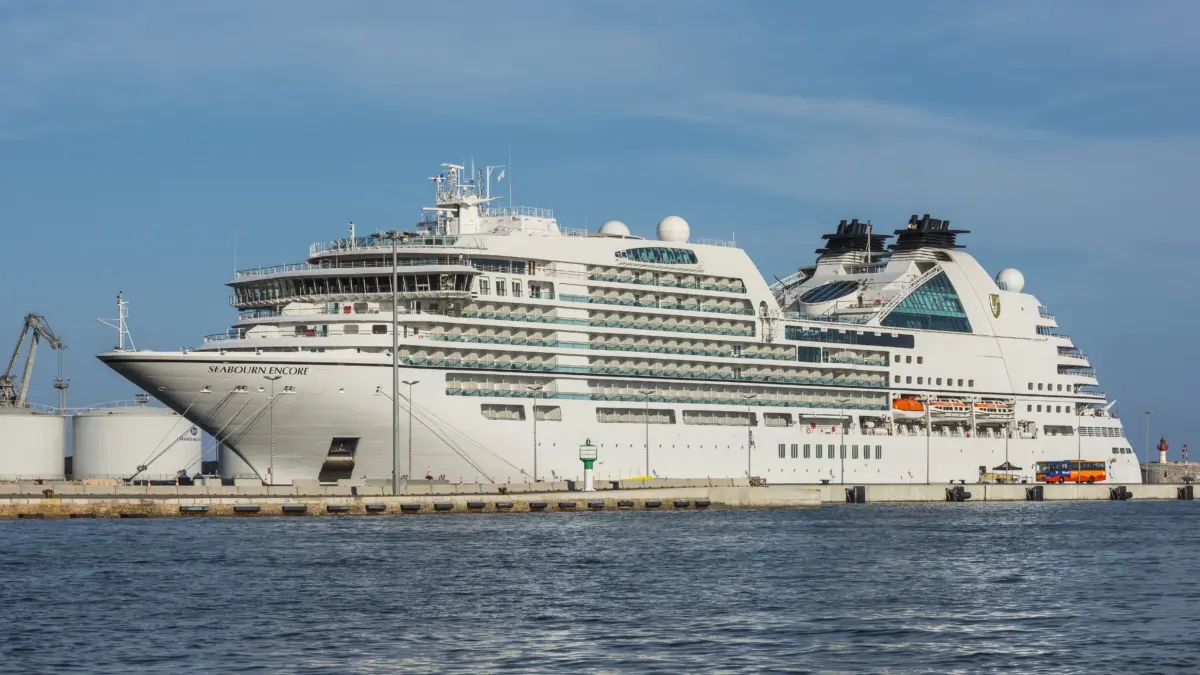
Seabourn Encore at Sète, France.
Photo: Christian Ferrer. Licence: CC BY-SA 4.0; crop by CruisePing.
Seabourn Encore takes the brand’s classic small-ship idea and stretches it without turning it into a resort vessel. At 41,865 GT and 600 guests, it is large enough for a dedicated Sushi restaurant, Solis, several lounges, a substantial spa and the paid Retreat, yet it remains tiny beside the premium ships carrying three or four thousand passengers.
The ship is particularly persuasive in Alaska and Japan because every suite has a veranda. Scenic cruising does not become balcony-dependent – open decks still matter – but private outdoor space removes one of the biggest cabin compromises on older small ships.
Seabourn Encore is the safest first Seabourn choice when you want the full ocean-ship venue range without leaving small-ship luxury. Its strongest selling points are all-veranda suites, dedicated Sushi, the Retreat and a service culture that still feels intimate at 600 guests.
Seabourn Encore at a glance
| Cruise line | Seabourn |
|---|---|
| Ship class or type | Encore Class ocean ship |
| Entered service | 2016 |
| Last major refurbishment | Original 2016 ship with incremental venue and programme updates rather than a wholesale redesign |
| Gross tonnage | 41,865 GT |
| Length | 210 m / 690 ft |
| Guest capacity | 600 guests |
| Crew | Near 1:1 guest-to-team-member service ratio |
| Passenger decks | 10 passenger decks |
| Cabins or suites | 300 suites, all oceanfront with private veranda |
| Accessible cabins | Six accessible shower-configured suites are listed: five transfer-shower suites and one roll-in-shower suite |
| Dining venues | The Restaurant, The Colonnade, Solis, Sushi, Earth & Ocean, The Patio, Seabourn Square and 24-hour in-suite dining |
| Bars and lounges | Observation Bar, The Club, Sky Bar, Patio Bar and Seabourn Square |
| Pools and hot tubs | Main pool, smaller aft pool areas and whirlpools; paid Retreat has a central whirlpool |
| Library | No large traditional library; reading material and quiet seating are integrated into social spaces |
| Spa and fitness | Spa at Seabourn, fitness centre and Motion Studio |
| Children’s facilities | No dedicated resort-style children’s club; adult-oriented programming |
| Adults-only facilities | The Retreat is a paid quiet cabana area, not a conventional adults-only sun deck |
| Wi-Fi | Complimentary Surf Wi-Fi with unlimited minutes via Starlink; paid Stream upgrade available |
| UK departures or deployment | Alaska and Japan are major deployments; selected global itineraries, but no regular UK homeport programme |
Best suited to
- First-time Seabourn guests who want the broadest conventional ocean-ship experience
- Alaska or Japan travellers who value a private veranda on every suite
- Couples who want strong dining, calm social spaces and included drinks without expedition routines
Think carefully if
- You want the smallest possible Seabourn ocean ship
- You dislike long corridors or prefer fewer than 500 guests
- You would not use the extra Encore-class venues enough to justify a fare premium over Quest
The booking decision
Choose Encore when you want the broadest expression of Seabourn’s conventional ocean product and the itinerary suits. The hardware case is strongest in the 300 all-veranda suites, the dedicated Sushi restaurant, the Retreat and the additional public space that came with enlarging the older Odyssey-class platform.
Do not pay a large premium simply because Encore is larger than Quest. The smaller ship can feel more exclusive precisely because it carries fewer people. Encore earns its premium when the extra venue choice and all-veranda accommodation are useful, not because 600 guests is automatically better than 458.
Seabourn Encore full ship tour video

Quick booking comparison
| Decision | CruisePing view |
|---|---|
| Choose this ship when | First-time Seabourn guests who want the broadest conventional ocean-ship experience |
| Compare carefully when | You want the smallest possible Seabourn ocean ship |
| Strongest practical advantage | All-veranda suites and widest ocean-ship venue range |
| Closest Seabourn alternative | Seabourn Ovation |
Suites and cabin choice
Every one of the 300 suites faces the ocean and has a private veranda. That removes the usual inside-versus-balcony decision and shifts the choice to location, size and premium-suite benefits. Standard veranda suites start at a generous size for a cruise cabin and include a proper sitting area, walk-in storage and the in-suite bar that is part of the Seabourn experience.
The practical upgrade is Penthouse or above when separate living space matters. Owner’s, Signature and Wintergarden categories add much more room but can become poor value on a port-heavy itinerary. Study the exact deck plan vertically. A suite close to lifts can save repeated walking, while one beneath an active deck or beside a service area can undermine the quiet you paid for.
Dining: where the ships differ
The dedicated Sushi restaurant is the clearest dining advantage over Quest. It sits alongside The Restaurant, The Colonnade, Solis, Earth & Ocean, The Patio, Seabourn Square and 24-hour in-suite dining. All of those core venues are included, so the issue is availability and preference rather than a nightly cover charge.
Solis requires planning because reservations are limited. Earth & Ocean is particularly good when weather makes outdoor dining appealing, while The Colonnade provides the relaxed fallback for breakfast and lunch. In-suite dining can become a genuine restaurant alternative rather than room-service compromise because dinner from The Restaurant can be served in the suite.
Bars, lounges and evenings
Seabourn Square is the daytime social anchor, combining coffee, information and relaxed seating. The Observation Bar is better for views, tea and pre-dinner drinks, while The Club becomes livelier later. The ships are sociable, but nightlife is measured in conversation, cocktails, live music and smaller shows rather than nightclub queues and arena entertainment.
Formal evenings still apply on Seabourn Encore. Elegant Casual is the normal after-6pm dress standard. On formal nights, The Restaurant has the stricter dress requirement while other venues remain Elegant Casual, giving passengers a workable alternative if they do not want to pack full formalwear.
The Retreat: useful luxury or unnecessary extra?
The Retreat on Deck 12 is a paid cabana area with a central whirlpool, dedicated service and a small number of private cabanas. It is deliberately separated from the ordinary included deck experience. That can make it worthwhile on sea days when guaranteed quiet space matters, but it should not be treated as something you need in order to enjoy the ship.
The ordinary pool deck and open decks remain part of the core fare. A couple who spends most days ashore may get very poor value from advance Retreat bookings. A guest building a sea-day-heavy itinerary around privacy and service may value it highly.
Wi-Fi, drinks and what is still extra
Complimentary Surf Wi-Fi with unlimited minutes is included, with Starlink providing the fleet’s connectivity. A paid Stream upgrade is available for passengers who need heavier bandwidth. Satellite performance can still vary by region, so do not build a work-critical trip around hotel-style guarantees.
Premium spirits, fine wines and an in-suite bar are included, and gratuities are neither required nor expected. The main extras are shore excursions, spa treatments, premium reserve wines, boutique spending and paid experiences such as the Retreat where applicable. This is why Regent can sometimes look closer in price than expected once excursions are added to Seabourn.
Families, solo travellers and accessibility
The ship accepts children, but it is designed around adults. There is no large dedicated children’s club programme, and the atmosphere assumes passengers can enjoy long meals, quiet lounges and destination-led days. Minimum ages apply to infants, ocean crossings and expedition voyages.
Solo travellers can find Seabourn unusually easy socially because the lounges and open dining culture create natural conversation without forcing hosted activities. The financial question is the supplement: compare the exact sailing rather than treating Seabourn as universally solo-friendly or solo-expensive.
Accessible suites and route maps are published, but the exact configuration matters. Six accessible shower-configured suites are listed: five transfer-shower suites and one roll-in-shower suite. Contact Seabourn before paying when a roll-in shower, turning space, storage for a mobility device or tender access is essential.
Where this ship works best
Encore is particularly well matched to Alaska because every suite has a veranda and the ship still offers substantial indoor lounges when weather turns. Japan also suits the ship: the itinerary can be port-intensive while the onboard product remains calm enough to recover between long days ashore.
For UK travellers these are usually fly-cruise holidays. Price flights and a pre-cruise hotel into the decision. A cheaper Encore sailing can cease to be cheaper once the long-haul journey is added.
How Encore feels on a sea day
Encore has enough public space to let passengers spread out without losing the sense of a small ship. Seabourn Square absorbs coffee, reading and informal conversation; the Observation Bar pulls people forward for views; The Club becomes more social later; and the pool deck carries the warm-weather daytime load. The ship feels busiest around dinner and after shows, but the 600-guest scale remains modest enough that queues are not the defining experience.
The extra deck and venue choice matter most on longer itineraries. On a seven-night cruise with ports every day, you may barely use the Retreat, Sushi, spa and multiple lounge options. On Alaska repositioning, crossings or extended Japan programmes, those spaces become a larger part of the value.
Alaska: why every veranda matters
Encore’s Alaska role is more than a marketing fit. Every suite has private outdoor space, so glaciers, coastal scenery and wildlife can be watched without first deciding whether a balcony category is worth the upgrade. The important caveat is that a private veranda shows only one side of the ship. Open decks remain essential during glacier viewing because the best angle can change quickly.
For Alaska, cabin position should balance views against movement and walking distance. A higher forward suite may give a dramatic outlook but can move more in exposed water. A lower central suite sacrifices some height in return for easier motion and more practical access. Do not pay for a premium suite while ignoring the deck position.
Encore versus Regent and Silversea
Encore is especially attractive to passengers who like the all-inclusive idea but do not want every day ashore pre-shaped by an excursion programme. Regent bundles more touring into its price. Seabourn gives you more freedom to decide whether to book a private guide, wander independently or stay aboard. Against Silversea, the difference is less about measurable hardware and more about service style and atmosphere. Encore feels conversational and club-like rather than built around a butler identity.
That is also why the fare should be compared on a total-trip basis. Add the excursions you will actually buy, then compare. A headline Seabourn fare that initially looks lower than Regent can become closer after several expensive days ashore.
Cabin-location checks before you pay
Small ship does not mean cabin position becomes irrelevant. Check what is immediately above and below the proposed suite, distance to the lift bank you will actually use, proximity to The Club or pool deck and whether an overhang affects the veranda. Our forward, midship and aft cabin guide explains the broader motion and walking trade-offs.
Passengers sensitive to movement should favour lower and more central accommodation when possible. Those prioritising views may accept a higher deck. Mobility needs can make a few metres of extra corridor more important than a nominal category upgrade.
Before you book
- Compare this ship with the other Seabourn ocean ships on the same itinerary before comparing it with a mainstream premium line.
- Open the exact suite plan and check whether the category delivers the veranda and living space you expect.
- Add shore excursions, flights, hotels and transfers to the fare before judging value.
- Check the formal-evening schedule and decide whether you will use The Restaurant on those nights.
- Reserve Solis early if it is important, and price the Retreat separately on Encore-class ships.
- Confirm accessible-suite and tender arrangements in writing when mobility needs are material.
CruisePing verdict
Seabourn Encore is the safest first Seabourn choice when you want the full ocean-ship venue range without leaving small-ship luxury. Its strongest selling points are all-veranda suites, dedicated Sushi, the Retreat and a service culture that still feels intimate at 600 guests.
Related CruisePing guides
- Seabourn guide
- Which Seabourn Cruise Ship Is Best for You?
- Seabourn Ovation guide
- Seabourn Quest guide
- Regent Seven Seas Cruises guide
- Silversea Cruises guide
- Inside versus balcony cabins
- Choosing the best cabin position