
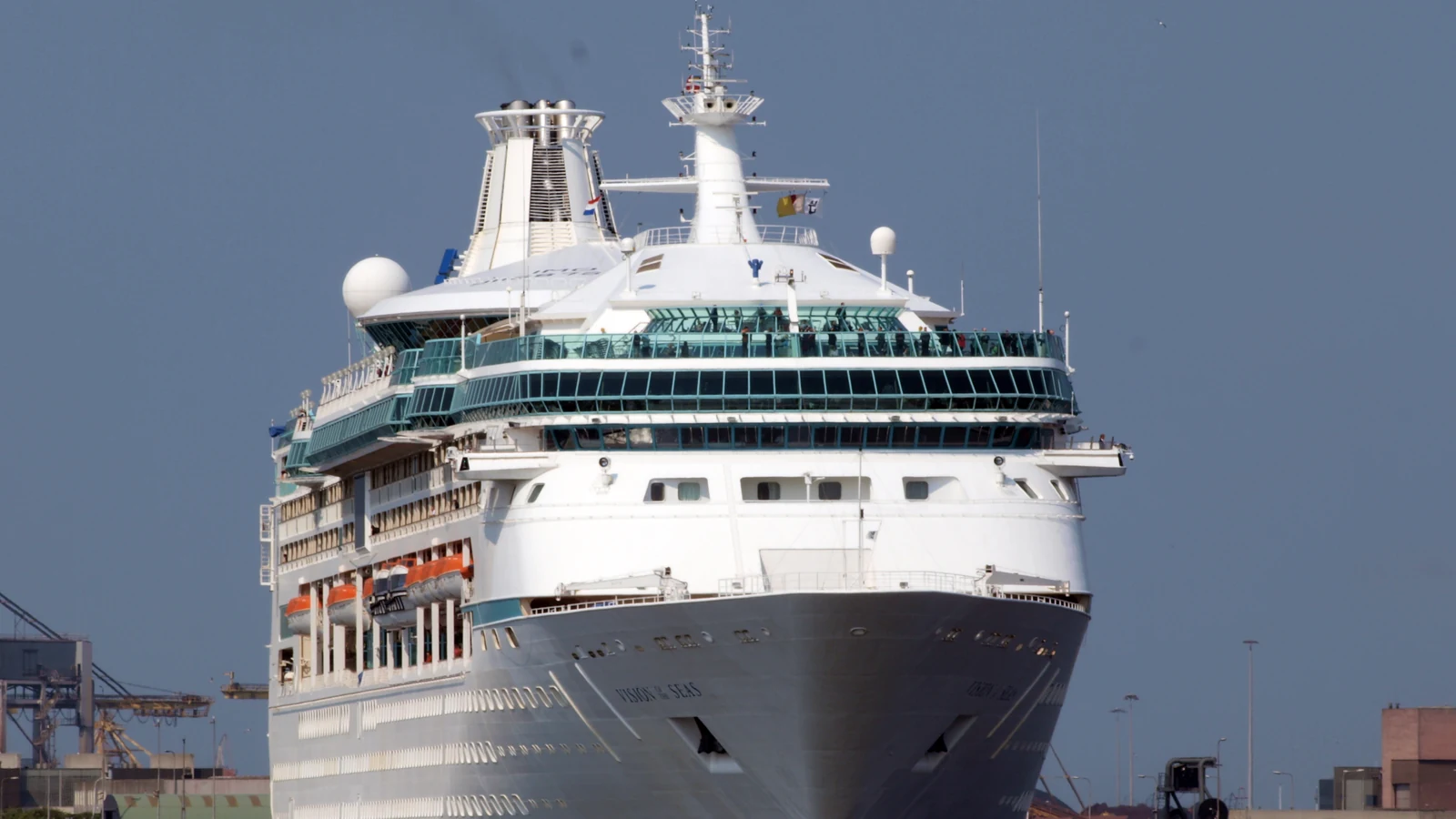
Photo: AlfvanBeem | Licence: Public domain; crop by CruisePing.
Vision of the Seas is shaped by its homeport as much as by its class. The ship’s official page highlights getaways from Baltimore, and that is the key to understanding it. Vision can sail beneath the Chesapeake Bay bridges and offer Bermuda, Bahamas, Caribbean and Canada or New England itineraries from a drive-to port that cannot accommodate Royal Caribbean’s largest vessels.
For many American passengers, avoiding a flight is the decisive advantage. For UK travellers, Baltimore is less convenient, but the itinerary variety can still be interesting. A five-night Bermuda cruise, a nine-night Bahamas combination and an autumn Canada and New England sailing are very different products even though the ship is the same.
Vision entered service in 1998. It has a glass Centrum, outward-facing lounges, traditional dining and a modest activity list. It does not have a Promenade, ice rink, FlowRider or modern waterpark. The ship works when the homeport and route matter more than the onboard hardware.
Vision is the practical Baltimore ship: small enough for the homeport, varied enough in itinerary to reward careful date selection, and calm enough for passengers who do not need Royal Caribbean’s newest attractions.
Vision of the Seas Cruise Ship at a Glance
| Cruise line | Royal Caribbean |
|---|---|
| Ship class or type | Vision Class |
| Entered service | 1998 |
| Last major refurbishment | Major revitalisation in 2013, followed by later maintenance dry docks |
| Gross tonnage | 78,340 GT |
| Length | About 279 m / 915 ft |
| Guest capacity | Approximately 2,050 passengers |
| Crew | Approximately 742 |
| Passenger decks | 11 |
| Cabins or suites | 1,020 guest rooms |
| Accessible cabins | Accessible staterooms are available in selected categories |
| Dining venues | Main dining, buffet and casual options; Chops Grille and selected paid restaurants |
| Bars and lounges | Several traditional lounges and bars, including Schooner Bar and an observation lounge |
| Pools and hot tubs | Main outdoor pool, adults-only Solarium pool and several whirlpools |
| Library | Small Library and Card Room for reading, cards and quiet time |
| Spa and fitness | Vitality Spa and fitness centre |
| Children's facilities | Adventure Ocean, arcade and family activities, but limited high-energy attractions for older children |
| Adults-only facilities | Solarium adults-only pool and lounge area |
| Wi-Fi | VOOM Wi-Fi is available at extra cost unless included in the fare or package |
| UK departures or deployment | No regular Southampton homeport programme in the main 2026 programme |
Vision of the Seas suits passengers who value manageable scale and itinerary over headline attractions. Compare the Vision Class ships with the wider fleet, then check the official deck plans and ship overview before choosing a cabin.
Best suited to
Couples, mature families, regional US travellers and itinerary-led passengers who value Baltimore access, Bermuda or Canada and New England routes, and a ship that is easy to navigate.
Think carefully if
Passengers flying a long distance mainly for the ship, families needing resort-scale attractions, or travellers unwilling to accept compact older cabins and limited balcony inventory.
Baltimore changes the comparison
Vision should not be judged only against another Royal Caribbean ship. It competes with the convenience of driving to Baltimore and boarding without an airport. That can remove luggage restrictions, flight disruption and the cost of several air tickets. For a regional family or couple, those savings may outweigh the attractions on a newer ship from Florida.
The Chesapeake departure also adds long river and bay transits. Some passengers enjoy the gradual sail-away and bridge passages. Others see the early and final hours as travel time before reaching open sea. The itinerary length matters because a five-night Bermuda cruise has little spare time, while nine-night routes can absorb the approach more comfortably.
The 2026 programme includes short Bermuda sailings, longer Bahamas combinations and Canada and New England cruises. The ship is therefore not tied to one climate or holiday style. Choose the route first. Vision on a crisp autumn coastal itinerary is a different experience from Vision on a humid Bahamas week.
The onboard experience
The Centrum provides the visual focus, with glass lifts and sea views creating a lighter atmosphere than the ship’s age might imply. The layout is compact, and most passengers can learn the route between cabin, dining room, theatre and pool within the first day.
Vision has a rock-climbing wall, pool, Solarium, arcade, theatre, casino, spa and live entertainment. This is a conventional cruise programme, not a floating theme park. Sea days depend on shows, quizzes, music, reading, conversation and pool time. The ship rewards passengers who are comfortable making their own pace.
Cabins and room choice
Royal Caribbean Incentives lists 1,020 guest rooms, including 135 balconies. The low balcony proportion means that ocean-view cabins are central to the ship rather than a budget second choice. A window can provide the daylight and weather awareness needed on Bermuda or Canada and New England routes without the price of scarce balcony stock.
The room guide shows available categories, while the deck plans reveal the exact relationship to lifts and public areas. Standard cabins can feel narrow, and bathrooms belong to an earlier design generation. Bring the charging equipment you genuinely need, but avoid unsafe multi-socket devices that breach cruise rules.
A balcony is most attractive on scenic coastal itineraries or when the room will be used as a retreat. On a five-night Bermuda cruise, the premium may be harder to justify. Interior cabins suit passengers focused on price and public spaces. Families need to inspect sleeping arrangements closely, because a room that accommodates four on paper may offer little floor space once every bed is open.
Best and worst positions
Vision is smaller than most of the fleet, yet cabin position still affects comfort. Midship rooms near a lift reduce walking. Lower decks can feel steadier. Cabins with passenger rooms above and below limit the risk of noise from pool equipment, chairs or entertainment.
Forward cabins can feel movement on exposed Atlantic sections, and aft rooms may involve vibration or long corridors. Avoid assuming that a high deck is automatically better. Weather on Baltimore routes can be cool or windy, and proximity to the pool deck may be less useful than a quiet residential position. Connecting rooms can transmit sound when not being used by the same family group.
Dining and meal planning
Main Dining Room service and Windjammer buffet meals provide the core. Park Café adds casual food near the Solarium. Vision’s smaller scale makes dining simpler, but choice narrows over a longer cruise. A nine-night itinerary may justify one or two speciality meals more than a five-night Bermuda sailing.
Chops Grille, Giovanni’s Table, Izumi and Chef’s Table are among the charged venues shown for the ship. Check the live Cruise Planner before buying a package, because restaurant availability and pricing can change. A package should fit the number of evenings onboard, not dictate the holiday.
Traditional dining is a positive feature here. Passengers who like a regular table and familiar waiting team can settle into a routine. Those who want to graze through a large food hall or choose from many casual outlets will find Vision limited. Breakfast timing can become busy on early port days, so room-service or an alternative venue may be worth considering.
Bermuda, Bahamas and Canada or New England
Bermuda is the most distinctive short-cruise case. The Royal Naval Dockyard gives access to beaches, ferries and historic sites, and an overnight or extended call can reduce the pressure to book a formal excursion. Weather and sea conditions remain more variable than in the Caribbean, particularly outside midsummer.
Longer Bahamas and Caribbean cruises involve more sea days and place greater pressure on the onboard programme. Vision can still work for readers, card players, spa users and passengers happy with organised activities. Families who need constant attractions should examine the daily rhythm carefully.
Canada and New England suits the ship’s glassy public areas. Coastal scenery and cooler weather make indoor viewing valuable. The itinerary can also attract a more adult passenger mix. Cabin daylight, warm clothing storage and access to sheltered decks may matter more than a pool-focused location.
Pools and all-weather space
The main pool works best in warm conditions. The Solarium is the important fallback, offering an adults-only covered pool environment when Baltimore weather is cool or wet. It can become crowded because the entire ship recognises the same advantage.
There are no major slides or splash districts. The rock wall, pool, arcade and Adventure Ocean provide a basic family framework. On a Bermuda or Canada cruise, weather may remove some outdoor options, making the age of the children and their tolerance for organised sessions especially important.
Entertainment and nightlife
Theatre productions, visiting acts, live bands, casino gaming and lounge music fill the evening. The Centrum often hosts events and gives the ship a social centre. The entertainment is accessible and traditional rather than technically spectacular.
A quieter passenger may appreciate being able to find a seat, hear live music and return to the cabin without navigating several neighbourhoods. A passenger who chooses Royal Caribbean for ice shows, diving productions and large nightclubs should move to another class. Vision is not an inferior version of those ships so much as a different, older product.
Families, couples and older travellers
Couples and older travellers are well matched to Vision’s scale. The ship offers enough activity to avoid feeling sleepy, while retaining places to read, watch the water or have a quiet drink. The varied Baltimore itineraries also support repeat travel without booking the exact same ports.
Families benefit from easy navigation and Adventure Ocean, but the ship requires realistic expectations. Younger children may enjoy the club and pool. Teenagers can exhaust the arcade and organised options quickly. A port-rich Bermuda itinerary may solve that problem; a long weather-affected sailing may expose it.
Accessibility and mobility
The compact footprint can reduce walking, but Vision’s age and cabin supply require careful booking. Royal Caribbean’s mobility information covers accessible doorway widths, boarding support and pool lifts. Confirm the exact room rather than relying on a generic accessibility symbol.
Baltimore embarkation can be convenient for regional travellers, but UK passengers need airport and hotel transfers. Ports on Canada and New England routes may involve older pavements, gradients or tendering. Bermuda transport has its own restrictions for scooters and wheelchairs. Research the entire journey, not only the ship.
Costs and value
The value argument is strongest for passengers who can drive. Removing flights can make Vision substantially cheaper than a newer ship even when the cruise fare is similar. UK passengers do not receive that benefit, so the itinerary must work harder.
Add gratuities, drinks, internet and shore spending. The drink-package page and My Royal Cruise show current prices. On a short cruise, the daily cost of upgrades can become disproportionate. On a longer itinerary, internet and drinks may matter more but should still be compared with normal consumption.
Condition and refurbishment
Vision received a major revitalisation in 2013 and has undergone later maintenance. The public areas can remain handsome, especially where glass and views dominate. Standard cabins and bathrooms are where the age is most likely to show.
Recent photographs, not the refurbishment date alone, should guide expectations. Read current reviews for repeated issues and distinguish cosmetic wear from isolated faults. Vision is best priced as an older, well-used ship with practical strengths, not marketed mentally as a hidden modern luxury vessel.
Before choosing a Baltimore sailing
Vision’s biggest advantage is often the homeport. For travellers able to drive to Baltimore, avoiding flights can reduce cost, disruption and luggage restrictions. That convenience should still be tested against the itinerary. Bermuda, the Bahamas and Canada or New England create very different holidays, and the number of sea days changes how much time you will spend relying on the ship’s relatively modest facilities.
Choose the cabin with the route in mind. A balcony is attractive for scenic approaches and longer cruises, but the limited supply can make the price difficult to defend. A midships ocean-view room may be the better purchase, especially when the itinerary is port intensive. Families should check school-holiday passenger mix and the current Adventure Ocean arrangements, while anyone using a wheelchair or scooter needs to research Baltimore, the ship and every port as one journey. Vision is at her best when the departure convenience and itinerary are both strong, not when either is being used to excuse the other.
CruisePing final verdict
Vision of the Seas earns its place through Baltimore. It gives regional passengers a no-fly route to Bermuda, the Bahamas, Caribbean and Canada or New England on a ship small enough to use the port. The varied programme is more interesting than a simple list of onboard facilities suggests.
For British travellers, choose Vision only when the route is unusually appealing or the total price remains strong after flights. For everyone, accept the traditional cabins and limited attractions before paying. Vision can be a calm and practical holiday, but it is the itinerary and homeport, not the hardware, that make it worth booking.