
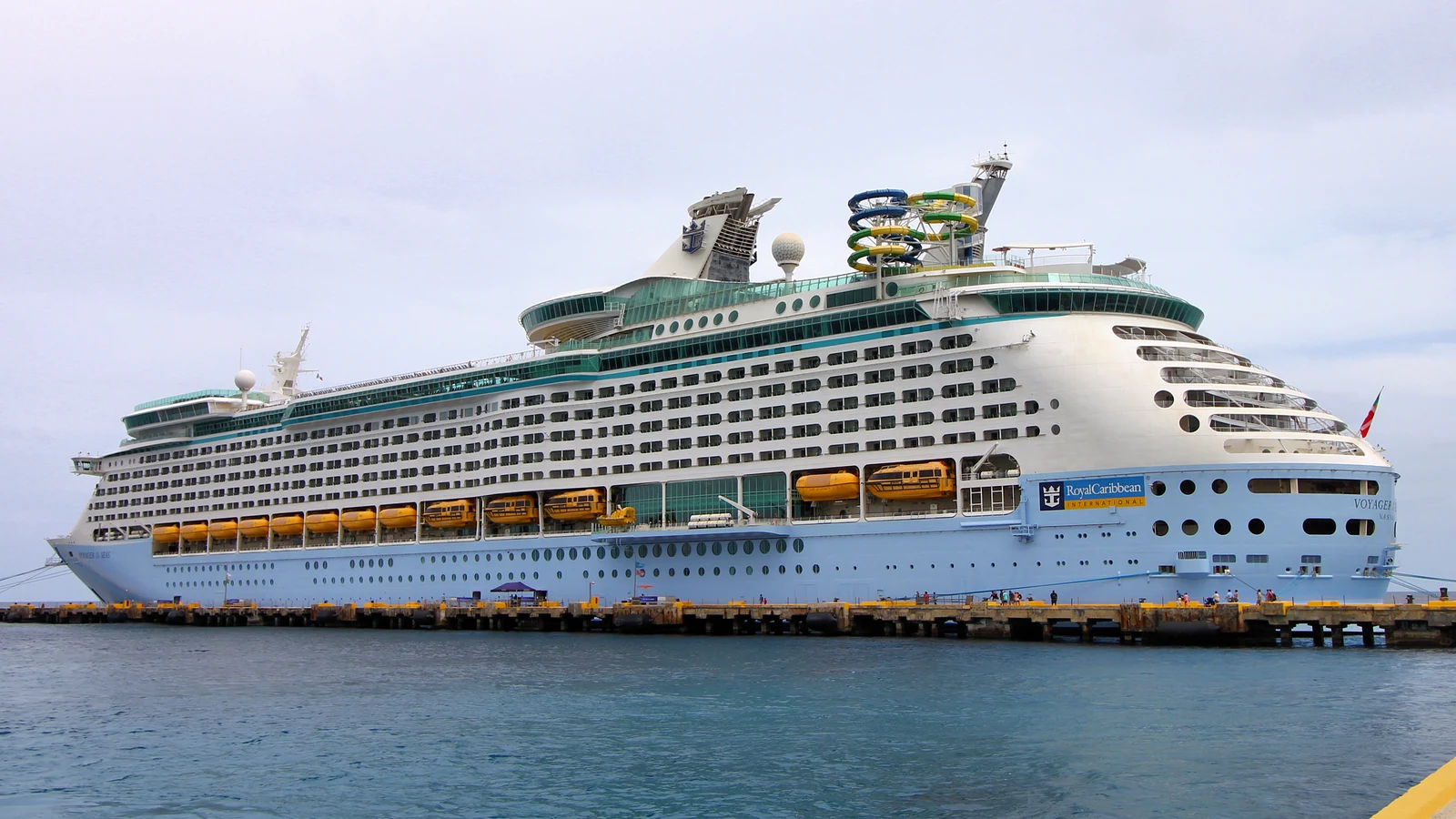
Photo: Larry D. Moore | Licence: CC BY 4.0; crop by CruisePing.
Voyager of the Seas changed the direction of mainstream cruising when it entered service in 1999. The indoor Royal Promenade, ice rink and rock wall made the ship feel like a destination rather than simply transport between ports. Later additions, including FlowRider, The Perfect Storm waterslides and laser tag, have kept that basic idea relevant.
Its present appeal is more practical than historic. Voyager is large enough to keep families occupied, but it is much easier to learn than Oasis or Icon Class. The 2026 schedule also gives it an unusually varied role, with Alaska cruises from Seattle, a published 25-night transpacific to Brisbane and subsequent Australia and South Pacific sailings.
The ship is not new, and some cabins make that obvious. Book it for the route, the manageable scale and the strong family facilities, not because an amplification has turned a 1999 design into a modern newbuild.
A well-equipped, easy-to-understand family ship whose 2026 Alaska and Australia programme matters more than its age. Book carefully because the attractions feel newer than many standard cabins.
Voyager of the Seas Cruise Ship at a Glance
| Cruise line | Royal Caribbean |
|---|---|
| Ship class or type | Voyager Class |
| Entered service | 1999 |
| Last major refurbishment | Royal Amplified modernisation in 2019 |
| Gross tonnage | 137,276 GT |
| Length | About 1,020 ft / 311 m |
| Guest capacity | Approximately 3,602 passengers |
| Crew | Approximately 1,200 |
| Passenger decks | 14 |
| Cabins or suites | About 1,801 |
| Accessible cabins | Accessible staterooms are available in selected categories |
| Dining venues | Main dining, buffet and casual venues; Chops Grille, Izumi, Johnny Rockets and other paid choices |
| Bars and lounges | Multiple bars and lounges, including Schooner Bar, Boleros and pub-style venues |
| Pools and hot tubs | Main pools, children’s splash area, adults-only Solarium and several whirlpools; most outdoor space is weather-sensitive |
| Library | A modest Library and Card Room rather than a large traditional collection |
| Spa and fitness | Vitality Spa and fitness centre |
| Children's facilities | Adventure Ocean, teen areas, arcade, sports facilities and family entertainment |
| Adults-only facilities | Solarium adults-only pool and lounge area |
| Wi-Fi | VOOM Wi-Fi is available at extra cost unless included in the fare or package |
| UK departures or deployment | Alaska, transpacific, Brisbane and South Pacific programmes; no regular UK departures |
Voyager of the Seas can look similar to its Voyager Class sisters on paper, but refurbishment, itinerary and cabin position create meaningful differences. Use the Voyager Class comparison and fleet guide, then review the official deck plans alongside the ship overview.
Best suited to
Families, active couples and itinerary-led travellers who want Royal Caribbean’s core attractions without the scale of Oasis or Icon Class.
Think carefully if
Passengers who need modern cabins, extensive sheltered pool space, a large library or an adult-led premium atmosphere.
Why Voyager still works
Voyager’s strongest quality is clarity. The Royal Promenade forms an obvious central street, the theatre and ice rink anchor the lower decks, and the main pools and sports attractions sit high. Most passengers can understand the ship within a day. That matters on a seven-night itinerary, where losing the first two days to navigation feels wasteful.
The design also spreads people reasonably well. Families move between the pool deck, sports area, Adventure Ocean and Studio B; adults use the Solarium, spa and lounges; and the promenade absorbs evening traffic. It can still feel crowded around lifts, parades and buffet peaks, but the ship rarely has the disorientating scale of Royal Caribbean’s latest classes.
Alaska, Australia and a ship that changes character
Voyager’s 2026 programme should be read season by season. On Alaska sailings, the ports and scenery are the main event. The ship supplies evening entertainment and family activity, but its large open pool deck is not as well protected as Quantum Class. A balcony is valuable for private views, although wind, rain and early starts mean it will not replace warm indoor observation space.
After the transpacific, Voyager moves into a warmer-weather role from Brisbane. Royal Caribbean lists Queensland and South Pacific itineraries, where FlowRider, waterslides and outdoor pools make more sense. British travellers should price flights, hotels, transfers and long-haul recovery alongside the fare. A cheap cabin can become an expensive holiday once the full journey is counted.
Cabins: useful choices, older foundations
Voyager offers interiors, Royal Promenade-view rooms, ocean views, balconies and suites. The room dimensions and bathrooms belong to an earlier generation, so do not expect the plug provision, storage detail or contemporary finishes of a new ship. The 2019 work improved parts of the product, but it did not enlarge standard cabins.
Promenade-view rooms are an interesting compromise. They bring light and people-watching into an interior category, but curtains are essential and event noise can carry. Royal Caribbean also lists Virtual Balconies on selected interior cabins. These screens can reduce the closed-in feeling, yet they are not a substitute for fresh air or a real sea view. Families should inspect bed layout rather than relying on the headline occupancy number.
The pool deck and active facilities
The official Voyager activities guide confirms the combination of FlowRider and The Perfect Storm. Add the rock wall, mini golf, sports court, ice skating and glow-in-the-dark laser tag, and the ship has more genuine activity than many vessels of similar age. These are useful facilities rather than decorative claims: a family can build several sea days around them.
The weakness is exposure. Alaska weather can close or discourage outdoor attractions, and the Solarium is not a fully enclosed Quantum Class pool complex. Activity opening hours also vary. Treat the daily programme as the authority, especially for FlowRider sessions, skating, laser tag and age or height restrictions.
Food without pretending everything is included
The Main Dining Room, Windjammer and Cafe Promenade can cover a cruise without speciality spending. The included offer is strongest when passengers use each venue for what it does well: the dining room for an unhurried evening meal, the buffet for flexibility, and the promenade cafe for quick snacks outside peak times. Longer transpacific voyages make menu repetition more noticeable.
Chops Grille, Giovanni’s Table, Izumi and Johnny Rockets add variety at extra cost. Packages can be worthwhile on a long sea-day-heavy itinerary, but they are often poor value on port-intensive Alaska weeks. Royal Caribbean’s current inclusions guide is worth checking before purchase because packages, room service and branded drinks are easy sources of budget drift.
Families, teenagers and multigenerational groups
Voyager is a sensible family ship because it offers recognisable attractions without demanding the planning intensity of Icon Class. Children have Adventure Ocean, teenagers have dedicated social space, and the ice show gives several generations something they can enjoy together. The promenade makes regrouping simple.
The ship can still be demanding during school holidays. Clubs may require registration, popular activities can queue, and four people in a standard cabin will feel the limited floor space. Multigenerational groups should choose cabins near the same lift bank rather than chasing identical categories at opposite ends of the vessel.
Evenings: more variety than the ship’s age suggests
Studio B is the feature that keeps Voyager distinctive. Ice shows remain unusual enough to feel special, and the venue also supports skating sessions and other events. The theatre, live music, quizzes, karaoke and promenade activity create a busy but conventional Royal Caribbean evening.
Travellers looking for intimate jazz, extensive enrichment or a premium adult atmosphere may find the programme noisy and sales-led. Voyager is most comfortable as a family resort. Light sleepers should avoid cabins directly above or below entertainment venues and should treat promenade rooms cautiously.
Library, quiet space and adult time
The Library and Card Room is useful, but it should not be oversold. The collection is modest and the area may feel more like a shared quiet room than a serious maritime library. Bring a Kindle or your own reading material for a long crossing.
The Solarium provides adult-only respite, while upper lounges and early-morning promenade seating offer quieter periods. True calm depends on timing. On cold or wet sea days, sheltered public space becomes more contested, so a well-positioned balcony or ocean-view cabin can be worth more than an extra dining package.
Accessibility and the amount of walking
Voyager is manageable by large-ship standards, but 311 metres is still a long vessel. A midship cabin near lifts reduces repeated journeys, while lower central cabins generally suit motion-sensitive passengers. The promenade is level and practical, though events can make it congested.
Accessible cabins and assistance should be confirmed directly before booking. Tender ports, gangway gradients and Alaska excursions can matter more than movement around the ship. The live deck plan is the right place to check the exact cabin relationship to lifts, restaurants and noisy venues.
Costs that change the value calculation
Voyager can appear attractively priced because it is an older ship. That is only meaningful after adding flights, hotels, transfers, gratuities, drinks, Wi-Fi, speciality dining and excursions. Alaska shore days and a transpacific itinerary produce very different budgets, even when the cabin fare looks similar.
The best-value booking is often a conventional balcony or well-located ocean view with restrained onboard spending. Suite prices require closer scrutiny because Voyager lacks the fully developed suite neighbourhoods found on newer Royal Caribbean ships. Pay for the space and specific benefits, not for an assumption that every premium perk is included.
Choosing a cabin location
Midship on a cabin-only deck is the safest general choice. Avoid rooms beneath the pool deck, beside service areas or directly around the Royal Promenade if sleep is a priority. Aft cabins can appeal for wake views but involve longer walks; forward cabins can feel more movement in rough water.
On Alaska, choose the better itinerary and cabin position before obsessing about one side of the ship. Scenery appears on both sides over a week, and public decks remain important. On the transpacific, shade, sea conditions and long stretches of private cabin use make exact balcony position more consequential.
How Voyager compares with its sisters
Explorer is the strongest 2026 choice for a Mediterranean itinerary. Adventure is a straightforward Caribbean ship. Navigator has the class’s most dramatic amplified pool deck and waterslides. Mariner offers an established amplified product with a lively bar and dining mix.
Voyager is the route-led all-rounder. Its Alaska and Australia seasons give it a broader geographic identity than the Caribbean-focused sisters, while its 2019 amplification keeps the activity list current. Choose it when the itinerary fits. Do not choose it merely because it founded the class.
CruisePing verdict on Voyager of the Seas
Voyager remains a capable family ship with a coherent layout and a surprisingly deep activity list. It is particularly effective when a strong itinerary, such as Alaska or the South Pacific, is more important than having the newest cabin design.
The honest caution is age. The ship’s public attractions have evolved faster than its standard accommodation. A sensible fare and a carefully chosen cabin make Voyager easy to recommend; a large premium over a newer ship does not.
Planning Voyager from the UK
Voyager is not a casual no-fly booking for a British passenger. Seattle, Brisbane and the transpacific all require a proper land-and-air plan. For Alaska, a Seattle hotel the night before sailing is sensible protection against flight disruption. For Australia, the long journey makes a short cruise poor value unless it forms part of a broader holiday. The published Brisbane programme is most convincing for travellers already planning Queensland or the South Pacific.
The transpacific is a different proposition again. Twenty-five nights magnify cabin comfort, laundry, storage, dining repetition and Wi-Fi costs. A saving on an interior cabin can look less clever after three weeks without private outdoor space. Price the whole journey, including one-way flights, hotels and insurance, before being seduced by an attractive per-night cruise fare.
A realistic week aboard Voyager
On an Alaska week, the ship works best as a dependable base rather than the star. Eat breakfast early, protect port time, and use Studio B, the theatre and promenade after returning aboard. Pool and slide use will depend on the weather. On an Australian warm-weather sailing, the same ship becomes much more of a resort, with the sports deck and pools carrying a larger share of the holiday.
Families should agree a simple rhythm rather than chasing every activity. Register Adventure Ocean on embarkation day, mark the ice show and any restricted sessions, and leave room for unplanned time. Voyager rewards passengers who use its facilities selectively. Trying to attend every parade, quiz, sports session and sale makes the ship feel busier than it needs to be.
What to check before paying a deposit
Start with the exact deck plan and not a generic cabin photograph. Confirm the bed arrangement, connecting door, promenade or sea view, lifeboat position and distance from lifts. Then check the route. Alaska port times, transpacific sea-day stretches and Brisbane turnaround logistics have more influence on the holiday than small differences between adjacent cabin categories.
Finally, look at the live cruise planner rather than assuming a package price. Dining, drinks, Wi-Fi and activities can be repriced repeatedly before sailing. Voyager can be good value, but only when the older cabin product is matched by a sensible fare and the itinerary is one you genuinely want.
Who Voyager suits less well
Voyager is a weak match for passengers who want a quiet, adult-led cruise or who expect every room to feel recently built. The promenade programme, family traffic and sales activity are part of the ship’s personality. The Solarium and a carefully chosen balcony can create breathing space, but they do not change the wider resort atmosphere.
It is also not the strongest Royal Caribbean option for cold-weather viewing. Alaska works because of the itinerary, not because Voyager has the sheltered observation spaces of Quantum Class. Anyone who plans to spend hours watching scenery from inside should compare the ships and cabin prices carefully before committing.