
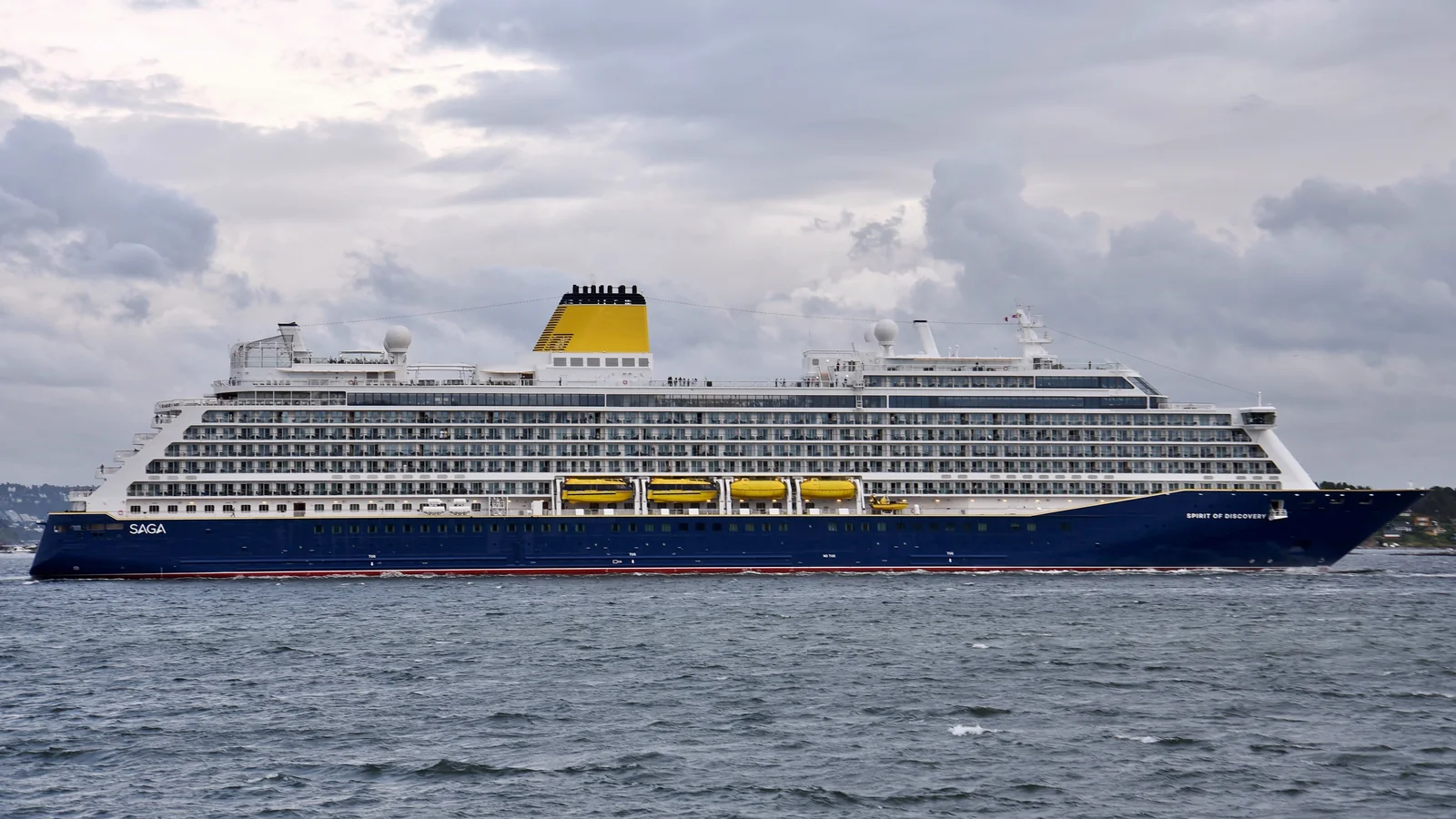
Spirit of Discovery departing Oslo.
Photo: Bahnfrend
Licence: CC BY-SA 4.0; cropped by CruisePing
Saga cruise fares often look high because there is no stripped-back entry product. The cheapest cabin already has a balcony, the passenger is buying a mature-audience boutique ship, and the fare includes drinks, speciality dining, Wi-Fi, gratuities, room service, selected excursions and coordinated travel to the port. The honest question is not whether Saga is cheap. It is whether the bundle costs less – or creates more value – than assembling the holiday another way.
A meaningful comparison must use the cabin and extras the passenger would actually buy. Comparing a Saga balcony with an inside cabin on a mainstream ship proves only that an inside cabin is cheaper. It does not establish which complete holiday is better value.
Start with the cabin, not the advertised fare
Every Saga cabin has a private balcony. On another line, the relevant comparison is therefore a reasonably similar balcony cabin, not the lowest lead price. The ships also carry no more than 987 guests, so a large-ship balcony on a vessel carrying four or five thousand passengers is not an identical product.
Passengers who normally book an inside or inexpensive ocean-view cabin face the clearest Saga premium. They are being required to buy outside space and a smaller-ship experience that they may not value. Passengers who already choose balconies have a much narrower gap to explain.
What the all-inclusive basket replaces
| Included Saga element | Potential separate cost or inconvenience elsewhere | Who values it most |
|---|---|---|
| Return chauffeur or arranged travel | Fuel, parking, hotel, rail, taxi or family transport | Solo travellers, distant households and passengers avoiding a long drive |
| Premium drinks | Individual drinks or a package | Regular drinkers and passengers who dislike monitoring a bill |
| Speciality dining | Supplements for several dinners | Passengers who enjoy varied restaurants |
| Wi-Fi | Per-device or per-person internet package | Passengers who need regular contact or online access |
| Gratuities | Daily service charge or discretionary budget | Anyone wanting a settled final cost |
| Included excursions | Guided tours or port transport | Passengers who normally book organised sightseeing |
| 24-hour room service | Delivery fees or limited menu charges | Passengers using the cabin as private living space |
| Optional insurance | Independent policy subject to medical needs | Eligible passengers for whom the Saga cover is suitable |
Chauffeur value depends heavily on postcode and circumstances
The return travel service can replace parking, an overnight hotel and a tiring drive. It is particularly valuable for a solo passenger or a household a long distance from the port. It may be worth little to somebody living nearby with easy family transport.
The exact service can be shared and collection times are coordinated around embarkation. A passenger who values complete control over the journey may prefer an alternative arrangement even if it costs more. Check the current booking conditions and any offered travel allowance before assigning a notional value.
Drinks and dining: use realistic habits
Saga includes premium drinks throughout the day and all speciality restaurants. The official inclusions page makes this broader than a limited mealtime-drinks offer.
A passenger who normally drinks wine with dinner, coffee, soft drinks and several bar drinks can replace meaningful spending. A light drinker who has one occasional glass of wine cannot claim the full retail value of a drinks package they would never have purchased.
The same applies to dining. Included speciality restaurants are valuable if the passenger wants to use them. Someone satisfied with the main restaurant should not count three hypothetical supplements as savings.
Excursions reduce spending, but do not eliminate it
A selection of excursions is included, and this can substantially reduce costs on a port-rich voyage. The included tour may be a panoramic or introductory option. Passengers may still buy optional tours, private guiding or independent transport where the standard excursion does not match their interests.
The greatest value goes to passengers who would normally book organised sightseeing in most ports. Confident independent travellers may regard the excursion as useful occasionally rather than a major financial saving.
Insurance can be valuable or unsuitable
Saga’s optional insurance and additional cancellation cover are subject to eligibility, medical screening and policy conditions. Where it is suitable, the inclusion can be significant. Where it is not suitable – or a passenger already has strong annual cover – the relevant comparison is the Saga fare reduction for declining it.
Never treat an insurance inclusion as a cash saving until the policy has been read and compared. Medical history, trip length, destination and cancellation needs can change the answer.
The small-ship and service premium cannot be itemised perfectly
Some of the Saga price buys a less crowded ship, purpose-built public rooms, a high crew-to-passenger ratio and service designed around a mature market. These benefits do not appear as line items on an onboard bill, yet they may be the main reason a passenger prefers the cruise.
They are also subjective. A traveller who loves a large theatre, multiple pools, international restaurants and energetic nightlife may receive more enjoyment from a less expensive mainstream ship. Paying more for an experience you like less is not value.
When Saga is likely to be good value
- You already book balcony cabins and prefer ships carrying fewer than 1,000 guests.
- You would buy a substantial drinks package, Wi-Fi and several speciality meals elsewhere.
- The chauffeur service replaces costly parking, a hotel or an uncomfortable journey.
- You normally book organised excursions in many ports.
- The included insurance is suitable and valuable for your circumstances.
- You are travelling solo and value a purpose-designed single balcony cabin rather than a double-room supplement.
- You value having most costs settled before departure more than finding the lowest possible fare.
When Saga is unlikely to be good value
- You are happy in an inside cabin and rarely use a private balcony.
- You drink very little, do not need Wi-Fi and prefer the main restaurant.
- You live near the port and arrange easy transport at negligible cost.
- You explore independently and would not buy organised excursions.
- You want family facilities, high-energy attractions or a younger international passenger mix.
- You can obtain a substantially cheaper comparable balcony holiday and do not value the smaller ship.
A practical comparison method
Price the exact Saga cabin and record whether insurance is included or declined. Then price a comparable balcony on the alternative line and add only the extras you would realistically purchase: transport, parking or hotel, drinks, Wi-Fi, dining, gratuities, excursions and insurance.
After the financial comparison, make a separate judgement about ship size, service and convenience. Do not convert every inclusion into an inflated retail saving, and do not ignore the value of reducing stress simply because it cannot be expressed precisely in pounds.
Use the Saga Cruises guide for the full proposition and the Fred. Olsen versus Saga comparison for the closest British smaller-ship alternative.
The CruisePing verdict
Saga can be excellent value, but only for a passenger whose normal holiday resembles the package being sold. The fare is easiest to justify for balcony-booking, organised, socially minded mature travellers who use the drinks, dining, transport and excursions.
It is poor value when the passenger is being forced to buy convenience and inclusions they would normally avoid. Compare the realistic basket, not the maximum theoretical value of every benefit.