
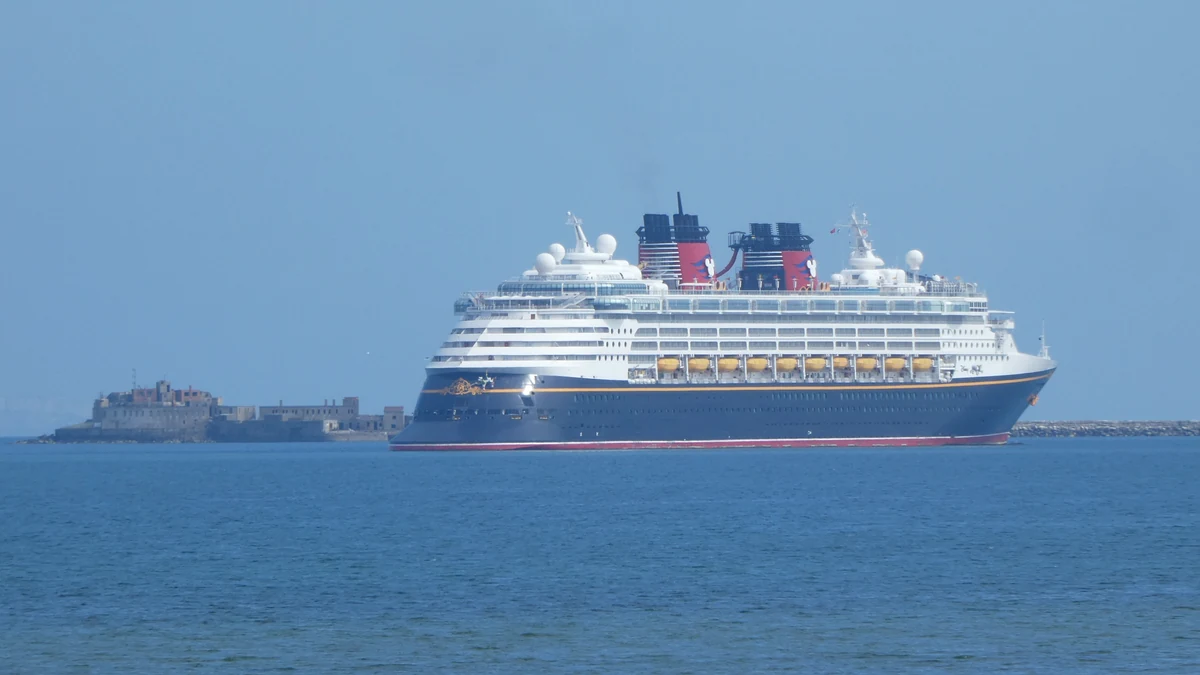
Disney Magic anchored in Portland Harbour, Dorset.
Photo: Andrew Bone. Licence: CC BY 2.0; crop by CruisePing.
Disney Magic is no longer the ship to choose merely because it is the original Disney vessel. In 2026 its strongest argument is more practical: it is small enough to feel noticeably easier to live with than the newest Disney ships, yet it still carries the dining, theatre, youth clubs and adult spaces that define the line. The new Alaska programme makes that difference unusually relevant because long scenic days reward a ship that is quick to cross and straightforward to understand.
Disney Magic is the best current Disney choice for travellers who want the brand without its largest-ship complexity. The 2023 refurbishment gave the oldest vessel meaningful new life, while Rapunzel’s Royal Table, Tangled on stage and AquaDunk give Magic attractions its sister does not duplicate. For UK families, Alaska is the compelling 2026 reason to consider it. The trade-off is clear: cabins and some public spaces reveal the ship’s 1998 origins, and there is less sheer variety than on Dream or Wish Class.
At a glance
| Cruise line | Disney Cruise Line |
|---|---|
| Ship class or type | Magic Class |
| Entered service | 30 July 1998 maiden voyage |
| Last major refurbishment | 2023 |
| Gross tonnage | 84,000 GT |
| Length | 984 ft / about 300 m |
| Guest capacity | 2,713 guests |
| Crew | 950 |
| Passenger decks | 11 |
| Cabins or suites | 875 staterooms |
| Accessible cabins | Wheelchair-accessible staterooms are available in selected categories; Special Services can arrange additional accessibility support |
| Dining venues | Rapunzel’s Royal Table, Lumiere’s and Animator’s Palate rotational dining, plus Cabanas, pool-deck food and Palo |
| Bars and lounges | Soul Cat Lounge, O’Gills Pub, Keys, Fathoms, Cove Café, Signals and other bars and lounges |
| Pools and hot tubs | Family pool, Quiet Cove Pool, hot tubs, AquaLab, AquaDunk, Twist ’n’ Spout and children’s splash areas |
| Library | No conventional dedicated public library |
| Spa and fitness | Senses Spa & Salon and fitness centre |
| Children’s facilities | Oceaneer Club and Lab, Edge, Vibe, nursery, AquaLab, sports areas and family activities |
| Adults-only facilities | Quiet Cove, Palo, After Hours nightlife, Cove Café and Senses Spa |
| Wi-Fi | Paid Internet and Internet + Streaming packages; Navigator app functions use the onboard network |
| UK departures or deployment | Vancouver for Alaska in summer 2026, then San Diego and later Galveston; no UK departures scheduled |
Best suited to
Families who prefer a smaller ship, Disney fans drawn to Tangled and Rapunzel, Alaska cruisers who value easy onboard navigation, and couples who like Disney service but do not need a vast resort ship.
Think carefully if
Travellers who equate newer with better, families wanting the broadest pool deck or biggest choice of venues, passengers seeking a casino, and anyone choosing Disney mainly on price rather than using the entertainment and youth facilities.
See the ship before booking
The small-ship advantage is now the main reason to choose Magic
At about 84,000 GT and 875 staterooms, Disney Magic sits in a very different size category from Disney Dream and the newer Disney Wish. That changes the rhythm of the day. The main dining rooms, Walt Disney Theatre, family pool deck and adult spaces are connected by shorter walks, and the ship is easier to learn within the first afternoon. Families moving between a child in Oceaneer Club, a teenager in Edge and adults at dinner feel that difference repeatedly.
Smaller does not mean uncrowded. The atrium, theatre exits, Cabanas and pool deck can still compress passengers into a limited footprint, particularly on cold Alaska days when more people remain indoors. The advantage is not empty space. It is legibility. There are fewer competing districts and fewer long cross-ship journeys, so the ship demands less planning than Wish Class.
Alaska gives Disney Magic a new purpose in 2026
The most important change for Magic in 2026 is deployment rather than hardware. Alaska sailings from Vancouver include five-, six-, seven- and eight-night options on Disney Magic, giving the ship a destination programme substantial enough to justify a transatlantic flight from the UK. Later in the year it moves south through Pacific Coast and San Diego cruises before returning to Galveston.
For Alaska, Magic’s age is less important than itinerary and viewing strategy. Most scenic value comes from the route, glacier-viewing day, port hours and excursions. A balcony can be excellent, but it is not essential if the fare premium is large because open decks provide broad sightlines and the ship is compact enough to move from one side to the other. The more important cabin decision is avoiding a location that makes repeated trips to the pool deck, youth clubs or theatre unnecessarily awkward.
The 2023 refurbishment matters more than the launch date
Magic entered service in 1998, but the better reference point for its current condition is the 2023 dry dock. The work introduced Soul Cat Lounge, expanded and rethemed the Concierge Lounge, refurbished Concierge suites and added new family entertainment. The 2023 ship enhancements were substantial enough to change how key premium and evening spaces work.
That does not erase the ship’s age. Corridor proportions, cabin architecture and some public rooms still feel like an earlier generation of cruising. CruisePing would not pay a large premium simply for the claim of sailing the original Disney ship. The case for Magic is stronger when the older design is part of the appeal: traditional proportions, a coherent three-restaurant rotation and a ship that feels more like a vessel than a floating theme park district.
Dining: Rapunzel gives Magic its clearest signature
Rotational dining remains central. Rapunzel’s Royal Table, Lumiere’s and Animator’s Palate form the three-main-restaurant cycle, with the serving team following the table each night. Rapunzel’s Royal Table is the distinctive venue because dinner is integrated with live character entertainment rather than relying on décor alone. Lumiere’s supplies the more traditional dining-room evening, while Animator’s Palate delivers the Disney animation concept shared across several older ships.
The practical question is whether the family wants scheduled main dining every evening. Disney’s fare includes the rotational restaurants, casual food and many snacks, so using that structure helps justify the premium. Passengers who prefer eating whenever they like may find the fixed early or late seating less natural. Palo is the adult-exclusive speciality option and costs extra. Cabanas and pool-deck outlets give flexibility, including Duck-In Diner on Magic, but they are supplements rather than a replacement for the full rotational experience.
Entertainment: Tangled is not a small detail
Magic has one of Disney’s strongest ship-specific theatre identities. Tangled: The Musical makes Rapunzel a recurring thread between stage and dining, while Disney Dreams and Twice Charmed reinforce the classic Disney tone. For families who attend the theatre most nights, this matters more than another bar or speciality restaurant would. The main shows are part of the cruise fare, which is one of the reasons the Disney price comparison should be made against the total family holiday rather than cabin cost alone.
Character encounters, deck events and film programming fill the gaps around the theatre. The risk is over-scheduling. A family that tries to attend every character event, show and meal can turn a small ship into a timetable exercise. Magic works best when the headline experiences are chosen in advance and the rest of the day is allowed to remain flexible.
Pools and AquaDunk: better for thrill than breadth
AquaDunk is the feature Magic can claim over Disney Wonder: a steep drop slide that starts with a floor release and sends riders through a translucent tube over the ship’s side. AquaLab and Twist ’n’ Spout add family water play, while the main family pool and adult Quiet Cove cover the basic pool functions. The overall pool deck is much smaller than Dream or Wish Class, so warm-weather sea days can feel busy.
For Alaska, this weakness softens because pool time is less central, although weather can push families inside. In Mexico or the Caribbean the reverse applies. Anyone booking primarily for waterslides and deck attractions should compare Magic with Disney Dream before paying Disney prices.
Children and teenagers: familiar Disney strength in a smaller footprint
Oceaneer Club and Lab remain the centre of the children’s programme, with Edge for tweens, Vibe for teenagers and nursery care for the youngest children. Disney’s youth model is strongest when children are happy to spend meaningful time in organised spaces rather than merely visiting once. That can materially improve the holiday for adults because the ship is compact enough to move between the clubs, Quiet Cove and dining without long transit time.
Families should still check the current age bands and operating arrangements before sailing because youth programming changes. The key booking judgement is behavioural rather than numerical: a child who dislikes clubs removes one of Disney’s largest advantages, whereas a child who embraces them can make Magic feel significantly better value.
Adults: Magic is more convincing than its family branding suggests
After Hours gathers several evening venues in the forward part of the ship, including Fathoms, O’Gills Pub and Keys. Soul Cat Lounge adds a jazz-led identity inspired by Pixar’s Soul. Quiet Cove Pool, Cove Café, Senses Spa and Palo create daytime and dining escape routes. Disney still has no casino and nightlife is not designed to compete with adult-heavy mainstream ships, but couples do not have to spend every hour inside a character environment.
The compact adult district is particularly useful after the second theatre show because there is a natural place to move for a drink rather than choosing among venues scattered across a much larger ship. Adults who want late-night clubs until the early hours should look elsewhere. Adults who want polished bars after a day shared with children may be pleasantly surprised.
Cabins: generous family logic, older hardware
Magic has 875 staterooms across Inside, Oceanview, Verandah and Concierge categories. Most cabins retain the family-friendly Disney ideas that still matter: useful storage, a privacy curtain and, in many categories, split-bathroom arrangements. The current Magic stateroom range is worth checking carefully because room size, occupancy and balcony configuration vary within the headline categories.
Location is more important than paying automatically for a verandah. Alaska creates a strong emotional case for a balcony, but a well-located Oceanview can preserve several thousand pounds of holiday budget for flights and excursions. Families using the youth spaces heavily may prefer the middle decks; light sleepers should avoid treating a pool-deck-adjacent room as automatically convenient. Concierge was materially refreshed in 2023, making it a more defensible premium for passengers who will use the lounge and service, but it remains expensive.
Accessibility and connectivity need planning before final payment
Accessible staterooms are available and Disney’s Special Services information covers mobility support, pool lifts, assistive listening and other arrangements. Anyone relying on a specific room layout or equipment should resolve that before choosing a non-refundable fare. Magic also supports communication kits for guests with hearing loss.
Wi-Fi is sold through paid Internet and Internet + Streaming packages. The Navigator app works through the onboard network for schedules, menus and messaging within the travelling party. Satellite connectivity is still vulnerable to geography and weather, which matters on Alaska routes. Passengers who must work reliably at sea should not plan as though the connection were equivalent to a hotel broadband service.
What is included and what still costs extra
The base fare covers the stateroom, rotational and casual dining, many soft drinks, major theatre entertainment, films, character experiences, pools and youth clubs. That is a substantial package. It does not make the holiday all-inclusive. Palo, alcohol, speciality drinks, spa treatments, excursions, internet, some childcare and other optional services add to the final bill.
Gratuities are also a real planning cost. The current recommended gratuity is $16 per guest per night, including infants and children, with a higher recommendation for Concierge accommodation. An 18% gratuity applies to specified bars, beverage, wine, adult and premium dining, deck service and spa charges. A family comparing Magic with a cheaper cruise should include those costs before deciding whether the fare gap is tolerable.
Before you book Disney Magic
- Choose Magic for the itinerary and smaller scale, not because it is the original ship.
- For Alaska, compare the five-, six-, seven- and eight-night routes before comparing cabin categories.
- Price flights, Vancouver accommodation and high-priority Alaska excursions alongside the cruise fare.
- Decide whether the family will genuinely use rotational dining, theatre and youth clubs. Those are central to Disney value.
- Compare Oceanview and Verandah pricing rather than assuming Alaska requires a balcony.
- Check dining seating time and children’s club age bands before final payment.
- Confirm San Diego or Galveston deployment if booking later in 2026 because the experience changes sharply once Alaska ends.
Magic, Wonder or a larger Disney ship?
Disney Wonder is the closest comparison, but the sisters are not interchangeable. Magic has Rapunzel’s Royal Table, Tangled: The Musical and AquaDunk; Wonder counters with Tiana’s Place, Frozen on stage and a different West Coast personality. Both are substantially easier to navigate than Dream Class. Disney Dream adds more venues, AquaDuck and a larger resort feel, while Disney Wish pushes further into highly themed new-generation design.
Booking decision
| Decision | CruisePing view |
|---|---|
| Choose Disney Magic | Alaska or the smaller Disney scale is the reason for travelling, and Rapunzel, Tangled and AquaDunk appeal. |
| Choose Disney Wonder | Tiana’s Place, Frozen and the Wonder’s West Coast programme suit the family better. |
| Choose Disney Dream | You want more venues, a larger pool deck and a classic large Disney ship. |
| Choose Wish Class | Newest-ship hardware and highly themed venues matter more than simple navigation. |