
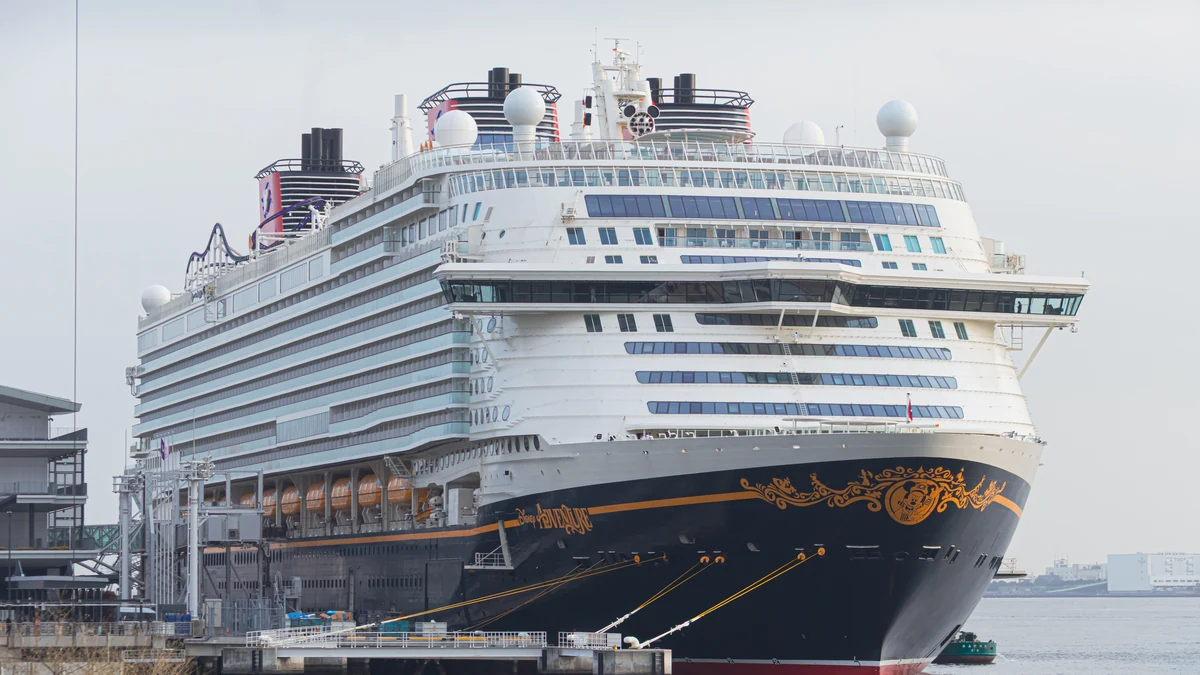
Disney Adventure in Tokyo shortly before entering service in 2026.
Photo: nagi usano. Licence: CC BY 4.0; crop by CruisePing.
Disney Adventure is not simply the newest Disney ship. It is a different kind of Disney cruise. At more than 208,000 GT and with capacity for about 6,700 guests, it is by far the largest vessel in the fleet, based permanently in Singapore and built around short three- and four-night voyages where the ship itself is the destination. For UK travellers, that makes Adventure a long-haul city-and-ship holiday rather than a conventional cruise chosen mainly for ports.
Disney Adventure is the most ambitious and least conventional ship in the current Disney fleet. Its strongest reasons to book are Singapore, extraordinary family entertainment, Marvel Landing, the Ironcycle roller coaster, unusually broad dining and a ship large enough to occupy a short cruise without ports. Its weakness is the same scale that makes it exciting: 6,000-plus guests, long walking distances and a complex multi-district layout demand more planning than Disney Magic, Wonder, Dream or even Wish Class. Choose Adventure because you want this ship in Southeast Asia, not merely because it is the newest Disney vessel.
At a glance
| Cruise line | Disney Cruise Line |
|---|---|
| Ship class or type | Disney Adventure / Global Class platform |
| Entered service | March 2026 |
| Last major refurbishment | None – entered service in 2026 after extensive completion for Disney Cruise Line |
| Gross tonnage | 208,108 GT |
| Length | 1,124 ft / 342.7 m |
| Guest capacity | About 6,700 guests |
| Crew | About 2,500 |
| Passenger decks | 19 |
| Cabins or suites | 2,111 staterooms and suites |
| Accessible cabins | Accessible staterooms and suites are available across multiple categories; communication kits and additional Special Services support are available |
| Dining venues | Three assigned Disney dining experiences per voyage, including Hollywood Spotlight Club, Navigator’s Club, Animator’s Palate or Animator’s Table, plus Enchanted Summer, Pixar Market, casual food and premium dining |
| Bars and lounges | Spellbound, Tiana’s Bayou Lounge, Buccaneer Bar, Royal Court Lounge, Taverna Portorosso and other themed bars and lounges |
| Pools and hot tubs | Toy Story Place water play, Wayfinder Bay, family pools and splash areas, plus an adults-only Infinity Pool and whirlpools |
| Library | No conventional dedicated public library |
| Spa and fitness | Opulence Spa – Elemis at Sea and fitness facilities |
| Children’s facilities | Oceaneer Club, Edge, Vibe, nursery, Mickey & Minnie Captain’s Deck, Toy Story Place and family recreation |
| Adults-only facilities | Infinity Pool, Palo Trattoria, Opulence Spa and adult-focused lounges and evening spaces |
| Wi-Fi | Paid Internet and Internet + Streaming packages; Navigator app functions use the onboard network |
| UK departures or deployment | Year-round 3- and 4-night round trips from Singapore; no UK departures scheduled |
Best suited to
Families combining Singapore with a major resort-style ship, Marvel and Pixar fans, children who will use the youth clubs and water areas heavily, and travellers who enjoy planning a packed three- or four-night programme.
Think carefully if
Anyone who dislikes very large ships, wants quiet destination-led cruising, needs a simple walkable layout, expects several ports on a short itinerary, or is flying from the UK solely because this is Disney’s newest ship.
See the ship before booking
The scale changes the Disney experience
Adventure is roughly two and a half times the tonnage of Disney Magic or Disney Wonder, and substantially larger than Disney Wish, Disney Treasure and Disney Destiny. That difference is not an abstract specification. It changes how a family moves through the day. The themed districts are spread across a 342.7-metre ship with 19 passenger decks, so a cabin selected only by price can leave you repeatedly crossing large distances between youth clubs, dining, pools, theatre and the attractions you care about most.
The reward is choice. Disney has used the scale to create spaces that do not have direct equivalents elsewhere in the fleet, from the open Disney Imagination Garden and Marvel Landing to extensive Asia-focused dining and multiple entertainment zones. The penalty is that Adventure cannot deliver the instant familiarity of Magic Class. On a three-night cruise, there is not enough time to discover the ship casually and still use everything. A little planning before embarkation is more valuable here than on any other Disney vessel.
Singapore is part of the product, not just the embarkation port
Disney Adventure sails three- and four-night round trips from Singapore, with the voyage focused on days at sea rather than a sequence of ports. That makes the booking logic unusually clear. If you want a port-intensive Southeast Asia itinerary, Adventure is the wrong ship. If you want several days inside a floating Disney resort and can use Singapore before or after the cruise, the format makes much more sense.
For UK travellers, the long flight needs to earn its place in the holiday. A standalone three-night cruise is difficult to justify once flights, airport transfers and Singapore accommodation are included. Adventure becomes more persuasive when the cruise sits inside a longer Singapore break or a wider Asian trip. The no-port format also removes one of cruising’s usual variables: you are not paying for itinerary variety. You are paying for ship access, entertainment, dining, service and a very concentrated Disney experience.
Seven themed areas make Adventure feel more like a resort complex
Disney Adventure is organised around large themed areas rather than the more conventional sequence of atrium, pool deck, theatre district and adult zone familiar from older Disney ships. Disney Imagination Garden acts as a central social and entertainment space, while Discovery Reef, San Fransokyo Street, Wayfinder Bay, Town Square, Marvel Landing and Toy Story Place each carry a distinct visual identity and function.
This can be excellent for mixed-age groups because one family can find very different experiences without leaving the ship. It can also make rendezvous more complicated. Parents with children in separate age groups should agree meeting points in advance rather than assuming everyone will naturally pass through the same atrium. The Navigator app is useful here not merely for schedules but as a way of reducing wasted walking between a show, dinner reservation and youth-club collection time.
Marvel Landing gives Adventure its clearest hardware advantage
The headline attraction is Ironcycle Test Run, a 250-metre roller coaster at sea. It sits within Marvel Landing alongside other Marvel-themed attractions and gives Adventure a thrill component that no other current Disney ship duplicates. This is a meaningful difference for older children and teenagers who might find the character-heavy side of Disney less compelling.
Do not build the entire booking around a single ride. Height, health and operating restrictions matter, queues can reshape a short day, and outdoor attractions remain exposed to weather and operational conditions. The better argument for Marvel Landing is the combination of attractions, live entertainment and visual theming. Families should treat Ironcycle as a high-value bonus within a broader ship, not as the only reason to fly to Singapore.
Toy Story Place and Wayfinder Bay broaden the outdoor choice
Toy Story Place is the major family water-play area, with pools, slides and splash features designed for children rather than simply adding another conventional lido pool. Wayfinder Bay takes a different approach, combining a Moana-inspired open-air setting with water, food, views and entertainment. The two areas help spread families across the upper decks instead of forcing everyone towards a single central pool.
Adventure still has the familiar large-ship problem on hot sea days: outdoor capacity is finite and shade can be valuable. Cabin location matters if your children expect to move repeatedly between Toy Story Place and the youth spaces. Families with small children should also check the daily programme rather than assuming every water feature and event runs continuously from breakfast to evening.
Dining is broader than on any other Disney ship
The dining system is still recognisably Disney, but the scale allows several pairs and clusters of restaurants. Each voyage includes three assigned Disney dining experiences, with venues including Hollywood Spotlight Club, Navigator’s Club, Animator’s Palate and Animator’s Table. Adventure also uses Enchanted Summer Restaurant and Pixar Market Restaurant, while casual counters extend through the themed districts.
The most important difference is not simply the number of places to eat. The ship has been designed for an Asia-Pacific audience as well as international Disney guests. Regional flavours are more prominent, and premium options include Mike & Sulley’s Flavors of Asia with Japanese steakhouse, teppanyaki, omakase-style and sushi or sashimi experiences. Palo Trattoria gives adults the familiar Disney premium-dining proposition in a form adapted to Adventure.
On a three-night cruise, premium dining creates an opportunity cost. A paid dinner may be excellent, but it replaces one of only three included assigned dining experiences. First-time Disney cruisers should normally experience the included sequence before sacrificing a night. Repeat guests who already understand Disney dining can make a stronger case for Palo or the Asian premium venues.
Entertainment is the strongest reason to accept the crowds
Adventure has the physical scale for entertainment to happen in several places at once. The Walt Disney Theatre remains the principal traditional show venue, while Disney Imagination Garden supports large outdoor performances and character-led productions. Shows such as Remember and Moana: Call of the Sea sit alongside Marvel entertainment and Duffy and Friends experiences that reflect the ship’s Asian home market.
This is where Adventure can justify its size. A family that actually attends the headline shows, deck entertainment, character events and youth programming receives far more value from the ship than one that mainly wants a pool and buffet. The schedule is dense enough that clashes are inevitable on a short sailing. Check show times against assigned dining as soon as the daily programme appears and decide which experiences are genuinely priorities.
Children and teenagers get some of the fleet’s best dedicated space
Disney’s Adventure youth programme includes Oceaneer Club for ages 3 to 10, Edge for 11 to 14, Vibe for 14 to 17 and the “it’s a small world” nursery for younger children. Within Oceaneer Club, Marvel WEB Workshop, Andy’s Toy Box, Fairytale Hall and the Walt Disney Imagineering Lab give younger guests very different activities without leaving the supervised programme.
The key practical issue is collection. On a ship this large, parents should not assume they can leave dinner at the opposite end of the vessel and reach a youth club instantly. Allow time, especially before shows and at peak evening collection periods. Adventure also requires Disney Oceaneer Bands for participating children, so families should follow the registration instructions before expecting a completely frictionless first afternoon.
For teenagers, the combination of Vibe, Marvel Landing, cinemas, live shows and casual food makes Adventure one of Disney’s strongest ships for keeping older children occupied without forcing them into younger character programming. That matters for multigenerational families where a six-year-old and a sixteen-year-old need very different holidays.
Adults have more than a token retreat
Adult-focused Adventure spaces include Palo Trattoria, the Opulence Spa, an adults-only Infinity Pool and a substantial collection of lounges. Spellbound is the most distinctive, using the Evil Queen from Snow White as the basis for a dark, theatrical cocktail setting. Tiana’s Bayou Lounge and Taverna Portorosso add further evening choice.
The caveat is location and timing. Adventure is fundamentally a family ship carrying thousands of children, and adult areas exist inside that larger environment rather than transforming it into an adult cruise after dark. Couples who enjoy Disney storytelling can have an excellent evening. Travellers who want a quiet, low-child environment across the whole vessel should choose a different cruise line rather than relying on adults-only pockets.
Cabins need more thought than the category name suggests
Adventure has Inside, Oceanview, Verandah and Concierge accommodation, but the ship adds unusual outlooks. Some rooms face internal themed spaces such as Disney Discovery Reef or Wayfinder Bay rather than a conventional open-ocean view. That can be appealing if you want visual access to the life of the ship, but it changes privacy and atmosphere.
Most standard staterooms retain Disney’s family-friendly thinking, including split bathrooms in many categories, under-bed storage and beds that convert the room between day and night use. Inside and Oceanview rooms can be up to 209 sq ft, while non-Concierge verandah accommodation reaches about 253 sq ft including the balcony. Concierge options become dramatically larger, with top suites stretching well beyond 2,000 sq ft.
Location is unusually important. Before accepting a guarantee cabin or a low fare, identify the three places your family will use most and inspect the deck plan. A saving that adds several long cross-ship walks every day can be false economy, particularly with young children or reduced mobility.
Accessibility should be planned around distance as well as cabin design
Accessible staterooms and Special Services are available across Disney Cruise Line, and Adventure also supports communication kits. The ship’s challenge is scale rather than the absence of accessible accommodation. Someone who can manage a smaller Disney ship comfortably may still find the length of Adventure tiring.
Mobility-equipment users should check cabin location, lift access and the routes to dining and entertainment before final payment, not simply confirm that an accessible cabin exists. Families managing sensory or medical needs should make Special Services requests early and build slack into transitions between venues. The same planning principle applies to older travellers who do not require a formal accessible room but find repeated long walks difficult.
Wi-Fi is useful, but the Navigator app matters more
Disney sells Internet and Internet + Streaming packages, while the onboard network supports the Navigator app for schedules, menus, plans and ship information. On Adventure, the app is particularly valuable because the number of simultaneous activities makes a paper-style mental plan impractical.
Do not assume shipboard internet will behave like hotel fibre. Satellite service can slow or interrupt, and the higher-tier package is still a cruise-ship connection. Download essential travel documents and entertainment before embarkation. The onboard app should be treated as operational infrastructure for the cruise; paid internet is a separate decision.
What is included and what still costs extra
The core Disney fare covers assigned main dining, casual food, soft drinks at meals and beverage stations, major entertainment, pools and most youth clubs. That makes Adventure easier to budget than a headline fare might suggest, particularly for families that would otherwise buy theatre-style entertainment and children’s activities separately.
Extra spending can still grow quickly. Premium restaurants, spa treatments, speciality drinks, some character or boutique experiences, internet, merchandise and recommended gratuities sit outside the base fare. On a short sailing, it is easy to overspend by pre-booking extras before seeing how much included entertainment already competes for your time. The best value strategy is restraint: book the experiences that are genuinely distinctive to Adventure and leave enough space to use what the fare has already paid for.
Before you book Disney Adventure
| Build the holiday around Singapore | For UK travellers, use the cruise as part of a longer Singapore or Asia trip rather than flying long haul for three nights at sea alone. |
|---|---|
| Choose cabin location deliberately | Prioritise the youth clubs, pool deck, dining or adult spaces your party will use most and reduce repeated cross-ship walking. |
| Treat the ship as the destination | The standard three- and four-night voyages are round trips from Singapore without a port sequence, so do not book expecting conventional sightseeing days. |
| Plan the first evening | Dining, shows and youth-club logistics can collide quickly on a short cruise. Decide the non-negotiable experiences before boarding. |
| Do not overbook paid extras | Three or four nights is short. Premium dining and spa time can displace included experiences that are central to the Adventure proposition. |
| Check attraction restrictions | Confirm current requirements for Ironcycle and other attractions for every member of the travelling party before making them a booking reason. |
Adventure versus the rest of the Disney fleet
If you want a no-fly Disney cruise from Britain, Adventure is not the answer. Disney Dream is the Southampton choice in summer 2026 and Disney Wish takes over the UK spotlight in 2027. If you are already flying to Florida, Disney Treasure gives a more conventional seven-night Caribbean cruise, while Disney Destiny concentrates newer Wish Class ideas into shorter Fort Lauderdale sailings.
Disney Magic and Disney Wonder are the opposite of Adventure: smaller, easier to learn and stronger when destination matters more than onboard scale. Disney Fantasy and Dream occupy the middle ground, with mature large-ship Disney layouts that are less complicated than Adventure. Use Which Disney Cruise Ship Is Best for You? if you are still choosing between classes rather than between individual itineraries.
Booking decision
Book Disney Adventure when Singapore and the ship are both part of the reason for travelling. It offers more onboard choice than any other Disney vessel and has genuine fleet-first attractions rather than merely a newer version of familiar ideas. The case is strongest for families who will use the shows, youth clubs, Marvel Landing, themed dining and water areas intensively.
Choose another Disney ship if you want ports to drive the holiday, prefer a compact vessel or need an easier no-fly proposition from the UK. Adventure is not automatically the best Disney ship because it is the largest or newest. It is the best fit for a very particular holiday: several high-intensity Disney days at sea, starting and ending in Singapore.
Related CruisePing guides
- Disney Cruise Line guide
- Which Disney Cruise Ship Is Best for You?
- Disney Wish ship guide
- Disney Treasure ship guide
- Disney Destiny ship guide
- Disney Dream ship guide
- Disney Fantasy ship guide
- Disney Magic ship guide
- Disney Wonder ship guide