
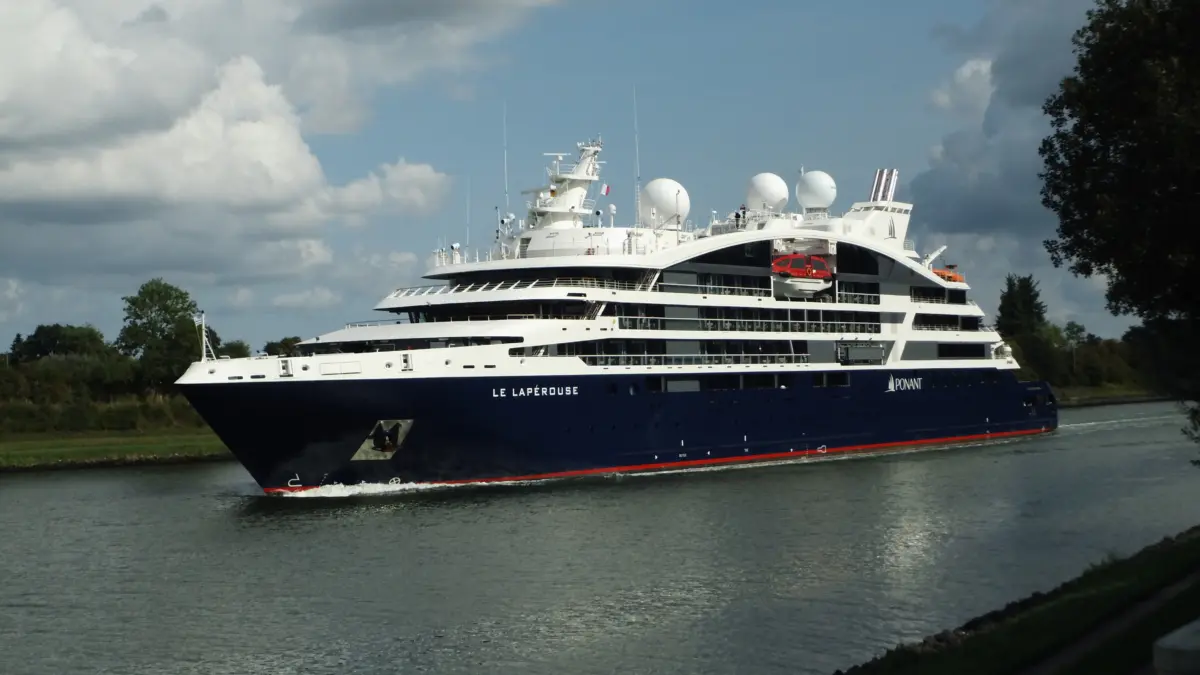
Le Lapérouse in the Kiel Canal near Königsförde in August 2018.
Photo: HenSti. Licence: CC BY-SA 4.0; crop by CruisePing.
Le Lapérouse is the most useful starting point for understanding modern PONANT. It carries 184 guests, every stateroom has a balcony, the ship is small enough for expedition work and unusual ports, yet it still has two restaurants, a pool, theatre, spa, marina and the Blue Eye underwater lounge. It gives travellers a much more conventional luxury-ship rhythm than Le Ponant without approaching resort scale.
As the first of six closely related PONANT Explorers, it also has an important limitation: there is rarely a reason to choose it solely because of the name on the bow. Itinerary, departure point and fare usually matter more than small differences between Explorer sisters. Use the full PONANT selector before committing, then compare the very different Le Ponant and Le Commandant Charcot if either sailing style or extreme polar access is the real priority.
Le Lapérouse is the safest all-round PONANT choice for many first-time passengers. It is small enough to feel genuinely intimate, has enough facilities to make sea days comfortable and can move between classic small-ship cruising and expedition work. Choose the itinerary rather than paying extra simply because one Explorer sister is newer.
Le Lapérouse at a glance
| Cruise line | PONANT Cruises |
|---|---|
| Ship class or type | PONANT Explorer, first ship of the six-ship Explorer series |
| Entered service | 2018 |
| Last major refurbishment | No major transformative refit publicly highlighted; the current ship retains the Explorer-class configuration |
| Gross tonnage | 9,976 GT |
| Length | 131 m |
| Guest capacity | 184 maximum |
| Crew | 118 |
| Passenger decks | 5 principal guest-accessible decks |
| Cabins or suites | 92 staterooms and suites, all with private balcony |
| Accessible cabins | 2 wheelchair-adapted cabins |
| Dining venues | Main gourmet restaurant and informal grill restaurant, plus room service |
| Bars and lounges | Main lounge, observation lounge, pool bar and Blue Eye underwater lounge |
| Pools and hot tubs | Heated outdoor infinity-style pool plus marina access for water activities |
| Library | Reading collection integrated with the observation lounge rather than a large separate library room |
| Spa and fitness | SOTHYS spa, hammam, hair salon and fitness room |
| Children’s facilities | Kids Club on selected voyages from age 4; expedition voyages normally from age 6 |
| Adults-only facilities | No dedicated adults-only retreat |
| Wi-Fi | Included 24-hour Wi-Fi, with satellite performance varying by region |
| UK departures or deployment | Wide deployment including Northern Europe, Iceland, Atlantic, Mediterranean and expedition regions; selected British Isles calls but no regular Southampton season |
Best suited to
- Couples wanting a small luxury ship with real expedition capability but familiar hotel facilities
- First-time PONANT passengers who want a representative Explorer-class experience
- Travellers who value balconies, a pool, spa, lounges and good food without a large passenger count
Think carefully if
- You want the sailing-yacht intimacy of 32-guest Le Ponant
- Your itinerary requires the extreme ice capability of Le Commandant Charcot
- You expect a large entertainment programme, casino, multiple speciality restaurants or extensive children’s attractions
The booking decision
Le Lapérouse works because it avoids the extremes of the fleet. At 131 metres and just under 10,000 GT, it is small enough to access places that shut out large ships, but it does not ask passengers to accept the stripped-back facilities of a yacht. The current Le Lapérouse overview confirms 184 guests, 92 staterooms and suites and 118 crew, a ratio that supports personal service without creating the almost private-yacht atmosphere of Le Ponant.
For most bookings, route should break the tie between Explorer sisters. Le Lapérouse can appear in Northern Europe, the Atlantic, the Mediterranean and expedition regions. A convenient embarkation and a better sequence of ports are more valuable than choosing another sister because it entered service a year or two later.
| Book it for | A balanced modern PONANT experience with small-ship access and familiar luxury facilities |
|---|---|
| Main strength | 184 guests with balconies throughout and unusually good public-space choice for the size |
| Main compromise | Explorer sisters are very similar, so ship loyalty can distract from the better itinerary |
| Cabin priority | Location and suite space, not balcony access, because every stateroom already has a balcony |
| Best comparison | Other PONANT Explorers first, then Sisterships if itinerary and fare are similar |
Why the Explorer design works
The Explorer series was designed around a simple balance: enough ship to be comfortable, little enough ship to remain destination-led. The pool and marina sit aft, observation spaces give wide views and the theatre supports lectures as well as evening entertainment. Corridors are short compared with mainstream ships, and 184 guests means embarkation, dining and shore departures rarely require the queuing culture of a large vessel.
There is still a recognisable cruise-ship routine. Breakfast, shore briefings, afternoon tea, dinner and evening performances give the day structure. Travellers who worry that expedition cruising means basic accommodation can find this reassuring. The ship feels French and refined rather than rugged.
Blue Eye is unusual, not a reason to book by itself
The Blue Eye underwater lounge sits below the waterline with large viewing windows and an acoustic system that can bring underwater sound into the room. It remains one of the Explorer class’s most recognisable features. The novelty is real, but wildlife does not arrange itself outside the windows on demand. Treat Blue Eye as an atmospheric lounge rather than an underwater safari attraction.
Its greater value is that it adds a genuinely different evening or quiet-day space on a ship that otherwise has a main lounge and observation lounge. On a 184-guest vessel, one additional distinctive room matters more than it would on a 4,000-passenger ship.
Cabins: the balcony decision is already made
Every stateroom and suite has a private balcony, removing one of the usual cruise-booking dilemmas. Entry rooms are about 19 square metres, which is comfortable rather than enormous. Suites add living area and, in the upper categories, butler service. Because the ship is small, location can matter more than walking distance itself: proximity to the aft marina, public lounges or lifts can influence noise and convenience.
Two cabins are wheelchair-adapted. That is useful, but accessibility still depends on the itinerary. Tenders, Zodiacs, beaches and expedition landings can defeat an otherwise accessible ship. Anyone who uses a wheelchair or cannot manage steps should ask about the actual shore programme, not just the cabin dimensions.
Dining: two venues are enough if the food matters more than choice
The main restaurant provides the more formal French-led dinner, while the grill gives passengers a relaxed alternative. Room service adds flexibility. The range is modest compared with a large luxury ship, but 184 guests do not need a district of restaurants. The quality and daily menu variation matter more than the number of signs outside dining rooms.
PONANT’s gastronomy programme draws heavily on French culinary tradition while adapting to local supply. Passengers should expect a stronger French identity than on British or American premium lines. That is part of the appeal, not something the ship tries to neutralise.
Open Bar, gratuities and extras
Water, soft drinks, wines, beer, champagne, spirits, coffee and tea are included through the Open Bar, apart from selected premium alcohol. Wi-Fi is included as well. One activity at each stop is normally part of the core PONANT proposition, although specific inclusions vary with the voyage and partnership programme. Read the individual itinerary carefully because some themed sailings include additional transfers or excursions.
Gratuities remain discretionary. PONANT provides an informational guide of EUR10 to EUR12 per passenger per day rather than adding a compulsory daily service charge. Spa treatments, boutique purchases, premium alcohol and some optional activities create the most obvious extra spending.
Pool, marina and warm-weather itineraries
The aft pool is modest in size but proportionate to the guest count. More important is the marina platform, which can support water access and activities when local conditions allow. On Mediterranean, tropical and island itineraries, the combination lets the stern of the ship become part of the destination rather than merely a sun deck.
On colder expedition routes the value shifts to indoor spaces, lectures and observation. A ship with one outdoor pool is not compromised in Iceland or the Arctic if the itinerary is strong, but passengers should understand that the hardware was designed to work across very different climates.
Spa, hammam and fitness
The spa includes treatment rooms, hammam, hair salon and fitness facilities. These are proper shipboard amenities rather than token rooms squeezed into an expedition vessel. They are especially useful on sea days or after active landings. Treatments are extra, so passengers who use the spa heavily should allow for that in a fare comparison with lines that package onboard credit or more inclusions.
Entertainment and the bilingual atmosphere
The theatre hosts naturalist talks, destination lectures, films and performances. Music and social events also take place in the lounges. The evening is deliberately low-key. There is no casino and no attempt to create a resort nightlife district. French and English are the principal onboard languages, with signage in both.
English-speaking passengers should be comfortable with a genuinely international, French-rooted atmosphere. Some departures are specially tailored for English-speaking markets or partnerships, but the wider product does not need to feel like a British ship to be accessible. Travellers who see bilingual operation as part of the interest usually enjoy PONANT more than those expecting every social cue to mirror a UK cruise line.
Families: possible, but not the core market
Classic cruises can accept children from age one, subject to limits for the youngest ages, and Kids Club provision can operate from age four on selected departures. Expedition voyages normally begin from age six. The policy makes family travel possible, but Le Lapérouse remains an adult-oriented small ship in atmosphere, with no water park, arcade or large children’s zone.
Families whose children enjoy wildlife, geography, swimming and shared adult meals can make it work very well. Those who need constant organised children’s entertainment should not choose the ship simply because a Kids Club appears on a particular sailing.
Le Lapérouse ship tour video

Expedition or classic cruise?
The same hardware can deliver very different holidays. On a classic Mediterranean or Atlantic itinerary, the ship behaves like a refined small cruise vessel: ports, meals, pool time and cultural visits dominate. On an expedition route, Zodiacs, naturalists, briefings and flexible landings reshape the day. Passengers should book the style of voyage first and the ship second.
This distinction is important when comparing prices. A classic sailing can be judged against other small luxury lines. An expedition sailing should be compared with other expedition operators on guide ratios, included activities, time ashore and destination depth. The ship is only one component of the value.
Le Lapérouse versus Le Ponant
Le Ponant carries 32 guests and is built around sailing, open decks and marina life. It has no conventional pool and far less venue choice. Le Lapérouse feels like a complete small cruise ship. Choose Le Ponant when intimacy and sailing are the point; choose Le Lapérouse when you want a small ship without giving up the familiar structure of a luxury cruise.
Le Lapérouse versus Le Commandant Charcot
Le Commandant Charcot is a much larger and more specialised polar vessel. Its Polar Class 2 hull, science facilities, larger expedition team and high-latitude reach justify a different price category. Le Lapérouse is the better all-rounder for destinations that do not require extreme ice capability.
What to check before booking
- Compare the itinerary with the other five PONANT Explorers before paying more for one particular sister.
- Confirm whether the departure is a classic, expedition or partnership voyage because the daily programme and inclusions change materially.
- Study the exact shore activities, especially if mobility or Zodiac transfers are a concern.
- Check flight and hotel logistics from the UK rather than focusing only on the cruise fare.
- Review the cabin deck vertically against the theatre, pool, marina and observation spaces.
- Use the current Le Lapérouse voyage list to judge where the ship is actually strongest.