
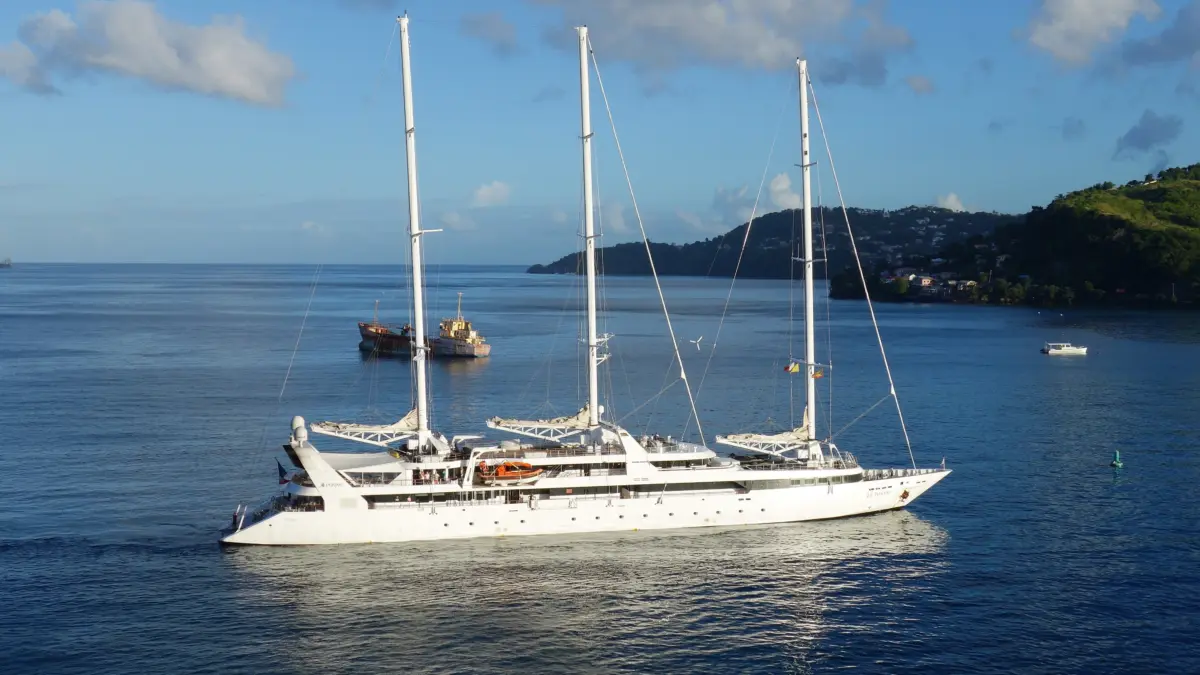
Le Ponant approaching Grenada’s cruise terminal in December 2017.
Photo: Ein Dahmer. Licence: CC BY-SA 4.0; crop by CruisePing.
Le Ponant is the ship for travellers who want PONANT at its most intimate and least cruise-like. With only 32 guests, 16 staterooms and suites and three masts, it behaves more like a fully crewed luxury yacht than a scaled-down cruise ship. That gives it access to small anchorages and creates unusually personal service, but it also removes many facilities that passengers may assume are standard at this price.
The yacht makes most sense when sailing itself, sea access and a flexible small-group rhythm are central to the holiday. It is not the best choice simply because it is the smallest vessel in the PONANT fleet selector. Travellers who want more dining choice, a pool, theatre and broad expedition infrastructure should look at Le Lapérouse. Those chasing ice and high-polar access need Le Commandant Charcot.
Le Ponant is one of the most distinctive ships in the fleet, but only for the right traveller. Book it for sails, tiny-group access, direct contact with the sea and a 32-guest atmosphere. Do not pay yacht-level fares expecting the restaurant choice, entertainment and accessibility of a conventional luxury ship.
Le Ponant at a glance
| Cruise line | PONANT Cruises |
|---|---|
| Ship class or type | Three-masted sailing yacht |
| Entered service | 1991 |
| Last major refurbishment | Major transformation completed in 2022 |
| Gross tonnage | 1,443 GT |
| Length | 88 m |
| Guest capacity | 32 maximum |
| Crew | 33 |
| Passenger decks | 3 principal guest accommodation and public-space levels |
| Cabins or suites | 16 staterooms and suites |
| Accessible cabins | No dedicated wheelchair-adapted cabin identified; mobility suitability should be confirmed before booking |
| Dining venues | One intimate restaurant with indoor and outdoor service; meals are served à la carte or on request |
| Bars and lounges | Main salon, bar and outdoor lounge areas |
| Pools and hot tubs | No conventional pool; marina platform provides direct access to the sea and water sports |
| Library | Books and reading material available, but no large dedicated library room |
| Spa and fitness | Massage room, fitness room, solarium and wellness-focused outdoor spaces |
| Children’s facilities | No dedicated children’s club; suitability depends on the individual sailing and age policy |
| Adults-only facilities | No formal adults-only enclave; the entire yacht is quiet and low-density |
| Wi-Fi | Included Wi-Fi; performance varies by sailing region |
| UK departures or deployment | Mediterranean, Caribbean, Cape Verde and other warm-water sailing regions; no regular UK homeport season |
Best suited to
- Couples who want a quiet, highly personal yacht experience rather than conventional cruising
- Sailing enthusiasts who value time under canvas, open decks and close contact with the sea
- Travellers who enjoy small harbours, secluded anchorages and water activities from a marina platform
Think carefully if
- You want multiple restaurants, a conventional swimming pool, theatre shows or a busy evening programme
- You have significant mobility needs and require the infrastructure of a larger accessible vessel
- You prefer anonymity and do not want to spend a week in a social environment of only 32 guests
The booking decision
Le Ponant should win or lose the booking in a few minutes. The 32-guest scale is not a marketing detail. You will see the same passengers repeatedly, the crew will know individual preferences quickly and meals will feel communal even when tables remain private. Shore arrangements can be more flexible than on larger ships because the group is so small. The reverse is that there is nowhere to disappear into a different venue if the social rhythm does not suit you.
The current Le Ponant overview confirms 16 staterooms and suites and 33 crew members for a maximum of 32 guests. That near one-to-one staffing level is where much of the price goes. The experience is closer to a private yacht charter shared with other guests than to a premium cruise ship.
| Book it for | Intimacy, sailing, marina access and anchorages that suit a small yacht |
|---|---|
| Main strength | 32 guests with almost as many crew |
| Main compromise | Very limited conventional ship facilities |
| Cabin priority | Upper-deck balcony accommodation if private outside space matters; lower rooms trade balcony access for yacht character and price |
| Best value test | Would the itinerary still appeal if the vessel had no theatre, casino or pool? If yes, Le Ponant may be exactly right. |
The 2022 transformation matters
A ship launched in 1991 could easily sound like a nostalgic product preserved for loyalists. Le Ponant is not presented that way now. Its major transformation created a modern 16-cabin yacht with a deliberately restrained interior, much more outside living space and a strong connection between decks and sea. The age of the hull is therefore less useful than the current accommodation and operating concept when comparing it with the rest of the fleet.
The yacht remains structurally different from a new PONANT Explorer. Narrower passages, yacht-scale stairs and the absence of large-ship redundancy are part of the design. Travellers should not translate ‘refurbished’ into ‘built like a 2020s expedition ship’. The transformation renewed the experience without changing the fact that this is an 88-metre sailing yacht.
Sailing is not just decoration
Three masts and a large sail plan make Le Ponant visually romantic, but the important question is how much the voyage design allows the sails to matter. Wind, route and schedule determine when the yacht can sail rather than motor. Passengers who would be disappointed if a particular day is not under full sail should treat it as seamanship rather than a staged attraction.
When conditions work, the change in pace is the reason to be aboard. There is less engine noise, open decks become the centre of the day and the voyage feels connected to wind and sea. That is a fundamentally different pleasure from watching scenery through an observation lounge on a conventional expedition ship.
The marina platform changes warm-water days
Instead of a conventional pool, Le Ponant uses the sea as the playground. The marina platform supports kayaking, paddleboarding, snorkelling and other water activities where local conditions permit. On warm itineraries this can be more rewarding than a small shipboard pool because guests move directly into the bay, cove or anchorage they came to see.
The obvious limitation is weather and location. A marina platform is useless when local rules, sea state or temperature prevent water access. Anyone who sees a pool as a guaranteed daily facility should choose another ship. The yacht’s best itineraries are those where the sea can be used rather than merely observed.
Cabins: only sixteen, but not identical
The accommodation ranges from Mistral-deck porthole and window rooms to upper-deck balcony staterooms and substantial suites. With only 16 rooms, location differences are easier to understand than on a large ship, yet they matter because this is a compact yacht. Upper rooms provide private outside space. Lower rooms bring more traditional sailing-yacht character and may feel closer to the water.
Do not assume the most expensive suite is necessary to receive personal service. The guest count is so low that the whole vessel operates at an unusually high service ratio. Spend the upgrade money when you genuinely value a separate living area or private balcony, not to buy attention that should already be part of the basic product.
Dining without restaurant choice
Le Ponant does not try to imitate a ship with six speciality restaurants. Breakfast, lunch and dinner are served à la carte or on request, with indoor and outdoor dining shaped around the day. The emphasis is on ingredients, regional influence and flexibility rather than venue-hopping. The yacht became the first sailing vessel to receive the Relais & Châteaux label, which reinforces how central food is to the current proposition.
A traveller who likes choosing between steakhouse, Asian restaurant, buffet and room service each evening will feel constrained. A traveller who prefers one good kitchen that knows their tastes may find the simplicity liberating. Dietary requirements should be discussed before sailing because a tiny galley cannot carry the breadth of backup stock found on a large ship.
Drinks, gratuities and what the fare covers
The broad PONANT Open Bar is included, covering standard water, soft drinks, wine, beer, champagne, spirits, coffee and tea, while selected premium alcohol costs extra. Wi-Fi is also included. These inclusions reduce the friction of a yacht product where signing repeatedly for ordinary drinks would feel particularly intrusive.
Gratuities are not compulsory. PONANT leaves them to passenger discretion and gives an informational average of EUR10 to EUR12 per person per day. Spa treatments, selected premium drinks and some personal services remain extra, so ‘all-inclusive’ should not be interpreted as every possible onboard expense.
Social life with 32 guests
There is a salon, bar, open deck and the restaurant, but no need for a schedule full of competing venues. The social environment develops through the guests themselves. On a good sailing, shared days ashore and in the water produce an easy house-party rhythm. On a poor fit, the small scale can magnify personality differences because there is no second lounge full of strangers to move to.
Solo travellers should think particularly carefully about this. Selected PONANT departures can waive single supplements, but Le Ponant has no dedicated solo cabins and its appeal depends on being comfortable in a small, recurring social group. The upside is that it is difficult to remain anonymous unless you deliberately want to.
Wellness and quiet time
The yacht has a massage room, fitness room, solarium and generous open deck areas rather than a large spa complex. That is enough for stretching, exercise and treatments, but wellness here is as much about being outside as booking an appointment. A morning on deck under sail may do more for the character of the trip than an elaborate thermal suite would.
There is no formal adults-only retreat because the entire vessel is quiet by design. Families can sail subject to the current age policy and individual voyage suitability, but there is no dedicated children’s infrastructure. Parents should choose it because the children genuinely enjoy sailing, water activity and adult company, not because the word yacht sounds special.
Accessibility needs a frank conversation
Le Ponant is not listed alongside the Sisterships, PONANT Explorers and Le Commandant Charcot in PONANT’s detailed wheelchair-adapted cabin information. Stairs, marina operations, tenders and small-yacht circulation can all be limiting. Anyone with reduced mobility should discuss the exact itinerary and required assistance directly before booking rather than relying on generic cruise accessibility expectations.
This is one of the clearest cases where a larger ship can be the better luxury product. Le Lapérouse has two adapted cabins, lifts and more conventional public-space access while remaining a very small ship by industry standards.
Where Le Ponant works best
Warm-water regions suit the design because the open decks and marina become part of daily life. Mediterranean islands, Caribbean anchorages and routes through Cape Verde can exploit the yacht’s small size. The current Le Ponant voyage programme should be read for the actual anchorages and activities rather than judged only by country names.
A seven-night itinerary that visits places already easy to reach from a large cruise ship weakens the value case. A route built around little ports, beaches, bays and time under sail makes much more sense. On Le Ponant, itinerary design is more important than itinerary length.
Official Le Ponant ship video

Le Ponant versus the rest of PONANT
The fleet comparison is especially important because Le Ponant is an outlier. The six PONANT Explorers carry 184 guests and provide two restaurants, a pool, theatre, spa and Blue Eye underwater lounge. The four Sisterships are slightly larger and more conventional. Le Commandant Charcot is a high-polar specialist with substantial scientific and expedition infrastructure.
Choose Le Ponant only if its differences are strengths for you. If you find yourself trying to compensate for the missing pool, limited dining choice or absence of a theatre, a PONANT Explorer is likely the better match. The yacht is at its best when no compensation is required.
What to check before booking
- Confirm how much sailing and marina activity the itinerary is realistically designed to offer.
- Study the cabin position and decide whether a private balcony is worth the upgrade on such a small vessel.
- Ask about mobility, tender and marina access if stairs or transfers are difficult.
- Check the age mix and family suitability of the specific departure if travelling with children.
- Price flights and pre-cruise accommodation because Le Ponant does not operate as a regular UK homeport product.
- Compare the total fare with a PONANT Explorer itinerary before assuming smaller automatically means better.