
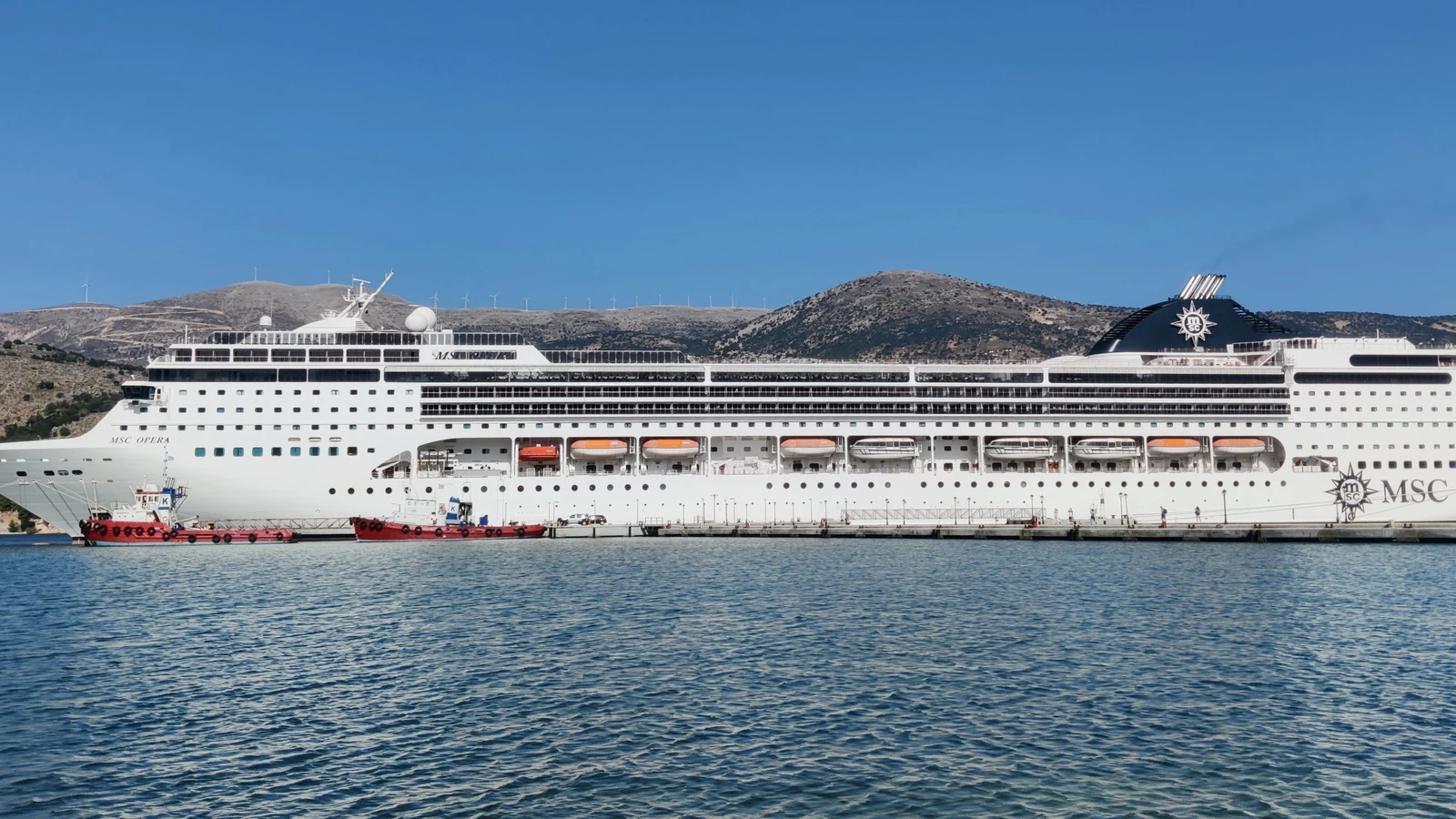
MSC Opera in Argostoli.
Photo: Kefalonitis94 | Licence: CC0 1.0; crop by CruisePing.
MSC Opera is the most itinerary-versatile member of MSC’s compact Lirica Class. Its advertised programme moves from the Mediterranean in summer 2026 to Caribbean cruises from La Romana in winter 2026-27 and summer 2027, with Grand Voyages adding longer repositioning choices. That range gives the ship a clearer reason to book than a simple claim of being smaller or cheaper.
The onboard product remains traditional. Public rooms are organised around theatre, piano bar, pub, disco, casino, main dining and an outdoor pool deck rather than a promenade or attraction district. Cabins and technology show their age, and the ship does not support MSC for Me. Opera is therefore strongest when the itinerary, warm weather and total fare carry much of the holiday.
MSC Opera is the most itinerary-versatile Lirica-class option, especially for La Romana Caribbean sailings from winter 2026-27. Choose it for ports, open-deck weather and a compact resort rhythm, not for a modern digital ship or a broad speciality-dining programme.
MSC Opera at a glance
| Cruise line | MSC Cruises |
|---|---|
| Ship class / type | Lirica Class |
| Entered service | 2004 |
| Last major refurbishment | Enlarged and renewed under MSC’s Renaissance Programme, completed by late 2015 |
| Gross tonnage | 65,691 GT |
| Length | 899 ft / 274 m |
| Guest capacity | 2,658 guests at maximum occupancy |
| Crew | 728 |
| Passenger decks | 9 passenger-accessible decks |
| Cabins and suites | 1,070 cabins and suites |
| Accessible cabins | Accessible cabins are available in selected categories; confirm the current deck plan and bed arrangement |
| Dining venues | Main restaurants, Le Vele buffet and casual Il Patio options; limited speciality choice |
| Bars and lounges | La Cabala Piano Bar, Cotton Club, Sottovento Pub, Byblos Disco and other lounges |
| Pools and hot tubs | Outdoor pool zone, whirlpools, Doremi Spray Park and Top 13 solarium |
| Library provision | Card room and quiet lounge space rather than a large dedicated library |
| Spa and fitness | MSC Aurea Spa, gym, beauty services and open-deck exercise areas |
| Children’s facilities | Baby through teen clubs, LEGO play, virtual-reality games and Doremi Spray Park |
| Adults-only facilities | Top 13 Exclusive Solarium, spa and quieter lounges; no MSC Yacht Club |
| Wi-Fi | Paid Wi-Fi is available; MSC for Me is not supported on this ship |
| UK departures and deployment | Mediterranean in summer 2026; Caribbean from La Romana in winter 2026-27 and summer 2027; Grand Voyages also offered |
Best suited to
- Caribbean travellers who want a La Romana departure and prefer a smaller MSC ship to a vast resort vessel.
- Couples, friends and families who enjoy a conventional pool, theatre, lounge and main-dining routine.
- Passengers who treat the ship as a comfortable base for ports and warm-weather sea days.
Think carefully if
- You want a large selection of modern balcony cabins, private-suite facilities or multiple speciality restaurants.
- You depend on MSC for Me for maps, schedules, reservations or group communication.
- Long-haul flights and Caribbean transfers make the total cost too close to a newer or more inclusive alternative.
Layout, scale and atmosphere
Opera follows a recognisable classic arrangement. Teatro dell’Opera sits forward, central decks contain reception, shops, casino and bars, while dining and outdoor facilities extend aft and upwards. The route between evening venues is easier to understand than the multiple districts on a very large ship. La Cabala Piano Bar and Cotton Club provide clear social anchors rather than anonymous pass-through space.
The ship has 1,070 cabins, more than the other three members of the class, and can carry 2,658 guests. Its compact dimensions do not guarantee quiet. Lift banks and corridors become busy when dinner, theatre and excursions change at similar times. The advantage is legibility, not emptiness. Travellers who learn one forward-to-aft route and avoid the sharpest peaks will find the ship manageable.
Cabins and suites
Opera’s cabins reflect both its original design and the accommodation added during the Renaissance enlargement. Interiors are generally around 12 to 13 square metres, ocean-view rooms span roughly 12 to 22 square metres, balcony cabins are about 13 square metres plus a small balcony, and junior suites are around 23 square metres with about 5 square metres outside. Those figures are modest beside modern MSC rooms.
The added balcony categories make Opera worth checking when private outside space matters, but supply and location remain limited. Study the deck plan for obstructed views, connecting doors, pull-down beds and noise from public rooms. A bright ocean-view cabin can offer better value than a small balcony with an awkward position. Accessible accommodation must be confirmed against the current plan, including bed arrangement and scooter storage.
Dining, drinks and what the fare buys
Main restaurants, Le Vele buffet and casual Il Patio options create a serviceable included programme. The emphasis is on familiar dishes, assigned or flexible evening dining and buffet convenience rather than destination restaurants. That structure works on a port-led cruise when many days begin early and dinner provides the main shared occasion. It is less appealing to travellers who regard dining variety as a central reason to cruise.
Caribbean itineraries can change the rhythm because warm evenings and late returns encourage more casual meals. Buffet peaks are likely when several excursions arrive together. A drinks package may suit passengers spending substantial time on deck, but the calculation must include port days and the rules attached to every adult in the cabin. Do not buy a broad package simply to make the fare feel more inclusive.
Pools, outdoor decks and weather
Opera’s outdoor pool zone, whirlpools, Doremi Spray Park and sun decks are most convincing in the Caribbean. Warm weather allows the ship’s straightforward resort pattern to work as intended: breakfast, port or pool, afternoon music, dinner and a show. The Top 13 solarium gives adults another place to seek sun, although none of these spaces creates the private separation found in MSC Yacht Club.
The same design is less robust in poor weather because there is no major covered pool hall. Mediterranean shoulder seasons and Atlantic crossings need a realistic view of wind, rain and temperature. Caribbean sun also creates its own pressure on shade and loungers. Use early mornings, port days and later afternoons, and choose a balcony only if private outdoor space will be genuinely useful rather than an occasional novelty.
Entertainment and evening atmosphere
Teatro dell’Opera provides the production-show centre, supported by the Med Pearl Casino, La Cabala Piano Bar, Cotton Club, Sottovento Pub and Byblos Disco. The names reflect a ship designed around distinct rooms rather than one central entertainment street. Passengers can move from a formal show to piano music, dancing or a pub atmosphere without crossing a huge vessel.
The offer is lively but conventional. Anyone expecting aerial shows, immersive technology or a large indoor promenade should look elsewhere. Multilingual announcements and international music are normal. Seating pressure is greatest around dinner and theatre turnover, so arrive early or use a different lounge until the crowd disperses. Opera’s evening strength is sociability and variety of mood, not technological spectacle.
Families, children and teenagers
Children’s clubs cover the main age groups, with LEGO play, virtual-reality gaming, teen spaces and Doremi Spray Park. The simpler layout can help families manage collection times and shared meals, while a Caribbean itinerary supplies beaches and active days ashore. Younger children who enjoy structured club sessions and pool play can be well served without needing a vast attraction deck.
Older children may compare the ship unfavourably with water slides, ropes courses, simulators and large sports areas elsewhere in the MSC fleet. Cabin size also becomes more important when third and fourth berths are occupied. Families should check the exact room layout and club hours, then decide whether the itinerary provides enough variety. Opera works better as a family base than as a destination in its own right.
Adults, spa time and quiet spaces
The MSC Aurea Spa, gym, Top 13 solarium, piano bar and quieter daytime lounges give adults several ways to step away from the main pool atmosphere. Sea days can be organised around exercise, treatments, reading and live music without chasing organised activities. The classic room-based layout also means a calm venue can sometimes remain calm because it is not part of a central pedestrian route.
Opera has no MSC Yacht Club. A suite or Aurea booking can improve the cabin and selected benefits, but it does not unlock a private restaurant, lounge and pool enclave. Travellers who need a reliably secluded environment should compare Yacht Club on a larger ship or a premium small-ship fare. Opera’s adult appeal comes from traditional spaces and warm-weather itineraries rather than exclusive facilities.
Wi-Fi, packages and extra costs
Paid Wi-Fi is available, but MSC for Me is not supported. On a port-intensive Caribbean itinerary, that means more reliance on printed schedules and agreed meeting points. Photograph excursion details, restaurant times and the daily programme. Download travel documents, insurance information and maps before leaving reliable shore connectivity. Group members should not assume that app messaging will work around the ship.
The long-haul holiday cost can include flights, luggage, airport hotels, transfers, excursions, drinks, Wi-Fi and spa spending. La Romana departures may still be excellent value, but only after every travel component is included. Compare an MSC fly-cruise package with independent arrangements on equal terms. A cheaper cabin can be false economy if awkward flights or unplanned extras absorb the difference.
Accessibility and moving around
Opera’s nine passenger decks and clear layout aid orientation, but busy lift periods and long corridors remain relevant. A cabin close to the appropriate lift bank can be more useful than a theoretical midship position. Passengers with reduced mobility should identify the route to their restaurant, theatre and gangway, then consider how often those journeys will be made during a typical day.
Accessible cabins exist in selected categories, but the current UK ship page does not present a simple total alongside the main specifications. Obtain written confirmation of dimensions, bed layout, bathroom equipment and storage before booking. Caribbean ports can involve steps, uneven surfaces, small boats or inaccessible vehicles. Assess every important call and transfer, not only whether the ship itself accepts mobility equipment.
Current deployment and itinerary fit
MSC advertises Opera in the Mediterranean for summer 2026, then in the Caribbean from La Romana for winter 2026-27 and summer 2027. Grand Voyages create additional longer routes. The Caribbean programme is the strongest booking reason because it combines dependable open-deck weather with a less common embarkation base and a ship small enough to feel more conventional than MSC’s newest Caribbean giants.
UK passengers must evaluate the flights as carefully as the cruise. Arrival times, luggage, transfer duration and any overnight stay affect both risk and value. In the Mediterranean, compare Opera directly with Lirica and other ships serving similar ports. On a Grand Voyage, the larger number of sea days increases the importance of cabin comfort, indoor space and entertainment tolerance.
How MSC Opera compares with other MSC ships
Opera’s clearest class advantage is deployment. Lirica is the stronger pure Mediterranean traditionalist, Sinfonia has a music-led identity and South America season, and Armonia relies more heavily on route and price. Opera’s 1,070 cabins and La Romana programme make it the logical first comparison for a Caribbean traveller who does not want the scale of Seaside or World Class.
Against newer MSC ships, the compromises are substantial: fewer dining choices, no Yacht Club, limited balcony supply, older cabin technology and no MSC for Me. The reward is a more legible vessel and potentially more emphasis on ports. Compare it with MSC Seaside or Seashore only after deciding whether attractions and private enclaves matter more than compact scale and the specific itinerary.
Booking decision
Book Opera for a route that is difficult to replicate at a comparable total cost, especially a well-priced La Romana itinerary with sensible flights. Select the cabin by exact plan rather than broad label. An ocean-view room can be enough on a port-heavy week, while a balcony earns its premium when warm sea days and private morning time are part of the plan.
Do not book solely because the ship is smaller or the lead fare looks low. Calculate the long-haul logistics, assess sea-day entertainment and decide whether the family needs more attractions. Opera can be a very effective Caribbean or Mediterranean base for passengers who like classic cruising. It is not suited to travellers trying to recreate a modern resort ship through add-on spending.
| Best overall fit | A warm Caribbean or Mediterranean itinerary where ports and outdoor time matter more than new ship hardware. |
|---|---|
| Best cabin strategy | Use the exact deck plan; a strong ocean-view position may beat a small balcony with noise or obstruction. |
| Main strength | La Romana deployment and a clear traditional layout with several distinct evening venues. |
| Main compromise | Limited dining breadth, older cabins, no MSC for Me and no private-suite enclave. |
| CruisePing booking rule | Approve the complete travel cost and itinerary first, then pay only for the cabin features that will be used. |
Before booking
- Compare package and independent flight times, luggage and transfer arrangements.
- Check the precise cabin position, view, occupancy and public decks above or below.
- Review the number of sea days, particularly on a Grand Voyage.
- Price Caribbean excursions and drinks against the amount of time likely to be spent ashore.
- Request written accessibility details for the cabin, gangways and priority ports.
- Confirm that the family is comfortable with clubs and pool play rather than major attractions.
Related CruisePing guides
- MSC Cruises guide – How MSC fares, experiences, dining and the wider fleet fit together.
- Best MSC cruise ship – Compare ship classes before deciding whether compact scale or modern attractions matter more.
- MSC Armonia – Compare another compact Lirica-class ship with a different itinerary or onboard emphasis.
- MSC Lirica – Compare another compact Lirica-class ship with a different itinerary or onboard emphasis.
- MSC Sinfonia – Compare another compact Lirica-class ship with a different itinerary or onboard emphasis.
- MSC Musica – A useful step up in size and public-space choice without reaching mega-ship scale.
- MSC Magnifica – Compare a larger classic MSC ship with broader facilities and different deployment.
- MSC Meraviglia – See how an indoor-promenade resort ship changes dining, entertainment and crowd flow.
- MSC Seaside – Compare a much larger outdoor-focused design for warm-weather cruising.
- What is included on MSC Cruises – Understand meals, entertainment and the common extras before comparing fares.
- MSC Cruises for families – Assess clubs, cabins, packages and the differences between ship generations.