
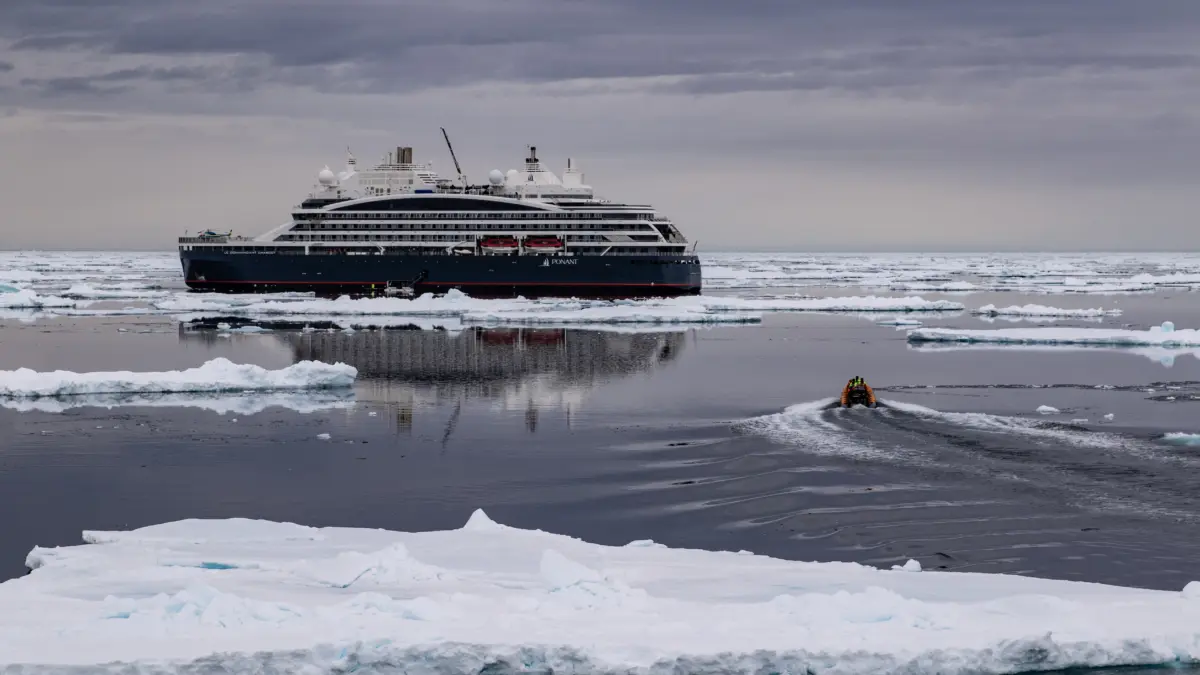
Le Commandant Charcot during a U.S. Coast Guard operation in Baffin Bay in June 2024.
Photo: U.S. Coast Guard photo by Cmdr. Krystyn Pecora. Licence: Public domain – U.S. federal government work; crop by CruisePing.
Le Commandant Charcot is not a small luxury cruise ship with an expedition department attached. It is a specialised polar ship whose engineering determines where the holiday can go. That distinction matters because the fare can be several times the cost of a conventional Antarctica or Arctic voyage. The strongest reason to pay it is access: serious ice capability, unusually early or late polar seasons and itineraries towards the Geographic North Pole or deep into regions that ordinary expedition ships cannot reliably reach.
The ship carries no more than 245 guests, yet at 150 metres and 31,757 GT it has the scale to support extensive public rooms, laboratories, indoor and outdoor pools and a large expedition operation. It therefore feels substantially more spacious and more hotel-like than its passenger count suggests. Compare it first with the complete PONANT fleet selector, because neither Le Ponant nor Le Lapérouse is trying to solve the same travel problem.
Choose Le Commandant Charcot when the polar itinerary genuinely needs the ship. Its restaurants, spa, lounges and suites are excellent, but they are not the main justification for the price. The compelling proposition is the combination of Polar Class 2 capability, a large expedition team, scientific infrastructure and enough onboard comfort to make remote high-latitude days enjoyable rather than merely tolerable.
Le Commandant Charcot at a glance
| Cruise line | PONANT Cruises |
|---|---|
| Ship class or type | Purpose-built Polar Class 2 luxury polar exploration vessel |
| Entered service | 2021 |
| Last major refurbishment | No transformative refit announced; the ship remains in its original current-generation configuration |
| Gross tonnage | 31,757 GT |
| Length | 150 m |
| Guest capacity | 245 maximum |
| Crew | 215 |
| Passenger decks | 9-deck ship, with principal guest spaces spread from the lower accommodation decks to Deck 9 |
| Cabins or suites | 123 staterooms and suites, all with private balcony or terrace |
| Accessible cabins | 3 wheelchair-adapted cabins |
| Dining venues | Nuna, Sila and the outdoor Inneq venue, plus room service |
| Bars and lounges | Main Lounge, Anori observation lounge, outdoor bar and Cigar Lounge |
| Pools and hot tubs | Indoor pool plus the heated outdoor Blue Lagoon and hot-water relaxation areas |
| Library | Travel-focused library integrated into the Anori observation lounge |
| Spa and fitness | Spa, hair salon, fitness room and snow room |
| Children’s facilities | No conventional kids club focus; polar voyages accept children from age 8 |
| Adults-only facilities | Cigar Lounge is an adult-oriented space; the ship otherwise has no large segregated adults-only resort zone |
| Wi-Fi | Included 24-hour Wi-Fi, with performance dependent on high-latitude satellite coverage |
| UK departures or deployment | Arctic and Antarctic deployment; fly-cruise logistics are normally required from the UK |
Best suited to
- Experienced expedition travellers who want to push beyond the usual Antarctic Peninsula or Svalbard circuit
- Luxury travellers who need substantial indoor comfort, good food and strong observation spaces in extreme climates
- Passengers interested in polar science, ice navigation and destinations where the vessel itself is part of the experience
Think carefully if
- You mainly want a first Antarctica cruise and could obtain the wildlife experience on a less expensive expedition vessel
- You dislike itinerary uncertainty, Zodiac operations or the physical realities of cold-weather landings
- You are choosing it for luxury alone rather than for the specific polar access offered by the sailing
The booking decision
The most important question is not whether Le Commandant Charcot is the best PONANT ship. It is whether the itinerary is one that rewards its unusual capability. On a North Pole voyage, a deep-ice Arctic programme or a route designed around conditions inaccessible to conventional expedition ships, the ship and itinerary are inseparable. On a more conventional polar route, compare the total fare with Explorer-class alternatives and ask what additional access you are actually buying.
The current Le Commandant Charcot information shows the vessel at 245 guests, 123 staterooms and suites and 215 crew. Those numbers explain why the onboard atmosphere is different from a mainstream ship of similar length: passenger density is low, while expedition staffing and hotel staffing remain substantial. The result is space rather than a catalogue of entertainment venues.
| Book it for | North Pole, deep Arctic, high-latitude Antarctica and other voyages where ice capability changes the route |
|---|---|
| Main strength | A rare combination of serious polar engineering and polished luxury |
| Main compromise | Very high fares and expedition uncertainty |
| Cabin priority | Choose by location, balcony preference and suite space rather than chasing a view that every cabin already receives |
| Before paying the premium | Compare the actual itinerary, included logistics, expedition activities and number of days in the target region |
A polar ship first, a luxury ship second
The hull is Polar Class 2, a level of ice capability that puts the vessel in a different category from the ice-strengthened expedition ships used on most passenger voyages. Its hybrid-electric propulsion system uses liquefied natural gas as one of its energy sources. For a passenger, the practical consequence is not a technical badge. It is the ability to operate in heavier ice, maintain ambitious high-latitude programmes and position the ship where scenery, wildlife and ice become the day rather than a distant backdrop.
That does not mean every voyage will follow the brochure map precisely. Polar travel remains governed by weather, ice, wildlife and local safety decisions. The more ambitious the itinerary, the more important it is to buy the expedition rather than a sequence of promised place names. Travellers who become frustrated when a port is substituted are poorly matched to the very voyages that make Charcot distinctive.
The expedition day
On expedition days, the ship becomes a base for Zodiac landings, guided outings, lectures and observation. PONANT’s expedition guidance describes a naturalist team of about 20 on Le Commandant Charcot, roughly twice the level used on its other expedition cruises. The benefit is not just a better lecture programme. More specialists can interpret geology, birds, marine mammals, history and ice from different perspectives, and the expedition staff can manage changing conditions without reducing the whole experience to one group activity.
A polar expedition is still physical. Stepping into Zodiacs, walking on uneven ground, dressing in layers and responding to weather changes are part of the trip. Some itineraries add hikes, snowshoeing, kayaking or polar plunges. The ship provides a polar parka and lends suitable boots on relevant voyages, but passengers should still arrive with realistic mobility expectations and good waterproof layers.
Science is visible rather than decorative
Le Commandant Charcot has more than 100 square metres dedicated to science and two laboratories. Researchers travel aboard and can work in regions that are difficult to reach by conventional research vessel schedules. For passengers, the strongest science element is the opportunity to hear from people actively studying the environment rather than receiving only destination lectures. It gives sea days and ice-navigation days a purpose that a standard cruise enrichment programme often lacks.
Anyone who is indifferent to lectures, naturalists or the mechanics of polar exploration may not extract the same value. There is still excellent food, a spa and attractive design, but this is an expensive way to buy a luxurious cabin if the science and destination access feel secondary.
Cabins and suites
All 123 staterooms and suites have a private balcony or terrace, so there is no need to pay a premium simply to obtain outside access. Entry-level balcony rooms are about 20 square metres, while suites add progressively larger living areas, better positions and, in selected categories, butler service. The biggest suites become genuine apartments, but the public observation areas are so strong that an enormous private sitting room is not essential for enjoying the polar scenery.
Cabin position deserves more attention than category name. Long walks matter on a large ship, especially after a tiring landing. Passengers with limited mobility should study the vertical relationship between cabin, restaurants, observation lounge, theatre and disembarkation areas. Three wheelchair-adapted cabins are provided, but accessible accommodation does not make every expedition landing accessible. Zodiac transfers and natural terrain remain the decisive constraint.
Restaurants and included drinks
The dining offer is unusually broad for 245 guests. Nuna provides the formal French-led main restaurant, Sila offers a more relaxed alternative, and Inneq gives the upper deck an outdoor food and drink venue that works when conditions allow. The cuisine is a serious part of the ship rather than a compromise made for expedition operations. The PONANT gastronomy overview is useful before booking if food is a major part of the decision.
The broad Open Bar is included. Water, soft drinks, wine, beer, champagne, spirits, coffee and tea are covered, with selected premium alcohol charged separately. That makes the onboard bill more predictable than on many luxury-adjacent lines. Gratuities, however, are discretionary rather than automatically included. PONANT gives an informational average of EUR10 to EUR12 per passenger per day.
Lounges, library and observation
The Anori observation lounge is one of the ship’s most useful spaces. It combines wide views with a travel-focused library and telescopes, making it somewhere passengers can genuinely spend a long ice-navigation day. The main lounge handles social events and music, while the outdoor Inneq bar creates a different atmosphere when temperatures allow. The Cigar Lounge is unusual in a modern expedition ship and is the one clearly adult-oriented indoor space.
The ship does not need a large casino, shopping arcade or multiple production-show venues. Its theatre is used for talks, briefings, films, concerts and performances, while much of the entertainment comes from the landscape outside. Travellers who need a constantly changing evening programme should be cautious. Those who enjoy dinner, a drink, a lecture and a long conversation over the day’s wildlife will find the scale coherent.
Pool, spa and the Blue Lagoon
The wellness facilities are a real strength on cold itineraries. There is an indoor pool, spa, hair salon, fitness room and snow room, plus the heated outdoor Blue Lagoon area. Moving from polar air to warm water can become one of the memorable parts of a sea day. Spa access and fitness facilities are available, while treatments and private coaching are extra.
The outdoor facilities should not be confused with a warm-weather resort deck. Weather can close or limit them, and the value changes with the itinerary. The indoor pool and observation spaces matter more consistently because they remain useful when wind, snow or sea state make the open decks uncomfortable.
Families and age limits
Le Commandant Charcot accepts children from age eight on its polar expeditions. That is a minimum eligibility rule, not a recommendation that every eight-year-old will enjoy an expensive, lecture-heavy high-polar voyage. A child needs to cope with cold, long travel days, changing plans and relatively limited children’s infrastructure. Families should discuss specific expedition activities and age restrictions before paying a deposit.
For a family whose children are fascinated by wildlife, geography and exploration, the experience can be extraordinary. For a family expecting clubs, water slides and flexible casual dining at every hour, it is the wrong ship. The comparison with mainstream family cruising is not meaningful.
Wi-Fi and life at the edge of satellite coverage
Wi-Fi is included. PONANT uses satellite connectivity including Starlink, but high-latitude operation means no passenger should treat connectivity as guaranteed office infrastructure. A remote expedition is one of the least sensible holidays on which to promise constant video calls or heavy cloud-based work. Download essential documents before departure and regard good connectivity as useful when available.
Le Commandant Charcot full ship tour video
Le Commandant Charcot versus Le Lapérouse
The Le Lapérouse guide is the most useful internal comparison because both ships can operate expedition itineraries while delivering a polished French onboard product. Le Lapérouse is much smaller in tonnage and simpler in engineering. It is excellent for remote coasts, islands and polar itineraries where an Explorer-class ship is sufficient. Charcot becomes worth the premium when the ice class and high-polar capability are central to the itinerary.
Le Ponant is an even more radical contrast. The 32-guest sailing yacht is about intimacy, sails, secluded anchorages and a marina platform. It is not a substitute for a polar icebreaker. The fact that both carry the PONANT name is a reminder to choose the ship family before deciding whether the line suits you.
What to check before booking
- Read the day-by-day itinerary and identify which experiences depend on ice, weather or wildlife rather than treating every named landing as guaranteed.
- Check the exact expedition activities included on your departure and whether any optional activities require prior experience, medical certification or additional payment.
- Price international flights, hotels, transfers, insurance and specialist clothing that is not supplied.
- Confirm mobility requirements for Zodiac embarkation and landings even if you are booking an adapted cabin.
- Compare the fare with an Explorer-class PONANT voyage and at least one other polar operator on a similar route.
- Check the current Le Commandant Charcot voyage programme rather than choosing the ship without a destination in mind.