
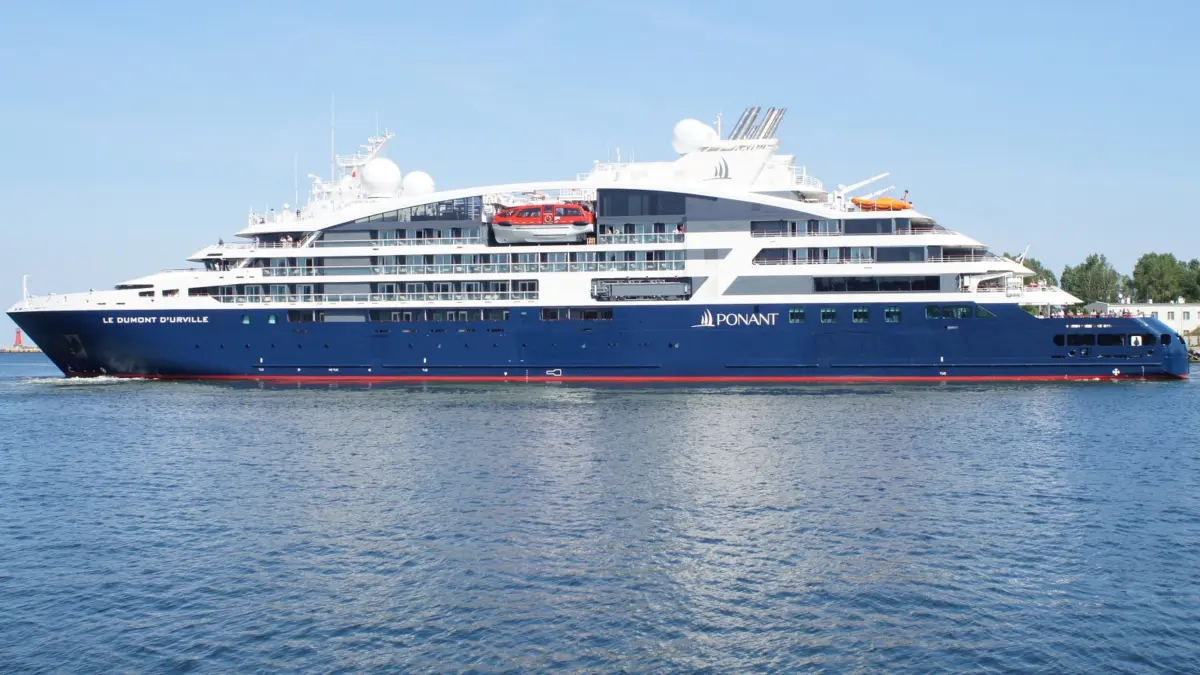
Le Dumont d’Urville in Gdańsk in August 2019.
Photo: Rudolf H. Boettcher. Licence: CC BY-SA 4.0; image preparation by CruisePing.
Le Dumont d’Urville is the Explorer sister that best demonstrates why itinerary should outrank launch date in a PONANT comparison. The ship has the same 184-guest, 92-balcony-room fundamentals as the rest of the series, yet its programme can range from Mediterranean culture to Atlantic passages and Southern African routes. The vessel is consistent; the holiday around it can be completely different.
Le Dumont d’Urville is therefore not a ship to seek out simply because it is the fourth Explorer. Compare it with Le Lapérouse, Le Champlain and Le Bougainville. The PONANT selector should narrow the ship family; the itinerary should then finish the decision.
Choose Le Dumont d’Urville when its route is unusually strong or its fare beats an Explorer sister, not because the onboard product is fundamentally different. That is a compliment to the class rather than a criticism. The ship delivers a proven small-scale combination of balcony cabins, marina, Blue Eye, French-led dining and expedition capability, while deployment creates the real distinction.
Le Dumont d’Urville at a glance
| Cruise line | PONANT Cruises |
|---|---|
| Ship class or type | PONANT Explorer, fourth ship of the six-ship Explorer series |
| Entered service | 2019 |
| Last major refurbishment | No major transformative refit publicly highlighted; the ship retains the Explorer-class configuration |
| Gross tonnage | 9,988 GT |
| Length | 131 m |
| Guest capacity | 184 maximum |
| Crew | 118 |
| Passenger decks | 5 principal guest-accessible decks |
| Cabins or suites | 92 staterooms and suites, all with private balcony |
| Accessible cabins | 2 wheelchair-adapted cabins |
| Dining venues | Main gourmet restaurant and informal grill restaurant, plus room service |
| Bars and lounges | Main lounge, observation lounge, pool bar and Blue Eye underwater lounge |
| Pools and hot tubs | Heated outdoor infinity-style pool plus marina access for water activities |
| Library | Reading collection integrated with the observation lounge rather than a large separate library room |
| Spa and fitness | SOTHYS spa, hammam, hair salon and fitness room |
| Children’s facilities | Kids Club on selected voyages from age 4; expedition voyages normally from age 6 |
| Adults-only facilities | No dedicated adults-only retreat |
| Wi-Fi | Included 24-hour Wi-Fi, with satellite performance varying by region |
| UK departures or deployment | Mediterranean, Adriatic, Atlantic and Southern African routes are important; no regular Southampton homeport season |
Best suited to
- Destination-focused travellers who want a modern Explorer on Mediterranean, Adriatic or African routes
- Couples who value every-cabin balconies and small-ship access more than restaurant or entertainment quantity
- Passengers willing to let route and shore programme determine the value
Think carefully if
- You expect a materially different ship from Le Lapérouse, Le Champlain or Le Bougainville
- You need a casino, large entertainment programme or extensive speciality dining
- You dislike itinerary changes caused by weather or expedition operations
Quick booking comparison
| Booking question | CruisePing view |
|---|---|
| Best reason to choose Le Dumont d’Urville | A Mediterranean, Adriatic or African itinerary whose route and fare are stronger than those of its Explorer sisters. |
| When to compare a sister | Almost always. The class similarities make itinerary and total trip cost more important than launch order. |
| Main compromise | A compact two-restaurant product can feel limited on itineraries with more sea days. |
| Cabin priority | Check position, balcony usability and connecting-room arrangements before paying for extra floor area. |
The booking decision
Le Dumont d’Urville becomes interesting when the schedule does something a larger luxury ship cannot do as elegantly. Mediterranean island calls, compact Adriatic ports and destination-led voyages along Africa all suit a vessel of this scale. The ship can also operate simple ocean passages, but those should be judged as a different product because there is less destination content to justify the expedition hardware.
A strong fare can be a legitimate reason to choose this sister. There is little sense in paying more for an adjacent Explorer if the itinerary and cabin are equivalent. Conversely, a small saving should not tempt you away from the better route. On this class, geography is the premium feature.
Le Dumont d’Urville full ship overview video

The Explorer layout is compact without feeling improvised
Le Dumont d’Urville is about 131 metres long and spreads the passenger experience over five principal guest decks. The observation lounge, main lounge and theatre give the ship enough indoor depth for sea days, while the aft pool and marina provide direct outdoor connection. It feels purpose-built for small-ship cruising rather than like a conventional vessel that has simply been downsized.
Corridors and stair runs are short, which helps daily life, but the expedition environment can still challenge mobility. Boarding Zodiacs, transferring to tenders and walking uneven ground are separate from moving around the ship. Passengers with mobility limitations need an itinerary-level assessment.
Cabins: private outdoor space is standard
All 92 staterooms and suites have balconies. That gives standard-category passengers a feature that remains an upgrade on many ships. The lower and upper deck balcony rooms are roughly the same core size, so location can be more important than category name.
Suites add living space and can be valuable on a long itinerary or an ocean crossing. They do not create a private restaurant or exclusive deck area. Study the exact layout before upgrading, particularly where connecting rooms form larger Prestige arrangements. A bigger suite is worthwhile when you want the space itself.
Blue Eye adds character to a class built around the sea
The below-waterline Blue Eye lounge is not just a decorative room. Windows, cameras and sound equipment create a perspective that most cruise ships cannot offer. It reinforces the Explorer idea that the sea is part of the destination rather than background scenery.
Conditions control the experience. Water can be dark or turbid, wildlife may be absent and some evenings will be more atmospheric than visually dramatic. Blue Eye is best seen as one part of a broader design that also includes balconies, observation areas and the marina.
Dining remains intentionally simple
The main restaurant and grill cover the principal dining needs, with room service adding flexibility. The low passenger count allows a more personal service style than a large ship, but it does not change the arithmetic: two main venues provide less variety than a larger ultra-luxury vessel.
That trade-off works when the destination is the reason to travel. After a full day ashore, many passengers prefer a reliable dinner and conversation to choosing among multiple speciality concepts. The PONANT gastronomy programme is the better measure of what PONANT is trying to do than restaurant count alone.
What is included and what still costs extra
Open Bar, Wi-Fi and gratuities are part of the normal inclusive proposition, reducing the number of daily charges. The value is particularly noticeable on a long cruise where mainstream drinks and internet packages would otherwise accumulate.
Premium beverages, spa treatments and retail spending remain possible extras. Shore arrangements vary by itinerary. Use the PONANT Cruises guide to compare the line-level inclusions, then check the exact cruise before assuming every activity is included.
The marina and pool change value with latitude
In the Mediterranean the aft marina can support swimming and water activities, and the pool is an obvious place to decompress after a port day. On an Atlantic passage or cooler southern route, those same facilities may be used less often. The ship does not change, but the passenger value of its spaces does.
This is another reason to resist ship-first booking. If you love water access, prioritise routes where climate and local rules make it realistic. If you are travelling for history, wildlife or landscapes, the observation lounge and expedition team may matter more.
Wellness fits the scale
A SOTHYS spa, hammam, salon and fitness room provide a complete but compact wellness offer. The environment is calmer than on a large resort ship, and sea days can make treatments appealing. Capacity is limited, so popular appointment times are worth securing early.
The gym is sufficient for maintenance exercise. It is not a reason to choose the vessel over a larger luxury ship with extensive fitness facilities. Many itineraries are active enough that shore days dominate the physical routine.
Theatre and lounges support the journey rather than compete with it
The theatre is used for lectures, briefings and small-scale performance. The main and observation lounges provide the social core. There is no casino and little late-night intensity. Evening life is designed to follow a destination day, not to replace one.
The bilingual French-English atmosphere is part of the experience. It can feel cosmopolitan and refreshingly different from a British or American mainstream line. Travellers who strongly prefer English-only social programming should weigh that before paying a premium fare.
Families should choose the route before the ship
Selected departures can include children and a Kids Club, but the ship remains adult-oriented in atmosphere. There are no large dedicated family attractions. A child who enjoys nature, culture and small-group exploration can get far more from the cruise than one who expects constant onboard activity.
Expedition age limits are stricter than classic-cruise rules. Check the PONANT UK FAQs and exact voyage conditions before booking a family cabin. The presence of connecting room options does not mean every itinerary is equally suitable for younger passengers.
Mediterranean and Adriatic programmes are a natural fit
A compact ship can reach ports and anchorages that would be awkward for a large resort vessel. In the Mediterranean and Adriatic, that can reduce the sense that every day begins in a major cruise terminal. Cultural itineraries also suit the quiet evening atmosphere because the day ashore provides the stimulation.
The ship is not confined to Europe. The Le Dumont d’Urville voyage calendar also shows Atlantic and Southern African roles, illustrating the breadth of the platform. Treat those voyages on their own terms rather than assuming a Greek-island review describes an African sailing.
African and ocean routes change the value equation
Longer passages between West and Southern Africa can give far more sea time than a port-rich European itinerary. That makes cabin size, deck comfort, Wi-Fi expectations and the limited restaurant count more important. It can also produce attractive fares for passengers who actively enjoy sea days.
Remote-region planning should include insurance, health requirements, flight resilience and the possibility of itinerary adjustment. The ship provides a high level of comfort, but it cannot remove the logistical realities of travelling far from familiar infrastructure.
Le Dumont d’Urville versus Le Bougainville
The ships are close contemporaries with nearly identical accommodation and public spaces. Le Bougainville is especially easy to recommend on warm-water Mediterranean and Caribbean programmes. Le Dumont d’Urville becomes compelling when its Mediterranean, Adriatic or African routing is better.
Choose between them with a map and a calculator, not a ship-ranking table. Flights, hotels, cabin fare and itinerary quality are likely to produce a bigger difference than the onboard hardware.
Le Dumont d’Urville versus Le Commandant Charcot
These are not substitutes even though both can support expedition travel. Le Commandant Charcot is a specialist high-polar vessel with radically different ice capability, science facilities and scale of operation. Le Dumont d’Urville is a versatile luxury expedition yacht.
If the destination requires Charcot’s capability, the choice is clear. If it does not, the smaller Explorer may offer a more intimate and less specialised holiday at a very different price.
What to check before booking
- Compare the route against Le Bougainville, Le Champlain and Le Lapérouse before comparing launch dates.
- Check sea-day count because it changes the importance of cabin size and restaurant variety.
- Review tender and Zodiac arrangements for any port that matters to you.
- Check the exact cabin position and whether connecting configurations affect privacy.
- Price long-haul flights and recovery nights for African or remote embarkations.
- Confirm age and mobility requirements for expedition activities.
- Buy insurance suitable for the geography and medical evacuation risk.