
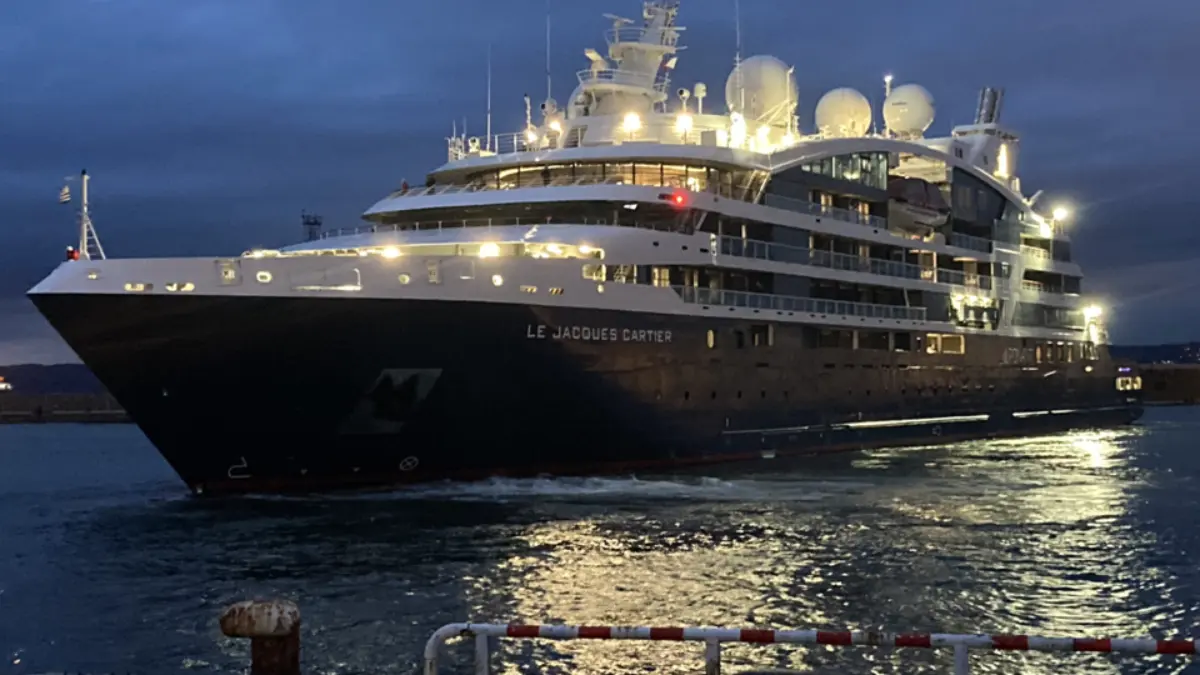
Le Jacques Cartier leaving Marseille in October 2021.
Photo: Bertrand SOUBEYRAND. Licence: CC BY-SA 4.0; image preparation by CruisePing.
Le Jacques Cartier is the PONANT Explorer I would choose when the destination is the Kimberley or the remote Pacific, because its current programme is more distinctive than the ship itself. The vessel is the sixth and final Explorer sister, but onboard it follows the same successful 184-guest pattern: 92 balcony staterooms and suites, two principal restaurants, Blue Eye, a marina, pool, spa and strong observation spaces.
That similarity is useful. You do not need to believe Le Jacques Cartier is technologically or stylistically superior to Le Lapérouse, Le Champlain or Le Bellot to justify booking it. The justification is geography. The ship’s programme reaches the Kimberley, Melanesia, Fiji, French Polynesia, Pitcairn and other places where small-ship access and expedition operations are central to the holiday.
Le Jacques Cartier is the Explorer to prioritise for the Kimberley and remote Pacific. Its onboard product is intentionally similar to its five sisters, so do not pay extra merely because it was the final ship in the series. Pay for it when the route is difficult to replicate, the expedition content is strong and the total long-haul trip cost still makes sense.
Le Jacques Cartier at a glance
| Cruise line | PONANT Cruises |
|---|---|
| Ship class or type | PONANT Explorer, sixth and final ship of the six-ship Explorer series |
| Entered service | 2020 |
| Last major refurbishment | No major transformative refit publicly highlighted; the ship retains the Explorer-class configuration |
| Gross tonnage | 9,976 GT |
| Length | 131.5 m |
| Guest capacity | 184 maximum |
| Crew | 118 |
| Passenger decks | 5 principal guest-accessible decks |
| Cabins or suites | 92 staterooms and suites, all with private balcony |
| Accessible cabins | 2 wheelchair-adapted cabins |
| Dining venues | Main gourmet restaurant and informal grill restaurant, plus room service |
| Bars and lounges | Main lounge, observation lounge, pool bar and Blue Eye underwater lounge |
| Pools and hot tubs | Heated outdoor infinity-style pool plus marina access for water activities |
| Library | Reading collection integrated with the observation lounge rather than a large separate library room |
| Spa and fitness | SOTHYS spa, hammam, hair salon and fitness room |
| Children’s facilities | Kids Club on selected voyages from age 4; expedition voyages normally from age 6 |
| Adults-only facilities | No dedicated adults-only retreat |
| Wi-Fi | Included 24-hour Wi-Fi, with satellite performance varying by region |
| UK departures or deployment | Kimberley, Melanesia, French Polynesia, South Pacific, Indonesia and Asia; generally a long-haul fly-cruise choice for UK travellers |
Best suited to
- Travellers prioritising the Kimberley, Melanesia, French Polynesia or remote South Pacific islands
- Couples who want expedition access without giving up a balcony, polished interiors and French-led dining
- Passengers comfortable with long-haul flights and itineraries where weather can change landing plans
Think carefully if
- You want an easy UK embarkation or a cruise that avoids long-haul air travel
- You want many restaurants, busy nightlife or a large resort-style ship
- You would be frustrated if a Zodiac landing or remote-island call had to change because conditions were unsuitable
Quick booking comparison
| Booking question | CruisePing view |
|---|---|
| Best reason to choose Le Jacques Cartier | A Kimberley or Pacific itinerary where the ship’s small scale and expedition operation materially affect where you can go. |
| When to choose Le Bellot instead | When Britain, Iceland, Greenland, the Great Lakes or eastern North America are the real objective. |
| Main compromise | The cruise may be only one part of an expensive long-haul journey, and onboard restaurant choice remains limited. |
| Cabin priority | A standard balcony cabin can be excellent value. Upgrade for genuinely useful space rather than because a remote itinerary makes a suite feel mandatory. |
The booking decision
The current voyage programme gives Le Jacques Cartier a clear role. The ship is working routes through the Kimberley, Melanesia, French Polynesia, the Solomon Islands, Palau and other Pacific regions. On those itineraries, the destination is expensive and difficult enough to reach that I would put route quality, expedition content and flight logistics ahead of almost every onboard difference.
For a UK traveller, the long-haul cost is significant. A lower cruise fare can be wiped out by awkward flight timings, hotel nights or a poor connection. Conversely, an expensive PONANT package may make sense if transfers or flights simplify a difficult journey. Compare the whole trip, not just the number printed against the cabin.
Le Jacques Cartier ship tour video

The final Explorer sister is not a new cruise concept
Le Jacques Cartier was the final ship added to the six-vessel Explorer series. That makes it later than Le Lapérouse and Le Champlain, but the class is intentionally consistent. The important advantages are shared: compact scale, balconies across the accommodation, Blue Eye, a marina and plenty of access to the sea.
I would resist the common assumption that the final sister must therefore be the best. A well-maintained earlier sister on the better itinerary is the stronger purchase. Ship age matters much less here than route, fare, cabin location and the operating style of the specific voyage.
Cabins work especially well on scenic expedition routes
All 92 staterooms and suites open to private balconies. In the Kimberley or South Pacific, that gives even the entry-level accommodation a useful private connection with the landscape. Standard balcony rooms are around the size expected on an intimate luxury expedition ship rather than a large resort vessel, so storage and layout deserve attention if you travel with substantial expedition gear.
The suite ladder adds space more than it transforms the basic quality of the experience. I would upgrade when the extra room will be used, particularly on a longer voyage with sea days. I would not upgrade simply because the itinerary is prestigious. The standard room already provides a balcony, quality finish and access to the same expedition programme.
Dining: French influence in a remote setting
The main restaurant and grill give the ship two clear dining personalities. PONANT gastronomy remains French-led, which can feel pleasantly incongruous after a day in a remote landing site. Service and food quality matter more here than venue count.
Longer itineraries expose the limitation. Two principal restaurants cannot create constant novelty, and passengers who need multiple speciality venues will notice that. The right buyer sees the dining as polished support for the destination, not the destination itself.
Blue Eye fits the Pacific better than the marketing suggests
Blue Eye is a below-waterline multisensory lounge with windows, sound and an intentionally atmospheric design. On warm-water voyages with clear seas it feels more naturally connected to the surroundings than on a grey-water transit, though wildlife appearances can never be guaranteed.
The room is still a shared class feature, not a Le Jacques Cartier exclusive. Enjoy it, but do not use it as a reason to choose this ship over another Explorer. The route should win that argument.
The marina and Zodiac operation are central to the product
The aft marina is more important on this ship than it may be on a classic Mediterranean itinerary. Water activities, Zodiac departures and sea-level access help turn the vessel into a platform for exploration. In the Kimberley, expedition logistics and local conditions can define each day.
That flexibility also means accepting change. Tides, weather, wildlife and permissions can affect the programme. PONANT explorations works best for passengers who see an altered landing as part of expedition travel rather than as a service failure.
Heat, shade and outdoor space
Le Jacques Cartier’s current geography makes outdoor usability especially important. The pool, marina and aft terraces can become genuine living spaces in the Pacific, but tropical heat also changes how long you want to stay outside. Shaded seating and the ability to move quickly into air-conditioned lounges matter.
Balconies are useful for short private views rather than necessarily for hours of sunbathing. On some routes humidity, insects or intense heat may reduce how much time you spend there. The value is having the choice whenever conditions are good.
Open Bar, Wi-Fi and remote-region reality
Included drinks and Wi-Fi simplify the onboard bill, but remote geography affects connectivity. Do not buy a Kimberley or Pacific expedition expecting city-quality internet throughout. The PONANT UK FAQs provide the practical baseline, while real-world performance depends on where the ship is operating.
For these itineraries I would budget more carefully for the journey to and from the ship than for onboard extras. Long-haul flights, pre-cruise hotels, insurance and specialist excursions can become major components of the total cost.
Families need to choose the departure carefully
PONANT can accept children and may run a Kids Club on selected voyages, but Le Jacques Cartier is not a family resort ship. The fit depends heavily on the child, the route and the physical demands of expedition activities. A wildlife-focused teenager may love the experience. A younger child who expects pools, slides and constant organised entertainment probably will not.
Age limits can be stricter on expedition voyages, so verify the current family rules for the specific departure before involving a child in the booking decision.
Accessibility and remote landings
The ship has two fully adapted cabins and lifts through the principal guest spaces, but a remote expedition is not made accessible simply because the accommodation is. Zodiac transfers, beach landings, steps, heat and uneven ground can be decisive.
Passengers with mobility limitations should discuss the itinerary in detail before paying a deposit. Some days may be comfortable and others impractical. The important information is what the landing programme requires, not only whether a wheelchair fits through the cabin door.
Why the Kimberley is the strongest reason to choose this ship
Australia’s Kimberley is exactly the kind of region that makes a 184-guest expedition ship sensible. Distances are large, shore infrastructure is limited and the experience depends on small craft, expedition guidance and timing around local conditions. The published programme includes repeated Darwin and Broome itineraries as well as longer Pacific positioning routes.
If the Kimberley is your goal, I would compare Le Jacques Cartier not only with its PONANT sisters but with expedition competitors operating the same region. The question becomes whether PONANT’s French luxury, ship size, cabin product and expedition team justify the fare. That is a much more useful comparison than asking whether Jacques Cartier is marginally newer than another Explorer.
Le Jacques Cartier versus Le Bellot
Le Bellot and Le Jacques Cartier are the cleanest illustration of why deployment matters more than hardware. Choose Le Bellot for a current focus on the British Isles, Iceland, Greenland, Great Lakes and North America. Choose Le Jacques Cartier for the Kimberley, Melanesia and the Pacific.
If both ships appeared on an identical route at similar prices, I would treat them as near-equivalents and choose by cabin position and timing. Their present programmes make that hypothetical comparison less useful than it sounds.
Life onboard between expedition days
Sea days and repositioning periods matter more on a remote itinerary than many brochures imply. Le Jacques Cartier is quiet by large-ship standards. Lectures, observation, the spa, the pool and conversation in the lounges carry much of the daytime rhythm. Evening entertainment exists, but nobody should book this ship expecting a theatre schedule that fills every hour.
I see that restraint as an advantage on a destination-heavy voyage. After an early Zodiac start or a hot landing, a calm ship is often exactly what you want. It becomes a disadvantage only if you need constant organised activity. The best fit is a passenger who is capable of enjoying the view, a book, a drink and an unhurried dinner without feeling that something is missing.
What to check before booking
- Price international flights, hotels, transfers and insurance before comparing the cruise fare.
- Read every expedition activity note and identify days likely to involve Zodiacs or difficult landings.
- Check cabin position before paying for a suite category you may not need.
- Compare the Kimberley or Pacific route against expedition competitors, not only against PONANT sisters.
- Confirm child-age and mobility rules for the actual departure.
Related CruisePing guides
- PONANT Cruises guide
- Which PONANT cruise ship is best?
- Le Bellot guide
- Le Lapérouse guide
- Le Champlain guide
- Le Bougainville guide
- Le Dumont d’Urville guide
- Le Commandant Charcot guide