
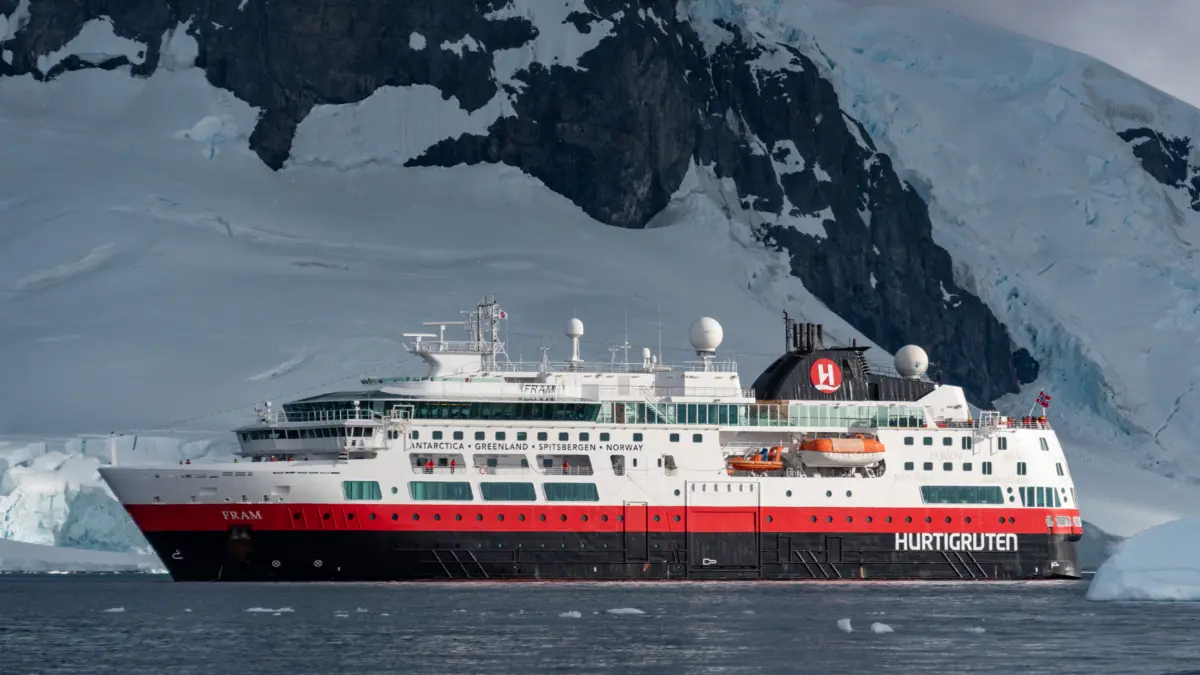
MS Fram in the Errera Channel of Antarctica in March 2019.
Photo: Gordon Leggett. Licence: CC BY-SA 4.0; crop by CruisePing.
MS Fram is the HX ship I would choose when I want the expedition to feel smaller than the ship. Its 200-guest capacity is less than half that of Roald Amundsen or Fridtjof Nansen, and that changes the social rhythm, the way groups move through the vessel and the sense that the Expedition Team is part of daily life rather than a department within a large ship.
Fram is older, but that needs context. A major 2025 refresh upgraded cabins and the Science Centre, so the relevant comparison is not a tired 2007 ship against two shiny hybrid sisters. It is a smaller, simpler, recently refreshed expedition platform against two larger ships with more balconies, restaurants and resort-style wellness. I think that is a much more interesting choice.
Fram is my HX pick for travellers who value a 200-guest expedition atmosphere more than an infinity pool or three restaurants. It is especially persuasive for Greenland, Svalbard, Antarctica and South Georgia. The hybrid sisters are objectively better equipped, but Fram can be the better expedition ship for the person who wants smaller scale. I would choose it over them when the itinerary is equally strong and the fare is competitive.
MS Fram at a glance
| Cruise line | HX Expeditions |
|---|---|
| Ship class or type | Purpose-built polar expedition ship |
| Entered service | 2007 |
| Last major refurbishment | 2025 |
| Gross tonnage | 11,647 GT |
| Length | 114 m |
| Guest capacity | 200 |
| Crew | About 70 in the vessel specification; operating complement can vary |
| Passenger decks | Deck plans cover Decks 2-8 |
| Cabins or suites | 119 cabins; inside, outside, superior and suite categories |
| Accessible cabins | Wheelchair-accessible SD outside cabin category; confirm availability |
| Dining venues | 2 restaurants, Aune and Lindstrøm, plus outdoor BBQ when conditions permit |
| Bars and lounges | Explorer Lounge & Bar is the main social and observation lounge |
| Pools and hot tubs | 2 outdoor hot tubs; no large swimming pool |
| Library | Books and learning resources integrated with the Science Centre and public spaces |
| Spa and fitness | Gym, panoramic sauna and relaxation facilities; more compact than the hybrid ships |
| Children’s facilities | No conventional kids club; children are welcome subject to destination and landing rules |
| Adults-only facilities | No dedicated adults-only retreat |
| Wi-Fi | Included satellite Wi-Fi; performance can be limited in remote regions |
| UK departures or deployment | No regular UK homeport programme; strong Arctic summer and Antarctic winter role, including Greenland and South Georgia itineraries |
Best suited to
- Polar travellers who genuinely prefer a smaller ship
- Greenland, Svalbard, Antarctica and South Georgia itineraries where expedition atmosphere matters
- Guests who will use the Science Centre and spend more time ashore than comparing facilities
- Value-conscious expedition travellers willing to trade a balcony-heavy cabin inventory for scale
Think carefully if
- Travellers who want multiple casual dining venues, a swimming pool or large spa
- Guests who expect every cabin to face outside
- People who prefer the broadest suite and balcony choice
- Anyone choosing by ship age without considering the 2025 refurbishment
What this ship is really like
Fram feels like an expedition ship first. The public spaces are more compact, there is one main Explorer Lounge & Bar and the Science Centre plays an outsized role in the social life of the vessel. You see the same people repeatedly. That can build the kind of shared expedition atmosphere that is harder to create on a 490-guest ship.
The 2025 refresh matters because it modernises the parts passengers notice most: cabins, suites and the Science Centre. It does not change the underlying 114-metre hull or create the breadth of the hybrid sisters. That is fine. Fram is strongest when you regard simplicity as part of the appeal rather than a deficiency to apologise for.
The refurbishment should therefore change how you judge the accommodation, not how you classify the ship. Fram remains a compact 200-guest expedition vessel with two principal restaurants, a single main lounge, hot tubs rather than a pool complex and a much smaller public-space footprint. Buyers comparing old photographs with the refreshed interiors should recognise that the soft product has moved on while the underlying expedition proposition has not.
I also would not promise that 200 guests automatically means twice as much time ashore as on a 490-guest ship. Landing rules, weather, boats and local site limits still control operations. What the lower number reliably changes is the social scale and the amount of human traffic moving through briefings, corridors, restaurants and observation areas. That is enough to make Fram materially different without overselling the operational advantage.
Cabins and suites
There are 119 cabins across inside, outside, Arctic Superior and Expedition Suite categories. The presence of inside cabins immediately creates a different value ladder from the hybrid sisters, where every cabin is outside. On a destination-led voyage, an inside room can be a rational way to reduce the fare if you expect to spend waking hours on deck, in the lounge, in the Science Centre or ashore.
The accessible SD category is an outside cabin of roughly 15-16 square metres with twin beds, one converting to a sofa. Refreshed suites add more comfort and some balcony options, but Fram remains a ship where cabin position can matter as much as category. Check what is above and below you and how quickly you can reach the observation and expedition areas.
Dining and drinks
Fram has two principal restaurants rather than the hybrid ships’ three. Aune handles the main inclusive dining and Lindstrøm provides the more refined option, with suite guests receiving the strongest access. An outdoor BBQ can add variety when conditions cooperate. Fredheim is not part of Fram’s current dining setup.
I do not consider that a serious weakness on a 200-guest expedition ship. A huge dining portfolio would consume space better used elsewhere. The real question is whether two restaurants feel repetitive on a long sailing. For most travellers, changing menus, expedition days and the social company at dinner create enough variety.
Science Centre and Expedition Team
The upgraded Science Centre is central to Fram’s appeal. Its scale makes interaction with the Expedition Team feel immediate, and the refreshed space supports lectures, microscopes, specimen work and citizen-science projects. On a smaller ship, these sessions can become part of the community rather than scheduled content you can ignore.
This is where I think Fram can outperform its age. A traveller who participates actively may remember the conversations and wildlife interpretation far more vividly than the lack of a pool. If you are uninterested in science, history or naturalist-led learning, however, you are again paying for the wrong expedition product.
Observation, outside decks and wildlife watching
Fram cannot match the hybrid sisters’ dramatic two-level bow observation area, but its smaller dimensions help in a different way. The outside world feels closer. Moving from lounge to deck is quick, and fewer passengers are competing for every rail position when wildlife appears.
Photographers should still inspect deck plans and cabin positions carefully. A balcony is less common, but I would not make that the deciding factor. On a polar expedition the public deck is where you can follow moving wildlife, change side and talk to naturalists who have already spotted what you are looking for.
Pool, hot tubs, sauna and fitness
Two outdoor hot tubs, a gym and panoramic sauna provide the essentials for warming up and recovering after shore days. There is no large infinity pool and the wellness footprint is more compact. For me, that is an acceptable trade on a 200-guest ship.
The hot tubs are more useful than they may sound on a cold-weather voyage. The best moment is not a resort-style afternoon by the pool; it is getting warm while ice, mountains or sea pass around you after an active landing. That fits Fram’s expedition-first character.
Watch before you book

This deck-by-deck tour is useful because it shows what “smaller” means in practice. Watch the width of corridors, the scale of the lounge and the transition between public rooms rather than judging the ship from individual cabin shots. If that compactness feels cosy rather than restrictive, Fram is probably the right direction.
Families and younger travellers
Fram is not my first HX choice for a family unless the children are deeply interested in the destination. There is no conventional kids club, fewer general leisure facilities than on the hybrid sisters and expedition rules still apply to young passengers.
For an older child obsessed with penguins, whales, glaciers or polar science, the small ship could be brilliant because the Expedition Team and Science Centre are so visible. For a child who needs a large pool and programmed entertainment, the experience will be far more demanding.
Solo travel
Fram’s scale is arguably its greatest solo-travel advantage. Two hundred guests is large enough to find compatible company but small enough that familiar faces appear quickly. Briefings, landings and meals create natural social contact without needing singles events.
Selected HX sailings can remove the solo supplement. I would watch Fram particularly closely for those offers because the combination of small-ship atmosphere and lower single price is compelling. Always compare the total fare when hotels and flights are bundled.
Accessibility and mobility
The SD wheelchair-accessible outside cabin gives Fram a genuine accessible accommodation option. The ship is older than the hybrids, though, and the expedition itself remains the bigger challenge. Small-boat boarding, shore gradients and uneven terrain can restrict participation regardless of cabin design.
Discuss the exact itinerary rather than asking only whether Fram is accessible. A Greenland town call and a wet Antarctic landing are completely different mobility tasks. If certain landings are essential to the holiday, get practical guidance before booking rather than relying on a general accessibility label.
Where this ship makes the strongest case
Fram has a particularly coherent polar role, moving between Arctic itineraries and Antarctica, with Greenland and longer South Georgia combinations among the routes that suit it best. This is exactly where 200 guests and a purpose-built expedition layout make sense.
I would choose Fram for a strong Greenland or South Georgia itinerary even if a hybrid sister looked more impressive on paper. Those destinations reward time outside, flexible expedition operations and a shared sense of purpose. If the route is identical and the hybrid ship is cheaper, the calculation changes.
How it compares within HX
| Booking question | CruisePing view |
|---|---|
| Versus Roald Amundsen | Choose Fram for 200-guest intimacy; Roald Amundsen for balconies, three restaurants, pool and larger wellness facilities. |
| Versus Fridtjof Nansen | Same logic: scale versus modern hardware, then let itinerary decide. |
| Best cabin value | Inside or outside cabin can be rational because the destination is the main room. |
| Best route fit | Greenland, Svalbard, Antarctica and South Georgia. |
Roald Amundsen and Fridtjof Nansen win almost every conventional facilities comparison. Fram wins the comparison that matters to a particular expedition traveller: fewer guests. That is why I would never rank HX ships solely by age or tonnage.
Who should book it?
Book Fram if you want a serious polar voyage on a ship that feels like a basecamp rather than a floating resort. It is ideal for travellers who care more about the Expedition Team, landings and wildlife than balcony square metres.
Choose a hybrid sister if you know you will miss multiple casual dining options, a swimming pool, a larger spa or extensive balcony choice. Fram is comfortable, especially after the refresh, but its best quality is not pretending to be a bigger ship.
What to check before booking
- Confirm whether the 200-guest operating capacity applies to your itinerary and any regional restrictions.
- Check whether an inside cabin would free enough budget to improve the itinerary or travel arrangements.
- Review the 2025-refreshed cabin category you are actually booking rather than old photographs.
- For Antarctica or Greenland, assess landing mobility separately from onboard accessibility.
- Compare Fram with a hybrid sister on the same route before assuming newer is automatically better.
Related CruisePing guides
- HX Expeditions guide
- Which HX Expeditions ship is best?
- MS Roald Amundsen guide
- MS Fridtjof Nansen guide
- PONANT Cruises guide
- Seabourn guide
- Silversea Cruises guide