
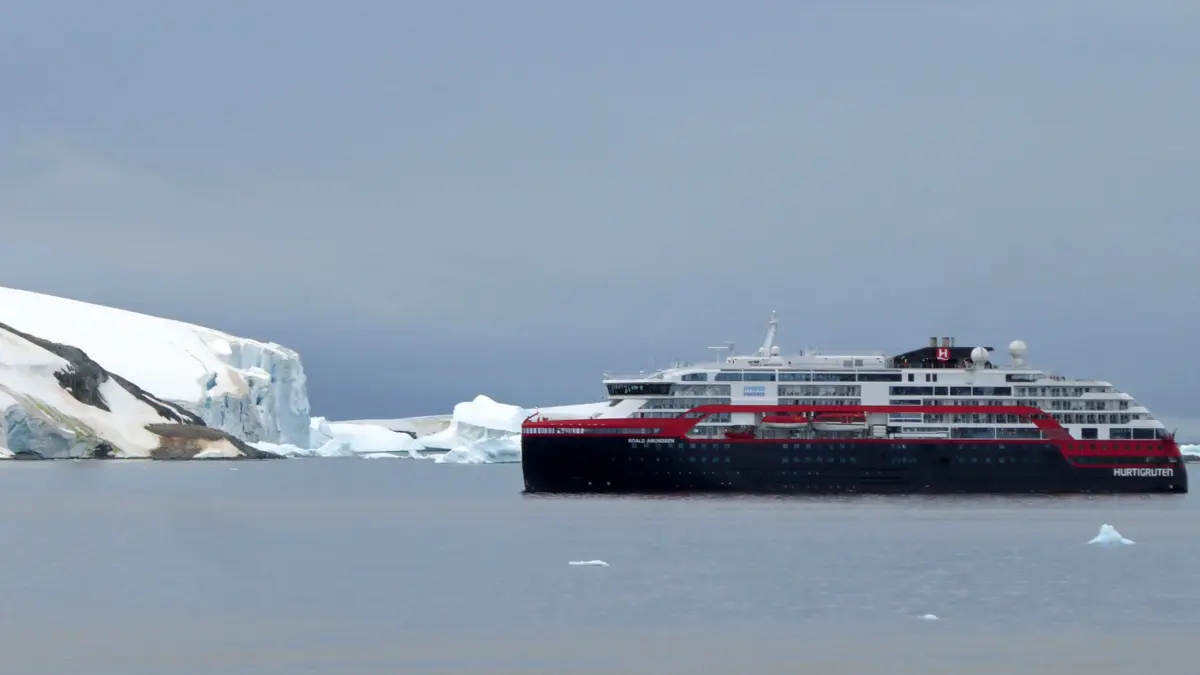
MS Roald Amundsen in Antarctica in January 2020.
Photo: Wolfgang Fricke. Licence: CC BY 3.0; crop by CruisePing.
MS Roald Amundsen is the HX ship I would recommend to a first-time expedition cruiser who is nervous about giving up the comforts of a modern cruise ship. It has the expedition equipment, Science Centre and polar credentials that matter, but also balconies, three restaurants, an infinity pool, hot tubs and a proper wellness area. The ship makes the transition from premium cruising to expedition travel unusually easy.
The qualification is size. At 490 guests, Roald Amundsen is large by expedition standards. You should book it because you want the combination of expedition programme and substantial onboard comfort, not because you imagine a tiny ship where everyone fits into one Zodiac group. For a smaller HX experience, MS Fram changes the equation more than choosing the almost identical MS Fridtjof Nansen.
Roald Amundsen is my HX all-rounder for Greenland, Arctic Canada and the Northwest Passage, with Antarctica as a strong second role. It is the better choice when cabin comfort, observation space and wellness matter alongside the expedition. I would not pay a premium over Fridtjof Nansen on the same itinerary simply for the ship name, and I would choose Fram instead if a 200-guest atmosphere is central to the holiday.
MS Roald Amundsen at a glance
| Cruise line | HX Expeditions |
|---|---|
| Ship class or type | Hybrid expedition ship; Polar Class 6 design |
| Entered service | 2019 |
| Last major refurbishment | Original 2019 layout remains substantially current |
| Gross tonnage | 20,889 GT |
| Length | 140 m |
| Guest capacity | 490 |
| Crew | 151 design complement; operating complement can vary |
| Passenger decks | Deck plans cover Decks 3-11 |
| Cabins or suites | 265 outside cabins and suites; roughly half have private balconies |
| Accessible cabins | Wheelchair-accessible XY balcony and TY outside cabin categories; confirm availability |
| Dining venues | 3: Aune, Fredheim and Lindstrøm |
| Bars and lounges | Explorer Lounge & Bar plus Pool Bar and other social seating |
| Pools and hot tubs | Aft infinity pool and outdoor hot tubs |
| Library | Small library within the Science Centre |
| Spa and fitness | Wellness centre, sauna, gym and chargeable treatments |
| Children’s facilities | No conventional kids club; children are welcome subject to destination and landing rules |
| Adults-only facilities | No dedicated adults-only retreat |
| Wi-Fi | Included satellite Wi-Fi; speed and coverage can be limited in remote regions |
| UK departures or deployment | No regular UK homeport programme; strong current focus on Greenland, Arctic Canada, Northwest Passage and Antarctica |
Best suited to
- First-time expedition cruisers who still want a modern, comfortable ship
- Greenland, Arctic Canada and Northwest Passage travellers who value a strong onboard base
- Balcony and suite buyers who want more accommodation choice than a small expedition ship
- People who will use the Science Centre, observation decks and wellness facilities
Think carefully if
- Travellers who define expedition cruising as fewer than 200 guests
- Anyone who mainly wants theatre, casino or conventional evening entertainment
- People who will resent weather-led changes to landings or timings
- Value hunters who are paying a large premium for a balcony they may rarely use
What this ship is really like
Roald Amundsen feels more like a modern Scandinavian premium ship that has been built around expedition operations than an old research vessel adapted for tourists. The interiors use light woods, stone, wool and large windows. The public rooms are designed to keep the outside world visible, which matters because the scenery does not stop when a landing ends.
The two-level observation area around the bow is particularly important. On a wildlife or ice itinerary, the quality of sightlines can matter more than the number of bars. The ship is large enough to give passengers space to spread out, yet the expedition programme keeps bringing people back together for briefings, lectures and shore groups.
Cabins and suites
All 265 cabins and suites face outside, and roughly half have private balconies. That is unusually generous for an expedition vessel. Standard outside categories can be the best value because the ship already has excellent open decks and public observation areas. Balcony cabins become more persuasive for travellers who like to watch for wildlife independently or want immediate outdoor access without going to a public deck.
The suite ladder is much more luxurious than the word expedition suggests. Larger suites add substantial living space, premium inclusions and, in selected aft categories, outdoor hot tubs. Accessible XY and TY categories provide either a balcony or a larger outside room. Book the actual category and deck position rather than assuming every room in a broad marketing label is identical.
Dining and drinks
Three restaurants give Roald Amundsen useful variety on long voyages. Aune is the main dining room, Fredheim is the informal option for casual dishes and takeaway, and Lindstrøm is the more refined Scandinavian restaurant. Suite guests receive the strongest Lindstrøm access; other guests can book it subject to availability and a cover charge.
The all-inclusive drinks policy makes the ship feel less transactional than many premium cruises. House and standard drinks are widely included, with selected premium choices extra. I would still value the restaurants primarily for variety rather than luxury theatre. After a long landing day, being able to choose a quicker Fredheim meal can be more useful than another elaborate dining room.
Science Centre and Expedition Team
The Science Centre is one of the ship’s defining spaces. It combines lecture areas, a small library, microscopes and practical workshop equipment, and it also works as a base for the Expedition Team. The difference from a normal cruise enrichment programme is that what happens here is tied directly to what you are seeing outside.
Use it. The ship becomes poorer value if you treat the Science Centre as somewhere to walk past on the way to the bar. Lectures, specimen work, photography sessions and citizen-science projects can turn a sighting into understanding, particularly on multi-week Arctic routes where geography and history are part of the story.
Observation, outside decks and wildlife watching
The wraparound two-level observation deck is one of the strongest reasons to choose the hybrid platform. It provides forward sightlines from both inside and outside and gives photographers multiple elevations. That is especially useful in broken ice or whale-rich waters, where a sighting can move quickly from one side of the ship to the other.
A private balcony is therefore a luxury rather than a necessity. If the fare difference is large, I would put the money into the itinerary or a better pre-expedition hotel rather than buy a balcony solely for views. The public decks already do the serious wildlife work better because you can move with the action.
Pool, hot tubs, sauna and fitness
The aft infinity pool, hot tubs, sauna, gym and wellness centre make Roald Amundsen one of the easiest expedition ships to live on during sea days. A hot tub after a wet landing has genuine value. The spa treatments are chargeable, so the all-inclusive label should not be read as meaning every wellness service is included.
These facilities matter most on longer voyages with sea days and unpredictable weather. They matter much less than landing operations when the itinerary is packed with shore activity. I would treat the pool deck as an excellent bonus, not a reason to choose a weaker route.
Watch before you book

This walkthrough is useful because it shows the scale of the public rooms and outdoor decks much better than a deck plan. Pay particular attention to the observation areas, Science Centre and the relationship between the pool deck and the aft public spaces. Those are the parts of the ship you are likely to use repeatedly on an expedition.
Families and younger travellers
Roald Amundsen can accommodate families, including cabins that sleep more than two, but there is no conventional children’s club proposition. HX’s age and landing rules remain the real test. Antarctica and Galápagos have a minimum age of five, and under-12 participation in small-boat landings is decided by the captain.
I would choose this ship over Fram for a family that values extra cabin space and more onboard facilities, but only if the children genuinely want the expedition. A pool does not turn a polar voyage into a family resort cruise, and the best days can involve long periods outdoors in cold or wet conditions.
Solo travel
The larger ship can work well for solo travellers because there are more public areas and enough guests to make social contact easy without forcing it. HX periodically offers selected departures without a solo supplement, and those are the sailings I would look for first.
Compare the actual single price across cabin categories. A no-supplement outside cabin can be far better value than a discounted balcony. The Expedition Team structure also helps solo travellers because shore groups and briefings create natural conversation without needing organised singles events.
Accessibility and mobility
Wheelchair-accessible XY and TY cabin categories are available, including a balcony option. The ship itself is modern, but expedition accessibility cannot be judged from the cabin alone. Zodiacs, wet landings, snow and rough ground can impose much greater limits than corridors or lifts.
Ask HX about the specific route and the activities you most want to do. A traveller may be comfortable on board and still be unable to join a particular landing. Conversely, scenic cruising, lectures and easier ports can leave a voyage worthwhile even when not every activity is practical.
Where this ship makes the strongest case
Roald Amundsen currently has a particularly convincing northern role: Arctic Canada, Greenland, Baffin Bay and Northwest Passage itineraries fit the ship’s observation spaces, PC6 design and comfortable long-voyage accommodation. Antarctica remains a major part of the programme and suits the same strengths.
For a UK traveller, the drawback is usually logistics rather than the ship. These voyages often require flights to remote gateways and may include dedicated connecting arrangements. I would budget at least one pre-embarkation buffer day where possible rather than risk a complex expedition because of a tight airline connection.
How it compares within HX
| Booking question | CruisePing view |
|---|---|
| Versus Fridtjof Nansen | Choose by itinerary, cabin position and price. The hardware is essentially sister-ship territory. |
| Versus Fram | Choose Roald Amundsen for balconies, dining variety, pool and wellness; Fram for 200-guest intimacy. |
| Best cabin value | A well-positioned outside cabin can be smarter than paying heavily for a balcony. |
| Best route fit | Greenland, Arctic Canada, Northwest Passage and Antarctica. |
Fridtjof Nansen is the closest comparison and should not be sold as a radically different experience. Fram is the meaningful alternative because its 200-guest scale changes the social and expedition feel. The later guides to MS Spitsbergen and MS Santa Cruz II will cover the small Arctic and Galápagos ends of the fleet.
Who should book it?
Book Roald Amundsen if you want expedition days to be serious but you do not want the ship to feel austere. It is particularly good for couples crossing over from premium cruise lines, photographers who value observation space and travellers who want a comfortable base for long polar itineraries.
Do not book it simply because it is one of HX’s newest-looking ships. A 490-guest vessel is a deliberate compromise. If the dream is a small community, fast group cohesion and a less resort-like environment, Fram or Spitsbergen is the more coherent choice.
What to check before booking
- Compare the exact itinerary with MS Fridtjof Nansen before paying more for the ship name.
- Price outside and balcony cabins separately; the public observation decks are excellent.
- Check included flights, hotel nights and transfer arrangements as part of the total fare.
- Read the landing and medical requirements for the destination, not just the ship accessibility information.
- For suites, confirm which premium dining, minibar and laundry benefits apply to your category.
Related CruisePing guides
- HX Expeditions guide
- Which HX Expeditions ship is best?
- MS Fridtjof Nansen guide
- MS Fram guide
- PONANT Cruises guide
- Le Commandant Charcot guide
- Seabourn guide