
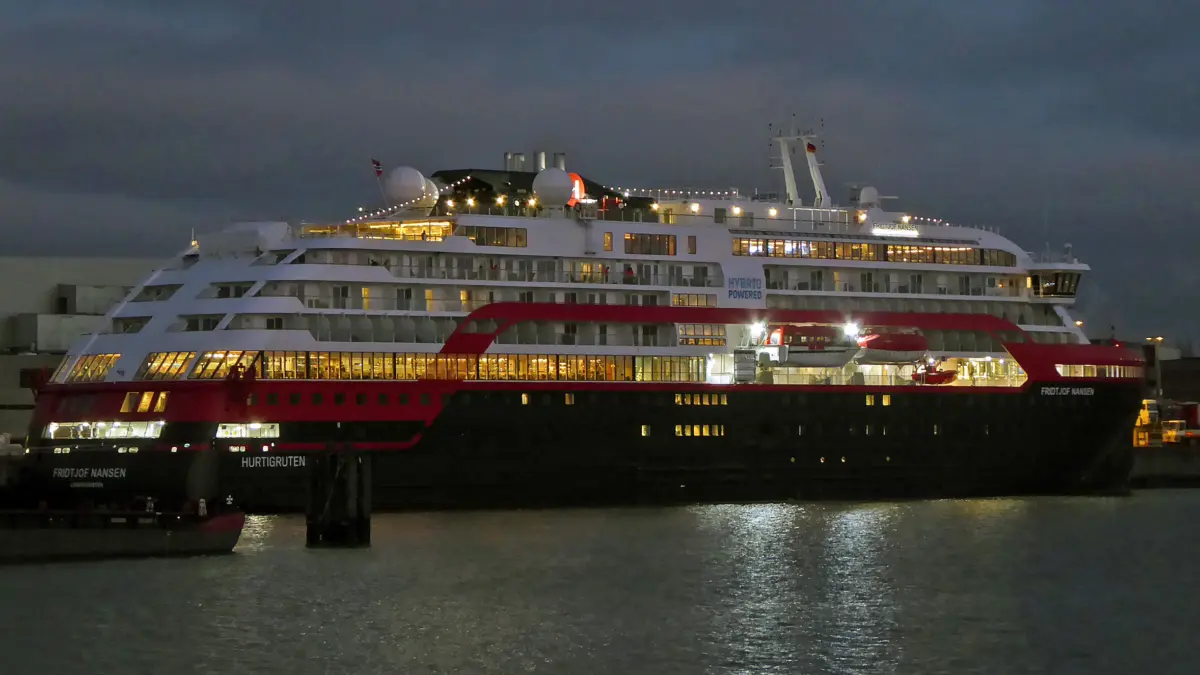
MS Fridtjof Nansen in Hamburg in December 2021.
Photo: Wolfgang Fricke. Licence: CC BY 3.0; crop by CruisePing.
MS Fridtjof Nansen is the HX ship I would choose for Alaska or Patagonia when I want a genuine expedition programme without giving up the comforts of a modern premium ship. It shares its core design with MS Roald Amundsen, so the meaningful difference is usually where it is sailing, not which sister has the better lounge or restaurant.
That makes Fridtjof Nansen unusually easy to recommend and unusually easy to overanalyse. At 490 guests it offers balconies, three dining choices, an infinity pool, hot tubs, a wellness centre and a large Science Centre. It is also much bigger than MS Fram. If you care about small-ship intimacy, that difference should dominate the choice.
Fridtjof Nansen is my HX pick when Alaska, British Columbia or Patagonia is the itinerary driver. The hybrid hardware is excellent and essentially matches Roald Amundsen, so I would not pay extra merely because one sister is newer. Choose it when the route is better, the cabin price is better or the departure works better. Choose Fram if a 200-guest expedition community matters more than the infinity pool and balcony-heavy accommodation.
MS Fridtjof Nansen at a glance
| Cruise line | HX Expeditions |
|---|---|
| Ship class or type | Hybrid expedition ship; Polar Class 6 design |
| Entered service | 2020 |
| Last major refurbishment | Original 2019 layout remains substantially current |
| Gross tonnage | 20,889 GT |
| Length | 140 m |
| Guest capacity | 490 |
| Crew | 151 design complement; operating complement can vary |
| Passenger decks | Deck plans cover Decks 3-11 |
| Cabins or suites | 265 outside cabins and suites; roughly half have private balconies |
| Accessible cabins | Wheelchair-accessible XY balcony and TY outside cabin categories; confirm availability |
| Dining venues | 3: Aune, Fredheim and Lindstrøm |
| Bars and lounges | Explorer Lounge & Bar plus Pool Bar and other social seating |
| Pools and hot tubs | Aft infinity pool and outdoor hot tubs |
| Library | Small library within the Science Centre |
| Spa and fitness | Wellness centre, sauna, gym and chargeable treatments |
| Children’s facilities | No conventional kids club; children are welcome subject to destination and landing rules |
| Adults-only facilities | No dedicated adults-only retreat |
| Wi-Fi | Included satellite Wi-Fi; speed and coverage can be limited in remote regions |
| UK departures or deployment | No regular UK homeport programme; strong current focus on Alaska and British Columbia, Patagonia, Antarctica, Greenland and Northwest Passage routes |
Best suited to
- Alaska and British Columbia expedition travellers who want more substance than a mainstream Inside Passage cruise
- Patagonia and Antarctic travellers who want strong wellness and dining on longer journeys
- Guests who want balcony and suite choice without abandoning an expedition-led programme
- First-time HX passengers who value a modern ship as a comfortable safety net
Think carefully if
- Travellers who want a genuinely small expedition ship
- Anyone expecting major experiential differences from Roald Amundsen
- Guests who prefer nightlife and production entertainment to lectures and briefings
- People booking purely for the infinity pool rather than the itinerary
What this ship is really like
Fridtjof Nansen is calm, modern and Scandinavian rather than theatrical. Natural materials, broad windows and open sightlines keep the destination visually present. The ship does not need elaborate themed spaces because the scenery supplies the drama. Public areas are comfortable enough for long sea days without becoming the purpose of the trip.
The 490-guest capacity makes the ship feel substantial. That is useful in rougher seas and gives the designers room for a proper Science Centre, multiple dining venues and wellness facilities. It also means the expedition is organised in groups. Passengers who romanticise expedition cruising as one small group moving together should reset that expectation before booking.
Cabins and suites
All 265 cabins and suites are outside, and about half have balconies. Standard categories are practical rather than stripped back, with tea and coffee facilities and modern bathrooms. The balcony categories are attractive in Alaska and Greenland, where scenery can stay close for hours, but public decks remain better for serious wildlife following.
Accessible XY balcony and TY outside categories are available. The larger suites add lounge space and strong premium benefits, including broader Lindstrøm dining and enhanced drinks. The best value point depends heavily on promotion: a suite upgrade offer can change the arithmetic, while at normal pricing an outside cabin may deliver almost the same expedition experience for much less.
Dining and drinks
Aune, Fredheim and Lindstrøm cover the useful bases. Aune handles main meals, Fredheim provides casual food and takeaway, and Lindstrøm adds a more refined option. The result is enough variety for a long expedition without wasting ship space on a dozen venues you will use once.
Standard drinks are widely included under HX’s all-inclusive structure, with selected premium choices extra. That makes the ship pleasant after a landing because you can order a beer, wine or cocktail without checking a package allowance. Suite inclusions go further, but I would buy a suite for space and comfort first, not simply for premium alcohol.
Science Centre and Expedition Team
The Science Centre is the intellectual hub of the ship. It combines lecture space, a small library, microscopes and workshop areas with easy access to the Expedition Team. On an Alaska or polar voyage, the best sessions connect directly to what happened outside that day: marine biology, glaciers, geology, photography or local history.
Fridtjof Nansen also currently carries an anniversary heritage-cabin concept on selected sailings, but that novelty should not distract from the core product. The value lies in the day-to-day science and expedition programme. I would judge the ship on how much you intend to participate, not on a one-off themed experience.
Observation, outside decks and wildlife watching
The forward two-level observation area and broad outside decks make the ship a strong wildlife platform. In Alaska, that can mean moving quickly between indoor and outdoor vantage points when whales appear. In Antarctica, it means being able to watch ice and seabirds without relying on the view from your cabin.
Because the public viewing is so good, balcony value is personal. Photographers who want private access may love one. Travellers who are happy to dress properly and move around the ship can save money with an outside cabin and lose very little of the actual destination experience.
Pool, hot tubs, sauna and fitness
The infinity pool and hot tubs are not expedition necessities, but they are very good expedition luxuries. The sauna, gym and chargeable wellness treatments add useful recovery options after active days. On a long Pacific or Southern Ocean passage, these facilities can materially improve the ship experience.
I would still refuse a weaker itinerary just to get them. The ship is a basecamp. The best voyage is the one with the strongest landings, wildlife seasons and route, provided the ship meets your comfort threshold. Fridtjof Nansen’s advantage is that the threshold is high enough for most premium-cruise travellers.
Watch before you book

The tour is particularly helpful for understanding how much larger this ship feels than Fram. Look at the Science Centre, pool deck, dining spaces and cabin corridors rather than just the suites. Those everyday areas reveal whether the 490-guest scale feels reassuringly spacious or larger than you want from an expedition vessel.
Families and younger travellers
Families get more cabin flexibility and onboard space here than on the smaller HX ships, but there is no resort-style children’s programme. HX accepts children subject to destination rules, with a minimum age of five for Antarctica and the Galápagos and captain discretion for under-12 small-boat landings.
Alaska can be a particularly good fit for an older child who is fascinated by wildlife and wants to use the Science Centre. The key is motivation. If the child wants waterslides, games arcades and a kids club, choose a mainstream family ship and book nature excursions instead.
Solo travel
For solo travellers, Fridtjof Nansen combines a sociable expedition structure with enough ship space to retreat when you want privacy. Selected no-solo-supplement departures can make it unusually competitive for a premium expedition product.
The final price matters more than the promotion label. Check whether hotels or flight elements still carry single supplements. If a no-supplement sailing aligns with Alaska, Antarctica or Greenland dates you already want, I would move quickly because the best cabin grades can disappear first.
Accessibility and mobility
XY and TY wheelchair-accessible categories exist, including a balcony option. Lifts and modern public areas help on board, but the decisive accessibility issue remains the expedition programme. Boarding a small boat, stepping onto a wet shore or walking uneven ground can be more demanding than anything on the ship.
Ask detailed questions before booking and distinguish between ship access and landing access. A traveller who cannot join every Zodiac landing may still get substantial value from scenic cruising, lectures and easier ports, but that decision should be made with clear expectations.
Where this ship makes the strongest case
Fridtjof Nansen’s current programme gives it a particularly strong identity in Alaska and British Columbia, followed by Patagonia and the Chilean Fjords, Antarctica and northern voyages. That makes it the hybrid sister I would check first for a traveller who wants Alaska without the feel of a mainstream mega-ship.
Alaska is also where the ship’s balance makes sense: enough stability and comfort for longer distances, strong observation areas for wildlife and an expedition programme that can put natural history ahead of shopping-port time. In Patagonia and Antarctica, the same hardware supports longer sea stretches between active days.
Alaska also exposes the difference between expedition cruising and simply taking a smaller cruise ship. On a conventional Inside Passage sailing, the ship is often the entertainment platform between ports. On Fridtjof Nansen, the ship works best as a comfortable base for learning, wildlife watching and active shore days. I would pay the HX premium only if I intended to use that expedition programme rather than spend most of the voyage enjoying the balcony.
For a longer voyage, cabin strategy matters more than sister-ship preference. A midship outside cabin can be a smarter purchase than stretching to a balcony if motion sensitivity is a concern or if the saving buys a better itinerary. Conversely, a balcony earns its keep for travellers who know they will repeatedly step outside for wildlife and scenery without wanting to move to a public deck.
How it compares within HX
| Booking question | CruisePing view |
|---|---|
| Versus Roald Amundsen | Treat them as near-identical sisters and choose route, cabin and price. |
| Versus Fram | Choose Fridtjof Nansen for modern comfort and facilities; Fram for smaller scale and a more intimate feel. |
| Best cabin value | Outside cabin if balcony pricing is high; public viewing is excellent. |
| Best route fit | Alaska, British Columbia, Patagonia, Antarctica and selected northern expeditions. |
Roald Amundsen is not a rival with a dramatically different personality. It is the same basic proposition deployed differently. Fram is the real alternative when you want to change the feel of the expedition rather than the itinerary map.
Who should book it?
Book Fridtjof Nansen if Alaska or Patagonia is high on your list and you want a ship that feels genuinely comfortable between active days. It is also a strong Antarctica choice for anyone who wants modern cabins and good wellness without switching to a luxury-first expedition line.
Look elsewhere if the number of guests is part of your expedition ideal. No amount of excellent design makes 490 people feel like 150. Fram and Spitsbergen make a stronger case when intimacy is the priority.
What to check before booking
- Compare the exact route with MS Roald Amundsen before assigning value to the sister-ship name.
- For Alaska, compare expedition content with mainstream cruise alternatives rather than comparing only fares.
- Check balcony pricing against a good outside cabin.
- Confirm connecting-flight and hotel arrangements for remote embarkation ports.
- If mobility is limited, ask about each priority landing as well as the accessible cabin.
Related CruisePing guides
- HX Expeditions guide
- Which HX Expeditions ship is best?
- MS Roald Amundsen guide
- MS Fram guide
- PONANT Cruises guide
- Seabourn guide
- Silversea Cruises guide