
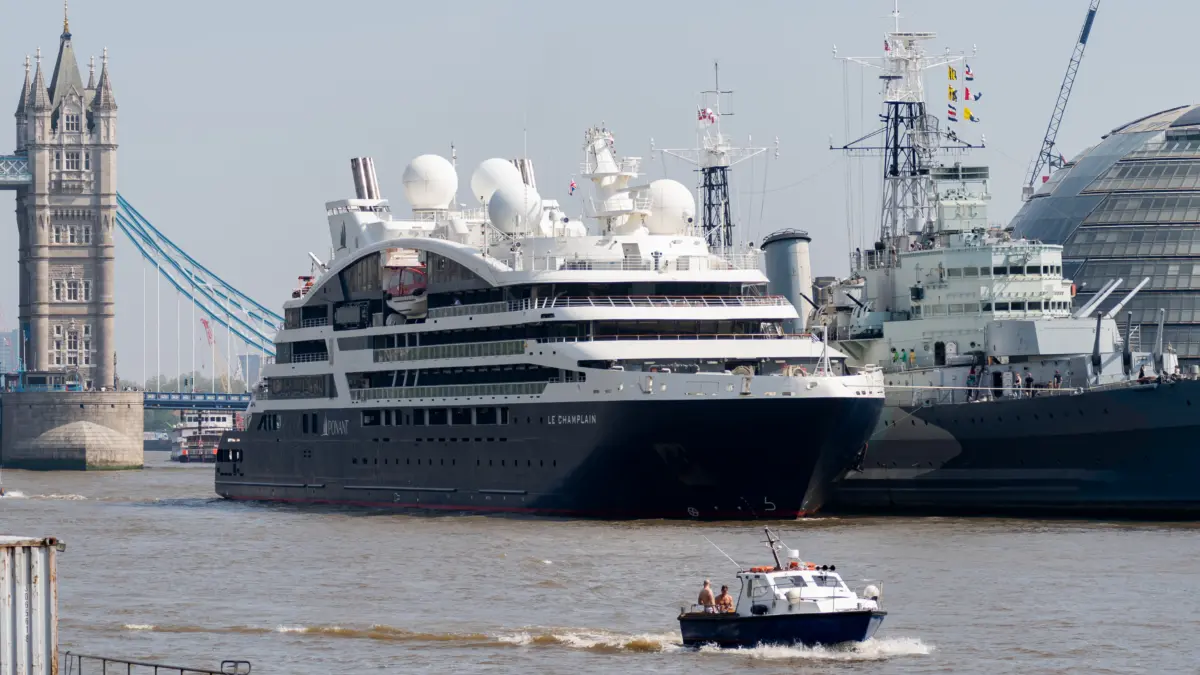
Le Champlain alongside HMS Belfast in London, with Tower Bridge beyond, in May 2024.
Photo: Barney Laurance. Licence: CC BY-SA 4.0; image preparation by CruisePing.
Le Champlain is one of the easiest PONANT Explorers for a UK traveller to understand because the ship regularly appears on Northern European and British Isles programmes as well as warmer-water voyages. The hardware is familiar from Le Lapérouse: 184 guests, 92 balcony staterooms and suites, two restaurants, a marina, pool, spa and Blue Eye underwater lounge. The reason to choose Le Champlain is therefore not a hidden design advantage. It is the combination of an intimate Explorer-class platform with the right route, date and fare.
The ship can move from the Baltic and Scandinavia to Scotland, Atlantic islands and warmer regions without changing its basic proposition. That breadth is useful, but it also makes comparison essential. Use the PONANT fleet selector before paying a premium simply because Le Champlain is the vessel on a particular departure.
Le Champlain is a particularly attractive Explorer when a British Isles or Northern Europe itinerary removes some of the travel friction for UK passengers. The ship itself is not meaningfully superior to its five Explorer sisters, so route and price should decide. Its small scale, balconies and strong viewing spaces make it far more persuasive on destination-led voyages than on a simple port-to-port luxury comparison.
Le Champlain at a glance
| Cruise line | PONANT Cruises |
|---|---|
| Ship class or type | PONANT Explorer, second ship of the six-ship Explorer series |
| Entered service | 2018 |
| Last major refurbishment | No major transformative refit publicly highlighted; the ship retains the Explorer-class configuration |
| Gross tonnage | 9,976 GT |
| Length | 131 m |
| Guest capacity | 184 maximum |
| Crew | 118 |
| Passenger decks | 5 principal guest-accessible decks |
| Cabins or suites | 92 staterooms and suites, all with private balcony |
| Accessible cabins | 2 wheelchair-adapted cabins |
| Dining venues | Main gourmet restaurant and informal grill restaurant, plus room service |
| Bars and lounges | Main lounge, observation lounge, pool bar and Blue Eye underwater lounge |
| Pools and hot tubs | Heated outdoor infinity-style pool plus marina access for water activities |
| Library | Reading collection integrated with the observation lounge rather than a large separate library room |
| Spa and fitness | SOTHYS spa, hammam, hair salon and fitness room |
| Children’s facilities | Kids Club on selected voyages from age 4; expedition voyages normally from age 6 |
| Adults-only facilities | No dedicated adults-only retreat |
| Wi-Fi | Included 24-hour Wi-Fi, with satellite performance varying by region |
| UK departures or deployment | Northern Europe, British Isles, Atlantic islands, Mediterranean and Caribbean; selected London and Glasgow opportunities rather than a regular Southampton season |
Best suited to
- UK travellers attracted by British Isles, Scotland, Baltic or Northern Europe itineraries
- Couples wanting a modern small ship with every cabin opening to a private balcony
- Passengers who value destination access and lectures more than a large entertainment programme
Think carefully if
- You want many restaurants, a casino, large theatre productions or busy nightlife
- You are paying substantially more than for an Explorer sister on a similar itinerary
- You need a cruise built around step-free shore access rather than Zodiacs, tenders and uneven quays
Quick booking comparison
| Booking question | CruisePing view |
|---|---|
| Best reason to choose Le Champlain | A British Isles or Northern Europe route that reduces travel friction while retaining the Explorer-class small-ship experience. |
| When to compare a sister | Whenever Le Lapérouse, Le Bougainville or Le Dumont d’Urville offers a similar itinerary at a better total price. |
| Main compromise | Only two principal restaurants and a deliberately quiet entertainment programme. |
| Cabin priority | Choose position and usable space before paying for a suite label, because every accommodation already has a balcony. |
The booking decision
Le Champlain should win a comparison because of the itinerary and total trip, not because it is newer or more luxurious than another Explorer. PONANT has used the vessel for routes that can be unusually practical from Britain, including voyages ending in London and programmes beginning or ending in Glasgow. That is a genuine booking advantage for some passengers. It reduces long-haul positioning and can make a premium small-ship fare easier to justify.
On the other hand, a Mediterranean or Caribbean Le Champlain sailing should be compared directly with Le Bougainville, Le Dumont d’Urville and other Explorer sisters. The ships share the same basic dimensions and public-space plan. Cabin category, embarkation city, shore programme and the actual ports carry more weight than the name on the hull.
Le Champlain full ship walkthrough video

A compact layout that works well in poor weather
The Explorer plan concentrates the main public rooms into a ship that is only about 131 metres long. The observation lounge gives a forward-facing indoor base, the main lounge handles social events and lectures, and the theatre supports talks as well as evening performance. This matters in Northern Europe because a small expedition yacht cannot rely on passengers spending every afternoon outside.
Movement around the ship is straightforward once the deck plan is understood, but small does not mean barrier-free. Expedition loading, marina operations and some remote quays still demand mobility. Anyone with limited walking ability should discuss the exact itinerary with PONANT before booking rather than treating the lift-served interior as proof that every landing will be easy.
Cabins: a balcony on every category changes the trade-off
The 92-room inventory removes one of the usual small-ship compromises because every stateroom or suite has a private balcony. Standard balcony rooms are compact rather than lavish, but they give fresh air and private viewing without requiring a suite upgrade. On fjord, island and coastal itineraries that can be more useful than extra internal floor area.
Suite pricing deserves closer scrutiny. A larger suite improves living space, but it does not unlock a separate ship-within-a-ship product. Before spending more, compare the exact square footage, balcony shape, bed arrangement and vertical position against a standard balcony. The ship is sufficiently intimate that ordinary cabins still use the same lounges, restaurants, pool and marina as the top suites.
Blue Eye is memorable but should not determine the booking
Blue Eye sits below the waterline and combines large windows with underwater sound and visual effects. It is one of the few features that immediately distinguishes the Explorer series from conventional small cruise ships. It can be atmospheric when sea conditions and marine life cooperate, especially after dark.
The lounge is still a bonus rather than a destination. Visibility is variable and the novelty is not worth choosing a weak itinerary for. The more important design strengths are the observation areas, marina and the ability to carry a full small-ship programme with fewer than 200 guests.
Dining is French-led and deliberately limited in number
There are two principal places to eat rather than a resort-ship restaurant district. The main restaurant handles the more formal dining rhythm, while the grill offers a lighter and more casual alternative when weather permits. Room service adds flexibility. The model works best for passengers who value ingredients, service and a civilised pace more than a long list of cuisines.
PONANT places gastronomy at the centre of the brand, and the PONANT gastronomy programme material explains the wider approach. Dietary requirements should still be declared early. On a 184-guest ship, the galley can usually respond personally, but there is less redundancy than on a vessel with a dozen outlets.
Open Bar, gratuities and the real onboard bill
The inclusive structure is part of the appeal. Many drinks are covered under Open Bar, Wi-Fi is included and gratuities are built into the fare. That makes the onboard account calmer than on a mainstream line where drinks, internet and service charges are separate daily decisions.
Premium bottles, spa treatments, boutique purchases and some optional experiences can still add cost. The fare should therefore be compared as a package, especially against an expedition line that initially appears cheaper but charges separately for items PONANT includes. The PONANT line guide breaks down the inclusions in more detail.
Pool and marina: more useful in some regions than others
The aft pool and marina platform give the ship a strong connection with the water. In the Caribbean, Atlantic islands or a calm Mediterranean anchorage, that can become a defining part of the day. The marina also supports launching water activities when the programme, local rules and conditions allow.
On a cold, windy Northern Europe sailing, the same hardware can be far less important. That is why the ship should be judged through the route. A passenger choosing Le Champlain for Scotland may care much more about the observation lounge, lectures and sheltered deck positions than the pool. The hardware does not change, but its value does.
Spa and fitness suit a small luxury ship
The wellness area includes a SOTHYS spa, hammam, hair salon and fitness room. It is a credible facility for a vessel of this scale, especially on sea days, but it is not a destination spa complex. Appointment capacity is naturally limited by the small treatment area.
Book popular treatment times early if wellness is important. The gym is adequate for maintaining a routine rather than for passengers expecting a large training floor. In practice, active expedition days and long shore visits often provide more exercise than the onboard equipment.
Entertainment is secondary to the destination
The theatre is used for destination briefings, lectures, presentations, concerts and small-scale shows. Evenings are sociable but restrained. There is no casino and no attempt to recreate the high-energy schedule of a large contemporary cruise ship.
The French-English mix is part of the identity. Announcements and programming can be bilingual, and the passenger mix often reflects the company’s French roots. Some British passengers enjoy the international atmosphere; others may prefer a line designed primarily around English-language social life. That preference is worth deciding before booking because it affects the feel of every day more than the age of the ship.
Families: possible, but never the central proposition
Selected voyages can offer a Kids Club, and classic itineraries may accept younger children than expedition departures. The ship does not become a family resort when children are aboard. There are no water slides, arcade zones or large children’s decks, and the daily programme remains destination-focused.
A well-travelled family can have an exceptional experience if the itinerary is suitable and everyone is comfortable with lectures, small-group excursions and quieter evenings. Families who need constant organised entertainment should choose a different style of cruise. Age rules can vary by voyage type, so the PONANT UK FAQs deserves checking before paying a deposit.
British Isles and Northern Europe are where Le Champlain stands out
The Le Champlain voyage calendar shows a particularly broad Northern European role, including Baltic programmes, Scotland and British Isles opportunities, alongside Atlantic and warmer itineraries. For a UK passenger, that can turn Le Champlain from an abstract French expedition yacht into a practical option with familiar embarkation geography.
Do not overgeneralise from one season. Deployment moves. The right approach is to search the live schedule, then compare the route with the other Explorer sisters. A Glasgow or London-linked voyage may justify choosing Le Champlain over a sister even when the ships themselves are nearly interchangeable.
Expedition or classic cruise?
Le Champlain can operate both styles. A classic cultural itinerary may spend most days alongside conventional quays with organised excursions. An expedition programme can involve Zodiacs, flexible landings, naturalists and greater dependence on weather. The cabin and restaurants are the same, but the holiday is not.
Read the itinerary language carefully. The word expedition changes expectations around timing and certainty. A landing can move or disappear because conditions are unsafe. Passengers who regard every printed stop as a promise may find that frustrating; travellers who value access and adaptability often see it as the point.
Le Champlain versus Le Lapérouse
There is no meaningful hierarchy. Le Lapérouse is the first Explorer and remains the clearest reference ship; Le Champlain followed with essentially the same formula. If both sail an itinerary you want, compare fare, flight logistics, cabin position and departure date. Paying a premium for Le Champlain purely because of the name makes little sense.
Le Champlain gains a practical edge when its British Isles or Northern Europe deployment fits your travel plans. Le Lapérouse may win elsewhere. Both are more conventional luxury expedition yachts than Le Ponant and far less specialised than Le Commandant Charcot.
What to check before booking
- Compare Le Champlain with at least one other Explorer on the same region and similar dates.
- Check whether the itinerary is classic, expedition-led or a mixture, because shore operations differ materially.
- Review cabin position above and below, especially near lounges, machinery and high-traffic stairs.
- Confirm mobility requirements for tenders, Zodiacs and uneven landings rather than judging accessibility from the ship alone.
- Check the live embarkation and disembarkation ports before pricing flights and hotels.
- Declare dietary requirements and important medical needs before final payment.
- Price travel insurance for the destination, not merely for the cruise fare.