
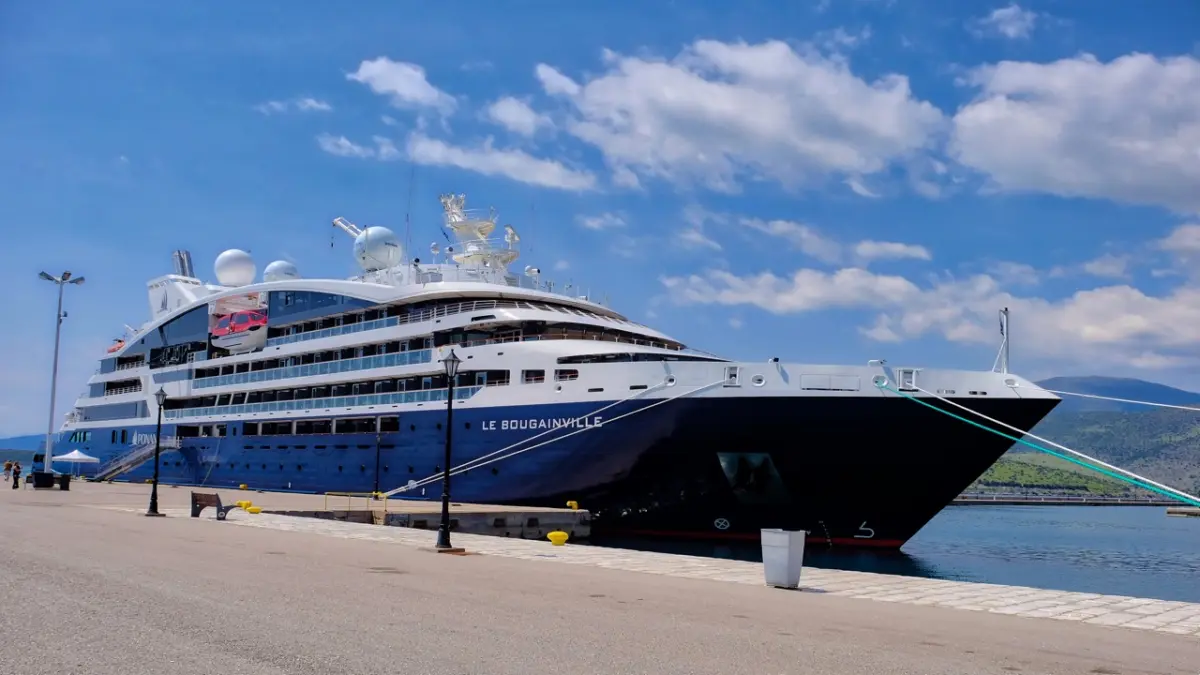
Le Bougainville moored at Itea in Greece.
Photo: Philiphurst. Licence: CC BY-SA 4.0; image prepared by CruisePing.
Le Bougainville makes most sense when the itinerary lets a 184-guest Explorer behave like a yacht. Warm-water Mediterranean, Adriatic, Caribbean and Central American programmes give the aft marina, pool and open decks a larger role than they have on a cold-climate voyage. The ship does not offer more facilities than Le Lapérouse or Le Champlain, but the right deployment can make the same hardware feel more relevant.
As the third PONANT Explorer, Le Bougainville shares the defining 92-balcony-room platform with Le Lapérouse and Le Champlain. The full PONANT selector is therefore more useful than a simple newest-ship ranking. Compare route, fare and cabin first. Le Bougainville is best treated as a highly capable vehicle for a destination rather than a separate resort product.
Le Bougainville is one of the most persuasive Explorer sisters on warm-water itineraries. The marina, pool and balcony-heavy accommodation fit the Mediterranean and Caribbean particularly well. Do not pay more merely because this specific sister is available. A better itinerary on Le Champlain, Le Dumont d’Urville or Le Lapérouse should beat a weaker Le Bougainville route.
Le Bougainville at a glance
| Cruise line | PONANT Cruises |
|---|---|
| Ship class or type | PONANT Explorer, third ship of the six-ship Explorer series |
| Entered service | 2019 |
| Last major refurbishment | No major transformative refit publicly highlighted; the ship retains the Explorer-class configuration |
| Gross tonnage | 9,976 GT |
| Length | 131 m |
| Guest capacity | 184 maximum |
| Crew | 118 |
| Passenger decks | 5 principal guest-accessible decks |
| Cabins or suites | 92 staterooms and suites, all with private balcony |
| Accessible cabins | 2 wheelchair-adapted cabins |
| Dining venues | Main gourmet restaurant and informal grill restaurant, plus room service |
| Bars and lounges | Main lounge, observation lounge, pool bar and Blue Eye underwater lounge |
| Pools and hot tubs | Heated outdoor infinity-style pool plus marina access for water activities |
| Library | Reading collection integrated with the observation lounge rather than a large separate library room |
| Spa and fitness | SOTHYS spa, hammam, hair salon and fitness room |
| Children’s facilities | Kids Club on selected voyages from age 4; expedition voyages normally from age 6 |
| Adults-only facilities | No dedicated adults-only retreat |
| Wi-Fi | Included 24-hour Wi-Fi, with satellite performance varying by region |
| UK departures or deployment | Mediterranean, Adriatic, Atlantic crossings, Caribbean and Central America are important; no regular Southampton homeport season |
Best suited to
- Couples who want yacht-like Mediterranean, Adriatic or Caribbean cruising without giving up a proper theatre, spa and two restaurants
- Passengers likely to use the marina, pool and private balcony in warm weather
- Experienced cruisers who value small ports and a quieter evening atmosphere over resort entertainment
Think carefully if
- You want a large choice of restaurants, bars and nightly shows
- You are choosing the ship before comparing the route with its five near-identical Explorer sisters
- You need guaranteed step-free shore access or dislike tender and Zodiac operations
Quick booking comparison
| Booking question | CruisePing view |
|---|---|
| Best reason to choose Le Bougainville | A warm-water Mediterranean, Adriatic, Caribbean or Central American itinerary that makes good use of the marina and outdoor spaces. |
| When to compare a sister | Whenever another Explorer offers the same ports, because the onboard hardware is deliberately very similar. |
| Main compromise | Limited restaurant and nightlife choice compared with a larger luxury ship. |
| Cabin priority | A well-positioned balcony cabin can be better value than automatically upgrading to a suite. |
The booking decision
Le Bougainville is a classic example of why PONANT has to be bought itinerary-first. The ship is capable of supporting both cultural cruises and expedition-style days, but the experience changes dramatically with the region. A week of Adriatic ports can feel like intimate French luxury cruising. A Central American programme can put naturalists, Zodiac landings and wildlife at the centre.
The hardware does not tell you which holiday you are buying. Read the route description, excursion structure and embarkation logistics before comparing cabin categories. If the itinerary is weak, Blue Eye and the marina will not rescue it. If the itinerary is exceptional, the compact Explorer platform is a genuine advantage.
Le Bougainville ship tour video

Why warm-water deployment suits the design
The aft of the Explorer class is one of its best pieces of design. The marina platform lowers the physical distance between ship and sea, while the pool and outdoor bar make the stern a natural social area in benign weather. In Greece, Croatia or the Caribbean, those spaces can be used repeatedly rather than treated as occasional extras.
That does not make Le Bougainville a beach-club ship. The atmosphere remains quiet, service-led and destination-focused. Water activities depend on local rules, sea conditions and the voyage plan. The value comes from having the capability available when the itinerary can use it.
Cabins: consistent, modern and balcony-led
Every one of the 92 staterooms and suites has a private balcony, so the entry decision is not inside versus outside. Standard rooms are compact but well suited to a voyage where much of the day is spent ashore or in public viewing spaces. The balcony gives private air and a place to watch an anchorage without competing for rail space.
Larger suites buy space rather than exclusive facilities. There is no separate suite restaurant or retreat complex. That makes the value calculation unusually clean: pay for the extra room if you will use it, not because you expect a different onboard status. For many couples, a well-located standard balcony is the rational choice.
Blue Eye is a clever lounge, not a wildlife guarantee
The underwater Blue Eye lounge is the feature most likely to appear in promotional photographs. Its windows, cameras and sound design create an immersive connection with the sea. It is unusual and genuinely interesting, especially for first-time Explorer passengers.
Marine visibility changes with depth, light, weather and location. Blue Eye cannot guarantee dolphins, fish or dramatic underwater scenes. Treat it as a distinctive evening room rather than the reason to choose the cruise. The ship’s small scale and itinerary access are more important.
Dining: quality matters more than choice
The two principal restaurants fit the passenger count. The main restaurant provides the more complete French-led dining experience; the grill is lighter and works particularly well in warm weather. With only 184 guests, service can feel personal and the absence of restaurant reservations for a dozen venues simplifies the evening.
The trade-off is repetition on longer voyages. Passengers who need a new speciality concept every night may find two venues limiting. Those who value well-executed food and a calm service rhythm are more likely to see the small number as proportionate. The PONANT gastronomy programme explains the wider culinary approach.
Drinks, Wi-Fi and gratuities simplify the fare
Open Bar, included Wi-Fi and included gratuities remove several of the add-ons that complicate mainstream cruise pricing. For a passenger who would otherwise buy a drinks package and internet, that matters when comparing daily rates. The comparison should be made against the final likely bill, not the cheapest advertised cabin on another line.
Premium wines and spirits, spa appointments, boutique purchases and optional extras can still appear on the account. The PONANT Cruises guide covers those inclusions and compromises at line level.
Pool, marina and the Mediterranean rhythm
A Mediterranean itinerary often produces exactly the pattern the ship handles well: an early arrival, a long day ashore, a late-afternoon return and time outside before dinner. The pool is small but proportionate, and the marina makes selected water-based activities easier to integrate into the programme.
Peak sun can make shaded space valuable. Passengers who are sensitive to heat should consider the season and exact route rather than assuming a yacht-like ship always means comfortable outdoor living. The vessel is climate-controlled, but many of its most attractive spaces are connected to the sea and weather.
Port access is part of the value proposition
Le Bougainville is small enough for itineraries built around anchorages, tenders and compact ports, but small-ship access is not the same as effortless access. Some of the most rewarding calls may involve a tender, Zodiac or uneven historic waterfront. Passengers with limited mobility should assess the landing method for the ports they care about rather than judging accessibility from the ship alone.
For everyone else, the payoff can be substantial. A quieter berth or anchorage can put the destination closer to the centre of the day and reduce the sense of travelling in a large cruise procession. That advantage is most valuable when the itinerary genuinely uses it, so read the port sequence closely before paying a small-ship premium.
Spa, hammam and fitness are credible rather than expansive
The SOTHYS spa, hammam, hair salon and fitness room give Le Bougainville enough wellness infrastructure for a luxury cruise without consuming a large share of the ship. Treatment slots can fill because capacity is naturally small.
The fitness room supports a normal routine but is not a large gym. On active itineraries, walking tours, swimming and expedition activities may provide most of the exercise anyway. Passengers who book primarily for spa facilities can find larger luxury ships with more depth.
Evenings are deliberately low-key
The theatre supports lectures, destination presentations, concerts and small performances. The lounges are better suited to conversation and a drink than to late-night crowds. There is no casino and little sense of scheduled entertainment competing for attention.
This quiet rhythm is a strength after a full day of sightseeing. It can feel too subdued to travellers who want comedy, multiple live bands and a choice of shows. The bilingual French-English environment adds to the European character and can make the passenger mix feel more international than on a UK-focused line.
Families need the itinerary to do the work
Children can be accepted under PONANT’s age rules and selected voyages may provide a Kids Club, but family facilities remain modest. The best family use is an itinerary that is inherently exciting: wildlife, islands, swimming, archaeology or active shore days.
Parents should not expect the ship to entertain children independently from breakfast to bedtime. Check age limits for the exact voyage, especially if it is expedition-led. The PONANT UK FAQs is the sensible final check because the rules differ by cruise type.
Mediterranean, Caribbean and Central America give the ship different personalities
The Le Bougainville voyage calendar currently shows a mixture of Mediterranean and Adriatic sailings, ocean passages and warmer western-hemisphere programmes. This variety is a reminder that the ship name is not the holiday. A port-intensive Malta or Adriatic cruise will feel culturally led; a Caribbean or Central American itinerary can lean more heavily on nature and water access.
Ocean voyages can offer unusually attractive pricing for passengers who simply want time on the ship, but they remove much of the destination advantage that justifies an Explorer. Consider them separately from expedition or port-rich itineraries.
Le Bougainville versus Le Champlain
The difference is usually deployment. Le Champlain often has strong Northern Europe and British Isles opportunities; Le Bougainville is especially convincing when the schedule leans into Mediterranean, Adriatic or tropical routes. The cabins, restaurants and public spaces are too similar to justify choosing on hardware alone.
If both ships offer the same region, compare the exact ports and timings. A late stay, unusual small port or easier embarkation can be worth far more than a small difference in launch date.
Le Bougainville versus Le Dumont d’Urville
Both entered service in 2019 and sit in the same Explorer generation. Le Dumont d’Urville can appear on a wider mix including Mediterranean, Adriatic and African programmes. Le Bougainville often suits passengers who specifically want warm-water yacht-like use of the stern spaces.
Neither is a general winner. Let geography decide, then cabin and fare. If the decision remains tied, flight convenience and hotel requirements may be more important than any onboard distinction.
What to check before booking
- Compare the exact Le Bougainville itinerary with another Explorer before paying a ship-specific premium.
- Check whether the marina and water activities are actually relevant to the chosen route.
- Confirm tender, Zodiac and mobility requirements for every important port.
- Study the cabin vertically as well as horizontally, including what sits above and below.
- Check likely weather and heat, because outdoor-space value changes substantially by season.
- Declare dietary needs early rather than waiting until embarkation.
- Price flights, pre-cruise hotels and transfers as part of the total holiday.