
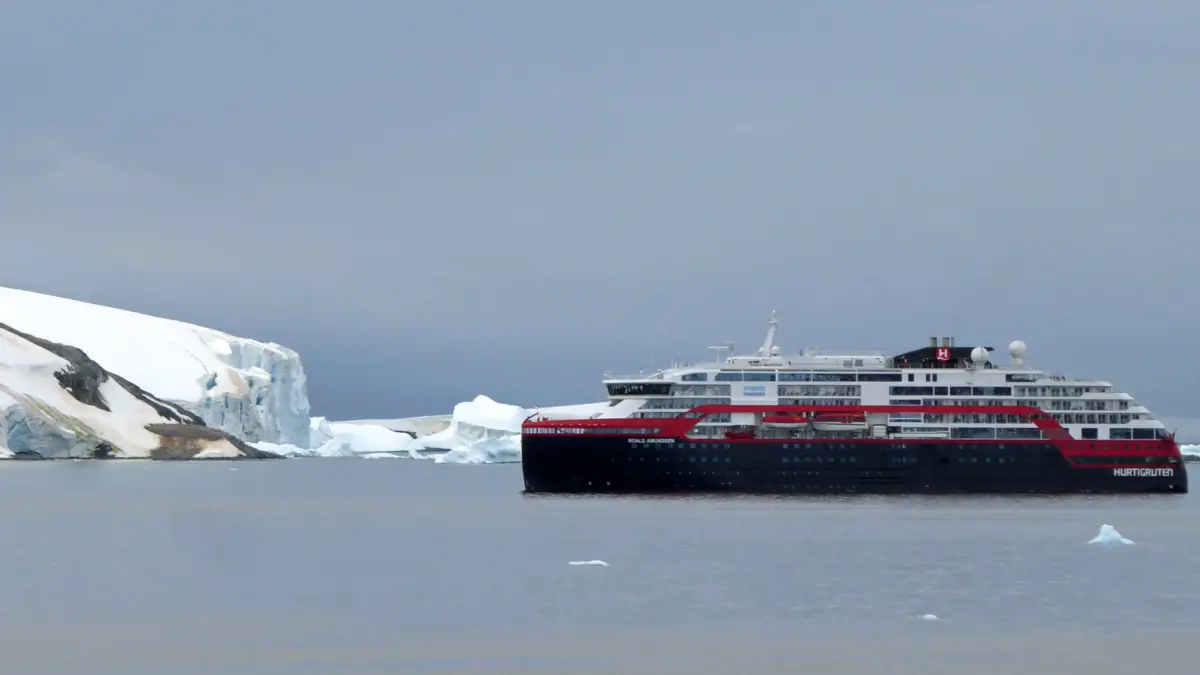
MS Roald Amundsen in Antarctica, representing the larger hybrid end of the HX fleet.
Photo: Wolfgang Fricke. Licence: CC BY 3.0; crop by CruisePing.
The best HX ship is not the newest one. It is the ship whose scale and route match the expedition you actually want. MS Roald Amundsen and MS Fridtjof Nansen are the comfortable all-rounders. MS Fram is the more intimate polar choice. MS Spitsbergen pushes that small-ship argument further, while MS Santa Cruz II is a specialist Galápagos vessel that should barely be compared with the polar fleet at all.
If you are choosing between Roald Amundsen and Fridtjof Nansen, do not waste time trying to identify a mythical better sister. They share the same 140-metre, 20,889-GT platform, 490-guest capacity, 265 outside cabins, major public rooms and hybrid concept. Choose the itinerary, cabin position and fare. The meaningful fleet decision is usually hybrid sister versus smaller expedition ship.
For a first HX expedition, I would start with MS Roald Amundsen or MS Fridtjof Nansen unless smaller scale is a priority. They offer the easiest balance of expedition substance and comfortable hardware. I would choose MS Fram over them when a 200-guest atmosphere and polar focus matter more than balconies, three restaurants and an infinity pool. MS Santa Cruz II wins the Galápagos question automatically, while MS Spitsbergen is the small Arctic specialist.
HX fleet comparison
| Ship | Guests | Best for | Main compromise |
|---|---|---|---|
| MS Roald Amundsen | 490 | Northwest Passage, Greenland, Arctic Canada and Antarctica with the fullest onboard facilities | Large for an expedition ship; intimacy is not its selling point |
| MS Fridtjof Nansen | 490 | Alaska, Patagonia, Antarctica and Greenland with the same strong hybrid-ship hardware | Almost no hardware reason to choose it over Roald Amundsen if itinerary and price are identical |
| MS Fram | 200 | Travellers who want a smaller, more expedition-centred polar ship after the 2025 refresh | Fewer dining choices and less resort-style hardware than the hybrid sisters |
| MS Spitsbergen | 150 | Small-ship Arctic and off-the-beaten-track exploration | Less cabin and dining variety; the ship is intentionally simple |
| MS Santa Cruz II | 90 | Galápagos wildlife and island exploration | A specialist Ecuadorian product, not the ship for polar or global itinerary flexibility |
Best overall: MS Roald Amundsen or MS Fridtjof Nansen
The hybrid sisters are the safest recommendation for travellers crossing from mainstream or luxury cruising into expedition travel. They have proper balconies, three restaurant concepts, strong lounges, large Science Centres, infinity pools, hot tubs, wellness facilities and enough cabin choice to feel comfortable on long voyages. They are not rough-and-ready expedition vessels.
The price for that comfort is scale. A 490-guest ship feels very different from Fram or Spitsbergen. HX manages landings in groups, but you still share the voyage with many more people. If you enjoy having a substantial ship around you, that is a benefit. If you imagine expedition cruising as an intimate community of 100 to 200 people, it is the wrong expectation.
Roald Amundsen vs Fridtjof Nansen: choose the route
MS Roald Amundsen currently makes a particularly strong case for Greenland, Arctic Canada and Northwest Passage routes, then Antarctica. MS Fridtjof Nansen has a strong Alaska and British Columbia role, Patagonia and Chilean Fjords, Antarctica and northern expeditions. Deployment changes, so this is not a permanent personality difference.
I would pay more attention to cabin position than the name on the bow. On both ships, a balcony is attractive but not mandatory. A well-priced outside cabin can be the smarter buy if it releases budget for the more interesting itinerary or extra travel days before embarkation.
Best for smaller-ship expedition feel: MS Fram
MS Fram is the ship in the fleet I would choose if the expedition itself is the luxury. Its current capacity is 200 and its 2025 refurbishment refreshed cabins and the Science Centre. It still has comfortable dining, a lounge, sauna, gym and hot tubs, but the ship does not compete with the hybrid sisters on facilities.
That trade is worthwhile when small scale matters. Fewer passengers can make the voyage feel more coherent, particularly on multi-landing polar itineraries. Fram is not automatically better at every destination, and a 490-guest ship can still run an excellent expedition, but the difference is real enough to influence my booking.
Best Arctic specialist: MS Spitsbergen
At 150 guests, MS Spitsbergen is even more intimate and has undergone a substantial 2025 refurbishment. It is particularly attractive for Svalbard and remote northern work where a simple, agile ship fits the destination. It has a Science Centre, Explorer Lounge & Bar, sauna and fitness room, but it is not trying to reproduce the hybrid ships’ breadth of restaurants and wellness.
I would wait for the full CruisePing ship guide before making a cabin-level choice, but the fleet position is clear now: Spitsbergen is for travellers who regard small scale as a positive feature rather than something to tolerate.
Best for Galápagos: MS Santa Cruz II
MS Santa Cruz II is the outlier. At 90 guests and 71.8 metres long, it operates a Galápagos-focused programme with different equipment, local rules and onboard logistics. Comparing its pool count with Roald Amundsen is pointless. You choose it because you want the Galápagos with HX.
For that trip, the smaller ship and destination-specific setup are strengths. For Antarctica, Greenland or Alaska, it is irrelevant because Santa Cruz II is not the ship serving those expedition programmes.
Which ship has the best cabins?
Roald Amundsen and Fridtjof Nansen win on breadth. Both have 265 outside cabins and suites, about half with balconies, plus large suites with substantial living areas. Accessible XY and TY categories are available. Fram’s cabin mix is more varied and includes inside rooms, which can help value-focused travellers.
I would not automatically buy a balcony for Antarctica. You may spend more time on open decks, in the Science Centre and ashore than sitting privately outside. A balcony becomes more valuable when you enjoy independent wildlife watching, photography from the room or simply want a private place to step outside without dressing for a public deck.
Which ship is best for solo travellers?
The winner changes with pricing. HX removes solo supplements on selected departures, so the best solo ship can be whichever has the strongest no-supplement offer on a route you want. Fram and Spitsbergen have an inherently more intimate social scale, while the hybrid sisters give you more public spaces and dining variety.
Do not compare percentage discounts. Compare the final single-occupancy price including any pre-cruise hotels and flights. Expedition cruising is expensive enough that a genuine solo-supplement waiver can outweigh a relatively small difference in ship preference.
Which ship is best for families?
None is a conventional family ship. The hybrid sisters have more space and cabin flexibility, but HX does not build the holiday around children’s clubs or family entertainment. For a wildlife-focused teenager, the expedition programme can be exceptional. For a younger child who needs constant organised entertainment, it can be hard work.
Antarctica and Galápagos minimum ages and small-boat participation rules matter more than cabin capacity. Read the HX family and expedition guidance before treating a four-berth cabin as proof that the itinerary suits four people.
What counts as a meaningful ship difference?
Expedition fleets are easy to compare badly. Décor, launch year and the number of bars matter less than guest numbers, expedition spaces, observation access, cabin mix and the regions in which a ship is actually deployed. That is why I treat the 290-passenger gap between Fram and the hybrid sisters as more important than small cosmetic differences between Roald Amundsen and Fridtjof Nansen.
Landing operations also make scale relevant, but not in a simplistic “smaller always gets ashore faster” way. Local rules, sea state, landing-site capacity, the number of expedition boats and the way guests are divided into groups all affect the day. A smaller ship reduces the number of people who need to move through the programme, while a larger ship can compensate with more equipment and staff. I would use guest capacity as a genuine consideration, not a guarantee of more time ashore.
Where value really comes from
The cheapest cabin on the newest ship is not automatically the best-value HX booking. Expedition value comes from the combination of route, season, included activity, cabin, pre-cruise logistics and the number of days spent in the destination. A stronger Greenland or Antarctica itinerary on Fram can be better value than a balcony on a hybrid sister if the latter sacrifices the places you actually travelled to see.
For the two hybrid sisters, I would be especially reluctant to pay a large premium purely for the ship name. Their hardware is too similar. Spend the difference on the better departure date, the cabin location you actually want, extra nights around embarkation or a route with more compelling expedition days. With Spitsbergen and Santa Cruz II, the value case is more specialist because the smaller scale and geographic focus are part of what you are buying.
My HX ranking by traveller type
| Traveller | First choice | Reason |
|---|---|---|
| First expedition cruise | Roald Amundsen / Fridtjof Nansen | The easiest combination of expedition substance and familiar comfort |
| Smaller-ship polar enthusiast | MS Fram | 200 guests and refreshed expedition spaces create a more intimate basecamp |
| Small Arctic specialist | MS Spitsbergen | 150 guests and a simple, expedition-first layout |
| Galápagos traveller | MS Santa Cruz II | Purpose-specific 90-guest ship and dedicated island programme |
| Luxury-first traveller | Compare Seabourn or Silversea too | HX is premium and comfortable, but expedition substance rather than luxury service is the core product |
Related CruisePing guides
- HX Expeditions guide
- MS Roald Amundsen guide
- MS Fridtjof Nansen guide
- MS Fram guide
- PONANT Cruises guide
- Seabourn guide
- Silversea Cruises guide