
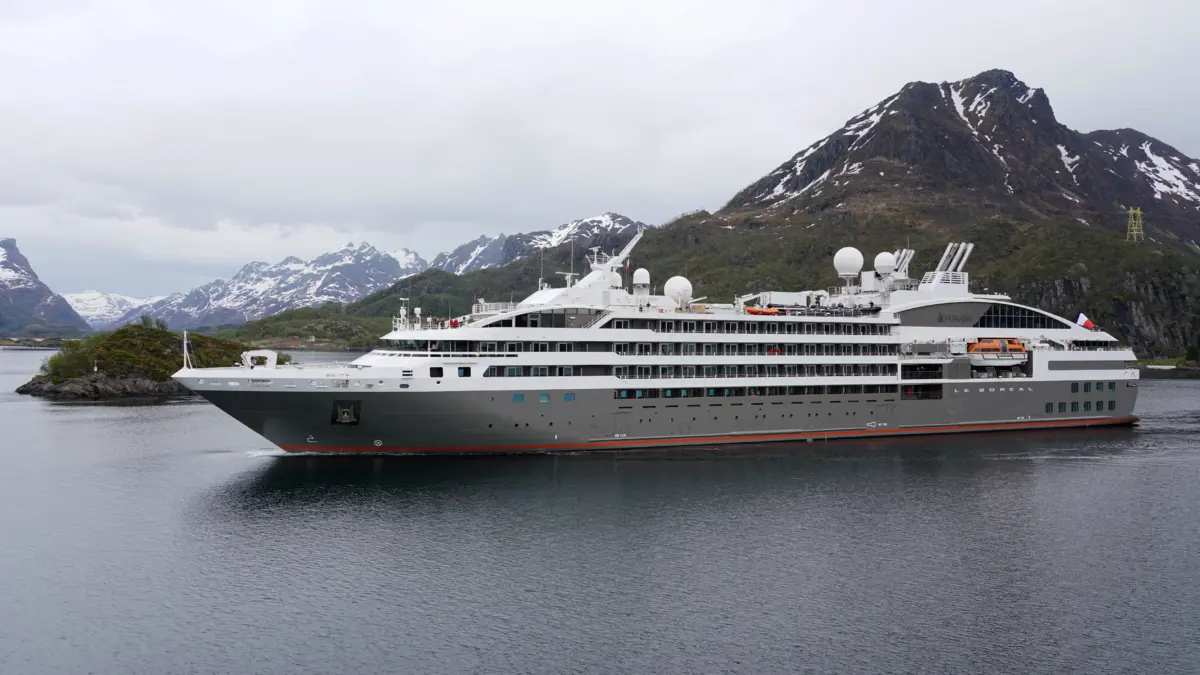
Le Boréal passing Hanøy in northern Norway, with the compact expedition profile that still defines PONANT’s original Sistership concept.
Photo: Virtual-Pano. Licence: CC BY-SA 4.0; crop by CruisePing.
Le Boréal is the PONANT Sistership I would book when the itinerary is doing the selling and the price is sensible. It is the oldest of the four-ship series, but that is not a reason to dismiss it. At 264 guests it remains genuinely small, has six passenger-accessible decks, two dining choices, a heated outdoor pool and enough lounge space to cope with sea days without turning the voyage into a resort holiday.
I would not, however, pay a significant premium for Le Boréal simply because PONANT wraps it in the same luxury language as its newer vessels. The six PONANT Explorers have a newer design, every room has a balcony and their aft marina and Blue Eye lounge are meaningful upgrades. Le Boréal earns its place when a Mediterranean, Iberian or Atlantic itinerary is better, the timing suits, or the fare makes the older hardware irrelevant.
Le Boréal is a route-first choice, not a ship-first choice. Its strongest case is classic small-ship Mediterranean and Atlantic cruising at a fare that recognises its age. I would choose a newer Explorer at the same price on the same itinerary, but I would choose Le Boréal without hesitation if it has the better ports, dates or value.
Le Boréal at a glance
| Cruise line | PONANT Cruises |
|---|---|
| Ship class or type | PONANT Sistership, first vessel in the four-ship series |
| Entered service | 2010 |
| Last major refurbishment | No recent transformative rebuild that changes the basic Sistership layout |
| Gross tonnage | 10,950 GT |
| Length | 142.1 m |
| Guest capacity | 264 maximum |
| Crew | 145 |
| Passenger decks | 6 passenger-accessible decks |
| Cabins or suites | 132 staterooms and suites; 125 have a private balcony or terrace and seven Deck 3 rooms have windows or a porthole |
| Accessible cabins | 3 wheelchair-adapted staterooms, on decks 3, 4 and 5 |
| Dining venues | Two main dining choices: a gourmet restaurant and a more informal grill/buffet venue, plus room service |
| Bars and lounges | Main lounge and panoramic/observation lounge with bar areas; no Blue Eye underwater lounge |
| Pools and hot tubs | Heated outdoor seawater pool; compact open-deck relaxation areas |
| Library | Books and board games available in the public lounges rather than a large stand-alone library |
| Spa and fitness | SOTHYS and Davines spa, sauna, hair salon and fitness room |
| Children’s facilities | Kids Club on selected voyages from age 4; expedition voyages normally accept children from age 6 |
| Adults-only facilities | No dedicated adults-only retreat |
| Wi-Fi | Included Wi-Fi throughout cabins and public areas; satellite performance still depends on geography and conditions |
| UK departures or deployment | Mediterranean, Iberian Peninsula, Atlantic coast and Atlantic islands are particularly prominent in the published programme; deployment changes by season |
Best suited to
- Couples who value a genuinely small ship and destination-led days
- Travellers comparing Mediterranean, Iberian and Atlantic itineraries where Le Boréal has the better route
- Passengers who prefer traditional small-ship lounges over novelty features
Think carefully if
- You expect the Blue Eye underwater lounge or the aft marina found on the newer Explorers
- You are paying materially more than a comparable newer PONANT ship
- You want a large choice of restaurants, entertainment venues or family facilities
Where this ship fits in the PONANT fleet
Le Boréal is the original member of PONANT’s four Sisterships, followed by L’Austral, Le Soléal and Le Lyrial. The first three share the same published 264-guest maximum and 132-room layout. Le Lyrial is the useful exception, carrying fewer guests and having a broader suite mix.
The age gap to the Explorer generation matters most in layout, not in the basic PONANT proposition. Le Boréal still offers French-led dining, a high crew count for its size, expedition operations on suitable voyages and an intimate scale. What it lacks is the newer class’s distinctive stern marina and underwater lounge. Those are nice advantages, but neither should outweigh a much better itinerary.
Cabins: choose position before category
Le Boréal has 132 staterooms and suites. Most have a private balcony or terrace, but seven higher-category rooms on Deck 3 break the pattern: one has a porthole and six have large square windows. That makes the cabin map worth checking rather than assuming every expensive category gives you outdoor space.
Standard balcony accommodation is compact rather than palatial, while the Deluxe, Prestige and Owner’s suites create more living space. My priority would be location before category. On an expedition sailing, easy movement to the public decks can be more useful than buying the largest suite. On a warm-water cruise, a balcony has more day-to-day value, so the few window-only rooms need a conscious price advantage.
Dining and drinks
Le Boréal’s two-venue dining format is simple and suits the size of the ship. The main restaurant carries the more formal French-led dinner experience, while the grill/buffet option gives you a less structured alternative. Room service and the included Open Bar remove much of the petty onboard spending that can make premium cruises feel less premium.
The limitation is choice. If you enjoy deciding between six restaurants each night, Le Boréal is the wrong ship. If you want good meals without planning the evening around reservations, the restricted number of venues can feel liberating. I would judge the food on execution and itinerary rather than count restaurants, especially because remote deployments can affect the availability of imported French products.
Lounges, pool and life between ports
Public life on Le Boréal is built around the main lounge, panoramic lounge, theatre, pool deck and spa rather than a long list of attractions. That suits passengers who spend their days ashore and want somewhere civilised to read, talk, listen to a lecture or have a drink afterwards. The ship feels like a small expedition vessel with a luxury hotel layer, not a miniaturised mainstream cruise ship.
The pool is useful on warmer voyages but should not be the reason to book. The observation spaces matter more because this ship moves between scenic coastlines and remote regions. There is no Blue Eye underwater lounge, and that is one of the clearest physical differences from the Explorers. I would treat it as a nice-to-have rather than a deal-breaker unless that feature genuinely excites you.
Watch before you book

The walkthrough is useful because it shows the proportions of Le Boréal more clearly than deck plans do. Pay particular attention to the scale of the lounges, circulation around the pool deck and how quickly you can move from accommodation to observation areas. Those practical details tell you more about whether the older layout will suit you than glossy cabin photography.
Expedition capability and shore days
Le Boréal can switch between classic destination cruising and expedition-style voyages. That flexibility is valuable, but it also means two holidays on the same ship can feel completely different. A Mediterranean sailing may revolve around long port days and conventional excursions. A polar programme can involve Zodiacs, wet or uneven landings, wildlife briefings and itinerary changes driven by weather.
Do not buy the word expedition without reading the daily programme. The ship’s small scale helps with remote access, but the actual activity level depends on the voyage. I would compare the landing schedule, included excursions and physical notes before comparing cabin categories. On this type of ship, what happens off the vessel can be worth far more than another few square metres inside it.
Accessibility and mobility
Le Boréal has three wheelchair-adapted staterooms on decks 3, 4 and 5, and the public areas include accessibility adaptations. That is significantly more reassuring than assuming a small ship will naturally be easy to use. Small vessels can present steeper gangways, tendering and more variable shore access than large ships with fixed terminals.
The crucial distinction is between onboard access and destination access. A cabin can work well while a Zodiac landing or uneven historic port does not. Anyone with limited mobility should have the exact itinerary reviewed before paying the deposit and should not treat the presence of an adapted room as a guarantee that every shore day will be practical.
Families, solo travellers and atmosphere
Le Boréal is not a family resort. Children can sail within PONANT’s age rules and a Kids Club may operate on selected departures, but couples and adults remain the natural audience. The quiet public rooms, lectures and destination focus are much more central than organised children’s entertainment.
Solo travellers can benefit from occasional no-single-supplement offers, which can materially change the value equation on a premium small ship. The onboard atmosphere is bilingual French and English and generally sociable without being forced. If you enjoy making your own evening from dinner, a drink and conversation, Le Boréal fits. If you want nightly spectacle, it does not.
Where the itinerary makes the case
Le Boréal’s published programme makes a particularly coherent case around the western Mediterranean, Iberian Peninsula, Atlantic coast and Atlantic islands. Routes linking places such as Nice, Málaga, Lisbon, Bordeaux and the Azores play directly to a ship of this scale because smaller ports and long days ashore matter more than onboard novelty.
That is why I would shop Le Boréal by map first. If the route gives you a chain of ports that would be awkward on a large ship, the vessel’s age fades into the background. If the itinerary is ordinary and an Explorer costs about the same, the newer ship is the stronger buy. Le Boréal needs the route or fare to justify the choice.
What is Le Boréal worth paying for?
Le Boréal is a poor place to practise brand loyalty for its own sake. I would set a total-holiday budget, compare the same region across PONANT and its small-ship competitors, then ask what premium is being charged for the ship rather than the route. The fare can look high until included drinks, Wi-Fi and some voyage logistics are considered, but an older vessel still needs to earn its price. If a newer Le Lapérouse sailing costs roughly the same and visits the same ports, I would choose the Explorer. If Le Boréal is cheaper or gives me the superior sequence of smaller ports, the calculation reverses.
Suite upgrades deserve the same discipline. A larger room can be worthwhile on a long voyage with sea days, but Mediterranean itineraries often keep you ashore for most of the day. I would rather spend the difference on better flights, pre-cruise nights or a more interesting itinerary than buy unused square footage. Le Boréal rewards travellers who know which parts of a luxury holiday they actually value.
How it compares with the other Sisterships
| Booking question | CruisePing view |
|---|---|
| Best reason to choose Le Boréal | A stronger Mediterranean, Iberian or Atlantic itinerary at a sensible fare. |
| Best cabin strategy | Prioritise balcony and location; check the seven Deck 3 rooms without a balcony. |
| Versus an Explorer | Choose Le Boréal for route or value, not because its onboard hardware is newer. |
| Versus Le Lyrial | Le Lyrial has lower capacity and a more interesting suite mix; Le Boréal often wins on classic warm-water routing. |
Among the Sisterships, Le Boréal is the one I would most readily treat as a value proposition. L’Austral is the better all-round deployment pick, Le Soléal is far more compelling for Asia-Pacific and the Kimberley, and Le Lyrial has the strongest hardware argument because it carries fewer guests and more varied suites.
Who should book it?
Book Le Boréal when you want PONANT’s intimate scale and the itinerary feels unusually well designed. It is especially convincing for travellers who spend heavily on the destination rather than on the ship itself. A good route through Mediterranean or Atlantic ports can make the vessel feel exactly the right size.
Skip Le Boréal when you are choosing primarily by ship features. The Explorers are the better default in that comparison. The older Sistership becomes persuasive when price, timing or ports give it a clear edge. That is a perfectly good reason to book an older vessel, and a much better reason than nostalgia.
What to check before booking
- Compare the full itinerary with an Explorer sailing before comparing ship age.
- Check whether your selected room has a balcony, particularly on Deck 3.
- Price flights, hotel nights and transfers into the total holiday cost.
- Confirm whether the voyage is classic cruising or expedition-led and read the activity notes.
- If mobility matters, have the shore programme assessed as carefully as the adapted cabin.
Related CruisePing guides
- PONANT Cruises guide
- Which PONANT cruise ship is best?
- Le Lapérouse guide
- Le Bellot guide
- Le Jacques Cartier guide
- Le Commandant Charcot guide
- Le Ponant guide
- L’Austral guide
- Le Soléal guide
- Le Lyrial guide