
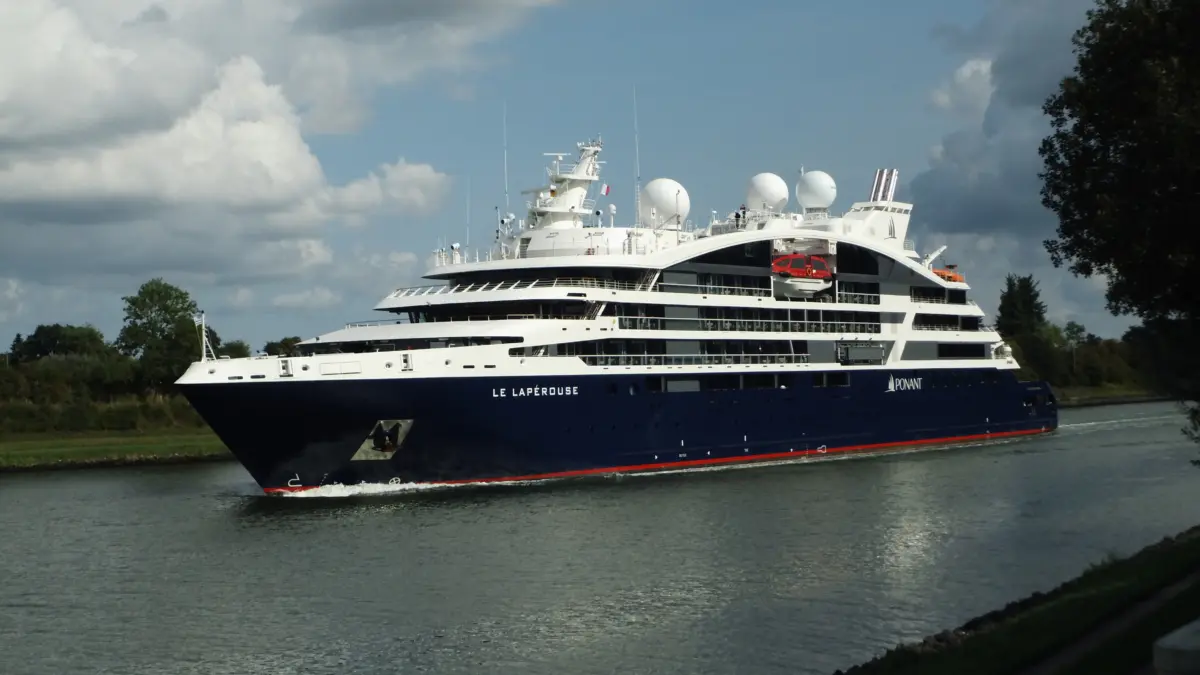
Le Lapérouse in the Kiel Canal, representing the modern PONANT Explorers.
Photo: HenSti. Licence: CC BY-SA 4.0; crop by CruisePing.
There is no single best PONANT ship because the fleet contains four different kinds of holiday. Le Ponant is a 32-guest sailing yacht. The six PONANT Explorers are modern 184-guest expedition yachts. Four Sisterships offer a slightly larger and more traditional small-ship experience. Le Commandant Charcot is a high-polar specialist whose capability changes where the itinerary can go.
Choose the ship family before choosing the individual vessel. For most first-time PONANT passengers, a PONANT Explorer is the safest all-round choice. Le Ponant is the most intimate. Le Commandant Charcot is the right answer only when its high-polar capability is the reason for travelling. The Sisterships can be excellent value when the itinerary is stronger than the hardware difference.
PONANT current fleet comparison
| Le Commandant Charcot | Best for high-polar reach. Up to 245 guests, Polar Class 2 construction, two laboratories, indoor pool, heated Blue Lagoon and specialist ice capability. Read the full guide. |
|---|---|
| Le Ponant | Best for sailing and intimacy. Just 32 guests, three masts, 16 staterooms and a near private-yacht atmosphere. Read the full guide. |
| Le Lapérouse | Best Explorer reference point. 184 guests, 92 staterooms, marina and Blue Eye underwater lounge. Read the full guide. |
| Le Champlain | Best Explorer for UK and Northern Europe opportunities when the route fits. The same 184-guest platform as Le Lapérouse, with Blue Eye, marina and balcony accommodation. Read the full guide. |
| Le Bougainville | Strong warm-water Explorer choice. Mediterranean, Adriatic, Caribbean and Central American programmes suit its marina, pool and compact outdoor spaces. Read the full guide. |
| Le Dumont d’Urville | Best chosen for itinerary value rather than hardware novelty. Mediterranean, Adriatic and African deployment shows how widely the Explorer platform can be used. Read the full guide. |
| Le Bellot | PONANT Explorer. Best current Explorer shortlist for UK, Iceland, Greenland, Great Lakes and North American planning. |
| Le Jacques Cartier | PONANT Explorer. Best current Explorer shortlist for the Kimberley, Melanesia and remote Pacific programmes. |
| Le Boréal | Original Sistership. Best bought for a strong Mediterranean or Atlantic itinerary and a fare that recognises the older hardware. |
| L’Austral | My all-round Sistership pick: unusually broad deployment across Antarctica, Greenland, North America, Mediterranean and UK-linked North Atlantic routes. |
| Le Soléal | The Sistership I would target for the Kimberley, Japan and Asia-Pacific, where itinerary is a stronger argument than newer hardware. |
| Le Lyrial | My hardware pick among the Sisterships: 245 guests, 122 rooms and the broadest suite mix, with strong polar and North Atlantic deployment. |
The quick answer
If you want a first PONANT voyage without a highly specialised brief, start with Le Lapérouse or one of her five Explorer sisters. They represent the fleet’s modern middle ground: only 184 guests, all-balcony accommodation, two restaurants, an aft marina and the Blue Eye underwater lounge. They are comfortable on a normal destination cruise and credible on expedition itineraries.
If the point of the holiday is sailing itself, Le Ponant is more distinctive than any powered sister. If the goal is the North Pole, deep pack ice or the most ambitious Antarctic routing, Le Commandant Charcot is in a different technical category. The Sisterships make most sense when one has the exact route, date or fare you want.
Why the PONANT Explorers are the default recommendation
The six Explorers solve the broadest range of booking problems. At 184 guests they are small enough for efficient landings and smaller ports, yet large enough to provide two restaurants, a theatre, spa, pool, several lounges and proper observation spaces. Every stateroom has a balcony, which matters on scenic itineraries where the ship itself is part of the viewing platform.
The class is also unusually consistent. Le Lapérouse, Le Champlain, Le Bougainville, Le Dumont d’Urville, Le Bellot and Le Jacques Cartier share the same core design. Small differences in decor, deployment and maintenance history exist, but they are not six separate cruise concepts. Itinerary, price and cabin position should normally decide between them.
The standout class feature is the Blue Eye underwater lounge, located below the waterline. It is intriguing rather than essential. Do not choose a week-long itinerary solely for it, but it adds a sense of place that fits a line built around the sea.
Le Ponant is not a miniature Explorer
Le Ponant removes almost everything that makes a ship feel like a cruise ship. There are only 16 staterooms and suites, 32 guests and 33 crew. Dining is intimate, water activities launch from the marina and the deck space is shaped around sails, wind and the sea. There is no conventional outdoor pool and no need for a theatre or multiple restaurants.
That simplicity can be the fleet’s greatest luxury or its biggest limitation. A passenger who wants privacy, sailing and tiny anchorages may value Le Ponant above a much newer ship. Someone who wants a choice of lounges, a large spa, a conventional pool and more structured entertainment will prefer an Explorer or Sistership.
Le Commandant Charcot should be chosen for access
Le Commandant Charcot has the highest technical specification and the most dramatic public spaces in the fleet, but treating it as the automatic flagship choice misses the point. Its value lies in ice capability. The 150-metre ship is built to operate where a normal luxury expedition vessel cannot, with Polar Class 2 construction, hybrid-electric machinery, LNG capability, ice-routing systems and dedicated scientific facilities.
The ship’s current 245-guest limit and 215 crew create a service ratio that feels luxurious, but the daily rate is driven by more than hotel service. Le Commandant Charcot carries expensive machinery, specialist crew and fuel requirements that exist to make extreme itineraries possible. Book it when that capability changes the destination.
Where the Sisterships still make sense
The Sisterships are no longer a generic block in this comparison. Le Boréal is the route-and-value pick for classic Mediterranean and Atlantic cruising. L’Austral is the all-rounder. Le Soléal is the strongest Asia-Pacific and Kimberley choice. Le Lyrial is the hardware favourite because it carries fewer guests and offers the broadest suite ladder.
If two Sisterships appear on the same route at the same price, I would normally choose Le Lyrial. If an Explorer appears on the same route at the same price, I would normally choose the Explorer. Those rules disappear the moment the older ship has the better ports, dates or fare, because destination is still the main reason to buy PONANT.
Accessibility changes the shortlist
The PONANT Explorers have two wheelchair-designated cabins, while Le Commandant Charcot has three. The Sisterships also have adapted cabins. Le Ponant is not among the ships specifically designed for reduced-mobility passengers, which is a significant distinction despite its very small passenger count.
Expedition operations remain the limiting factor. A lift and adapted cabin do not make a Zodiac landing or uneven beach accessible. Anyone with mobility constraints should evaluate the landing programme as carefully as the ship.
Families and age rules
PONANT is family-permitted rather than family-centred. Under-1s cannot sail. Classic cruises can accept children from age one within line limits, while expedition programmes generally start at six and Le Commandant Charcot at eight. A Kids’ Club can operate from age four on selected voyages.
The best family ship therefore depends more on itinerary than facilities. An Explorer can work for an older child fascinated by wildlife or geology. Le Ponant can work for a family that already enjoys sailing. None is a substitute for a mainstream ship with water slides, extensive clubs and flexible casual food all day.
Choose by destination
For the Mediterranean and warm-water islands, Le Ponant offers the most distinctive sense of sailing, while an Explorer offers more facilities and a pool. For Northern Europe, an Explorer or Sistership gives a strong balance of observation space and indoor comfort. For standard Antarctica, both Explorers and Sisterships can work. For the most ambitious ice routes, Le Commandant Charcot is the specialist.
The Sisterships now divide cleanly by geography too. Le Soléal is my first check for the Kimberley and Asia-Pacific. L’Austral has the broadest cross-region programme. Le Lyrial is especially persuasive in Greenland, Svalbard, the North Atlantic and Antarctica, while Le Boréal makes its strongest case around Mediterranean and Atlantic routes.
Among the later Explorer sisters, deployment now creates a useful split. Le Bellot is the one I would check first for British Isles, Iceland, Greenland, Great Lakes and eastern North America. Le Jacques Cartier is the more compelling shortlist for the Kimberley, Melanesia and the wider Pacific. That is a real booking difference. Their onboard hardware is not.
A ship can also move between classic and expedition roles. Do not assume that every Explorer voyage involves Zodiac landings or that every Sistership sailing is expedition-heavy. Read the day-by-day programme, included activities and physical notes for the actual departure.
PONANT Yachting is a separate comparison
PONANT Yachting now sits alongside the core cruise brand with tiny catamarans such as Spirit of Ponant and La Désirade. These carry roughly 9 to 12 guests and operate closer to a private charter model. CruisePing keeps them outside this 12-ship selector because their scale, pricing logic and onboard life are fundamentally different.
CruisePing guides available now
CruisePing now has a full standalone guide to every current core PONANT ship. The practical shortlist is no longer constrained by missing coverage: compare Le Commandant Charcot for high-polar capability, Le Ponant for sailing-yacht intimacy, all six Explorer-class vessels by itinerary, and the four Sisterships by the differences that actually matter – deployment, passenger count, suite mix, price and date.
Booking rules that matter more than ship age
- Compare the actual itinerary and included activity programme before comparing launch dates.
- Check whether a charter flight or transfer package is included on expedition departures.
- Do not assume every small ship is equally accessible, especially for Zodiac operations.
- Use no-single-supplement departures if travelling alone because the normal supplement can materially change value.
- Treat weather-dependent landings as opportunities rather than guaranteed calls.
- Check cabin position vertically as well as horizontally, especially near lounges, machinery and high-traffic stairs.
- Price travel insurance for remote evacuation before committing to a polar fare.